
Peppol in Germany: Avoid Invoice Delays Without Replacing Your ERP
A supplier sends a structured invoice, but it lands in an unmanaged mailbox, cannot be imported into the ERP, or fails because a buyer reference is missing. Finance must then correct and enter it manually. Peppol in Germany can reduce this routing friction but businesses need to know when the network is required, when it is optional, and how it fits their current invoice process.
At a glance
Peppol is a document exchange network, not an invoice format.
Germany does not require Peppol for every domestic B2B invoice.
It is an established channel for German public-sector invoicing.
Its main value comes from connecting structured invoices with ERP workflows.
Is Peppol in Germany Mandatory for B2B E-Invoicing?
No. Germany’s B2B rules require eligible e-invoices to use a structured electronic format, but they do not prescribe one universal transmission channel. The German Federal Ministry of Finance permits businesses to agree on methods such as email, electronic interfaces, shared storage locations or portals.
An invoice format and a delivery network serve different purposes. XRechnung and ZUGFeRD define how invoice data is structured. Peppol provides a standardized network for locating recipients and transporting documents between Access Points.
Peppol has a stronger role in business-to-government invoicing. Suppliers invoicing German public authorities may need XRechnung, a Leitweg-ID and the authority’s specified submission channel. Germany’s B2G requirements operate alongside the domestic B2B e-invoicing rules.
When Should Your Business Adopt Peppol?
Since 1 January 2025, German businesses have needed to receive structured e-invoices. An email inbox may meet the minimum receiving requirement, but it does not automatically validate, route, process or post the invoice into the finance system.
Peppol becomes useful when:
A customer or public authority requests Peppol delivery.
You exchange invoices across several Peppol-enabled countries.
Finance maintains multiple portals and invoice inboxes.
Manual downloading and data entry create errors or delays.
Invoice delivery statuses need to flow back into the ERP.
Germany’s issuing transition rules run through 2026 and, for qualifying issuers with prior-year turnover of up to €800,000, through 2027. Businesses above the threshold may need to issue structured B2B e-invoices from 1 January 2027, while qualifying smaller issuers may use the extended transition period until the end of 2027.
Check the Germany e-Rechnung 2025 vs 2028 timeline when planning the rollout for each legal entity.
Why Use Peppol Instead of Email or Customer Portals?
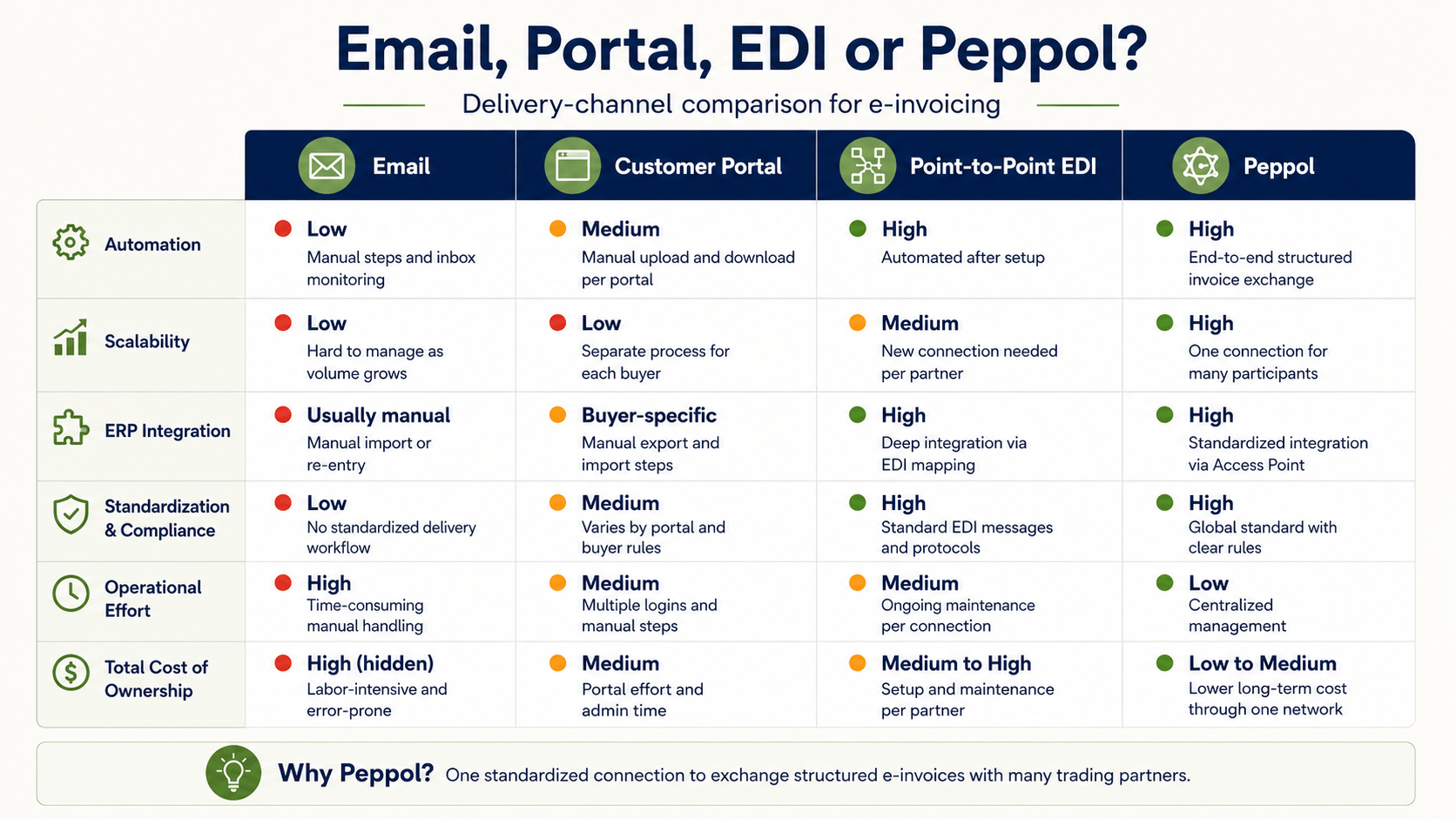
Email can transport an XML invoice, but someone must monitor the mailbox, identify the document, validate it and move its data into the correct system. Customer portals create separate accounts, submission processes and status checks for each buyer.
Peppol uses registered participant identifiers and Access Points to route documents between connected organizations. A business can connect through a Peppol Access Point and exchange supported documents with other registered participants rather than creating a separate delivery process for every trading partner.
However, Peppol does not repair poor invoice data. Missing VAT details, incorrect totals, invalid codes or outdated business rules can cause rejection even when the delivery route is correct.
Routing and validation must therefore operate as one process.
Which German Formats and Identifiers Do You Need?
XRechnung is a structured XML specification commonly used for German public-sector invoicing. ZUGFeRD combines a readable PDF/A-3 document with embedded structured XML, but the selected version and profile must satisfy the applicable requirements.
The German Federal Ministry of Finance identifies XRechnung and qualifying ZUGFeRD profiles from version 2.0.1 as commonly used formats that can meet the German structured e-invoice requirements. It also recommends validating invoices during creation and transmission to identify missing or illogical data.
A Peppol Participant ID identifies an organization on the Peppol network. A Leitweg-ID is generally used to address invoices to German public authorities and is not normally required for domestic B2B invoices.
The following elements must align:
Invoice format and version
Buyer reference
Recipient identifier
VAT and tax data
Payment information
Delivery channel
Customer-specific business rules
Run an automated XRechnung validation before sending rather than correcting the invoice after a customer or authority rejects it.
What Does Peppol Mean for Your ERP and Finance Systems?
Peppol adoption should not require replacing the ERP that creates and records invoices. The practical model is to place an integration layer between the existing system and the external e-invoicing network.
For outbound invoices, HubBroker can receive data from the ERP or billing system, map it into the required structured format, validate the document, route it through the correct channel and return processing information.
For inbound invoices, the flow works in reverse:
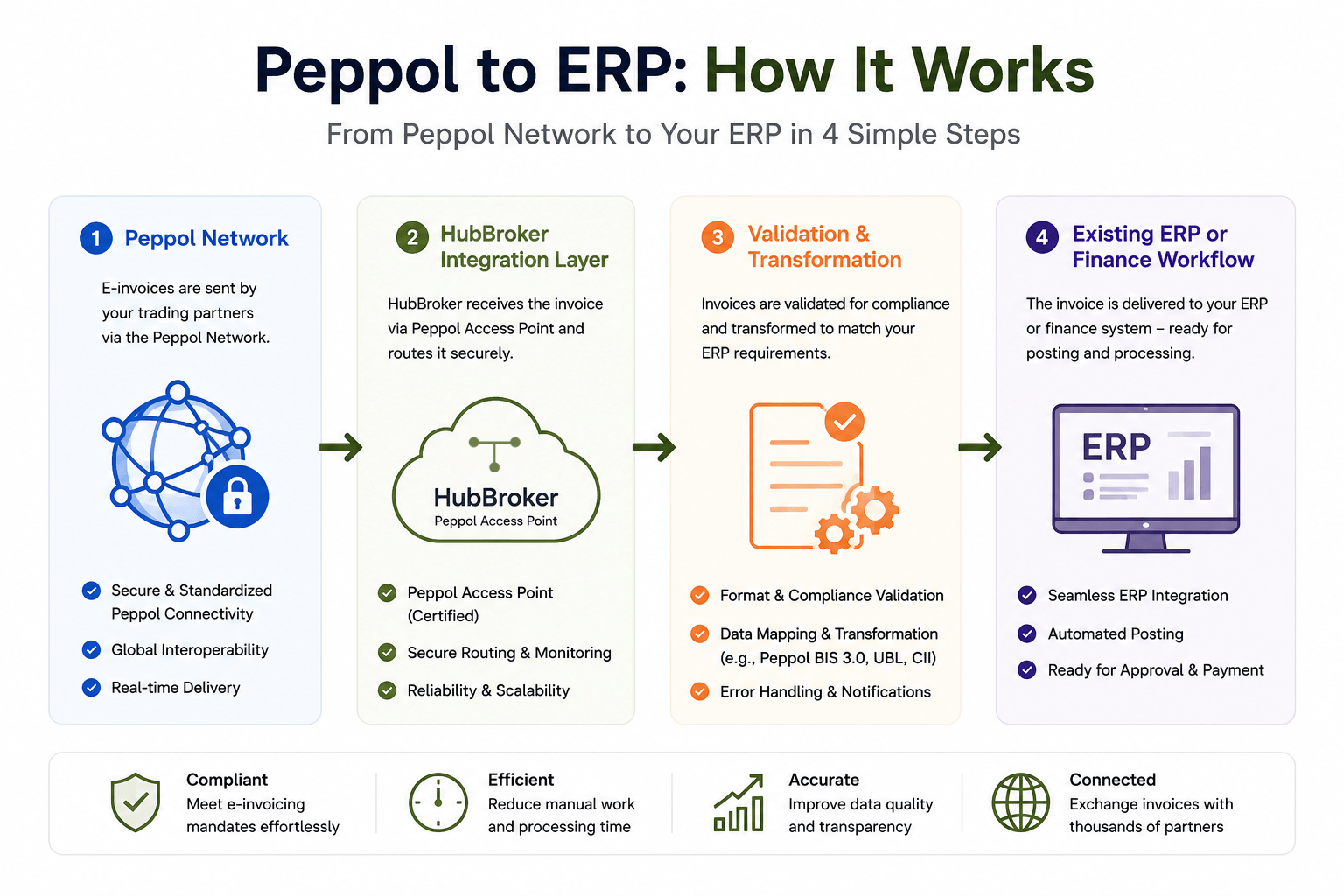
The structured document is received, checked, converted into the ERP’s expected format and delivered to the appropriate process.
Finance can continue working in familiar systems, while IT gains one controlled integration point for Peppol, EDI, API and other document flows. This avoids building and maintaining separate customer-specific connections across the ERP environment.
Learn more about HubBroker’s certified Peppol Access Point services.
How Can You Adopt Peppol Without Disrupting Live Invoice Flows?
Start with one real invoice route rather than changing every entity and customer at once.
Map current inbound and outbound invoice flows.
Separate B2B, B2G and cross-border requirements.
Confirm the required formats and recipient identifiers.
Connect the ERP to a Peppol Access Point.
Test mapping, validation, delivery, acknowledgements and error handling.
Move one trading partner into production before scaling.
A controlled rollout exposes missing master data and process gaps without putting the full invoice operation at risk. It also clarifies who owns rejected documents, corrections, trading-partner onboarding and format updates.
Map one German invoice flow with HubBroker to determine whether Peppol fits your ERP, customer requirements and rollout timetable.
