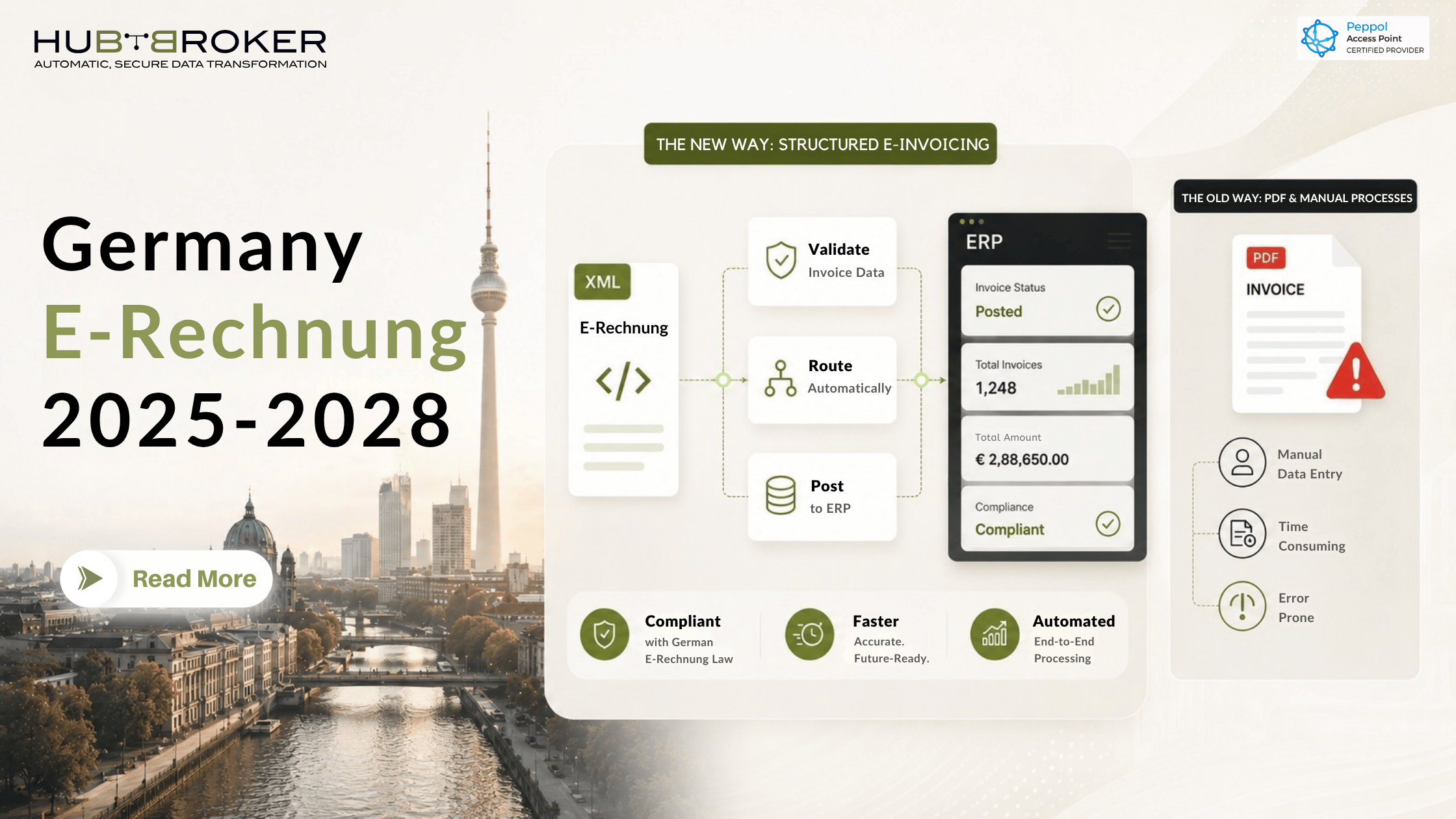
Germany E-Rechnung 2025–2028 Why PDF Invoices Are No Longer Enough
Many businesses still think they are “digital” because they send invoices by email. But Germany’s E-Rechnung mandate changes that assumption.
From 2025, a simple PDF invoice is no longer enough for affected German B2B invoicing. The invoice must be structured, machine-readable, and ready for electronic processing.
For finance and IT teams, this is not just another compliance update. It affects ERP systems, accounts payable workflows, supplier communication, invoice validation, and long-term VAT reporting readiness.
What Is the Germany E-Rechnung Mandate?
The Germany E-Rechnung mandate is Germany’s move toward structured electronic invoicing for domestic B2B transactions.
An E-Rechnung is not simply an invoice sent in electronic form. It must be issued, transmitted, received, and processed in a structured electronic format. That means invoice data can be read by software instead of being manually typed into an ERP or accounting system.
In simple terms:
A paper invoice is not an E-Rechnung.
A basic PDF invoice is not an E-Rechnung.
A structured XML invoice can be an E-Rechnung.
A hybrid format such as ZUGFeRD can be an E-Rechnung if it meets the required standard.
The goal is clear: reduce manual work, avoid invoice errors, and prepare businesses for future digital VAT reporting.
Germany E-Rechnung Timeline: 2025 to 2028
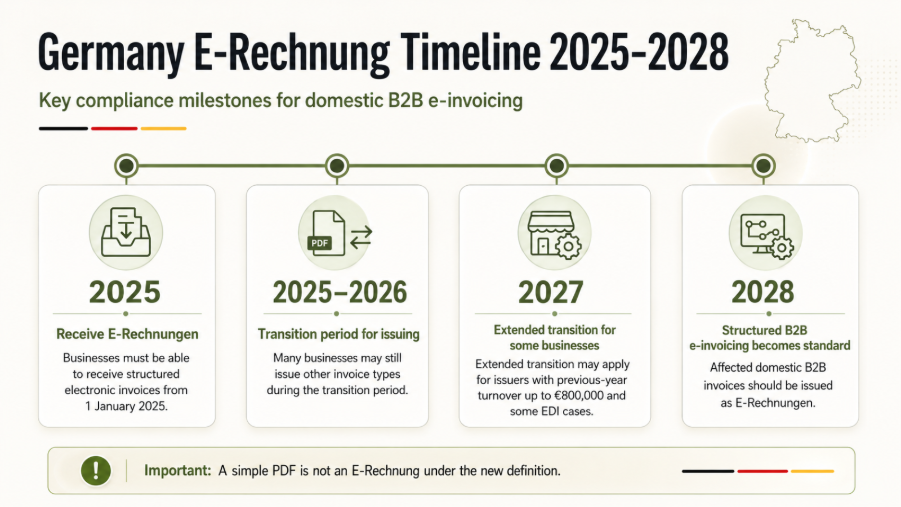
Germany is introducing the mandate in stages. That gives businesses time to prepare, but it does not mean they should wait.
2025: Businesses Must Be Able to Receive E-Rechnungen
From 1 January 2025, German businesses must be able to receive E-Rechnungen.
At the simplest level, this can be done through an email inbox. But in practice, companies need more than a mailbox. They need a process to read, validate, approve, post, and archive structured invoice data.
2025–2026: Transition Period for Issuing
During 2025 and 2026, many businesses can still issue other invoice types, such as paper invoices or PDF invoices, under transition rules.
However, this period should be used for preparation. ERP systems, suppliers, customers, and finance teams all need time to align on formats and workflows.
2027: Extended Transition for Some Businesses
For invoice issuers with previous-year turnover up to €800,000, the transition period can extend until the end of 2027. Some EDI procedures may also continue until the end of 2027 if they do not yet fully meet the new E-Rechnung requirements.
2028: Structured E-Invoicing Becomes the Standard
After the transition rules end, affected domestic B2B invoices between German businesses must be issued as E-Rechnungen. By 2028, structured e-invoicing should be treated as the normal process, not a side project.
Is a PDF Invoice Still Allowed in Germany?
A simple PDF invoice is no longer considered an E-Rechnung under the new rules.
This is one of the biggest misunderstandings for finance teams. A PDF may look digital, but it is usually designed for people to read, not for software to process automatically.
If an employee still has to open the PDF, copy invoice lines, check VAT amounts, and manually post the data in ERP, the process is not truly automated.
During the transition period, PDF invoices may still be allowed in certain cases as “other invoices.” But they should not be treated as a long-term compliance strategy.
XRechnung vs ZUGFeRD: Which Format Matters?
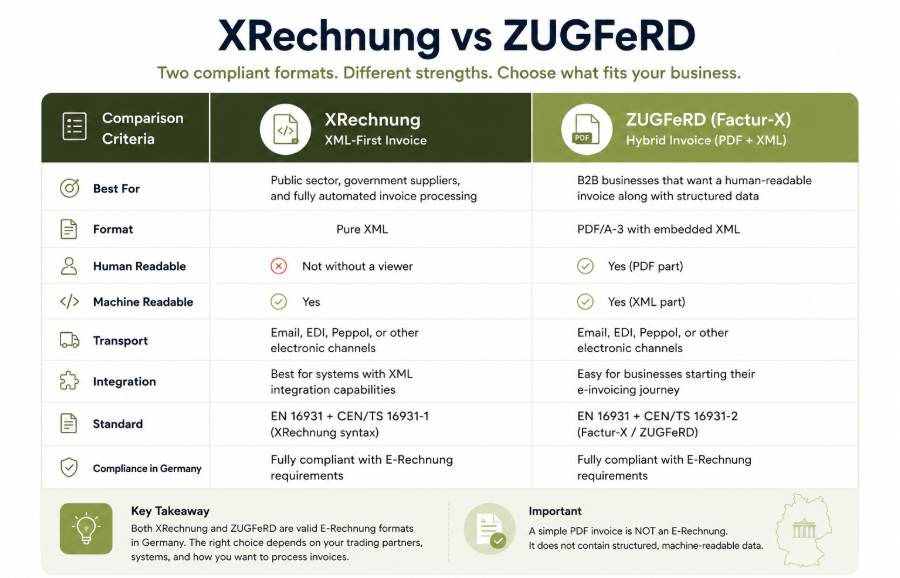
Two formats are especially important in Germany: XRechnung and ZUGFeRD.
XRechnung
XRechnung is an XML-based structured invoice format. It is commonly used in public-sector and formal e-invoicing workflows. It is machine-readable, but businesses often need a viewer or software tool to display it in a human-readable way.
ZUGFeRD
ZUGFeRD is a hybrid format. It combines a human-readable PDF with structured XML data inside the same file. This makes it easier for businesses that want a familiar invoice view while still supporting automated processing.
For many businesses, the right choice depends on customer requirements, ERP capability, invoice volume, and whether the company already uses EDI or Peppol-based workflows.
What Finance and IT Teams Should Do Next
The Germany E-Rechnung mandate affects more than invoice creation. It touches receiving, validation, approval, ERP posting, archiving, and supplier onboarding.
Start with these practical steps:
Map all German B2B invoice flows.
Check which invoices are currently sent as PDF, XML, EDI, or paper.
Confirm whether your ERP supports XRechnung and ZUGFeRD.
Set up a reliable process to receive structured invoices.
Validate invoice data before sending or posting.
Automate invoice import into ERP where possible.
Prepare supplier and customer communication.
Review archiving rules for structured invoice data.
This is also the right time to review wider invoice automation. If your business receives PDF, XML, EDI, and Peppol invoices, a single connected workflow can reduce manual work and improve compliance.
How HubBroker Helps with Germany E-Rechnung Compliance
Germany’s E-Rechnung mandate requires businesses to move beyond simple PDF invoices and prepare for structured formats such as XRechnung and ZUGFeRD. While transition rules allow some invoice types for a limited time, companies should use this period to update their ERP, finance, and supplier workflows.
HubBroker helps businesses manage this change by connecting E-Rechnung workflows with ERP, EDI, Peppol, XML, and invoice automation processes.
With HubBroker, businesses can:
Receive and process structured E-Rechnungen
Support XRechnung and ZUGFeRD formats
Connect invoice data with ERP systems
Reduce manual PDF handling
Validate invoice data before posting or sending
Automate B2B invoice exchange
This helps finance teams improve accuracy, reduce manual work, and prepare for Germany’s 2025–2028 e-invoicing requirements.
Contact us to prepare for Germany E-Rechnung compliance.
FAQ: Germany E-Rechnung Mandate
What is Germany’s E-Rechnung mandate?
It is Germany’s requirement for structured electronic invoicing in affected domestic B2B transactions. The invoice must be machine-readable and electronically processable.
Is a PDF invoice still an E-Rechnung in Germany?
No. A simple PDF is not considered an E-Rechnung because it does not contain structured invoice data for automated processing.
Which formats are commonly used?
XRechnung and ZUGFeRD are common formats. XRechnung is XML-based, while ZUGFeRD combines a readable PDF with embedded XML data.
Do foreign companies need to comply?
Foreign companies should review their position if they have German entities, fixed establishments, or domestic German B2B invoice flows.
Does my ERP need to change?
Not always. But your ERP or connected invoicing solution must be able to generate, receive, validate, process, and archive structured invoice data.
