
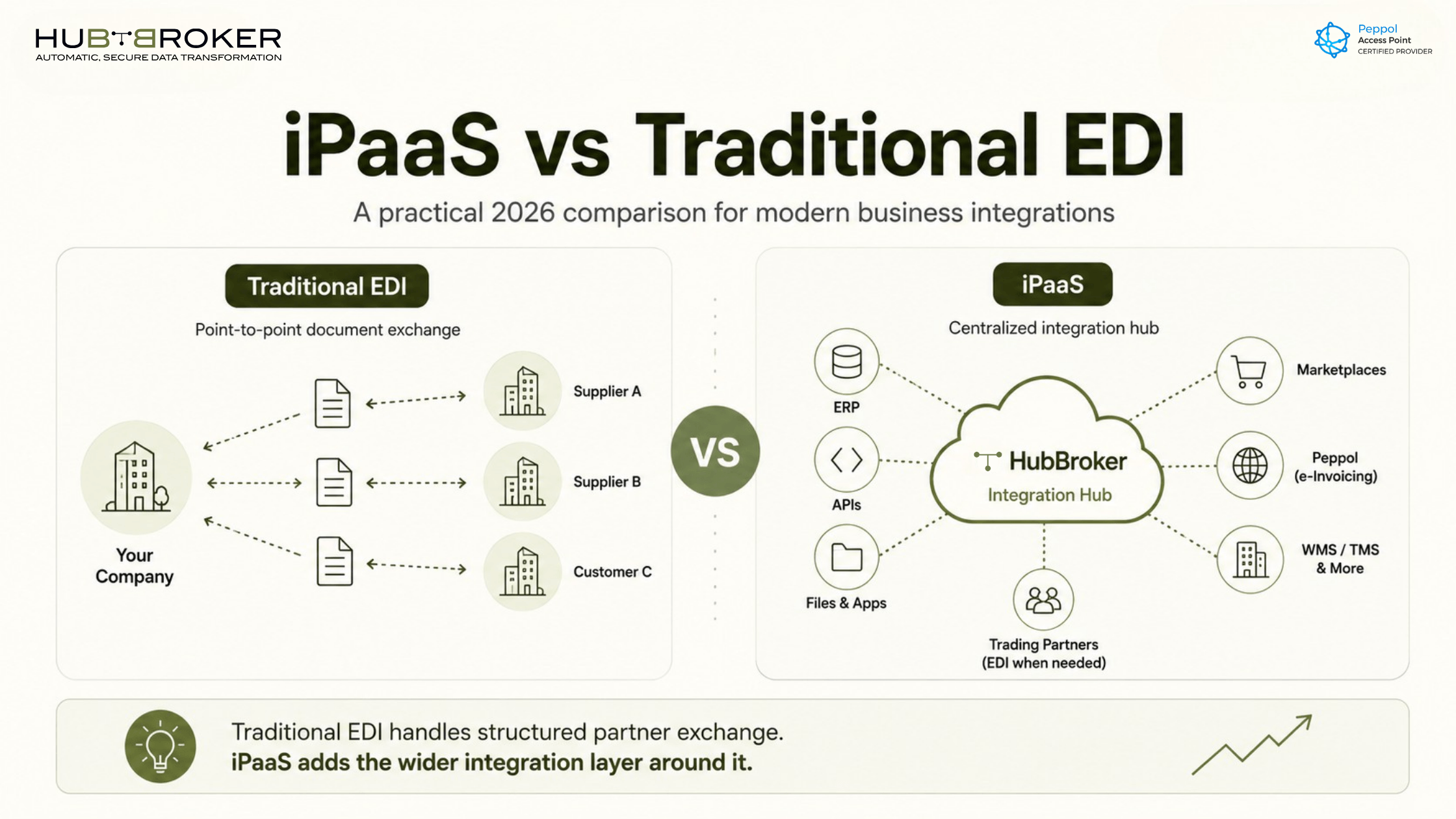
iPaaS vs Traditional EDI: Which Model Prevents Order and Invoice Delays in 2026?
A customer changes its required order format. A supplier moves to structured e-invoicing. An acquired business operates another ERP. Each change can create another mapping project, disconnected connector or manual workaround.
The iPaaS vs traditional EDI decision therefore affects more than IT architecture. It determines how quickly orders move, whether invoices reach the right system and how easily your business can respond when partner requirements change.
Why Are Businesses Reassessing Traditional EDI in 2026?
Traditional EDI remains effective for exchanging high volumes of structured documents such as purchase orders, invoices, order confirmations and dispatch notices.
The difficulty appears when the integration environment expands. Manufacturers and wholesalers may need to connect customers, suppliers, warehouses, marketplaces, e-commerce platforms, Peppol networks and multiple ERP systems.
A traditional setup can become difficult to manage when every new partner requires separate mappings, communication methods and support processes. When one connection fails, finance and operations teams may not know whether the problem sits in the source file, the mapping, the transmission method or the receiving ERP.
Businesses are therefore assessing whether their existing EDI integration model provides enough flexibility and visibility for their current operations.
iPaaS vs Traditional EDI: What Is the Practical Difference?
Traditional EDI focuses primarily on the structured exchange of business documents between trading partners. An integration platform as a service, or iPaaS, provides a wider integration layer that can manage EDI alongside APIs, ERP applications, cloud systems, marketplaces and document-processing workflows.
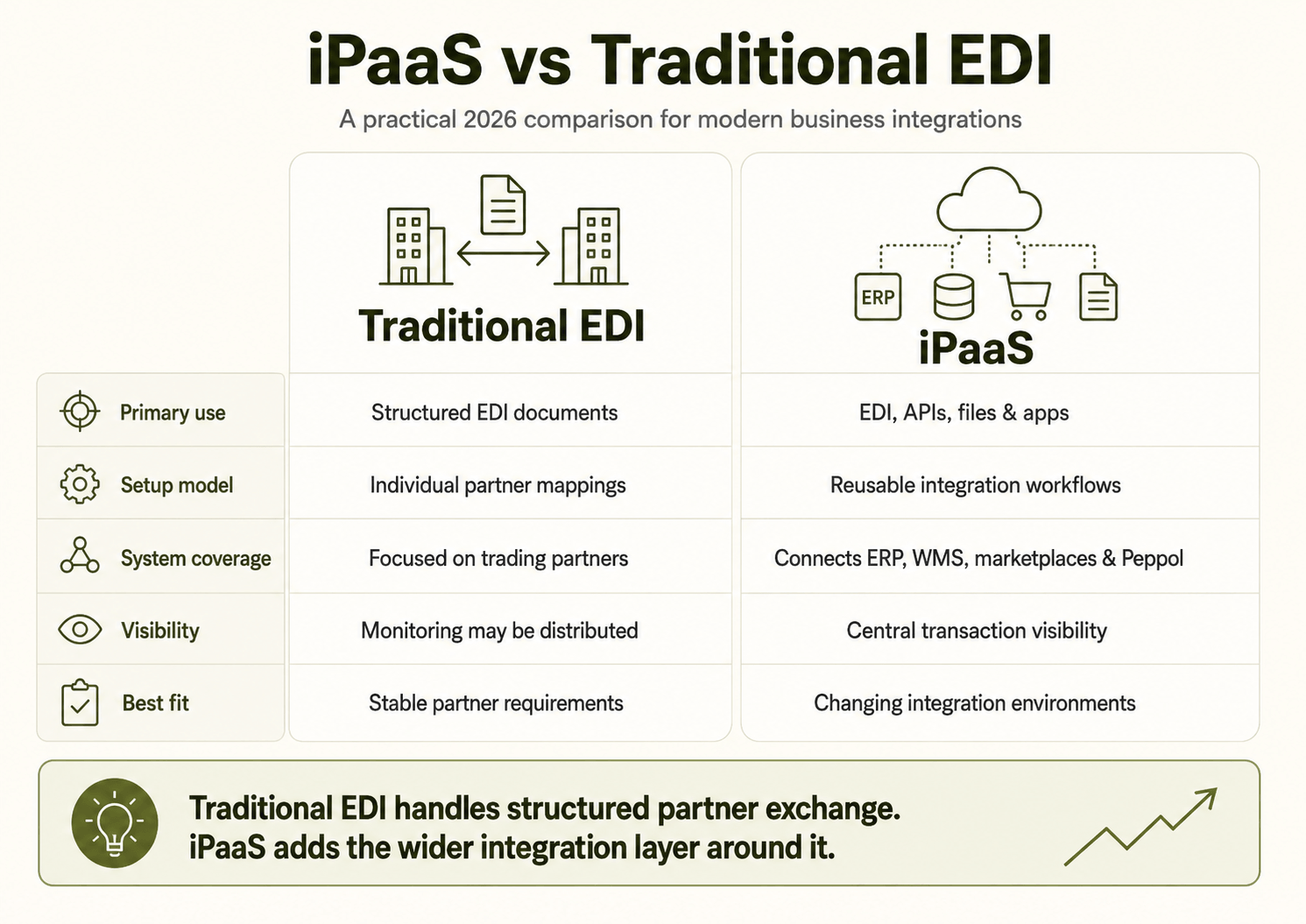
The choice is not simply between old and new technology. It is about the range of systems, formats and business processes that the integration layer must support.
Which Approach Handles New Partners and Formats Better?
Traditional EDI works well when partner requirements are predictable. A stable customer relationship using the same EDIFACT or X12 messages may not need a broader integration model.
Complexity increases when a new partner requires XML, JSON, CSV, an API connection or a different version of an existing EDI standard. The onboarding process may then involve new mappings, validation rules, transport configuration and ERP testing.
An iPaaS platform can manage these requirements through reusable workflows and a central processing model. Data can be received, validated, transformed and routed according to the requirements of both the trading partner and the internal system.
For buyers, the practical question is not whether a platform supports many formats. It is how quickly a new partner can be connected without disrupting existing order and invoice flows.
Does iPaaS Replace Traditional EDI?
In most cases, iPaaS does not remove the need for EDI. It extends the integration environment around it.
EDI standards continue to play an important role in structured B2B communication. Customers and suppliers may continue using EDIFACT, X12 or XML because those formats are embedded in their procurement, logistics and finance processes.
An iPaaS can process those EDI documents while also connecting APIs, e-commerce platforms, warehouse systems, Peppol and documents captured through PDF-to-XML or intelligent document processing.
This means businesses do not need to abandon functioning EDI relationships. They can modernise how those relationships are connected, monitored and maintained.
What Does This Mean for Your ERP and Existing Systems?
Your ERP should remain the operational system where teams process orders, stock movements, invoices and financial records. Modernising integration does not require replacing the systems employees already use.
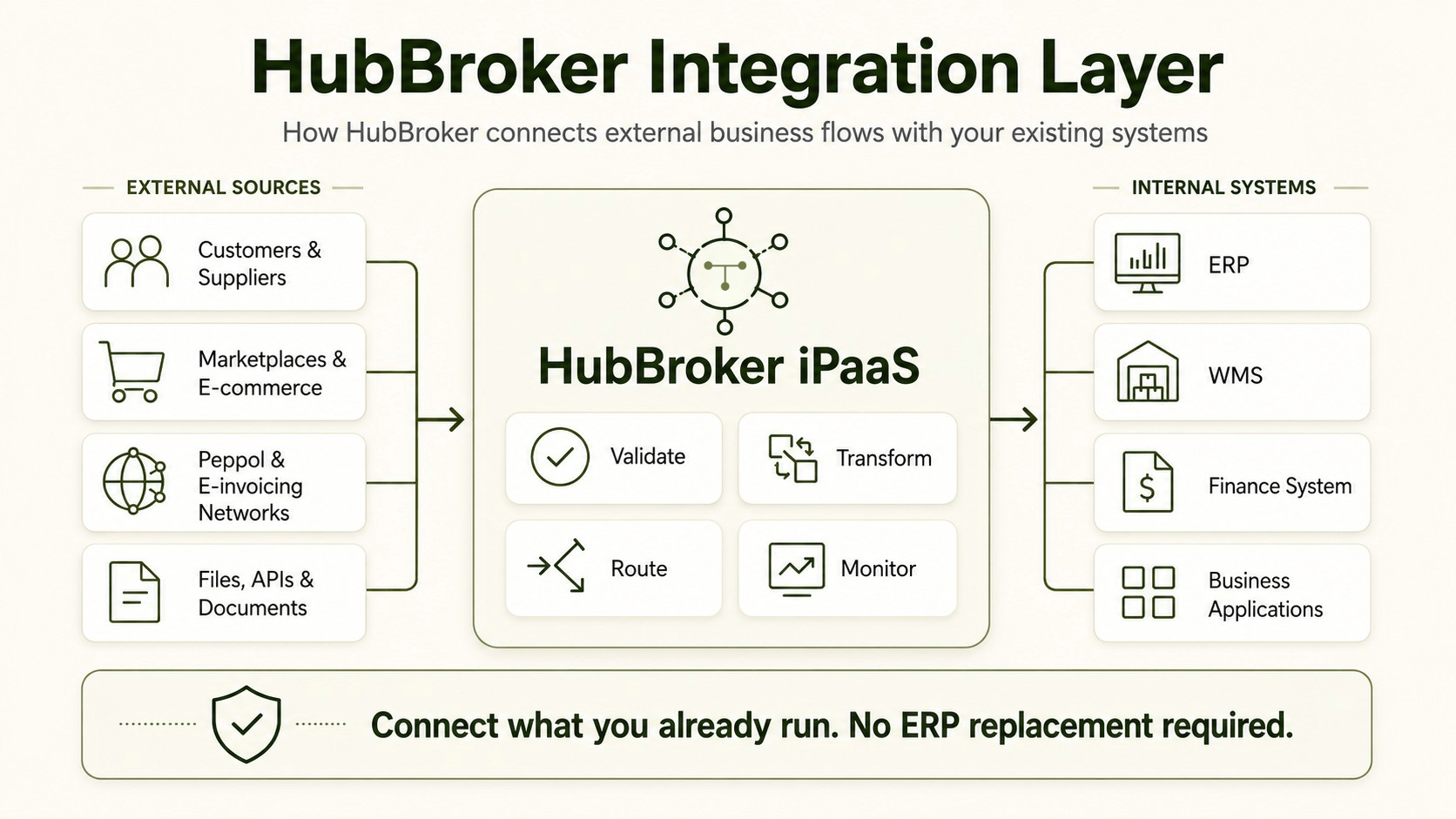
HubBroker acts as the integration layer between your ERP and external customers, suppliers, marketplaces, warehouses and business networks. Incoming data is validated and transformed into the format your ERP expects. Outgoing ERP data is converted and routed according to the recipient’s requirements.
This ERP EDI integration approach allows organisations to connect platforms such as Microsoft Dynamics, SAP Business One, Uniconta and Rackbeat without building an isolated point-to-point connection for every external party.
The same integration layer can also support newer requirements. For example, companies preparing for structured invoice mandates can connect ERP data to an approved exchange network rather than managing invoices through email and manual uploads. Related guidance is available in HubBroker’s France e-invoicing compliance guide.
When Should You Keep EDI, Add iPaaS or Use Both?
Keep your existing EDI model when partner requirements are stable, document types rarely change and your current monitoring provides sufficient visibility.
Consider adding iPaaS when:
New partner onboarding depends on repeated custom development.
The business must connect EDI with APIs, marketplaces or cloud applications.
Multiple integrations perform similar mapping and validation work.
Teams cannot easily track failed orders or invoices.
ERP changes regularly require updates across separate connections.
Using both is often the most practical option. EDI continues handling structured trading-partner documents, while iPaaS provides the wider orchestration, ERP connectivity and exception visibility needed across the business.
Document automation can also become part of that environment. HubBroker’s guide to AI-driven invoice processing explains how PDF and scanned invoice data can be captured before entering an ERP workflow.
The right architecture is the one that keeps business documents moving while allowing new systems and partners to be added without rebuilding the entire integration environment.
Contact HubBroker to review one current order or invoice flow and determine whether your existing EDI setup should be retained, extended through iPaaS or combined with both.
