
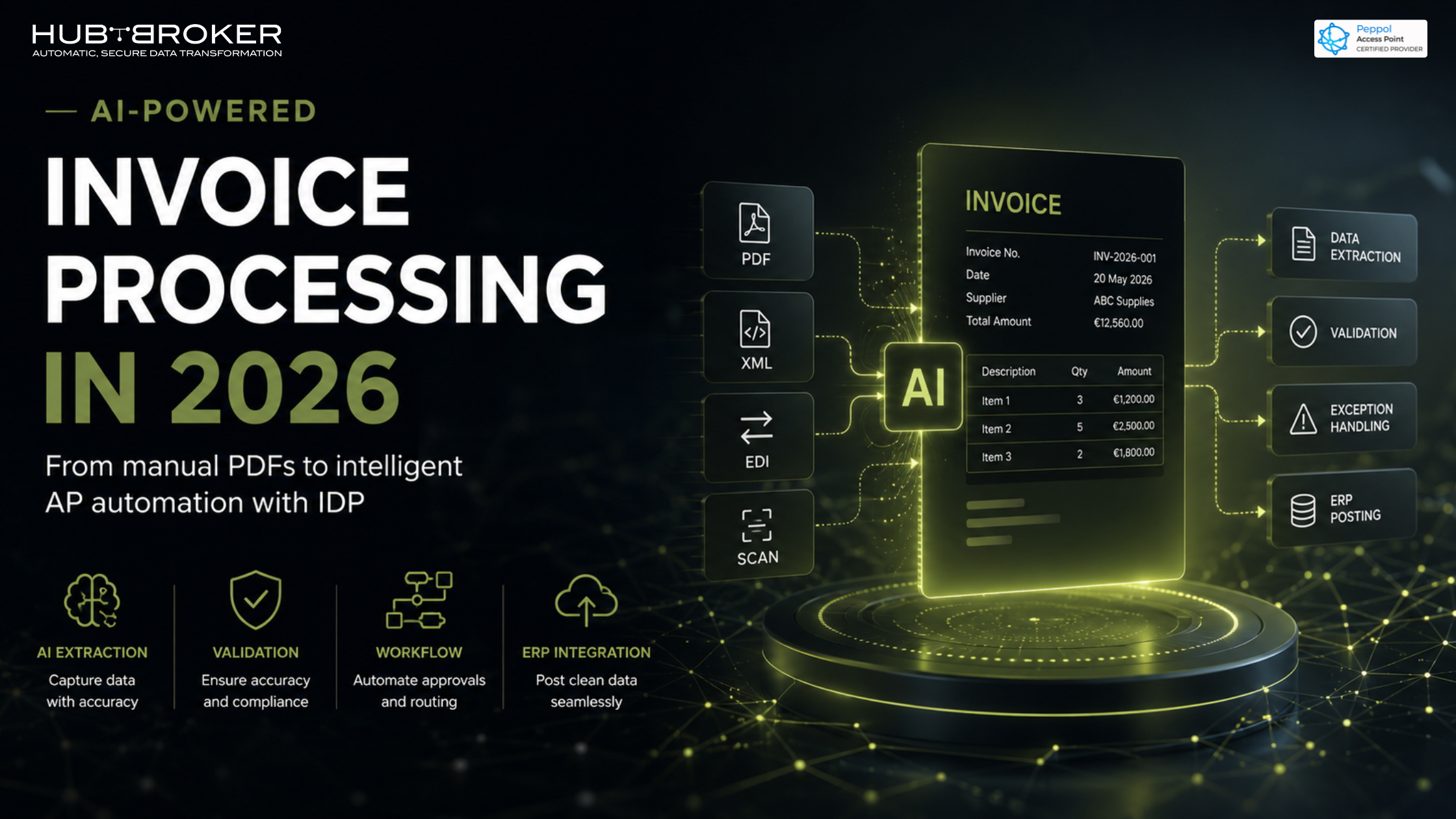
How AI Is Changing Invoice Processing in 2026
Invoice processing has quietly become one of the biggest bottlenecks in finance operations.
For years, many businesses treated invoices as simple documents: receive a PDF, enter the details into the ERP, approve it, and pay it. But in 2026, that approach is becoming too slow, too risky, and too manual.
Finance teams now receive invoices in multiple formats: PDFs, scanned documents, XML files, EDI messages, Peppol e-invoices, and country-specific structured formats. At the same time, e-invoicing mandates are pushing businesses toward machine-readable invoice data. Belgium requires structured electronic invoices between VAT-liable businesses from 1 January 2026, while Germany now defines an e-invoice as a structured electronic format that enables electronic processing; a simple PDF no longer qualifies as an e-invoice under the new German rules.
This is why AI invoice processing and Intelligent Document Processing (IDP) are becoming essential for modern finance teams.
AI is no longer just reading invoice text. It is helping companies capture, understand, validate, and route invoice data into ERP systems with far less manual effort.
Why Traditional Invoice Processing Is No Longer Enough
The problem with traditional invoice processing is not only that it takes time. The bigger problem is that it depends too much on manual work.
A typical accounts payable team may still need to:
Open supplier emails manually
Download invoice attachments
Read PDF or scanned invoices
Type invoice data into the ERP
Check VAT amounts and totals
Match invoices against purchase orders
Send invoices for approval
Follow up when something is missing
Correct errors after posting
This process becomes harder when suppliers use different formats, layouts, languages, currencies, and tax rules.
A simple PDF invoice may look readable to a human, but it is not always useful for automation. The finance team still has to extract the data, validate it, and move it into the correct business system.
That is where AI changes the workflow.
What AI Invoice Processing Actually Means
AI invoice processing uses artificial intelligence to turn invoice documents into structured, usable business data.
Instead of only detecting text, AI-powered IDP can understand the context of the invoice. It can identify the supplier, invoice number, purchase order number, tax amount, due date, line items, currency, and total value.
More importantly, it can help decide what should happen next.
For example, if the invoice has a valid PO number and the amount matches the purchase order, it can move forward automatically. If the VAT number is missing, the total does not match, or the supplier is unknown, the invoice can be flagged for review.
This means finance teams do not need to check every invoice line by line. They can focus on exceptions, approvals, and decision-making.
Transform Invoice Processing with AI in 2026
Reduce manual work, improve data accuracy, and speed up invoice approvals with AI-powered automation and intelligent document processing.
Contact Us to Know More
From OCR to IDP: The Real Shift
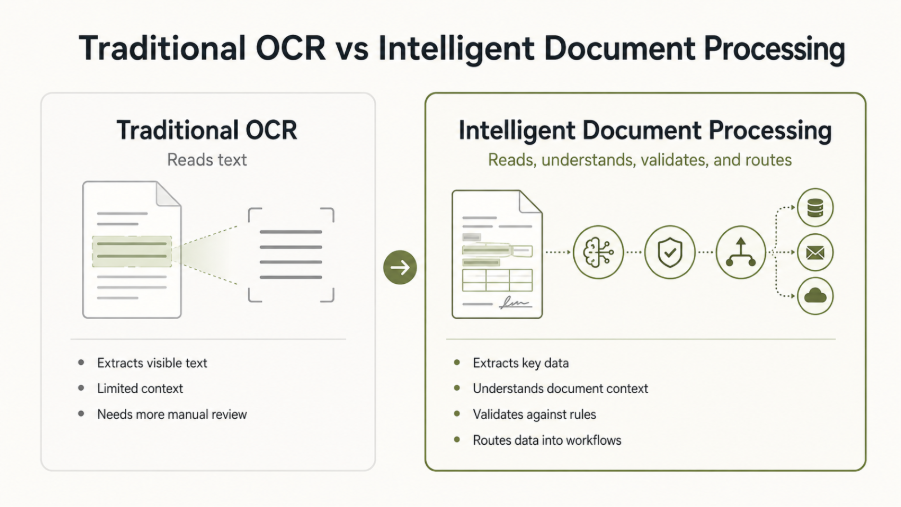
Many companies already know about OCR, but OCR alone is not enough for modern invoice automation.
OCR answers a basic question:
“What text is on this document?”
IDP answers a more useful business question:
“What does this document mean, and where should the data go?”
HubBroker’s IDP platform is built to extract, validate, and route business documents such as invoices, orders, and shipping notes directly into ERP or eCommerce systems. It supports document intake, classification, extraction, validation, workflow automation, and data integration with business systems.
That makes IDP more than a scanning tool. It becomes a bridge between supplier documents, ERP workflows, approval processes, and compliance requirements.
How AI Improves Invoice Processing in 2026
1. AI Reduces Manual Data Entry
Manual data entry is one of the most time-consuming parts of invoice processing.
AI-powered IDP can extract key invoice information automatically, including:
Supplier name
Invoice number
Invoice date
Due date
VAT number
Purchase order number
Currency
Tax amount
Total amount
Line-item details
This reduces the need for finance teams to manually copy information from PDFs or scanned invoices into ERP systems.
The result is faster processing, fewer typing errors, and less repetitive work.
2. AI Improves Invoice Data Accuracy
Invoice errors can create serious problems for finance teams.
A wrong tax amount, duplicate invoice, missing PO number, or incorrect supplier reference can delay approvals and create payment issues.
AI-based validation helps detect these problems before the invoice enters the ERP. HubBroker’s IDP platform validates extracted information against business rules and flags inconsistent entries before they reach ERP or eCommerce systems.
This helps companies improve invoice data quality and reduce the cost of correcting mistakes later.
3. AI Speeds Up Approval Workflows
Invoice approval often slows down because invoices are sent to the wrong person or lack the details needed for approval.
AI can help route invoices based on:
Supplier
Department
Amount
Cost center
Purchase order
Project
Business unit
Approval rule
This makes the approval process more structured and easier to monitor.
Instead of searching through emails and spreadsheets, finance teams can see which invoices are ready, which are waiting for approval, and which need attention.
4. AI Helps Finance Teams Handle Multiple Invoice Formats
In 2026, businesses cannot rely on one invoice format.
Some suppliers still send PDFs. Others use XML, EDI, UBL, EDIFACT, CSV, or Peppol formats. HubBroker IDP supports multiple global document formats, including PDF, XML, EDIFACT, UBL, CSV, and more, helping companies prepare for e-invoicing mandates and cross-border trade.
This is important because most businesses will not move from PDFs to fully structured e-invoices overnight.
There will be a transition period where finance teams must manage both traditional invoices and structured electronic invoices. AI-powered IDP helps businesses handle this mixed environment more efficiently.
Why IDP Matters for E-Invoicing Readiness
E-invoicing is not just about sending invoices electronically. It is about exchanging invoice data in a structured format that systems can process automatically.
This is a major change for companies still relying on PDFs and manual ERP entry.
For example, Germany’s rules now separate structured e-invoices from other invoice types, including simple PDFs. A PDF may still be readable to a person, but it does not provide the structured data needed for automated processing under the new definition.
This is why IDP should be part of a company’s e-invoicing strategy.
IDP helps businesses:
Capture invoice data from PDFs and scans
Convert invoice data into structured formats
Validate mandatory invoice fields
Prepare data for ERP posting
Support PDF to XML workflows
Connect invoice data with EDI and Peppol processes
Reduce manual checks before compliance reporting
In short, IDP helps finance teams move from document handling to data-driven invoice processing.
Where HubBroker IDP Fits into the Invoice Workflow
HubBroker IDP helps companies automate the full document lifecycle, from intake and classification to approval and system sync. The platform is designed to reduce manual touchpoints, shorten processing times, and connect documents with ERP, accounting, eCommerce, and trading partner systems.
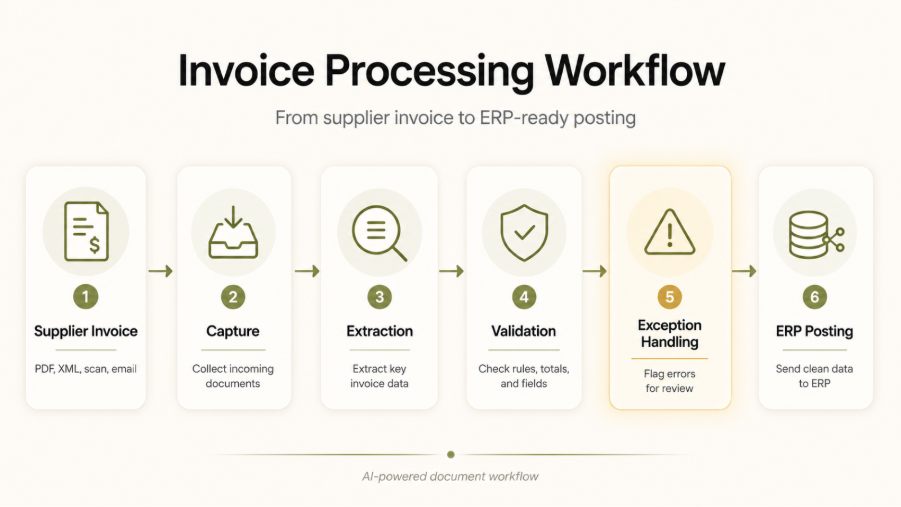
A typical HubBroker IDP invoice workflow can look like this:
Step 1: Invoice Capture
Supplier invoices are received from email, PDF, XML, scanned documents, or other sources.
Step 2: AI-Based Data Extraction
HubBroker IDP automatically extracts key invoice information such as:
Supplier details
Invoice number
Purchase order number
VAT information
Invoice and due dates
Currency and totals
Line-item details
Step 3: Invoice Validation
The extracted data is validated against:
Business rules
ERP master data
Supplier records
Purchase orders
Tax and compliance requirements
This helps identify inconsistencies before the invoice enters downstream finance workflows.
Step 4: Exception Handling
Invoices with missing or incorrect information are flagged for review.
Step 5: ERP Integration
Clean and validated invoice data is sent into the relevant ERP, accounting, or approval workflow.
Step 6: Structured Data for Automation
The processed data can support PDF to XML conversion, EDI exchange, Peppol e-invoicing, and other structured invoice workflows.
What Businesses Should Look for in an AI Invoice Processing Solution
Before choosing an IDP or invoice automation solution, finance and IT teams should ask:
Can it process PDFs, scans, XML, EDI, UBL, and Peppol invoices?
Can it extract both header-level and line-item data?
Can it validate invoice data before ERP posting?
Can it detect duplicate invoices and missing fields?
Can it connect with ERP and accounting systems?
Can it support approval routing and exception handling?
Can it help with e-invoicing and compliance workflows?
Can business users manage workflows without heavy development?
The best invoice automation solution should not only extract data. It should help the business create a reliable, end-to-end invoice workflow.
Ready to modernize your invoice processing workflow?
Discover how HubBroker IDP helps businesses automate invoice capture, validation, approval routing, ERP integration, and Peppol-ready e-invoicing with AI-powered document processing.
