
E-Invoicing for Microsoft Dynamics 365: The 2026 Compliance Gaps Most Finance Teams Miss
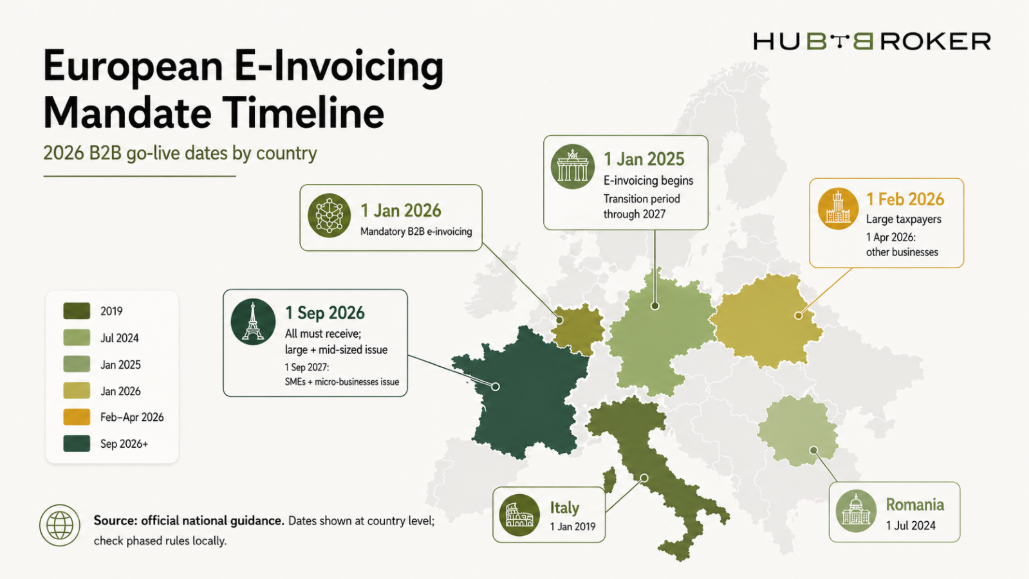
If you run finance or IT for a company using Microsoft Dynamics 365, your e-invoicing compliance project cannot wait any longer. Belgium has already enforced mandatory B2B e-invoicing from 1 January 2026. Poland’s KSeF rollout begins in 2026, with large taxpayers expected to comply first, followed by broader enforcement phases. France will begin its phased mandatory e-invoicing rollout on 1 September 2026.
Miss these deadlines, and the consequences go far beyond compliance warnings. Businesses can face rejected invoices, blocked VAT recovery, payment delays, and per-invoice penalties creating real cash-flow disruption within weeks.
Here’s what most Dynamics 365 teams still underestimate and how to close the compliance gap before it becomes an operational and financial problem.
The 2026 e-invoicing map at a glance
Each country has its own model, format, and platform and your Dynamics 365 environment has to speak all of them:
Belgium — Mandatory B2B e-invoicing via the Peppol network, using Peppol BIS / EN 16931. Live since 1 January 2026.
France — Continuous Transaction Control (CTC) model through certified PDPs (Plateformes de Dématérialisation Partenaires). Large companies from September 2026, SMEs by September 2027.
Poland — KSeF, a centralised clearance platform. Large taxpayers from 1 February 2026, all VAT-registered businesses from 1 April 2026.
Germany — B2B receiving already mandatory since January 2025. Sending mandatory for companies above €800K turnover from January 2027, all businesses from 2028.
EU-wide (ViDA) — From 1 July 2030, mandatory structured e-invoicing for all intra-EU B2B transactions, with near-real-time digital reporting.
If you trade across two or three of these countries and most mid-market and enterprise Dynamics 365 customers do you don't have one e-invoicing project. You have a portfolio of them, all with different formats, different submission rules, and different penalty regimes.
Where standard Dynamics 365 stops short
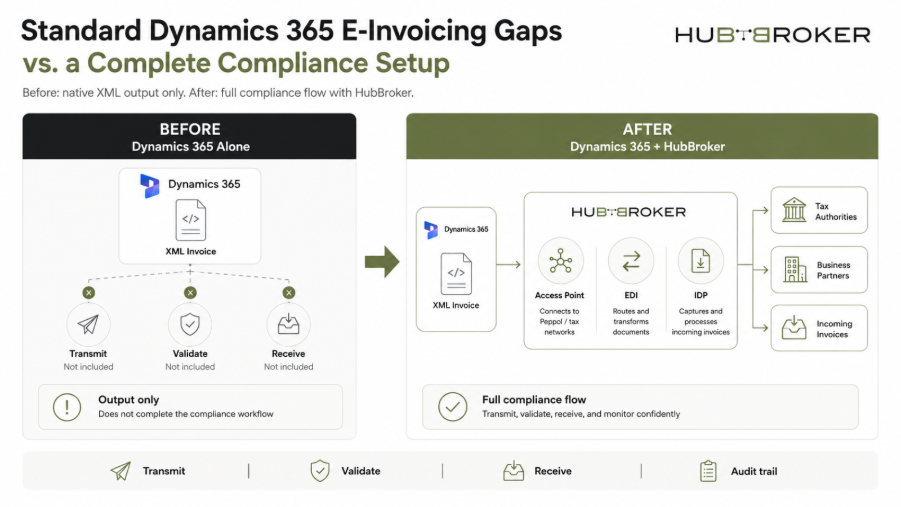
Microsoft Dynamics 365 Finance and Business Central both ship with Electronic Reporting (ER) configurations that can produce Peppol BIS 3.0 XML out of the box. That's a genuinely useful starting point but it's not a compliance solution. Three things are usually missing:
A certified Peppol Access Point. Dynamics 365 can generate a Peppol-compliant XML; it can't transmit it on the network. You need a registered Access Point provider to send and receive on your behalf.
Country-specific extensions. Belgium's Peppol BIS, France's Factur-X via a PDP, and Poland's KSeF XSD are all different. The standard ER configurations cover the common case, not every national wrinkle.
Inbound invoice processing. E-invoicing isn't only about sending you also have to receive, validate, and post structured invoices into AP. Most Dynamics 365 environments still rely on PDFs and manual keying.
The four building blocks every Dynamics 365 setup needs
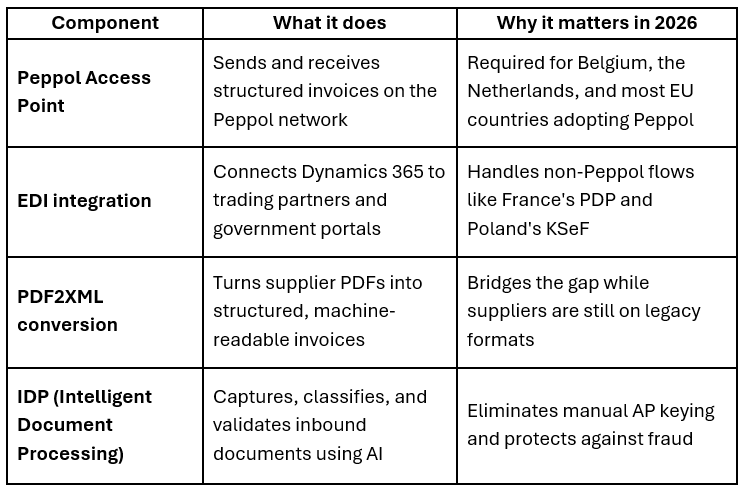
A complete 2026-ready architecture sits on four components:
Close the 2026 E-Invoicing Compliance Gaps in Dynamics 365
Prepare your finance team for changing e-invoicing rules with HubBroker’s compliant integration, automation, and ERP-ready invoice exchange solutions.
Contact Us to Know More
A 2026 readiness checklist for CFOs and IT leaders
Before you sign off on next quarter's budget, walk through this list:
Map your country exposure. List every entity that issues or receives invoices in Belgium, France, Poland, Germany, Italy, Spain, and Romania.
Audit your Dynamics 365 version. Older Business Central and Finance versions need ER configuration updates to handle EN 16931 confirm yours is current.
Pick an Access Point partner. Don't build it yourself. Procurement, security review, and Peppol certification take longer than the implementation.
Plan inbound, not just outbound. Many teams forget that receiving structured invoices triggers VAT recovery get PDF2XML and IDP in scope.
Run a parallel month. Issue real invoices through both your legacy flow and the new e-invoicing flow for at least 30 days before any cut-over.
Brief the finance team. CFOs, AP managers, and tax leads need to know how rejections, error codes, and dispute flows work in the new model.
The real cost of waiting
The penalties get the headlines France's fines reach €15 per missed invoice up to €15,000 per year, Poland's KSeF non-compliance can hit 100% of VAT but the operational cost is bigger. Buyers in regulated countries will simply stop accepting non-compliant invoices, which means delayed payment, frozen DSO, and very awkward conversations with customers you've worked with for years.
The good news: a properly configured Dynamics 365 environment, fronted by a Peppol Access Point and supported by EDI, IDP, and PDF2XML capabilities, handles every 2026 mandate without re-platforming. You don't need a new ERP. You need the right integration layer on top of the one you already own.
Next steps: Book a 30-minute Dynamics 365 e-invoicing readiness review we'll map your country exposure and flag the gaps before they become fines.
