
Poland KSeF Mandatory in 2026 Integration Risks and Challenges Explained
Poland is entering a decisive phase in digital tax transformation. With the mandatory rollout of KSeF (Krajowy System e-Faktur) in 2026, businesses operating in Poland must transition from traditional invoicing methods to structured e-invoices submitted through the government’s centralized platform.
KSeF is not just a formatting change. It fundamentally reshapes how invoices are issued, validated, stored, and reported to tax authorities. Companies that underestimate the integration complexity risk rejected invoices, delayed payments, operational disruption, and compliance penalties.
This guide explains what the 2026 mandate means, the integration risks involved, and how businesses can prepare effectively.
What Is Poland KSeF and Why Is It Becoming Mandatory?
Poland’s National e-Invoice System (KSeF) is a government platform designed to standardize and digitize invoice exchange. It requires businesses to issue structured invoices through a centralized system using a defined XML format.
The mandate aims to increase tax transparency, reduce VAT fraud, and improve invoice reporting efficiency. By introducing mandatory e-invoicing, Poland is modernizing financial processes while enabling faster validation, improved compliance monitoring, and greater visibility into business transactions.
Why Is It Becoming Mandatory?
-> Reduce VAT fraud and tax evasion
KSeF enables the government to receive invoice data in real time, making it easier to detect suspicious transactions, reduce VAT fraud, and prevent tax evasion across Poland’s business ecosystem.
-> Improve tax transparency and reporting
By requiring structured invoices to pass through a centralized platform, authorities gain clear visibility into transactions, improving tax monitoring and ensuring businesses report accurate financial data.
-> Standardize invoice formats nationwide
KSeF introduces a uniform XML invoice format that replaces multiple invoice styles used by businesses, creating consistency in invoice data exchange and simplifying financial processing.
-> Enable real-time invoice validation
Invoices submitted through KSeF are validated instantly by the system, helping businesses detect errors early and ensuring invoices meet regulatory requirements before being finalized.
-> Accelerate digital transformation in businesses
Mandatory e-invoicing encourages companies to digitize their financial processes, integrate ERP systems, and adopt automated workflows that improve efficiency and reduce manual work.
-> Strengthen regulatory compliance and audit control
Centralized invoice storage and verification through KSeF creates a reliable audit trail, making compliance checks easier for authorities and helping businesses maintain accurate financial records.
Which Businesses Will Be Affected by Poland’s KSeF E-Invoicing Mandate?
Retail and Wholesale Businesses
Retailers and wholesalers issuing high volumes of invoices must adapt their billing systems to generate structured invoices and submit them through KSeF to ensure compliant transaction reporting.
Manufacturing Industry
Manufacturers exchanging invoices with suppliers and distributors must integrate ERP systems with KSeF to handle large transaction volumes and ensure structured invoice submission.
Logistics and Transportation Companies
Freight, shipping, and logistics providers that invoice clients for transportation services must issue structured invoices through KSeF to maintain compliant billing processes.
IT and Software Services
Technology companies delivering digital services or software subscriptions must adopt KSeF-compliant invoicing formats to ensure accurate reporting of B2B service transactions.
Construction and Engineering Firms
Construction companies managing multiple contractors and project invoices must use KSeF to issue and track structured invoices, improving transparency in project-related billing.
Professional and Consulting Services
Consultants, legal advisors, and financial service providers issuing B2B invoices will need compliant invoicing systems to generate and submit invoices through KSeF.
Healthcare and Pharmaceutical Sector
Healthcare providers, medical suppliers, and pharmaceutical distributors invoicing hospitals or partners must comply with structured invoicing requirements through KSeF.
Automotive and Industrial Supply Chains
Automotive manufacturers, parts suppliers, and distributors involved in complex supply chains must ensure their invoicing systems support KSeF structured invoice submission.
Major KSeF Integration and Compliance Risks Businesses Must Prepare for Before the 2026 Mandate
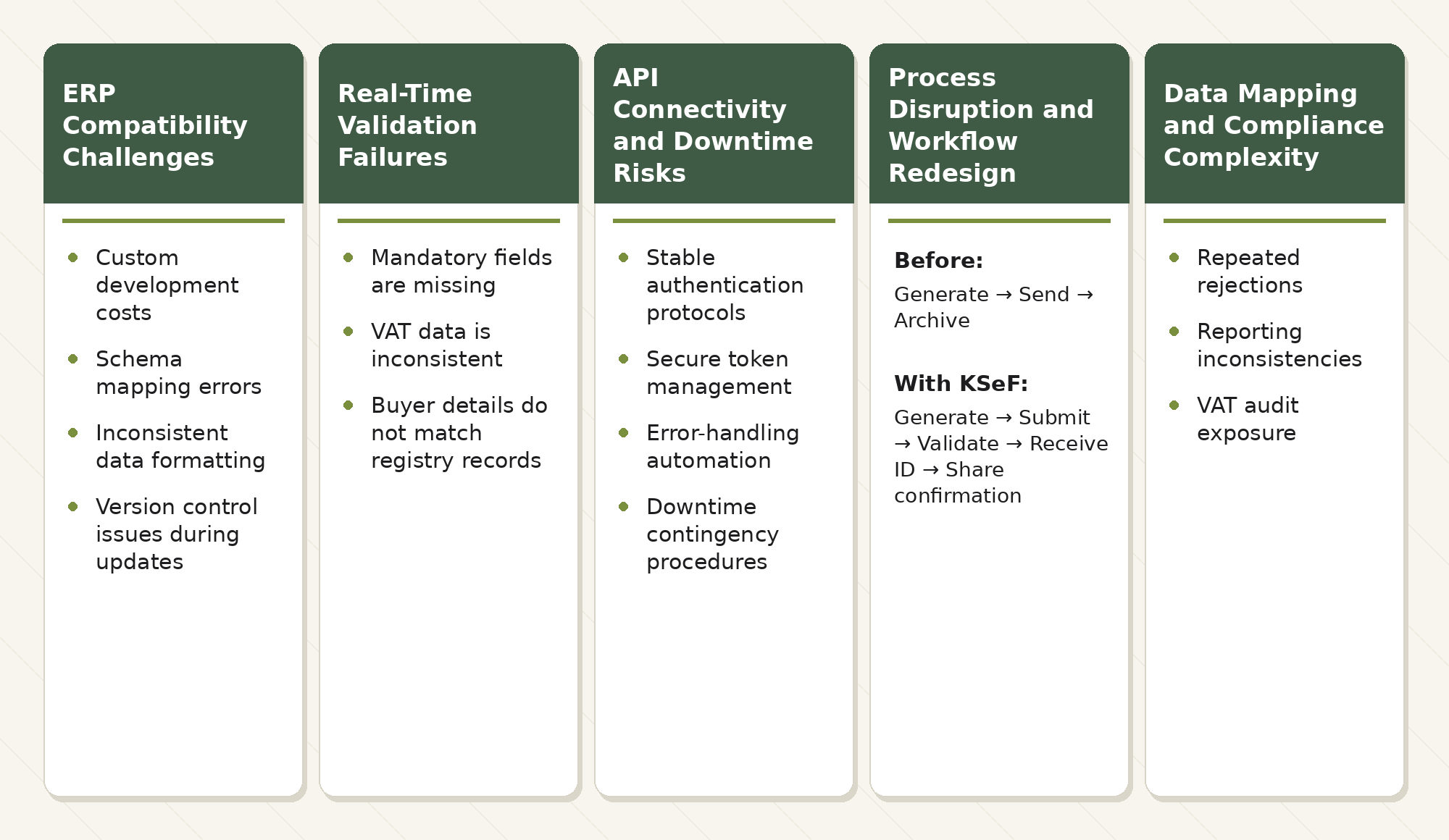
Compliance Challenges Beyond Technology
 How Businesses Can Prepare for 2026
Step 1: Conduct a Technical Readiness Assessment
Evaluate whether your ERP can:
Generate FA (2) compliant XML
Connect via secure API
Handle real-time validation feedback
Step 2: Map Invoice Data Fields
Ensure all mandatory KSeF fields exist in your ERP.
Step 3: Select an Integration Strategy
Options include:
Direct API integration
Middleware integration platform
Certified e-invoicing provider
Step 4: Test Extensively
Simulate:
High invoice volumes
Rejection scenarios
Downtime recovery
Step 5: Train Finance and IT Teams
Operational alignment is as critical as technical readiness.
How HubBroker Simplifies KSeF Integration and Compliance for Businesses
HubBroker simplifies KSeF integration by providing a secure, scalable, and automation-driven platform that connects your ERP or invoicing system directly with Poland’s KSeF infrastructure. Our solution manages XML transformation, real-time validation, and automated error handling while maintaining complete audit visibility. This enables businesses to comply with the 2026 mandate efficiently, reduce manual effort, and ensure invoices are processed accurately and transmitted to KSeF without disruptions.
Key Capabilities HubBroker Provides for Seamless KSeF Integration
Secure API-based integration
HubBroker connects your ERP or billing system directly with the KSeF platform through secure APIs, enabling reliable and encrypted data exchange while ensuring smooth invoice submission without disrupting existing workflows.
Automated XML transformation aligned with FA (2)
Our platform automatically converts invoice data from ERP or accounting systems into the required FA(2) XML format, ensuring compliance with KSeF technical specifications and eliminating manual data formatting errors.
Real-time validation monitoring
HubBroker continuously monitors KSeF validation responses in real time, allowing businesses to track invoice status, confirm successful submissions, and quickly identify validation issues.
Error-handling automation
Built-in error handling detects failed submissions or validation errors instantly and triggers automated alerts and correction workflows, helping businesses resolve issues quickly and avoid compliance risks.
Full audit tracking
Every invoice interaction with KSeF is recorded, creating a complete audit trail for submission, validation, and responses, supporting regulatory compliance and simplifying financial record verification.
Scalable architecture for high-volume transactions
HubBroker’s scalable infrastructure supports large volumes of invoices without performance loss, making it ideal for enterprises processing high transaction loads under the KSeF system.