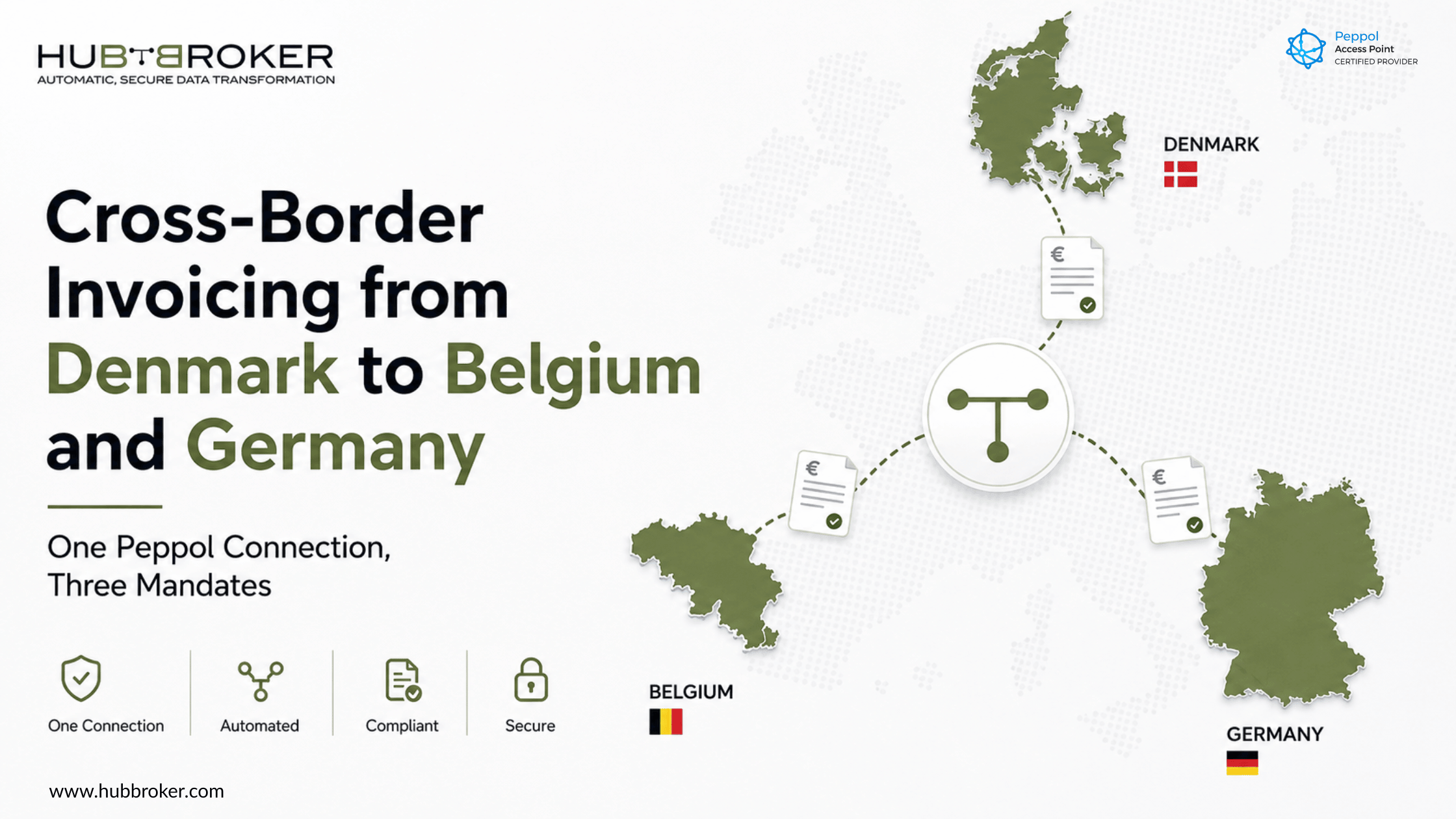
Cross-Border Invoicing from Denmark to Belgium and Germany One Peppol Connection, Three Mandates
Who Should Read This Guide?
Danish exporters trading with Belgium and Germany
Finance and ERP teams managing EU invoicing
Companies preparing for European e-invoicing mandates
Businesses using Peppol or planning Peppol onboarding
Organizations modernizing AP/AR automation
Cross-border invoicing in Europe is becoming more structured, more regulated, and more digital. For Danish businesses trading with Belgium and Germany, the challenge is no longer just sending an invoice across borders. The real challenge is sending the right invoice format, through the right network, in a way that satisfies each country’s e-invoicing requirements.
Denmark, Belgium, and Germany are all moving in the same direction: structured electronic invoicing. But each country has its own rules, timelines, formats, and technical expectations. That is where Peppol becomes important. With one Peppol connection, businesses can simplify how they exchange compliant e-invoices across multiple European markets.
Key Takeaways
Denmark has long required e-invoicing for suppliers invoicing public authorities, with NemHandel supporting standards such as OIOUBL and Peppol BIS.
Belgium made structured e-invoicing compulsory for B2B transactions between VAT-liable Belgian enterprises from 1 January 2026, with Peppol as the main exchange network.
Germany introduced mandatory B2B e-invoicing rules from 1 January 2025, with phased transition periods for issuing e-invoices until 2027 and 2028.
Peppol helps businesses avoid multiple one-off integrations by allowing them to connect once through an accredited service provider and exchange documents with other Peppol-enabled organizations.
For Danish exporters, Peppol is not only a compliance tool. It is a practical way to reduce invoice rejection, manual data entry, ERP complexity, and onboarding friction with customers in Belgium and Germany.
Why Cross-Border Invoicing Is Becoming More Complex
A few years ago, sending a PDF invoice by email was acceptable for many B2B transactions. That is changing quickly.
Governments across Europe want invoices to be structured, machine-readable, and ready for automatic validation. A PDF may look digital, but it is often not a true e-invoice because the data cannot always be processed automatically by the buyer’s accounting or ERP system.
Germany’s Federal Ministry of Finance makes this distinction clearly: from 1 January 2025, an e-invoice must be issued, transmitted, and received in a structured electronic format that enables electronic processing; a simple PDF is treated as an “other invoice,” not as a structured e-invoice.
For Danish companies selling into Belgium and Germany, this means invoice compliance can no longer be handled country by country, customer by customer, or PDF by PDF. Businesses need a scalable approach.
Denmark: A Mature E-Invoicing Market Built Around NemHandel and Peppol
Denmark is one of Europe’s more mature e-invoicing markets. Since 2005, NemHandel has been mandatory for exchanging e-invoices with Danish public authorities. NemHandel acts as a shared digital infrastructure for exchanging business documents between companies and public authorities in Denmark.
The Danish infrastructure includes:
Common document standards such as OIOUBL and Peppol BIS
A shared recipient register, Nemhandelsregisteret
A transport layer based on European eDelivery AS4 standards
For suppliers invoicing Danish public institutions, electronic invoicing is mandatory. OpenPeppol notes that senders can use either Peppol or Denmark’s national OIOUBL format, and Danish public sector invoice recipients must support both.
For Danish businesses, this creates a strong foundation. Many are already familiar with structured invoicing through NemHandel, but cross-border trade introduces additional formats, tax rules, and country-specific expectations. A company that can invoice a Danish public body electronically may still need extra capability to invoice Belgian and German trading partners correctly.
Belgium: B2B E-Invoicing Is Now a Business Requirement
Belgium has taken a major step toward mandatory structured e-invoicing. Since 1 January 2026, Belgian VAT-liable enterprises must use structured electronic invoices in transactions with each other. The Belgian government also makes clear that sending a PDF invoice by email or through a platform is no longer enough for these transactions.
Belgium’s e-invoicing approach is strongly connected to Peppol. Structured electronic invoices are sent through the decentralized Peppol network, where invoicing or accounting software connects securely to exchange invoice data between supplier and customer systems.
The Belgian FPS Finance states that invoices must be sent systematically via the Peppol network, with Peppol BIS used as the principal reference format.
For Danish companies selling to Belgian customers, the legal obligation may depend on whether the transaction falls within Belgian domestic B2B scope, VAT registration, establishment, or customer-specific requirements. But commercially, the direction is clear: Belgian buyers are increasingly preparing their accounting systems for Peppol-based structured invoices. Danish suppliers that can already send Peppol invoices will have a smoother onboarding experience with Belgian customers.
Germany: Structured E-Invoicing Is Being Phased In
Germany’s e-invoicing mandate follows a phased approach. Since 1 January 2025, German domestic businesses must be able to receive structured e-invoices. The obligation to issue e-invoices is subject to transition rules. During the period from 1 January 2025 to 31 December 2026, invoice issuers may still use other invoice types, such as paper invoices or PDFs with recipient consent. For issuers with prior-year turnover up to €800,000, this transition period extends until the end of 2027.
Germany recognizes structured invoice formats that comply with EN 16931. The Federal Ministry of Finance specifically notes that commonly used German formats such as XRechnung and ZUGFeRD from version 2.0.1 meet the VAT requirements for e-invoices, with some profile exceptions.
Germany also has a strong B2G e-invoicing background. In public procurement, XRechnung is a key national specification, and KoSIT became the German Peppol Authority in 2018. OpenPeppol also notes that German public authorities must be reachable via Peppol where they offer a service for electronic invoices.
For Danish exporters, Germany’s rules require careful handling. A Danish supplier may not always be directly covered by Germany’s domestic B2B issuance obligation, but German customers may still expect structured invoices because their own receiving, validation, and accounting processes are being redesigned around e-invoicing.
Simplify Cross-Border Invoicing from Denmark to Belgium and Germany
Manage multiple e-invoicing mandates through one Peppol connection with HubBroker’s compliant invoice exchange and ERP integration solutions.
Contact Us to Know More
One Peppol Connection, Three Compliance Environments
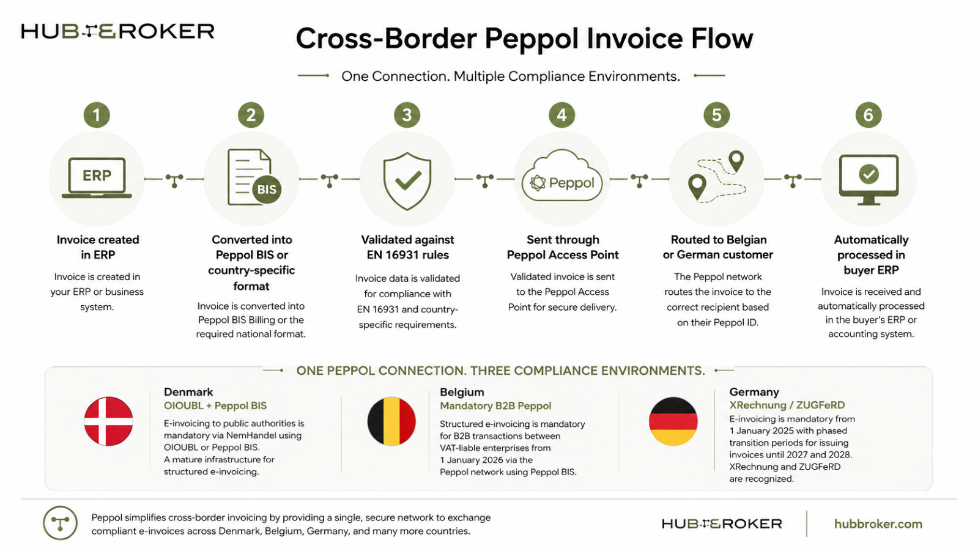
The value of Peppol is not that every country has identical rules. They do not. Denmark, Belgium, and Germany each have different compliance models.
The value of Peppol is that it gives businesses a common, interoperable exchange layer.
For Danish businesses invoicing customers in Belgium and Germany, Peppol creates a common technical foundation—but it does not remove country-specific compliance differences. Denmark, Belgium, and Germany each follow their own mandate model: Denmark through NemHandel and digital bookkeeping readiness, Belgium through Peppol-driven B2B e-invoicing, and Germany through EN 16931-based e-invoicing with phased obligations and multiple accepted formats.
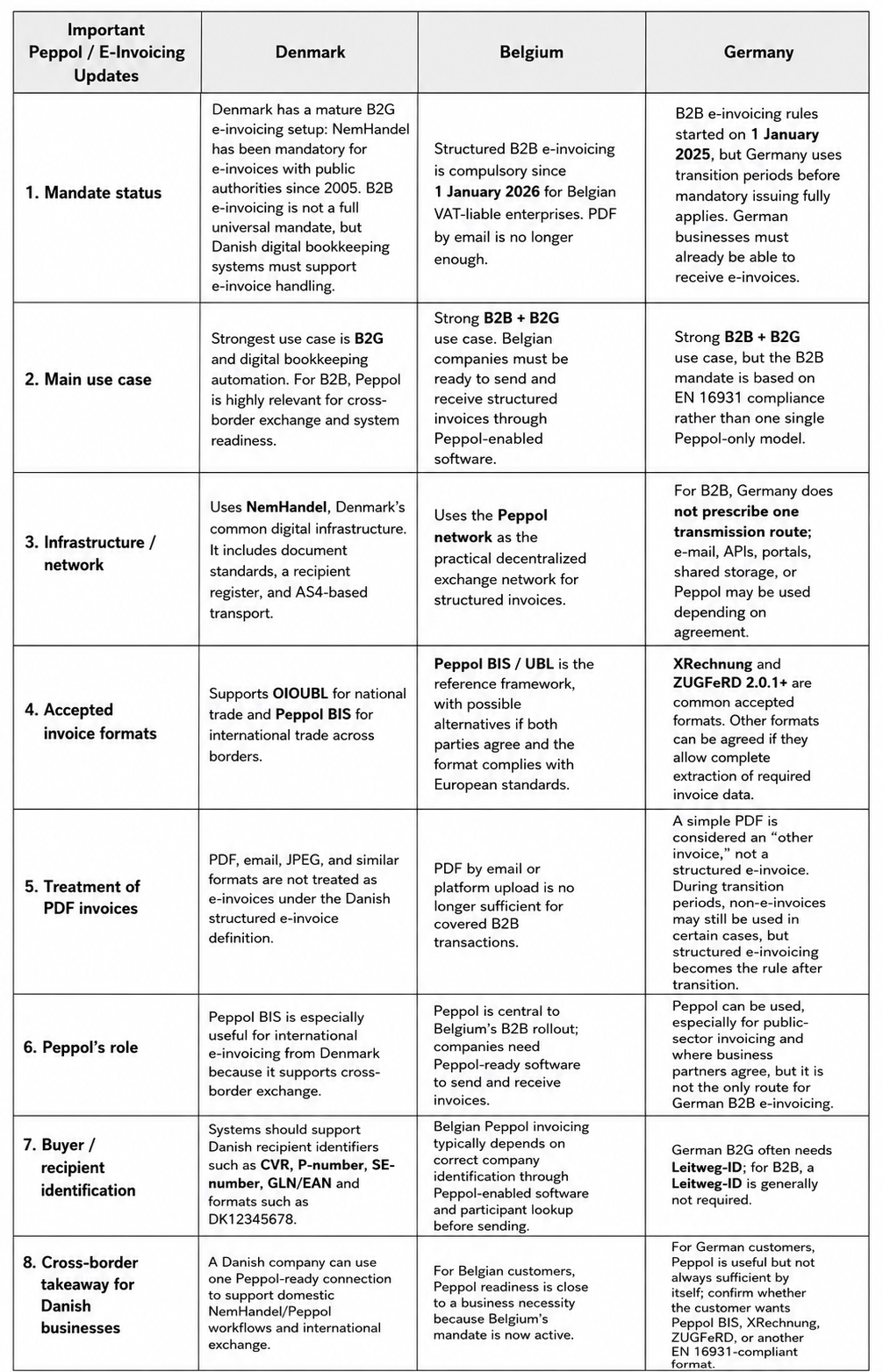
This is why “one connection” matters. Instead of building separate invoice workflows for each customer or country, businesses can centralize invoice generation, validation, routing, and ERP integration.
Why PDF Invoices Are No Longer Enough
PDF invoices are easy for humans to read, but they are inefficient for automated business processes. They often require manual entry, OCR, validation checks, and human review before posting into ERP or accounting systems.
Structured e-invoices work differently. They contain invoice data in a machine-readable format, allowing systems to automatically identify fields such as supplier details, VAT numbers, invoice lines, tax amounts, purchase order references, and payment information.
This matters because cross-border invoicing errors can cause:
Payment delays
Rejected invoices
VAT compliance issues
Duplicate manual work
Higher accounts receivable follow-up
Customer onboarding delays
ERP integration problems
In Belgium, the government explicitly states that structured electronic invoices are exchanged directly between enterprise software systems, and that PDF invoices by email are no longer sufficient for covered transactions.
In Germany, the BMF similarly states that a simple PDF is not considered an e-invoice from 2025 because it lacks a structured format.
The message is consistent: digital appearance is no longer enough. The invoice must be structured, validated, and processable.
How HubBroker Helps Danish Businesses Manage Cross-Border E-Invoicing
HubBroker helps businesses simplify electronic document exchange through Peppol, ERP integration, EDI, e-invoicing, and intelligent document processing.
For Danish companies sending invoices to Belgium and Germany, HubBroker can support the end-to-end process:
ERP Integration:- Invoice data can be extracted from ERP systems such as Microsoft Dynamics 365 Business Central, SAP, or other business platforms.
Format Conversion:- Invoice data can be converted into the required structured format, such as Peppol BIS, OIOUBL, XRechnung, ZUGFeRD, XML, or other agreed formats.
Peppol Connectivity:- As a Peppol Access Point provider, HubBroker enables businesses to send and receive e-invoices through the Peppol network.
Validation Before Sending:- Invoices can be checked for mandatory fields, format rules, and country-specific requirements before delivery.
Automated Routing:- Invoices can be delivered to the correct recipient through Peppol or other supported channels.
Inbound Invoice Processing:- Received e-invoices can be integrated directly into the customer’s ERP or accounting workflow.
Scalable Cross-Border Compliance:- Businesses can use one connected platform instead of managing separate workflows for Denmark, Belgium, Germany, and future e-invoicing markets.
The Business Case: Compliance Plus Automation
E-invoicing should not be treated only as a legal obligation. It is also an opportunity to modernize finance operations.
A strong Peppol-based invoicing setup can help businesses:
Reduce manual invoice handling
Improve invoice accuracy
Speed up customer payments
Lower invoice rejection rates
Strengthen audit readiness
Improve VAT data quality
Connect suppliers and customers more efficiently
Prepare for future e-reporting and tax digitization requirements
Belgium, Germany, and Denmark are not isolated cases. Across Europe, structured invoicing is becoming part of a broader movement toward real-time, digital, and automated tax and business reporting. Companies that prepare early will be better positioned than those waiting until each customer or country forces a change.
What Danish Businesses Should Do Now
Danish companies trading with Belgium and Germany should review their invoicing setup before customer requirements become urgent.
A practical readiness checklist includes:
Can your ERP export invoice data in a structured format?
Can you send and receive Peppol BIS invoices?
Can you support Danish OIOUBL where required?
Can you handle Germany’s XRechnung or ZUGFeRD requirements?
Can you validate invoice data before sending?
Can your system manage VAT numbers, buyer references, order numbers, and routing IDs correctly?
Can inbound e-invoices be processed automatically?
Can you scale the same setup to more countries?
The goal is not just to meet today’s requirement. The goal is to build an invoicing infrastructure that can handle the next mandate without starting again.
Common Cross-Border E-Invoicing Mistakes
Assuming PDF invoices are compliant
Using incorrect buyer identifiers
Missing VAT validation
Ignoring country-specific invoice references
Treating Germany and Belgium as identical Peppol environments
Delaying ERP readiness until customer pressure begins
Conclusion: Cross-Border Invoicing Needs a Connected Strategy
Denmark, Belgium, and Germany show how quickly e-invoicing is becoming the new standard in European trade. Denmark already has a mature public-sector e-invoicing environment. Belgium has moved into mandatory B2B structured e-invoicing. Germany is phasing in structured B2B e-invoicing with clear transition deadlines.
For Danish businesses, the safest approach is to stop treating each country as a separate invoicing project. A Peppol-enabled setup creates a reusable foundation for compliant, automated, and scalable cross-border invoicing.
With HubBroker, businesses can connect once, integrate with their ERP, exchange structured e-invoices, and prepare for the growing wave of e-invoicing mandates across Europe.
