Germany E-Invoicing 2027 vs 2028: Are You Above or Below the EUR 800,000 Threshold?
Germany's B2B e-invoicing rollout is no longer a future compliance topic it is already underway.
Since 1 January 2025, businesses in Germany are required to receive structured electronic invoices. The next critical milestone focuses on issuing e-invoices, raising an important question: will your business need to comply by 2027, or do you qualify for the extended transition period until 2028?
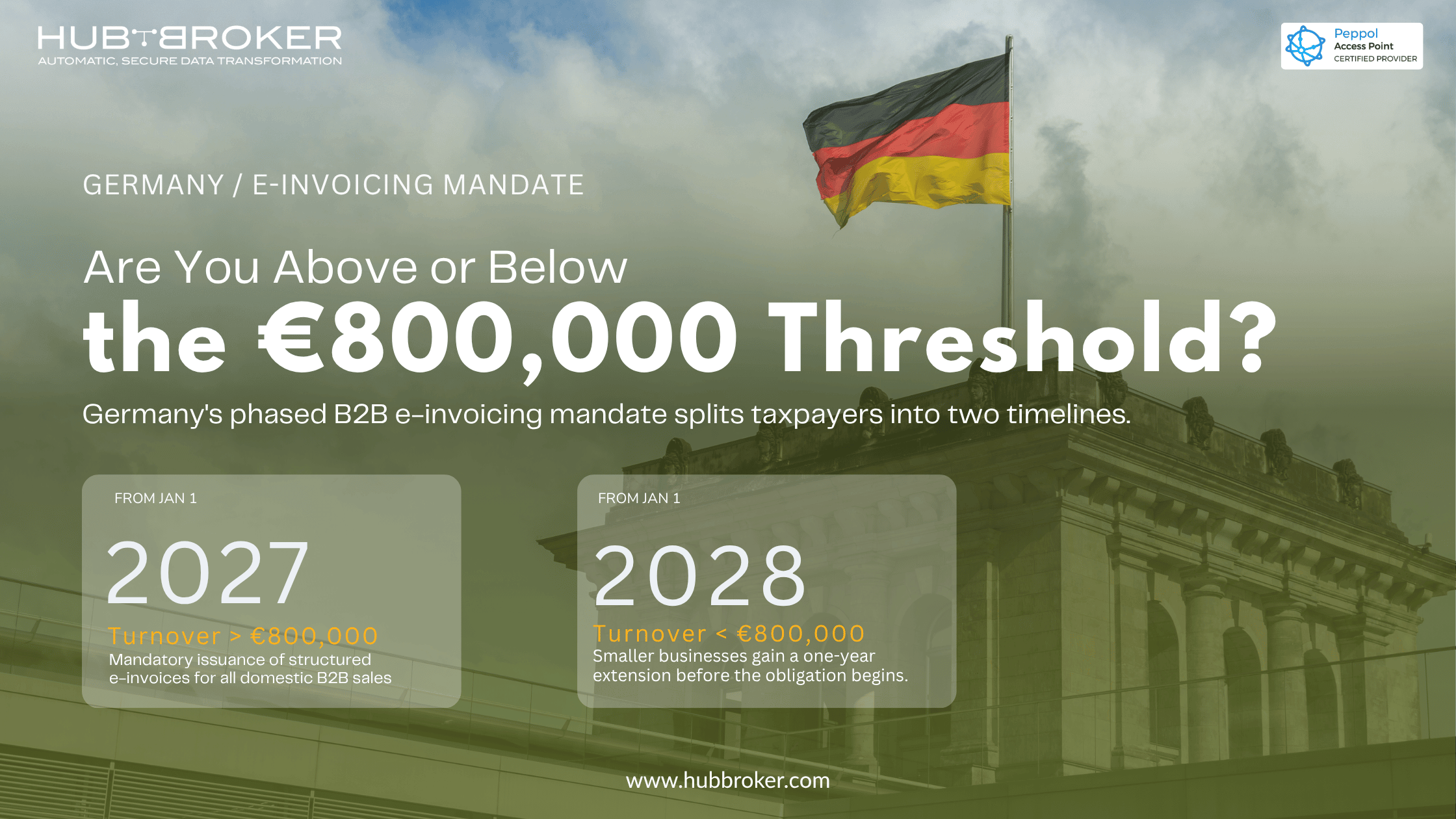
The answer depends on one figure: EUR 800,000 annual turnover.
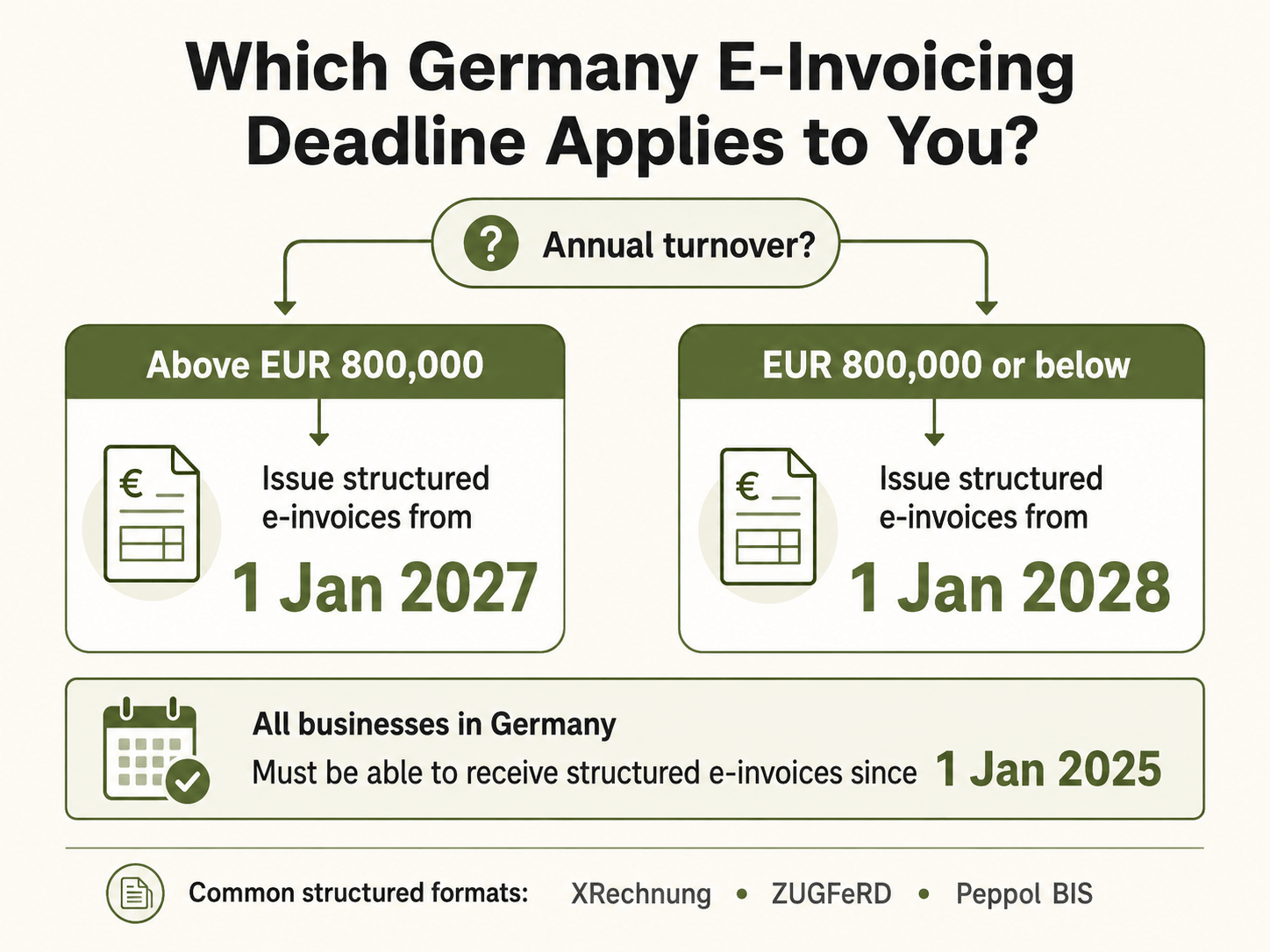
If your previous year's turnover exceeds EUR 800,000, your business must issue compliant B2B e-invoices starting 1 January 2027. If your turnover is EUR 800,000 or below, you fall under the extended transition period, with full compliance required from 1 January 2028.
For finance teams, ERP managers, and business owners, this is more than a regulatory update. It directly affects how invoices are created, transmitted, validated, archived, and integrated across your systems.
Germany E-Invoicing 2027 vs 2028: What the EUR 800,000 Threshold Means
The EUR 800,000 threshold determines when a business must begin issuing structured electronic invoices under Germany's phased B2B e-invoicing rollout.
In simple terms:
Above EUR 800,000 annual turnover → mandatory B2B e-invoice issuing from 1 January 2027.
EUR 800,000 or below → transitional allowances apply until 31 December 2027, with full compliance required from 1 January 2028.
This distinction matters most for businesses that rely on PDFs, paper invoices, email attachments, or partially manual ERP invoice workflows. During the transition phase, certain non-structured formats may remain permitted under specific conditions but that flexibility is temporary and narrowing as Germany moves toward fully structured electronic invoicing.
One common mistake is assuming: "We're below the threshold, so we have time." In practice, waiting can create operational problems well before the legal deadline arrives. Customers, suppliers, and larger trading partners are increasingly requiring structured e-invoices ahead of schedule, as ERP integrations and automated invoice processing become standard across supply chains.
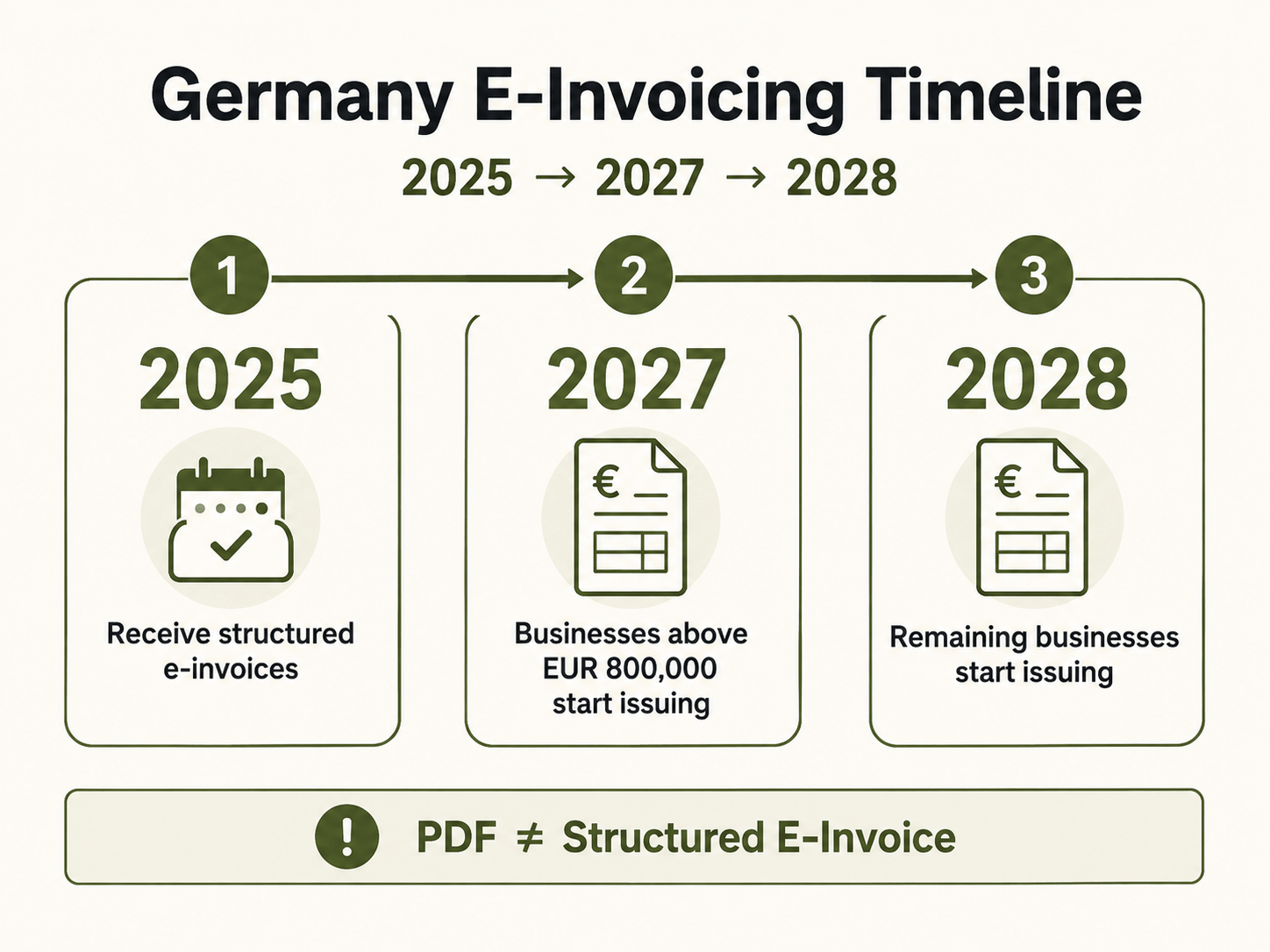
Germany's E-Invoicing Timeline: 2025, 2027, and 2028
Germany's B2B e-invoicing mandate is being introduced in stages. Understanding the timeline helps you plan implementation without a last-minute scramble.
2025 - Receiving e-invoices is already required. From 1 January 2025, German businesses must be able to receive structured e-invoices. Your company should already have a process for handling compliant electronic invoices, even if you aren't yet required to issue them. A standard PDF invoice alone does not qualify as a structured electronic invoice under the new requirements a PDF may look digital to a human reader, but compliant e-invoicing requires data that business systems can process automatically.
2027 - Businesses above EUR 800,000 must issue e-invoices. From 1 January 2027, companies with turnover above EUR 800,000 in the relevant prior year must issue structured e-invoices for applicable domestic B2B transactions. By this point, invoice creation shouldn't depend on manual formatting, PDF generation, or ad hoc email sending.
2028 - The issuing obligation applies more broadly. From 1 January 2028, the requirement to issue structured e-invoices extends to businesses previously covered by transition rules. Businesses below the EUR 800,000 threshold should prepare well in advance rather than waiting for the final deadline by then, structured e-invoicing will be a standard part of B2B transactions across Germany.
Above EUR 800,000? What to Do Before 2027
If your business exceeds the threshold, the 2027 deadline is closer than it appears from an implementation standpoint. Becoming e-invoicing-ready isn't a matter of installing a new tool it requires evaluating invoice workflows, ERP capability, customer requirements, invoice formats, validation processes, and long-term archiving.
Review your current invoice process. Are invoices generated directly from your ERP, exported as PDFs, or sent manually by email? Do employees copy invoice data between systems by hand? Every manual step adds operational risk once structured data has to be accurate and machine-readable by default.
Check ERP readiness. Your ERP likely already holds most of the required invoice information the challenge is transforming and transmitting it in the right format. This is where integration matters: a well-built e-invoicing setup connects your ERP to the required format and delivery channel instead of running a separate process outside your core systems.
Identify required formats. Germany's framework supports structured formats compliant with EN 16931, including XRechnung, ZUGFeRD, Peppol BIS Billing 3.0, and certain EDI-based exchanges permitted under transitional arrangements. Different trading partners may require different formats one customer may request XRechnung, another Peppol, and a third a direct ERP-to-ERP connection. Your setup needs to support more than one path.
Test before the deadline. Don't wait until January 2027 to send your first structured invoice. Testing should cover data extraction from the ERP, format conversion, validation, delivery, error handling, receiving confirmation, and archiving. The earlier gaps surface, the easier they are to fix.
Below EUR 800,000? Why Waiting Until 2028 Is Risky
Having more time before the mandatory issuing date doesn't mean preparation should wait.
Your customers may require it earlier. Large customers, enterprise buyers, and international trading partners may ask for structured invoices before your legal deadline applies. If a key customer requests XRechnung or Peppol invoices in 2027, you need to already be ready the transition rule protects you legally, not commercially.
Receiving is already mandatory. The 2028 date concerns issuing for businesses under the threshold; receiving compliant e-invoices has been part of the rollout since 2025. Finance and accounting teams need working processes for receiving structured invoices, reading invoice data, validation, error handling, and secure archiving today, not in 2028.
Implementation takes longer than expected. E-invoicing projects typically touch finance, IT, ERP administration, operations, compliance, and customer onboarding. Even smaller businesses run into delays from customer-specific invoice requirements, ERP mapping, validation rules, and integration testing. Waiting until late 2027 creates unnecessary pressure and raises the risk of a rushed rollout.
What Counts as a Valid E-Invoice in Germany?
A common misunderstanding is that any digital invoice qualifies as an electronic invoice. That isn't correct under Germany's requirements. A PDF sent by email is electronic in a general sense, but it is not a structured electronic invoice under the mandate. Qualifying invoices must use structured, machine-readable formats that support automated processing.
XRechnung - a structured XML-based format widely used in Germany, particularly in public-sector invoicing and compliance-driven B2B environments, built for fully automated processing.
ZUGFeRD - combines a human-readable PDF with embedded structured XML data, giving businesses visual readability alongside automated machine processing.
Peppol BIS Billing 3.0 - a common specification for structured invoice exchange across the Peppol network, particularly useful for organizations trading internationally or already connected to Peppol.
EN 16931-compliant EDI - certain EDI-based exchanges may qualify when they meet EN 16931 and applicable German regulations, though long-term compatibility with evolving requirements should be reviewed.
Common Mistakes Businesses Make with the 2027 and 2028 Deadlines
Assuming PDF invoices are enough. PDFs are familiar and easy to exchange, but a standard PDF alone does not qualify as a structured electronic invoice. Businesses relying heavily on PDF-based workflows will likely need structured data conversion, validation, and automation.
Treating e-invoicing as only a compliance project. Regulation may drive adoption, but automation is where the operational value sits reduced manual handling, improved accuracy, faster processing cycles, and better visibility across finance operations. Businesses that view this purely as a legal box to check often miss the process improvement behind it.
Keeping e-invoicing separate from ERP workflows. When e-invoicing runs outside the ERP, teams tend to fall back on manual uploads, spreadsheet corrections, and duplicate validation steps which limits the benefit of automation and adds operational complexity.
Ignoring customer-specific requirements. Technical compliance alone isn't enough. Different trading partners may require specific delivery methods, invoice fields, reference structures, or validation rules. An invoice that technically meets the legal standard can still be rejected if it doesn't meet a customer's business rules.
Waiting until the final deadline. ERP mapping, validation setup, integration testing, user training, and supplier and customer onboarding all take time. Starting late raises the risk of failed invoice delivery, payment delays, ERP bottlenecks, and last-minute compliance pressure.
What This Means for Your ERP and Existing Systems
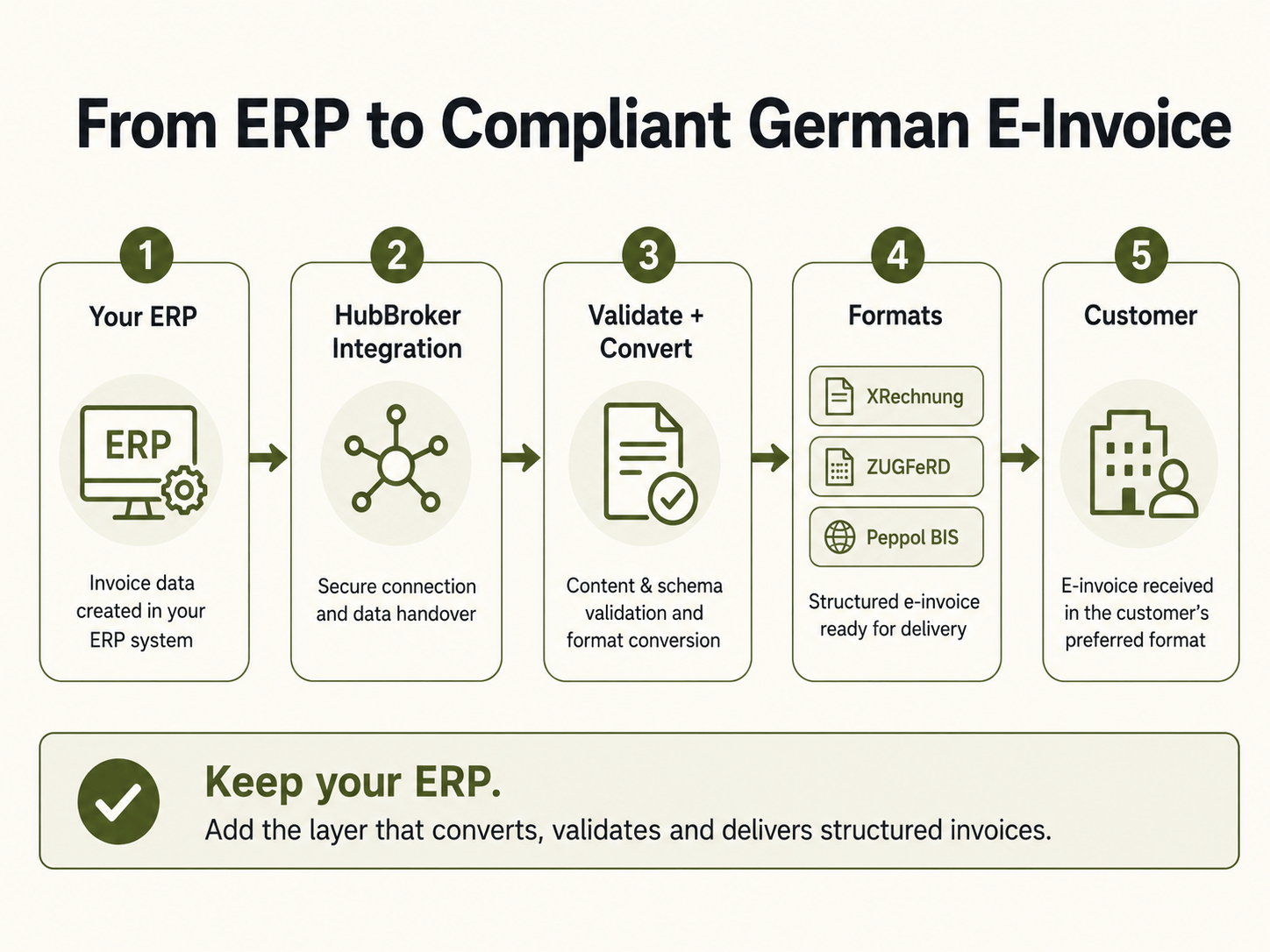
None of this requires ripping out your ERP. Systems like Microsoft Dynamics 365, SAP Business One, e-conomic, and Uniconta already hold most of the invoice data the mandate requires what's usually missing is the layer that converts, validates, and delivers that data in the format each trading partner expects.
HubBroker's e-invoicing platform connects to your existing ERP and handles that conversion, validation, and delivery without a system migration, supporting XRechnung, ZUGFeRD, Peppol BIS Billing 3.0, and EDI-based exchange from a single connection. For suppliers still sending PDFs, PDF-to-XML conversion turns unstructured invoices into EN 16931-compliant, ERP-ready data closing the gap between what arrives today and what the mandate requires.
For businesses above the EUR 800,000 threshold, this means preparing for 2027 without a system overhaul. For businesses below it, it means building a scalable, future-ready invoice process well ahead of the 2028 deadline instead of retrofitting one under pressure.
Germany E-Invoicing Readiness Checklist
Use this checklist to see where your business stands today.
Confirm your turnover category. Check whether your business is above or below the EUR 800,000 threshold this determines whether your issuing obligation starts in 2027 or 2028.
Review your invoice types. Identify which invoices are domestic B2B, which are cross-border, which are B2C, and which may fall outside scope. The mandate concentrates on domestic B2B transactions between German-established businesses.
Identify required formats. Check whether customers require XRechnung, ZUGFeRD, Peppol, EDI, or another compliant format different partners may require different standards.
Check ERP capabilities. Determine whether your ERP can generate structured invoice data natively, or whether you need middleware to transform, validate, and send invoices.
Review your receiving workflow. Confirm your team can already receive and process structured e-invoices without manual workarounds this obligation has applied since 2025.
Plan validation and error handling. A structured invoice can still fail if required fields are missing or incorrectly formatted; build validation into the workflow before invoices are sent.
Prepare archiving. E-invoices must be stored correctly for audit and tax purposes confirm your archiving process supports structured documents and retention requirements.
Test with real scenarios. Use real customer and supplier flows to test invoice creation, delivery, receipt, validation, and archiving before deadlines become critical.
Automate where possible. Manual handling increases delays, errors, and validation failures automation helps finance teams stay compliant while improving day-to-day operations.
For a deeper walkthrough of each step, HubBroker's e-invoicing compliance checklist for CFOs breaks the full process down further.
Ready to Find Out Whether 2027 or 2028 Applies to You?
Germany's e-invoicing mandate is moving quickly. Whether your business sits above or below the EUR 800,000 threshold, book a readiness check with HubBroker to confirm your deadline and see what needs to change before it arrives.
