
France E-Invoicing 2026 A 6-Month Implementation Plan for Large Enterprises Before September
Most companies think e-invoicing is just about switching from PDF to XML.
It’s much bigger than that.
From 1 September 2026, all French VAT-registered businesses must be able to receive electronic invoices. At the same time, large enterprises and ETIs will be required not only to issue e-invoices, but also to comply with e-reporting obligations.
This means your invoices won’t just be sent—they’ll be validated, structured, and exchanged through approved platforms. And if something doesn’t match the rules, invoices can be rejected before they even reach your customer. For large enterprises, the impact goes beyond compliance. It touches ERP systems, finance operations, supplier onboarding, customer communication, VAT reporting, master data, and integration flows.
The real challenge isn’t understanding the regulation—it’s preparing your systems and processes in time.
This blog outlines a practical 6-month implementation plan to help you get ready before the September 2026 deadline becomes a business risk.
Key Takeaways
1 September 2026 is the key deadline:- Large enterprises and ETIs must start issuing e-invoices and comply with e-reporting.
All businesses must be able to receive e-invoices:- Even if you’re not issuing yet, you still need to be ready.
This is not just e-invoicing—it includes e-reporting:- B2C and certain cross-border transactions may also be affected.
PDF invoices alone will no longer be sufficient:- Invoices must be structured (Factur-X, UBL, CII) and exchanged via approved platforms.
Platform-based exchange is mandatory:- Emails and manual processes won’t meet compliance requirements.
Preparation requires more than just IT changes:- It involves ERP readiness, data quality, integration, onboarding, and testing.
A structured 6-month plan is critical:- Late preparation increases the risk of invoice rejection and operational disruption.
What Is Changing in France from September 2026?
Until now, e-invoicing in France was mainly limited to public-sector transactions. From September 2026, this expands to domestic B2B transactions between VAT-registered businesses. At the same time, a new requirement—e-reporting—is introduced for transactions outside this scope, such as B2C and certain cross-border activities.
For large enterprises:
This isn’t just a format change—it’s a process transformation. Traditional invoicing methods based on paper, Word, Excel, or PDF-only workflows will no longer meet compliance requirements. Instead, invoices must be created, transmitted, received, and processed in structured electronic formats through compliant channels.
Why Large Enterprises Should Start 6 Months Before the Deadline
For large enterprises, e-invoicing isn’t just a system update—it’s a coordination challenge. Most organizations operate across multiple ERPs, business units, billing systems, shared service centres, customer portals, procurement platforms, and country-specific tax workflows.
That complexity means even small gaps can create big issues during implementation.
What happens when preparation starts too late?
ERP integrations are delayed or incomplete
Invoice data mapping errors lead to validation failures
Structured formats fail compliance checks
Suppliers and customers are not onboarded in time
VAT reporting data becomes inconsistent
Invoices get rejected ? payments are delayed
Go-live turns into operational disruption instead of a smooth transition
Prepare for France E-Invoicing Before September 2026
Follow a clear 6-month implementation plan with HubBroker’s compliant e-invoicing, PDP-ready integration, and ERP automation solutions.
Book a free Demo Now
Why a 6-month plan matters
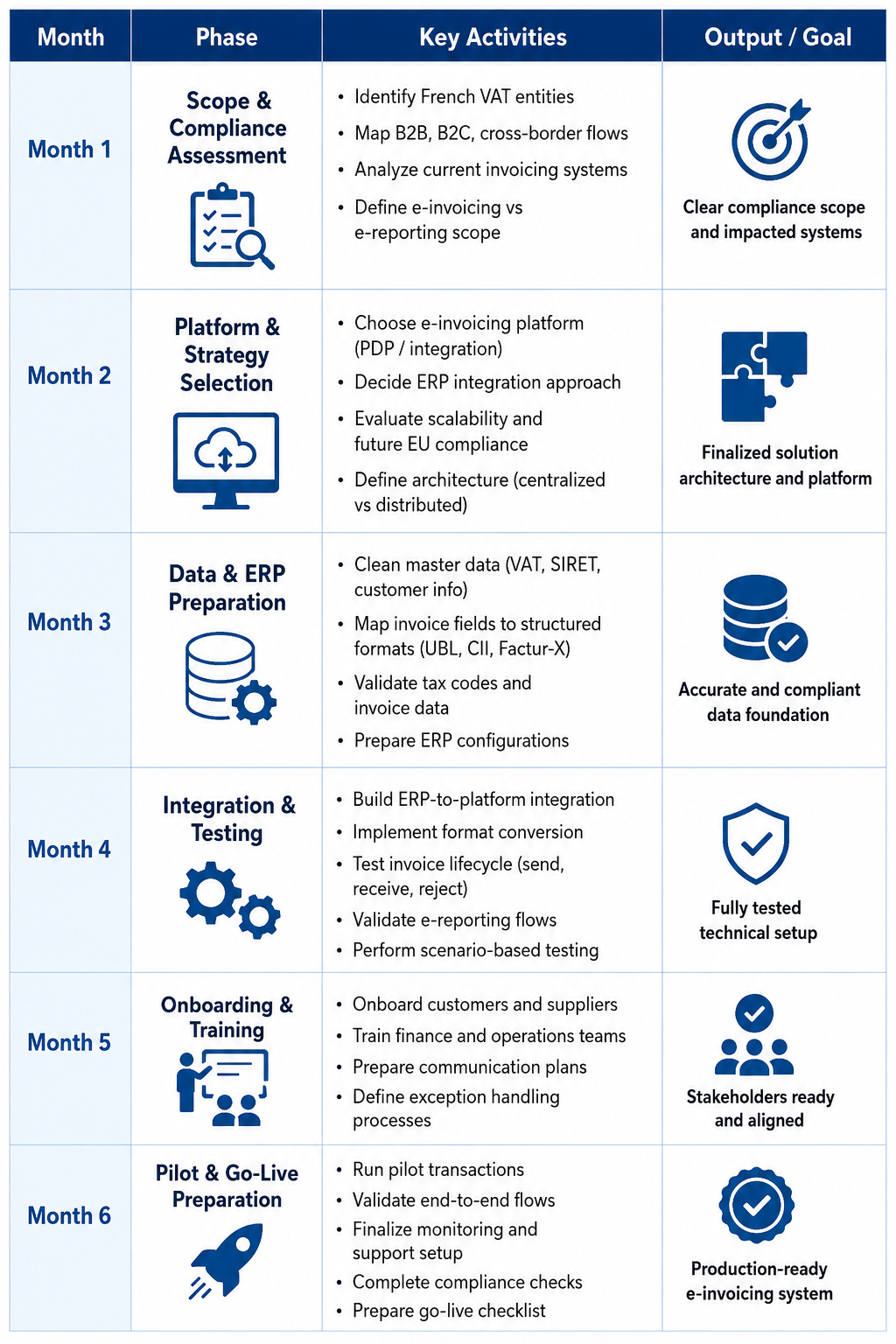
A structured 6-month implementation plan gives finance, IT, tax, procurement, and compliance teams enough time to:
Align systems and integrations
Clean and validate data
Test real-world scenarios
Onboard partners
Prepare for a stable go-live
Starting early isn’t just about meeting the deadline—it’s about avoiding disruption and protecting business continuity.
France E-Invoicing 2026: 6-Month Implementation Plan
Common Mistakes Large Enterprises Should Avoid
Most implementation challenges don’t come from the regulation itself— they come from how companies approach it.
❌ Treating it as a “PDF to XML” project
France’s e-invoicing model goes far beyond format conversion.
It includes invoice exchange, platform connectivity, transaction reporting, lifecycle tracking, and tax authority integration.
It’s not just a format change—it’s a process transformation.
❌ Ignoring e-reporting requirements
Many enterprises focus only on domestic B2B invoicing.
But B2C and certain cross-border transactions may require e-reporting— and missing this can lead to compliance gaps.
❌ Underestimating master data quality
Even small data issues can cause big problems.
Incorrect:
Customer identifiers
VAT numbers
Invoice references
Tax codes
These can lead to invoice rejections and delayed payments.
❌ Testing only basic scenarios
Testing a few simple invoices is not enough.
Real-world invoicing includes:
Credit notes
Corrections
Multiple VAT rates
Intercompany transactions
Without proper testing, issues will appear during go-live—not before.
How HubBroker Can Help You Prepare
Large enterprises don’t struggle with one problem—they deal with multiple challenges across systems, data, and processes.
Here’s how these challenges are typically solved in practice:
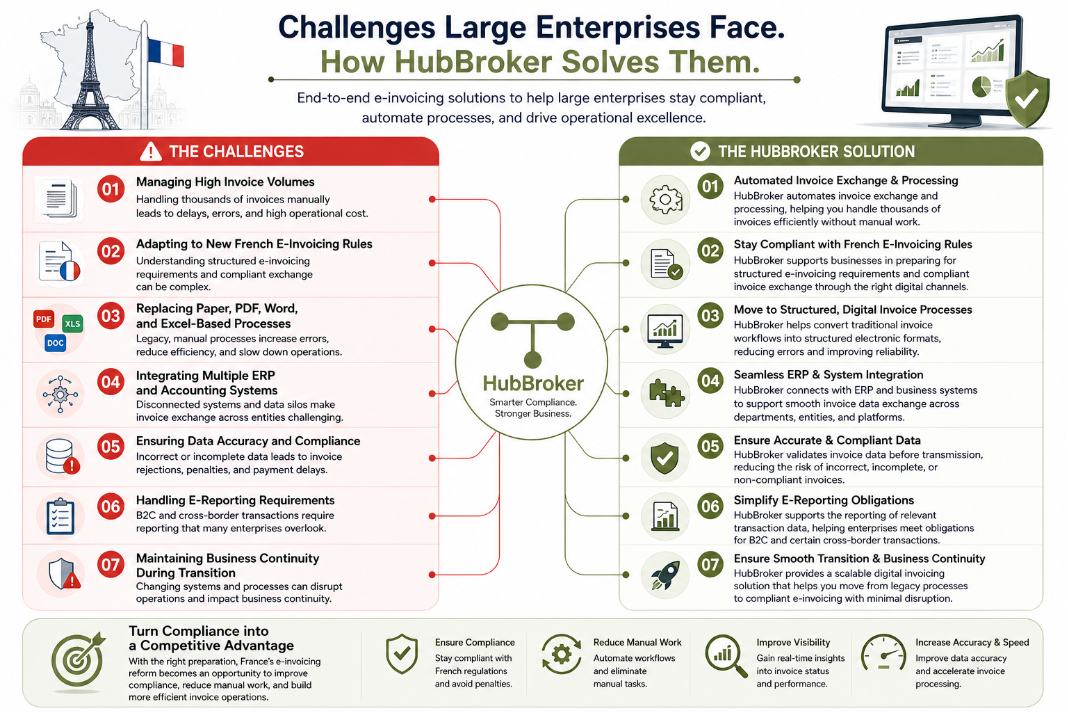
France’s e-invoicing reform doesn’t have to be a disruption—it can be a turning point. With the right preparation, large enterprises can move beyond compliance and build more efficient, automated, and reliable invoicing operations.
HubBroker supports this transition with scalable e-invoicing, seamless ERP integration, and automated data exchange—helping businesses stay compliant while improving visibility, accuracy, and processing speed across all business units.
The difference isn’t the deadline—it’s how early you prepare for it.
