
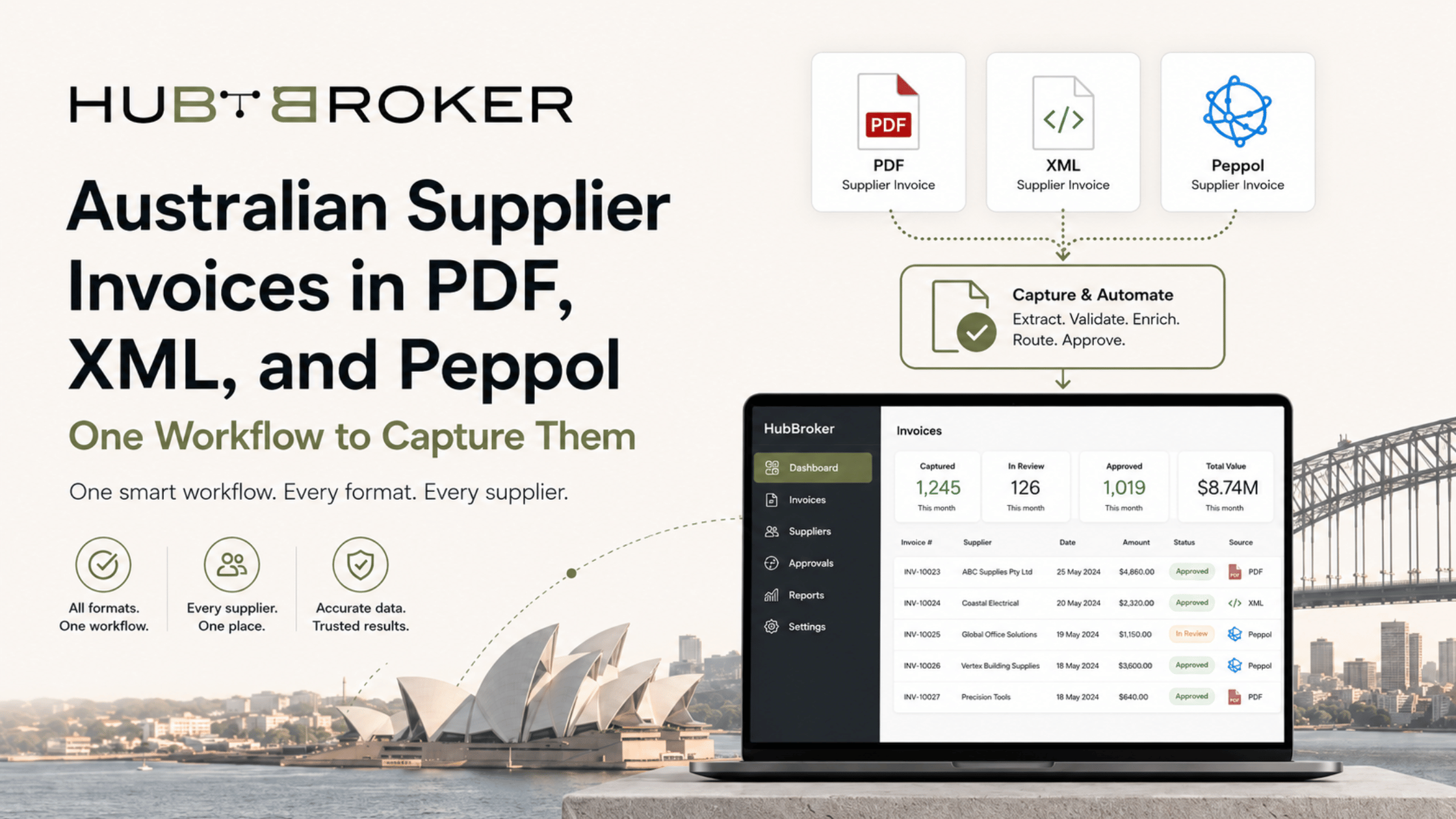
Australian Supplier Invoices in PDF, XML, and Peppol: One Workflow to Capture Them
If your accounts payable inbox is a jumble of emailed PDFs, XML attachments, and Peppol e-invoices landing through your access point, you already know the pain. Three formats, three habits, and no single source of truth. Your team sorts of invoices before it can even start processing them and that lost hour, multiplied across every supplier, every day, is quietly draining your finance function.
This guide explains why the three-format problem exists, what separates each format, and how a single capture workflow ends the sorting once and for all.
Why three formats is a daily AP headache.
Australian businesses rarely get to choose how their suppliers invoice them. A long tail of small vendors still emails PDF invoices. Mid-sized suppliers and ERP systems attach structured XML files. And true Peppol e-invoices are arriving in growing numbers because the Australian Taxation Office, acting as the Peppol Authority, has set e-invoicing as the default for government procurement, targeting 30% of invoices via the Peppol network by 1 July 2026, with automated processing across agencies by December 2026.
With more than 400,000 businesses already registered on the Peppol network in Australia, the share of structured e-invoices in your inbox is only going one way. The trouble is that most AP teams handle each format in a different tool OCR for PDFs, a parser for XML, an access point for Peppol so the work is fragmented before it begins.
PDF vs XML vs Peppol: a quick comparison
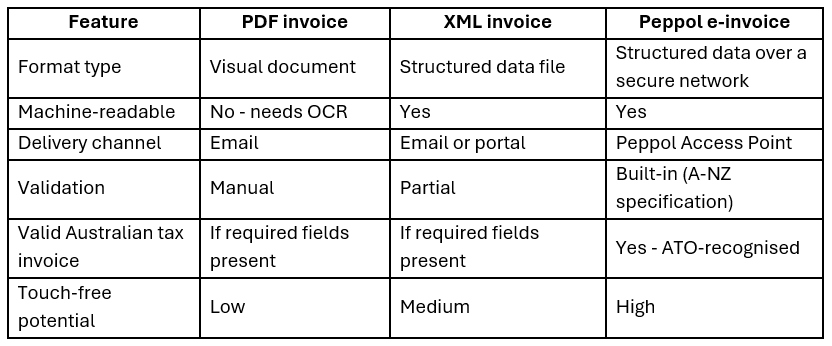
The key takeaway: a PDF is a picture of an invoice, while XML and Peppol carry the data itself. A capable workflow has to bridge that gap automatically.
Capture Australian Supplier Invoices in One Workflow
Process PDF, XML, and Peppol invoices through a single automated workflow with HubBroker’s invoice capture, e-invoicing, and ERP integration solutions.
Contact Us to Know More
The real cost of a fragmented workflow
Format fragmentation is not a cosmetic problem it shows up directly in cost, speed, and accuracy. The figures below are typical industry benchmarks for Australian AP teams and illustrate how much the capture method matters.
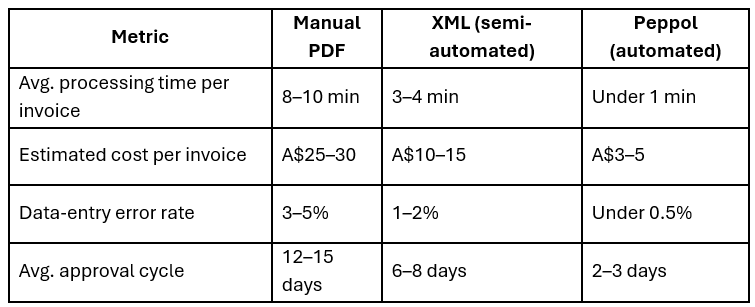
Processing time per invoice at a glance:

The pattern is clear: every step toward structured data removes minutes, dollars, and errors. Research cited by industry bodies suggests full national e-invoicing adoption could deliver up to A$22.5 billion in annual economy-wide benefits and your own savings scale the same way.
One workflow to capture them all
You don't need to wait for every supplier to switch to Peppol. The solution is a single capture layer that normalises all three formats into one consistent stream of invoice data. Here is what that workflow looks like:
One inbox, every channel. Email, supplier portals, and your Peppol access point all feed the same capture point no manual sorting.
Automatic format detection. The workflow identifies whether each file is a PDF, XML, or Peppol e-invoice and routes it accordingly.
Smart extraction. PDFs pass through AI-based OCR; XML and Peppol files are parsed directly from their structured fields far more accurate than reading an image.
Validation and matching. Every invoice is checked for mandatory fields, GST details, and ABN, then matched against purchase orders and receipts.
One clean output. Validated data flows into your ERP or accounting system in a single standard format, ready for approval.
The result: your team works from one queue, not three. Exceptions are flagged instead of hunted, and the supplier's choice of format becomes irrelevant to your process.
Getting ready for the 2026 deadlines
Even if you don't sell to government, the 2026 milestones will reshape supplier behaviour across the market. Acting now puts you ahead:
Register on the Peppol network through an approved access point so you can receive e-invoices natively.
Consolidate capture so PDF and XML are handled by the same workflow as Peppol no rip-and-replace required.
Map your supplier mix to see which vendors are likely to move to Peppol first.
Frequently asked questions
Is a Peppol e-invoice a valid tax invoice in Australia?
Yes. The ATO confirms e-invoices that meet the A-NZ specification qualify as valid tax invoices, even without the words "tax invoice" or "GST invoice", provided all mandatory fields are present.
Do I have to drop PDF invoices entirely?
No. Many smaller suppliers will email PDFs for years. A unified workflow keeps capturing them while you gradually shift larger suppliers to Peppol.
Is e-invoicing mandatory for B2B businesses?
Not as a blanket legal mandate. However, government agencies are encouraged to make e-invoicing a contractual requirement, so suppliers increasingly find it mandatory in practice.
