
Which Peppol Access Point Fits Japan Invoice Exchange Requirements
Japan’s digital invoice exchange is no longer just a local accounting topic. For companies trading with Japanese businesses, the question is becoming more practical: which Peppol Access Point can actually support Japan’s invoice exchange requirements?
Japan uses JP PINT, a Peppol-based digital invoice specification managed by the Digital Agency, Government of Japan, acting as the Japan Peppol Authority. The Digital Agency confirms that JP PINT is compliant with the Peppol PINT BIS Billing model, and the current published JP PINT specifications include Standard Invoice JP PINT, Self Billing Invoice, and Invoice for Non-tax Registered Businesses.
For finance and IT teams, this means choosing a Peppol Access Point is not only about “sending invoices through Peppol.” It is about selecting a provider that understands Japan-specific requirements, supports correct invoice validation, and connects smoothly with your ERP or accounting system.
What Makes Japan’s Peppol Invoice Exchange Different?
Japan’s Peppol invoice exchange is different because it combines global Peppol interoperability with Japan-specific invoice rules through JP PINT, ensuring invoices are structured, validated, and ready for automated processing before they reach the buyer.
Key points:
Japan uses JP PINT
JP PINT is Japan’s Peppol-based invoice specification for exchanging structured digital invoices.It is not just a PDF replacement
A normal PDF invoice or basic XML export may not meet Japan’s Peppol requirements.Invoice data must be structured correctly
Invoices need required fields such as invoice number, issue date, invoice type, currency, seller details, buyer details, tax identifiers, and electronic addresses.Mandatory fields must be validated
The invoice must include key information like seller and buyer electronic addresses, business process type, and specification identifier.Automation depends on correct identifiers
Buyer, seller, tax, and Peppol identifiers help systems route, read, and process invoices automatically.Validation happens before exchange
A Japan-ready Peppol workflow should check invoice structure and data quality before the invoice is sent to the recipient.ERP output may need mapping
Invoice data from ERP or accounting systems often needs conversion and mapping into the correct JP PINT format.
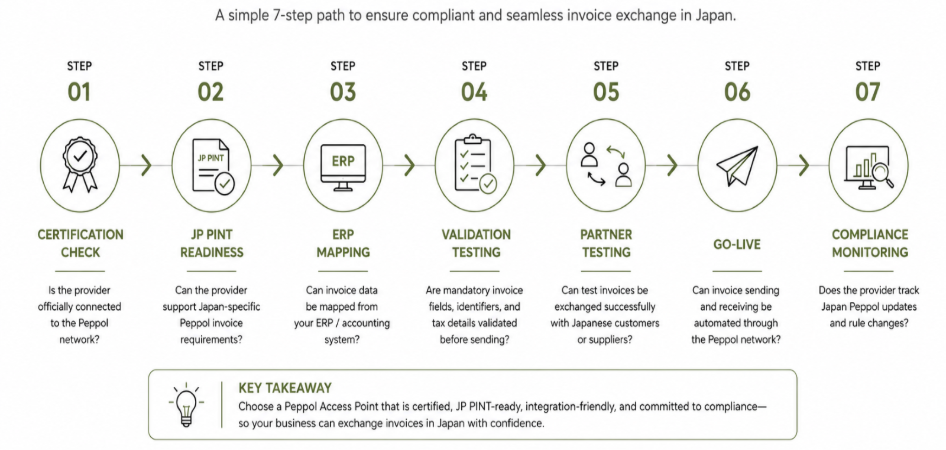
How to Choose a Japan-Capable Peppol Access Point
7-steps to ensure compliant and seamless invoice exchange in Japan.
Certification check
JP PINT readiness
ERP mapping
Validation testing
Partner testing
Go-live
Compliance monitoring
What Should a Japan-Ready Peppol Access Point Support?
The best Peppol Access Point for Japan invoice exchange should support more than basic Peppol connectivity. It should help your business manage the full invoice flow from ERP data to compliant JP PINT exchange.
A suitable provider should offer:
JP PINT support
The Access Point should support Japan’s Peppol invoice specification, not only general European Peppol BIS Billing 3.0.Invoice validation before sending
Errors should be detected before the invoice reaches the buyer. This includes missing identifiers, incorrect tax data, wrong invoice structure, invalid format, and incomplete buyer/seller information.ERP and accounting system integration
Your invoice exchange should connect with systems such as Microsoft Dynamics 365 Business Central, SAP, e-conomic, or other ERP platforms without heavy manual work.Support for Japanese invoice identifiers
Japan’s invoice exchange depends on correct seller, buyer, tax, and electronic address information. The JP PINT rules also state that at least one seller identifier, seller legal registration identifier, or seller tax identifier must be present so the buyer can automatically identify the supplier.Compliance monitoring
Standards change. Japan’s Digital Agency updated and published JP PINT Version 1.1.2 in December 2025, which shows why businesses need a provider that tracks specification updates.
Choose the Right Peppol Access Point for Japan Invoice Exchange
Simplify compliant invoice exchange in Japan with HubBroker’s Peppol connectivity, ERP integration, and secure e-invoicing automation.
Contact Us to Know More
Certified vs. Capable: What Should Businesses Check?
A provider may be a Peppol Access Point, but that does not automatically mean it is the right fit for Japan. The Digital Agency maintains a list of Peppol Certified Service Providers in Japan and shows providers accredited under different Peppol Authorities, including Japan, OpenPeppol, and European authorities.
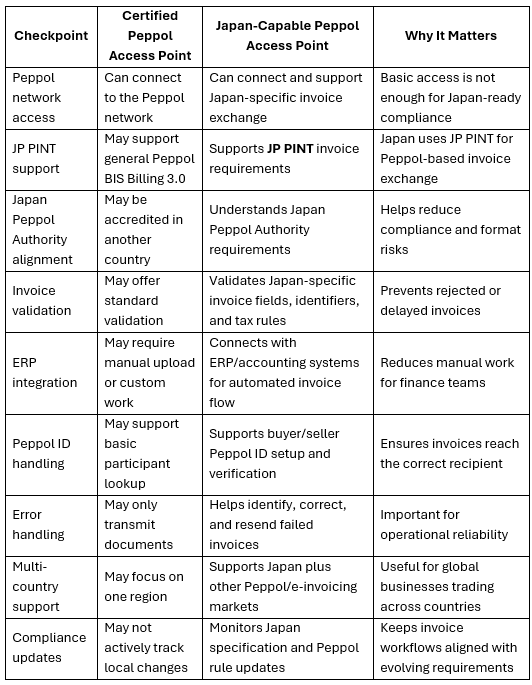
So, the right question is not only: “Is this provider a Peppol Access Point?”
The better question is: “Can this provider support Japan-ready invoice exchange with JP PINT validation, ERP integration, and reliable compliance handling?”
How HubBroker Helps with Japan Peppol Invoice Exchange
HubBroker provides Peppol Access Point solutions that help businesses connect once and exchange documents with multiple trading partners on the Peppol network. HubBroker’s Peppol Access Point service includes connectivity, validation, partner onboarding, format handling, and ERP integration support.
For companies dealing with Japan invoice exchange, HubBroker can help bridge the gap between business systems and Peppol requirements by supporting:
ERP-to-Peppol invoice conversion
Invoice validation before exchange
Peppol ID and partner onboarding support
Integration with ERP, accounting, eCommerce, and EDI systems
Error handling and deviation management
Support for multiple invoice and business document formats
This is important because many businesses do not only need Peppol connectivity. They need an operational invoice workflow that works with their existing finance process.
Key Questions Before Choosing a Peppol Access Point for Japan
Before selecting a Peppol provider, finance and IT teams should ask:
Does the provider support JP PINT?
Can it validate invoices before sending?
Can it connect with our ERP or accounting system?
Does it support Peppol ID registration and partner lookup?
Can it handle invoice errors, rejections, and corrections?
Does it track specification updates from the Japan Peppol Authority?
Can it support both Peppol and traditional EDI workflows?
The last point is especially important for global businesses. Many companies still exchange purchase orders, dispatch advice, order responses, and other documents through EDI while using Peppol for e-invoicing. A provider that supports both Peppol and EDI can reduce system complexity.
Conclusion
The best Peppol Access Point for Japan invoice exchange is not simply the one that connects to the Peppol network. It is the one that supports JP PINT, validates invoice data correctly, integrates with your ERP, and helps your business stay aligned with Japan’s evolving digital invoice requirements.
As Japan continues to develop Peppol-based digital invoicing, businesses should avoid treating compliance as a last-minute technical setup. The smarter approach is to build a reliable invoice exchange workflow now, with the right Access Point, correct data mapping, and scalable integration.
HubBroker helps businesses simplify Peppol invoice exchange, ERP integration, and compliance-ready document automation so your finance team can send and receive digital invoices with confidence.
