
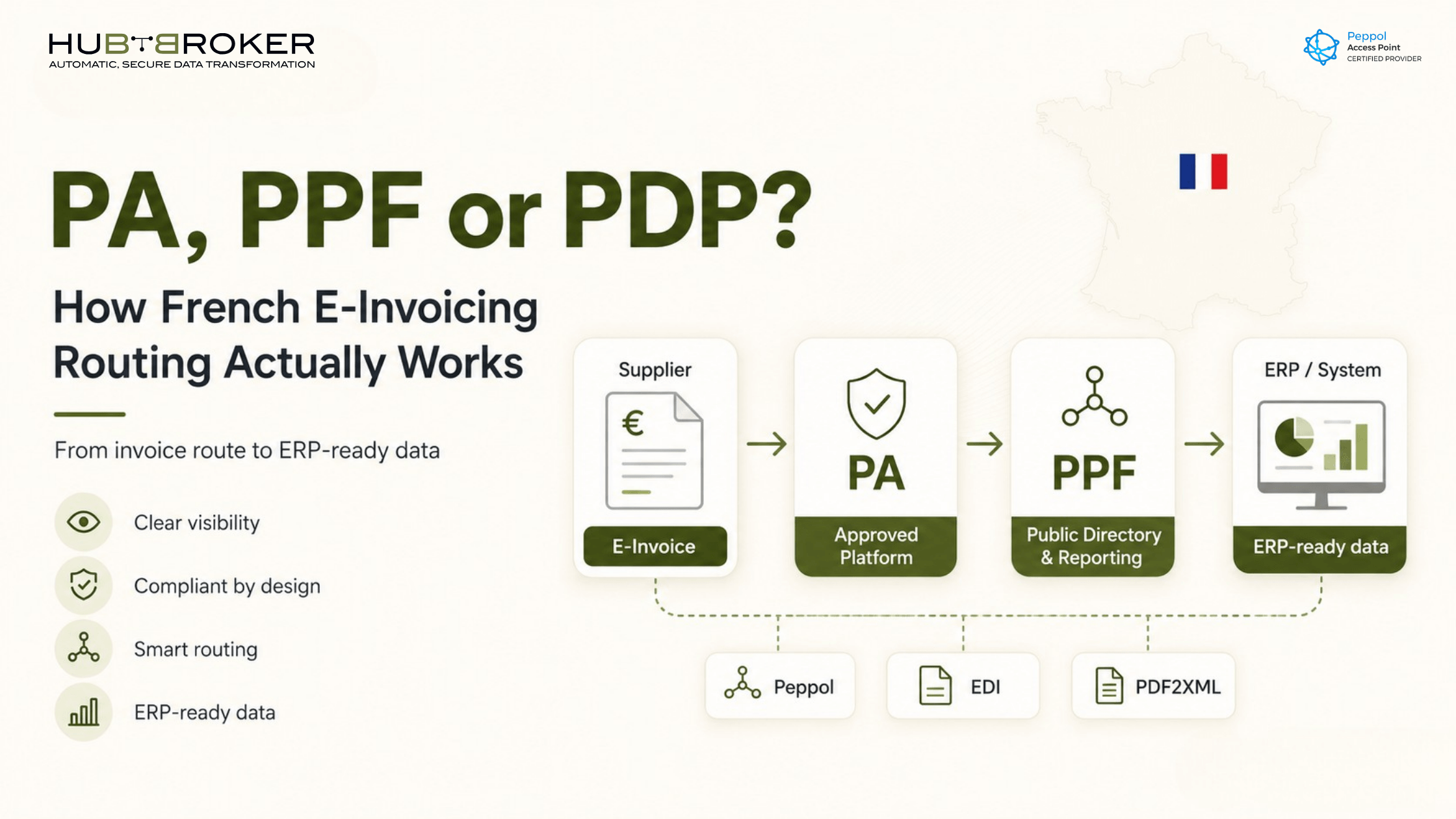
PA, PPF or PDP? How French E-Invoicing Routing Actually Works
From 1 September 2026, the first problem may not be a fine. It may be supplier invoices that no longer arrive in a usable form. For companies trading with French entities, PDP e-invoicing France decisions affect whether invoice data reaches the right platform, the right ERP and the right approval workflow.
The key question is not only “Which platform should we choose?” It is “Can our systems receive, route and process the invoice when it arrives?”
Why can French e-invoicing routing block invoice processing?
A French e-invoice can be compliant but operationally unusable if routing and integration are not ready. The invoice may reach a platform, but not the ERP, AP system or finance workflow where your team processes it.
That creates real disruption. Supplier invoices can sit outside approval flows. Payment runs can slow down. Finance teams may need to chase missing data, manually download files or re-key invoice lines into ERP.
For manufacturers, wholesalers and distributors, this affects purchase orders, VAT treatment, supplier payment terms and month-end close.
PDP e-invoicing France: what changed from PDP to PA?
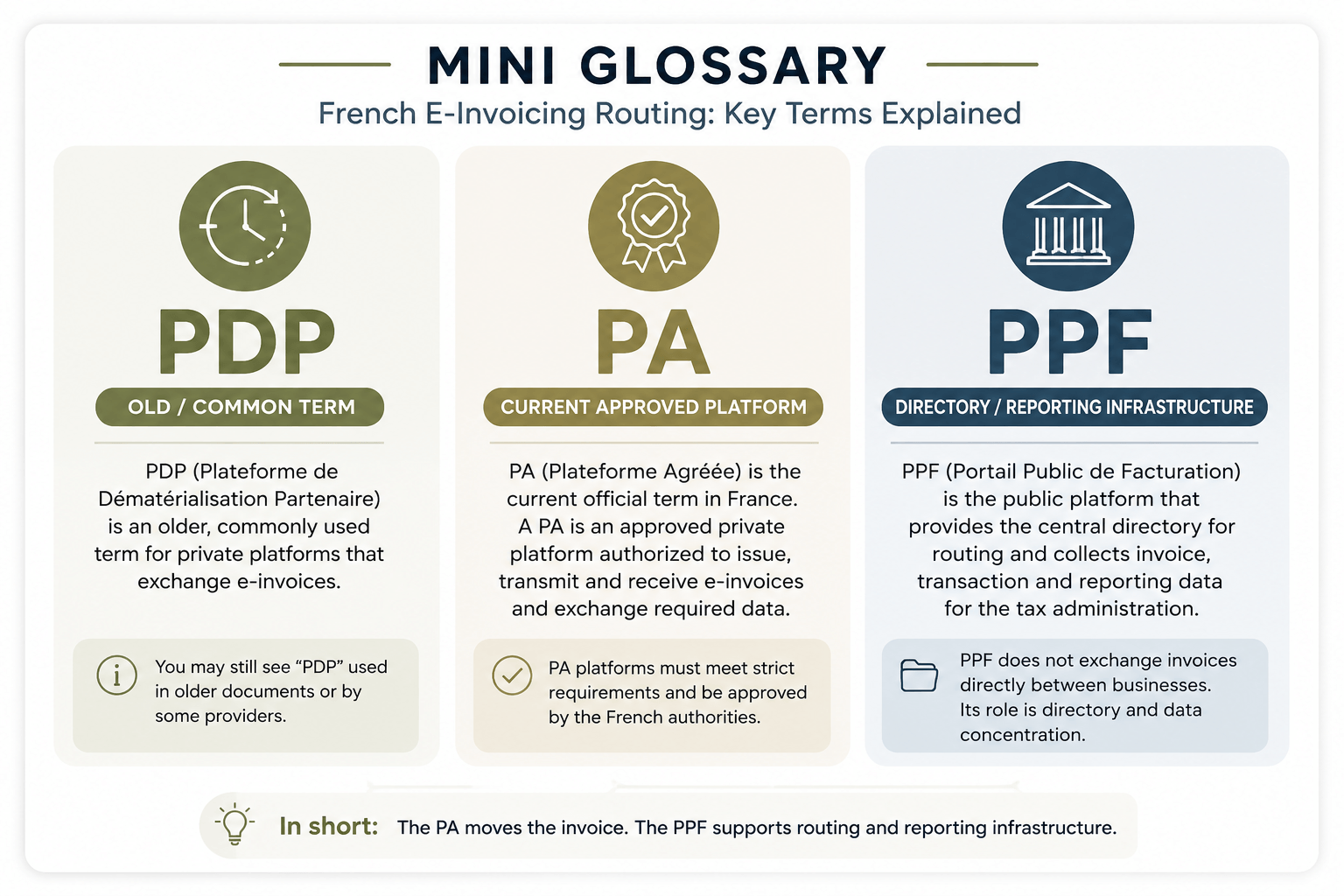
Many businesses still use the term PDP, but the current French wording is PA - plateforme agréée. A PA is an approved private platform that can issue, transmit and receive electronic invoices under the French framework.
A PA is not just a document mailbox. It must support structured invoice exchange, required data transmission and interoperability with the French public infrastructure and other approved platforms.
For buyers, this means supplier invoices may arrive through a route your finance team does not directly control. Your receiving setup must identify the route, accept the format and deliver the data into the right system.
What does the PPF actually do now?
The PPF, or Portail Public de Facturation, was first expected to play a broader role in invoice exchange. Its role has now been refocused.
The PPF mainly supports the central directory and the concentration of invoice, transaction and reporting data for the French tax authority. The directory helps identify which platform and electronic invoicing address should be used for a receiving entity.
In simple terms: the PA moves the invoice; the PPF supports routing and reporting infrastructure.
How does an invoice move between supplier, PA, PPF and buyer?
A supplier creates a structured invoice from its billing or ERP system. That invoice is sent through the supplier’s PA.
The supplier’s PA validates the invoice, checks routing data and sends it to the buyer’s PA. The buyer’s PA then delivers the invoice data to the buyer’s finance system, ERP or AP workflow.
The invoice must be structured. Ordinary PDFs and email attachments will not be enough. Common structured formats include UBL, CII and Factur-X, where a readable invoice is paired with structured data.
The operational risk is not only format compliance. It is whether the structured data lands where your team works: invoice queue, PO matching, approval flow, archive, reporting or payment workflow.
What does this mean for your ERP and finance systems?
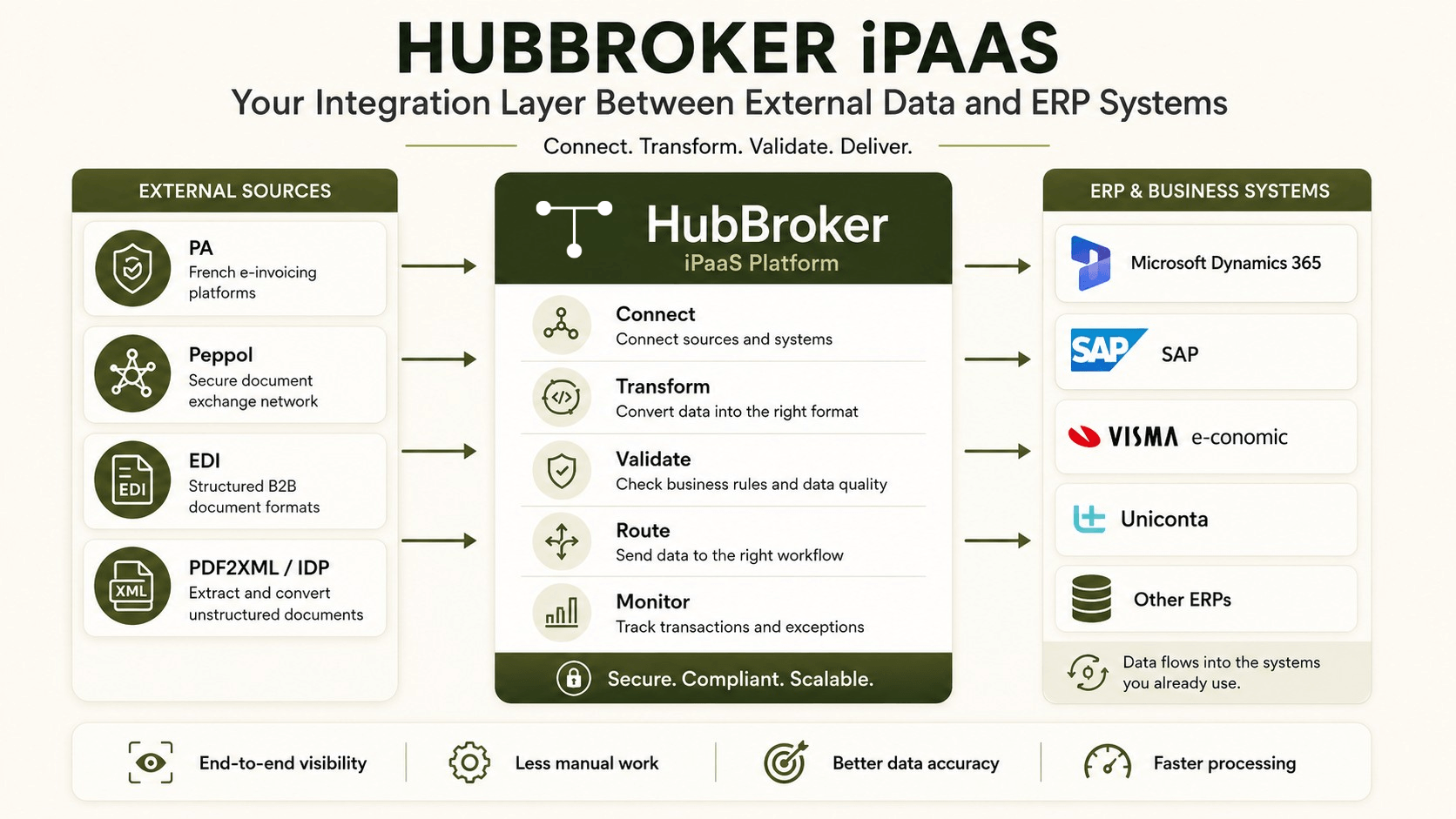
French e-invoicing readiness does not mean replacing your ERP. It means connecting approved routing channels with the systems already running your business.
HubBroker works as the integration layer between external document exchange networks, e-invoicing channels, EDI flows and internal ERP or finance systems. Companies using Microsoft Dynamics 365, SAP, Business Central, e-conomic, Uniconta or other ERPs may need invoice data transformed before it can be processed correctly.
Supplier data, VAT fields, line details, order references, tax codes and attachments may all need validation and mapping.
What should companies check before September 2026?
Start with receiving readiness. Every affected company needs to be able to receive French e-invoices from 1 September 2026, even if its own issuing obligation comes later.
Check these areas:
Which French suppliers, customers or entities are in scope
Which PA will receive invoices for your French entity
Whether your company appears correctly in the routing directory
Whether your ERP can receive UBL, CII or Factur-X data
Whether invoice statuses are mapped back to the right workflow
Whether rejected invoices create clear exceptions
Whether tax, supplier and payment fields are mapped correctly
The biggest mistake is treating platform selection as the whole project. Operational readiness depends on the route from supplier system to PA, from PA to receiving platform, and from platform to ERP.
Contact HubBroker to map your French e-invoicing routes and check how structured invoice data will move into your existing ERP before the 2026 receiving obligation starts.
