
Einvoicing Requirements In USA
E-invoicing in the USA: What Businesses Need to Know Before Customers Start Asking
Many U.S. businesses are asking one question: “Is e-invoicing mandatory in the USA?”
The more useful question is: “Are we ready when customers, federal buyers, or trading partners ask for structured digital invoices?”
Unlike some countries, the United States does not currently have one nationwide B2B e-invoicing mandate that applies to every business. But that does not mean e-invoicing can be ignored. Large customers, government-related buyers, retailers, manufacturers, and global trading partners are increasingly expecting invoices to move faster, cleaner, and with less manual work.
For CFOs, finance directors, and IT managers, e-invoicing in the USA is no longer just a compliance topic. It is an automation, cash flow, ERP, and customer-readiness topic.
Key Takeaways
The USA does not currently follow a single nationwide B2B e-invoicing mandate model.
Federal agencies and enterprise buyers may still require suppliers to submit invoices electronically.
A PDF invoice is digital, but it is not always a true structured e-invoice.
E-invoicing helps reduce manual entry, invoice delays, errors, and customer-specific processing issues.
Businesses should prepare their ERP, invoice formats, validation rules, and archive process before requirements become urgent.
Is E-invoicing Mandatory in the USA?
There is no single federal B2B e-invoicing mandate that requires every U.S. company to issue structured e-invoices for all business transactions.
However, that does not mean there are no e-invoicing requirements in the USA. Some federal procurement processes, public-sector workflows, and large enterprise customers may require vendors to submit invoices through approved electronic platforms, portals, EDI connections, or structured invoice formats.
This is where many businesses get caught off guard.
They assume that because there is no broad national mandate, their current PDF-and-email process is enough. Then a customer asks for EDI invoices, XML files, portal submission, or automated invoice exchange. Suddenly, finance and IT teams have to respond quickly.
The better approach is to prepare before the request arrives.
What Counts as an E-invoice in the USA?
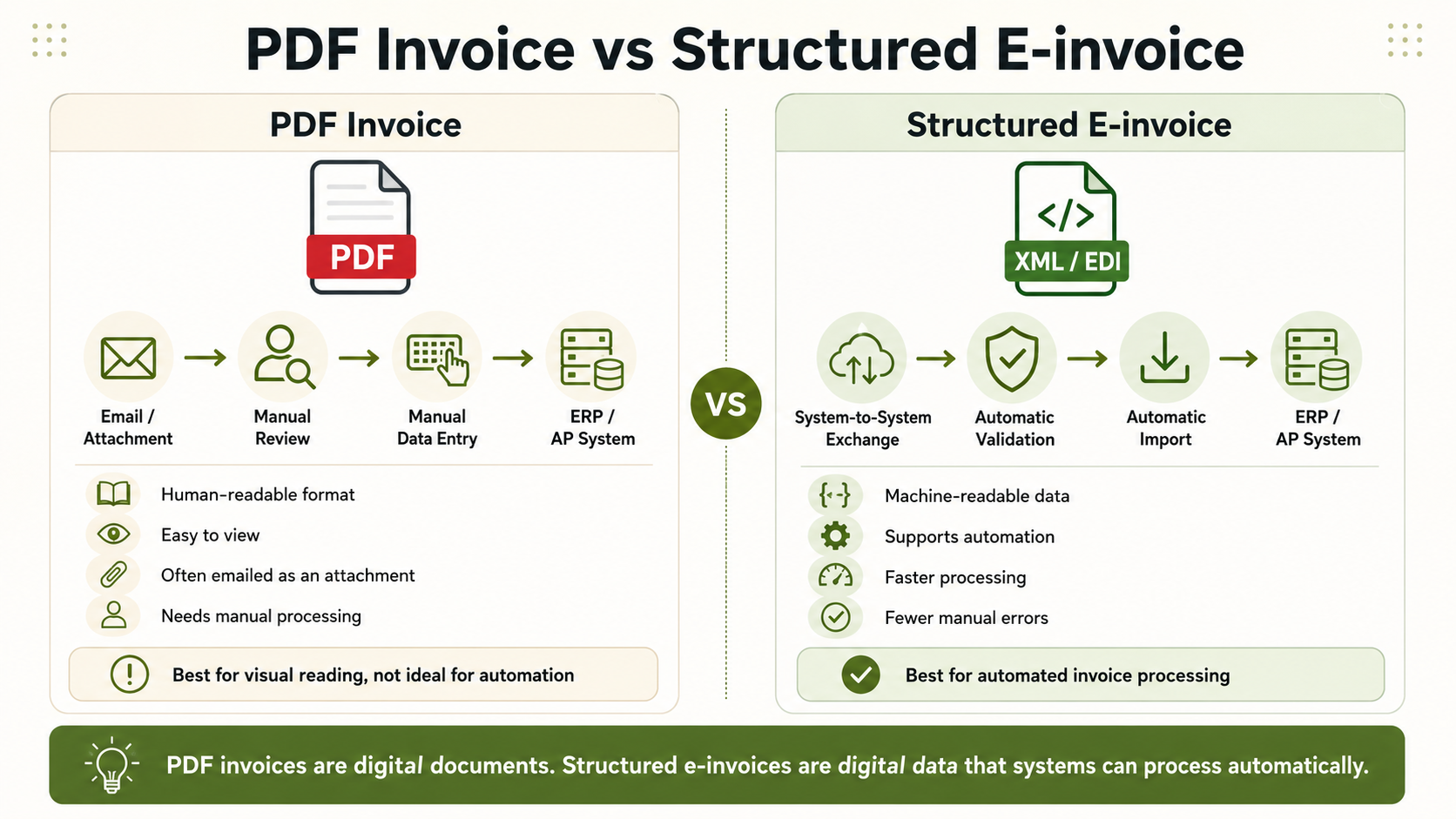
A PDF invoice sent by email is digital, but it is not always a true e-invoice.
A true e-invoice usually contains structured data that can be processed automatically by another system. That means the buyer’s system can read invoice fields such as supplier name, invoice number, tax amount, PO number, due date, line items, and totals without someone manually typing the information.
Common e-invoicing formats and methods include:
EDI invoices
XML invoices
Customer portal invoice submission
ERP-to-ERP invoice exchange
API-based invoice delivery
PDF invoice data converted into structured data
This distinction matters. A PDF may be easy for a human to read, but it can still create manual work for AP teams. Structured e-invoicing helps systems process invoice data faster and with fewer errors.
Get Ready for E-Invoicing in the USA
Understand evolving e-invoicing requirements and prepare your business with HubBroker’s compliant invoice automation and ERP integration solutions.
Contact Us to Know More
Why U.S. Businesses Are Moving Toward E-invoicing
Even without a broad national mandate, U.S. businesses are moving toward e-invoicing because manual invoice processing is slow and expensive.
Finance teams often deal with:
Manual invoice entry
Missing purchase order numbers
Duplicate invoices
Slow approvals
Customer portal uploads
Delayed payments
Invoice status confusion
Format differences between customers
For a small number of invoices, manual work may seem manageable. But as transaction volume grows, the process becomes harder to control.
E-invoicing gives finance teams a cleaner way to exchange invoice data. Instead of sending a PDF and waiting for someone else to process it, invoice data can move directly between business systems. This improves visibility, reduces manual corrections, and helps businesses respond faster to customer requirements.
What Finance and IT Teams Should Prepare
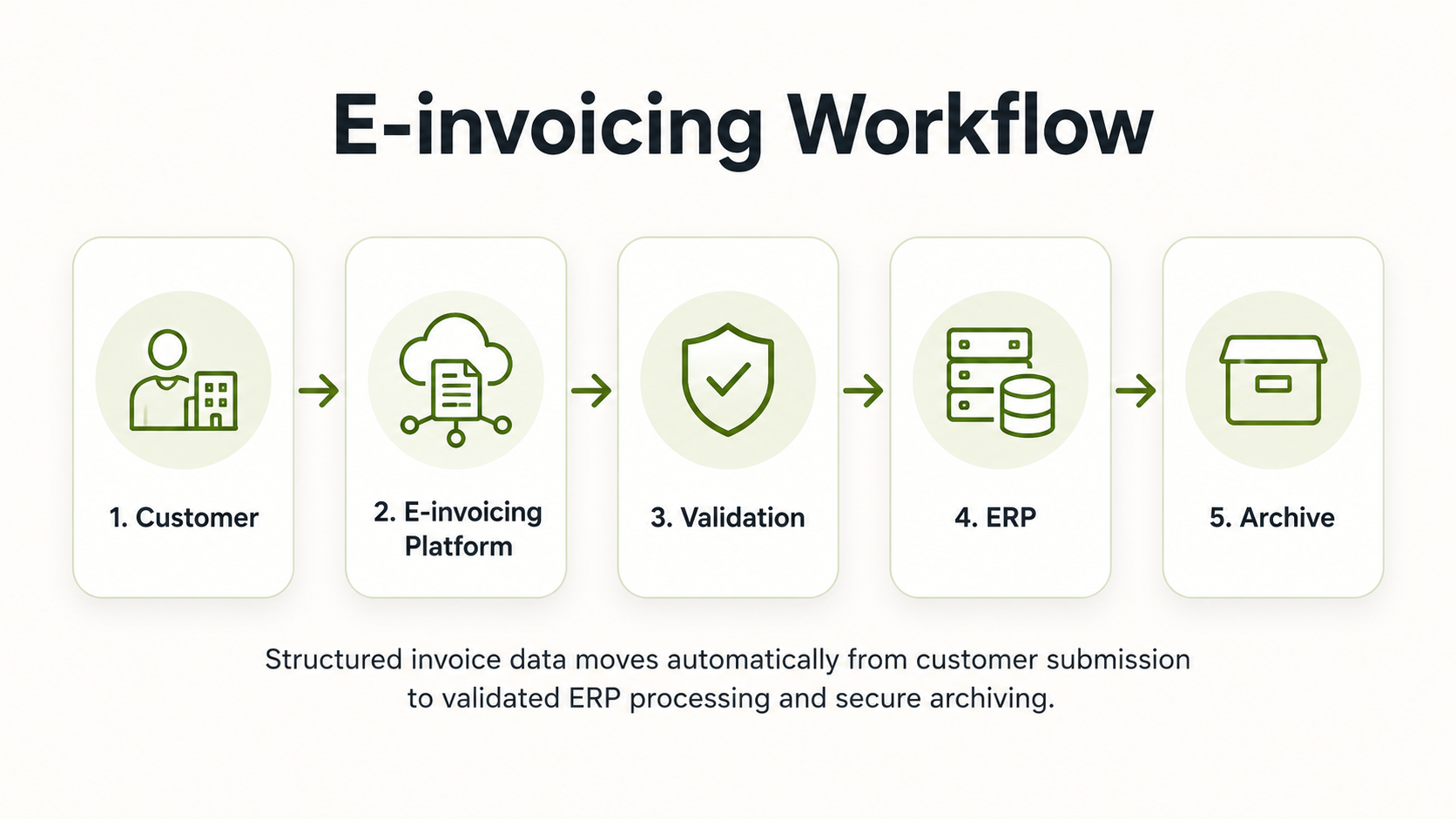
E-invoicing readiness is not only an IT project. It affects finance operations, customer service, compliance, and ERP workflows.
Here are the main areas to review.
1. ERP Readiness
Can your ERP create, receive, validate, and archive structured invoice data?
Many businesses use systems such as Microsoft Dynamics 365 Business Central, SAP, Oracle, or other accounting platforms. The question is not only whether the ERP can create an invoice. The question is whether it can exchange invoice data in the formats your customers and suppliers require.
2. Invoice Format Readiness
Different customers may ask for different formats. One may require EDI. Another may ask for XML. Another may use a supplier portal.
Your business should be able to manage multiple invoice formats without creating a separate manual process for every customer.
3. Customer and Supplier Connectivity
E-invoicing depends on reliable connections. These may include EDI connections, APIs, integration platforms, customer portals, or automated file exchange.
If your team is manually uploading invoices into portals, downloading supplier invoices, or copying data between systems, there is room for automation.
4. Recordkeeping and Audit Readiness
Invoices are business records. U.S. businesses need a process to store, retrieve, and reproduce records when required.
A strong e-invoicing setup should support clean archiving, clear transaction history, and easy access to invoice data. This is especially important for finance teams that need to support audits, tax reporting, and customer disputes.
5. Validation Before Sending
A good e-invoicing process should check invoice data before it reaches the customer.
For example:
Is the PO number correct?
Are mandatory fields complete?
Does the invoice total match the line items?
Is the customer format correct?
Is the tax or charge information included where required?
Validation helps reduce rejected invoices and payment delays.
Common Mistakes Businesses Make with E-invoicing
Many companies wait too long before reviewing their invoicing process. That creates pressure when a major customer suddenly asks for a specific format or connection.
Common mistakes include:
Thinking PDF invoices are enough for every customer
Waiting until a buyer sends technical requirements
Managing each customer format manually
Not connecting invoicing with ERP workflows
Ignoring invoice archiving and audit needs
Treating e-invoicing as only an IT task
Using too many disconnected tools for invoice exchange
The issue is not only whether your business can send an invoice. The issue is whether your business can send the right invoice, in the right format, through the right channel, without manual rework.
How HubBroker Helps with E-invoicing in the USA
HubBroker helps businesses automate invoice exchange and prepare for customer-specific e-invoicing requirements.
With HubBroker, companies can manage:
EDI invoice exchange
ERP integration
PDF to XML conversion
Intelligent Document Processing
API-based invoice workflows
Customer-specific invoice formats
Supplier and buyer connectivity
Automated document validation
Structured invoice delivery between systems
This is especially useful for U.S. businesses working with large customers, public-sector buyers, retailers, manufacturers, distributors, logistics companies, or international trading partners.
Instead of building a different manual process for every customer, HubBroker helps create a more connected invoice workflow.
E-invoicing Readiness Checklist for U.S. Businesses
Ask your finance and IT teams these questions:
Do we still send invoices manually by email?
Do customers ask us to upload invoices into portals?
Can our ERP export structured invoice data?
Can we support EDI, XML, PDF, and customer-specific formats?
Can we convert PDF invoices into structured data?
Can we validate invoice data before sending?
Can we track invoice status clearly?
Can we archive invoice records properly?
Do we have one scalable process for multiple customer requirements?
If several answers are “no,” it may be time to review your e-invoicing setup.
FAQ: E-invoicing Requirements in the USA
Is e-invoicing mandatory in the USA?
Not as one broad nationwide B2B mandate for every business. However, some federal, enterprise, and customer-specific invoicing processes may require electronic invoice submission.
Is a PDF invoice considered an e-invoice?
A PDF invoice is digital, but it is not always a structured e-invoice. True e-invoicing usually means invoice data can be processed automatically by business systems.
Do U.S. companies need EDI for e-invoicing?
Not always. But EDI is still widely used for structured B2B document exchange, especially in retail, manufacturing, logistics, wholesale, and distribution.
How can I prepare my ERP for e-invoicing?
Start by checking whether your ERP can create, receive, validate, convert, and archive structured invoice data. If not, an integration platform can help connect your ERP with customers, suppliers, and invoice networks.
Can HubBroker help with U.S. e-invoicing requirements?
Yes. HubBroker helps businesses automate invoice exchange, convert invoice formats, integrate ERP systems, and manage customer-specific e-invoicing workflows.
Not Sure If Your Invoice Process Is Ready for E-invoicing?
E-invoicing requirements in the USA may not look like one single national mandate, but customer expectations are already changing.
If your team still depends on manual invoice entry, PDF emails, customer portals, or disconnected systems, now is the right time to review your process.
HubBroker can help your business automate e-invoicing, connect with trading partners, and prepare your ERP for structured invoice exchange.
Contact HubBroker today to discuss your e-invoicing requirements and find the right solution for your business.