
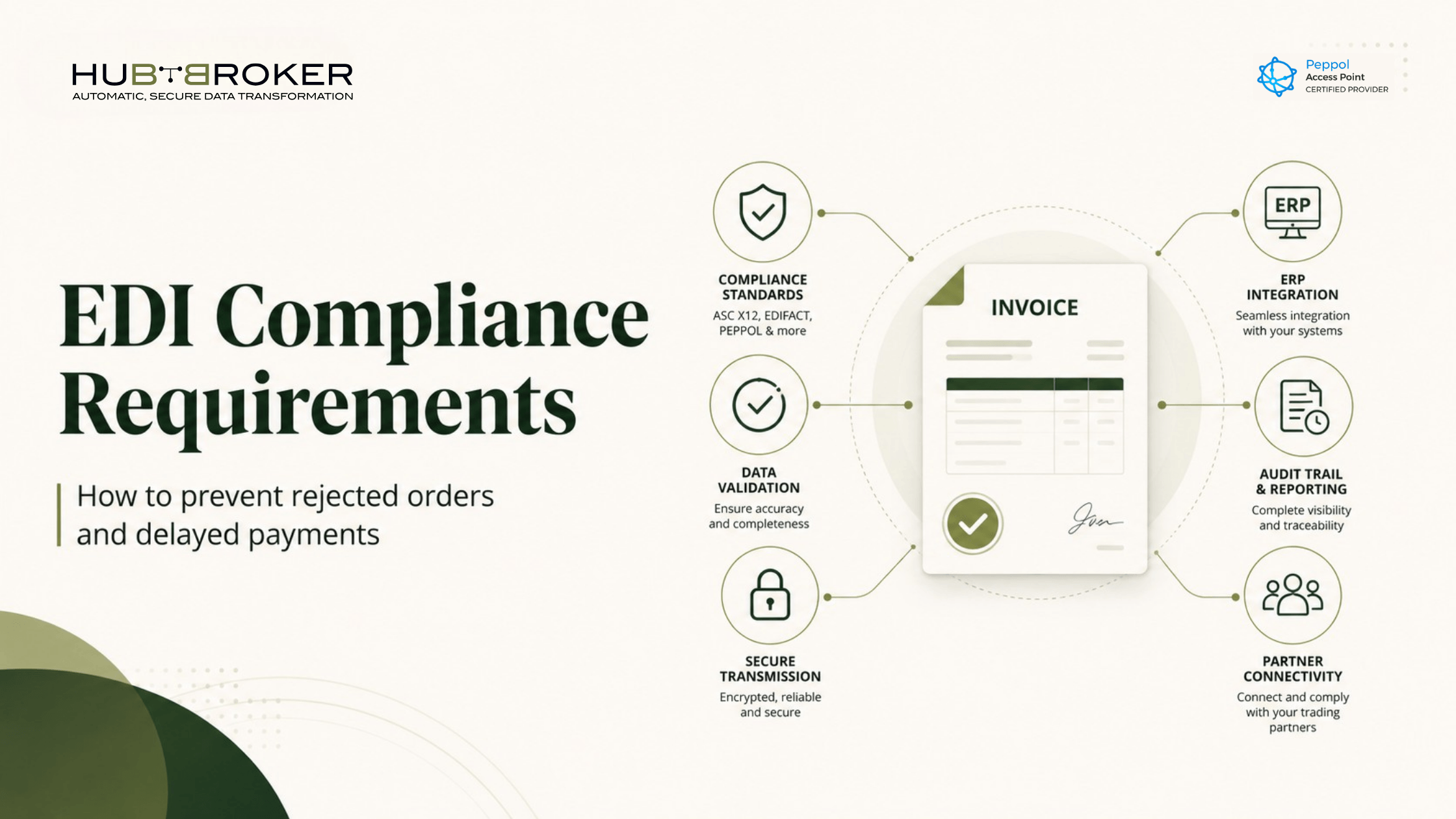
EDI Compliance Requirements That Prevent Rejected Orders and Delayed Payments
A customer sends a purchase order, but it never reaches your ERP. An invoice leaves your system, yet the buyer rejects it because one required field is missing. Operations think the document was delivered, finance is waiting for payment, and IT must search through logs to find what went wrong.
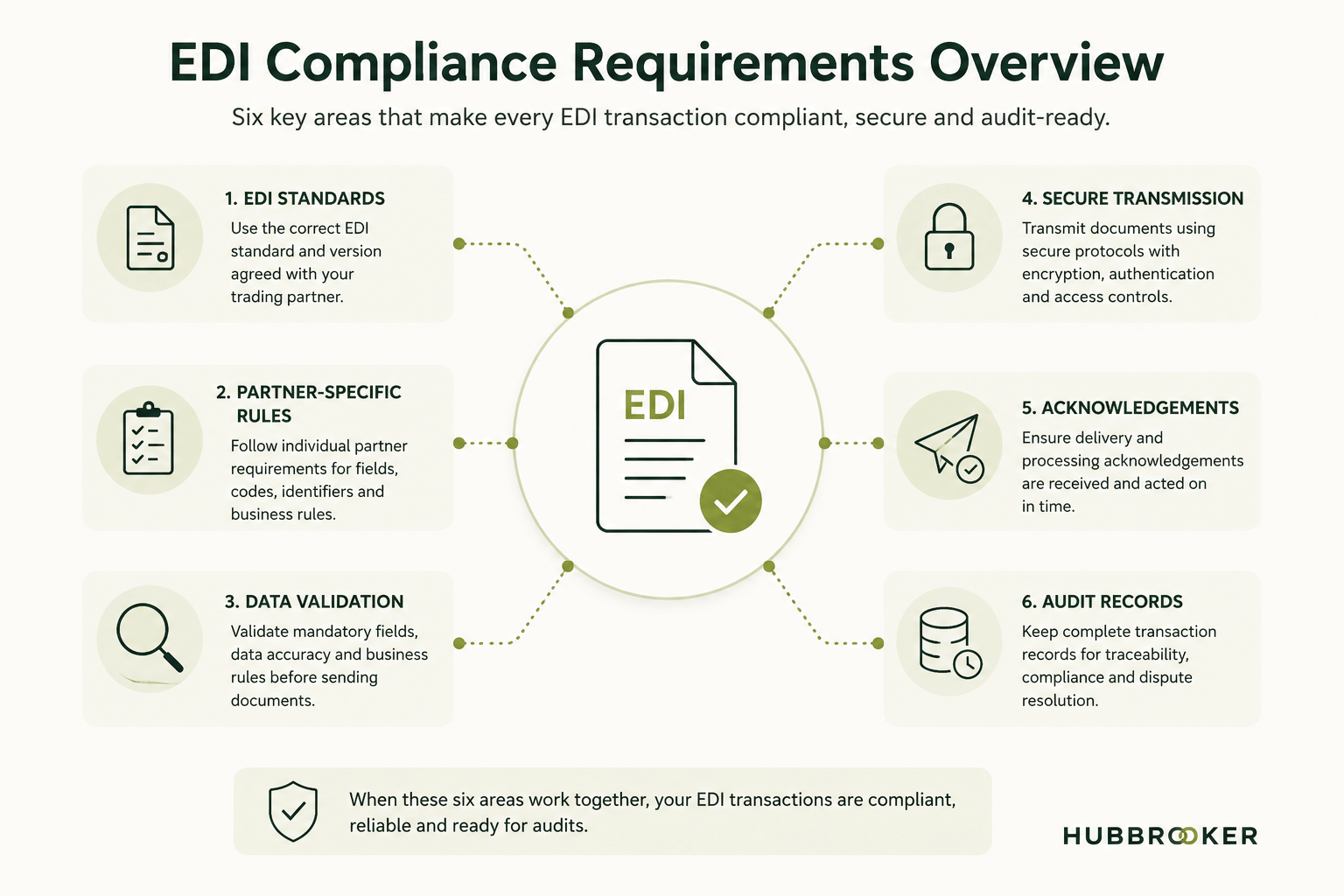
These are the operational risks behind EDI compliance requirements. Compliance is not only about selecting an EDI format. It also covers partner rules, secure delivery, data validation, acknowledgements and records that prove what happened with each transaction.
What do EDI compliance requirements actually cover?
EDI compliance means that every business document follows the technical, operational and contractual requirements agreed between trading partners.
The main requirements normally include:
The correct EDI standard and version
Mandatory document fields
Accurate customer, supplier and product identifiers
Secure transmission methods
Validation of business and data rules
Delivery and processing acknowledgements
Transaction history and audit records
Data protection and access controls
A document can follow a valid EDI standard and still get rejected. For example, the file structure may be correct, but the customer’s implementation guide may require a buyer reference, GLN, product code or delivery location that your mapping does not provide.
This is where many compliance issue starts. Businesses focus on whether the document is technically valid, but not whether it matches the exact rule used by the receiving partner.
Which EDI standards and partner rules must you follow?
There is no single EDI format that every company uses. The required standard often depends on the country, industry, customer and document flow.
Common standards and formats include:
EDIFACT
ANSI X12
XML
JSON
UBL
Peppol BIS
Partner-specific CSV or fixed-width files
A retailer may require an EDIFACT purchase order, while another customer asks for XML invoices. A public-sector buyer may use Peppol BIS, and a logistics partner may have its own status message format.
Even when two partners use the same standard, their rules may be different. One partner may make the buyer reference optional, while another partner rejects the invoice without it.
Your EDI setup therefore needs to manage both the standard and the individual trading partner profile. Following only the basic format specification is not always enough.
For a wider introduction to automated document exchange, read What Is EDI, and How Does It Simplify Business Communication?.
How should EDI transactions be secured and controlled?
EDI documents can contain customer information, prices, bank details, tax data and confidential order information. EDI data security must therefore cover how documents are transmitted, stored and accessed.
Secure EDI controls commonly include:
Encryption during transmission
User authentication
Role-based access
Secure protocols such as AS2, SFTP and HTTPS
Certificate and credential management
Restricted access to mappings and configuration
Logging of user and system activity
Certificate expiry is a common example of an issue that can stop document delivery. The mapping may be correct and the ERP may be working, but the connection fails because a certificate or password has expired.
Someone should have clear ownership of certificates, credentials and communication channels. Without this, a small technical issue can stop several customers or suppliers at once.
What records are needed for EDI audits and disputes?
A proper EDI audit trail should show the full journey of a document, not only the final file.
Useful records include:
The original inbound or outbound document
The converted document version
Date and time of transmission
Sender and receiver identifiers
Validation results
Delivery acknowledgement
Processing acknowledgement
Rejection or error messages
Mapping and configuration changes
These records becomes important when a customer says an invoice was never received or when a supplier disputes the date of an order.
Your team should be able to answer basic questions quickly: Was the document created? Was it transmitted? Did the receiving system accept it? Was it later rejected because of a business rule?
Retention periods can depend on the document type, country, contract and regulatory requirement. This should be defined as part of the EDI project rather than assumed after the system goes live.
What do EDI compliance requirements mean for your ERP and existing systems?
Your ERP may create purchase orders, invoices, delivery notes and credit notes, but it may not support every partner format, transmission protocol or validation requirement.
This does not mean that you need to replace the ERP.
HubBroker works as an integration layer between the systems you already use and your external trading partners. It can convert ERP data into the required format, validate documents, route them through the correct channel and send errors or acknowledgements back into the relevant workflow.
A typical flow may look like this:
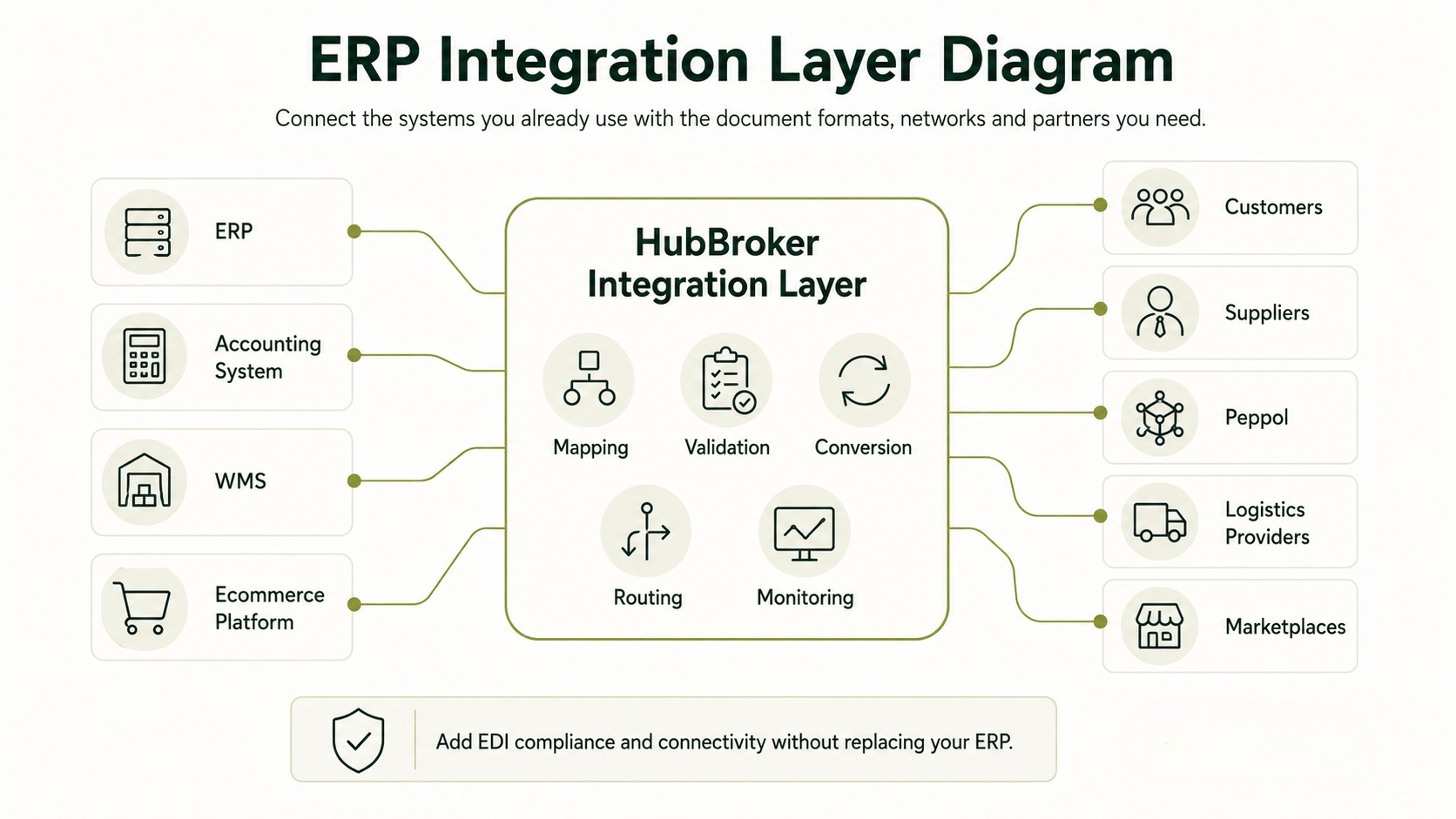
This approach allow companies to keep their current ERP while adding the compliance and connectivity functions required for different customers, suppliers and networks.
Learn more about ERP EDI Integration Services and how HubBroker connects document flows with existing ERP processes.
For businesses combining APIs with structured document exchange, the EDI API Integration Services page explains how ERP systems, applications and external platforms can be connected through one integration layer.
You can also read How EDI Integration Helps ERP Systems Work Faster, Cleaner, and Smarter for a practical overview of ERP and EDI working together.
How can you identify your current EDI compliance gaps?
Start by documenting every active trading partner and document flow. Do not review invoices only. Include purchase orders, confirmations, shipping notices, inventory updates, credit notes and remittance documents where relevant.
For each flow, record:
The required EDI format and version
The communication protocol
Mandatory fields and partner rules
Sender and receiver identifiers
Required acknowledgements
Certificate or credential owners
Error-handling responsibilities
Transaction retention requirements
Then compare these requirements with your existing mappings and system setup.
Test both successful and unsuccessful scenarios. A compliant EDI process should not only process correct documents. It should also clearly identify invalid documents, explain why they failed and route the issue to the correct person.
The EDI Integration Platform provides more information about document mapping, format conversion, validation, monitoring and audit readiness.
Build compliance into the document flow
EDI compliance is not a one-time format conversion. It is an ongoing process covering partner requirements, secure connectivity, validation, acknowledgements, system integration and transaction evidence.
When these areas are controlled properly, companies reduce the risk of blocked orders, rejected invoices, manual corrections and delayed payments.
Contact HubBroker to review your existing EDI flows and identify where partner rules, validation gaps or ERP connections may cause document failures.
