How to Implement EN 16931 E-Invoicing
Many businesses believe they are already doing e-invoicing because they send invoices as PDFs by email.
That is where the confusion starts.
A PDF invoice may be digital, but it is not a structured electronic invoice. In Europe, true e-invoicing means invoice data must be exchanged in a machine-readable format that systems can process automatically without manual intervention.
The European Commission makes this distinction clear. PDFs, Word documents, scanned invoice images, and OCR-based files are not considered compliant structured eInvoices under the European e-invoicing framework.
This is where EN 16931 becomes important.
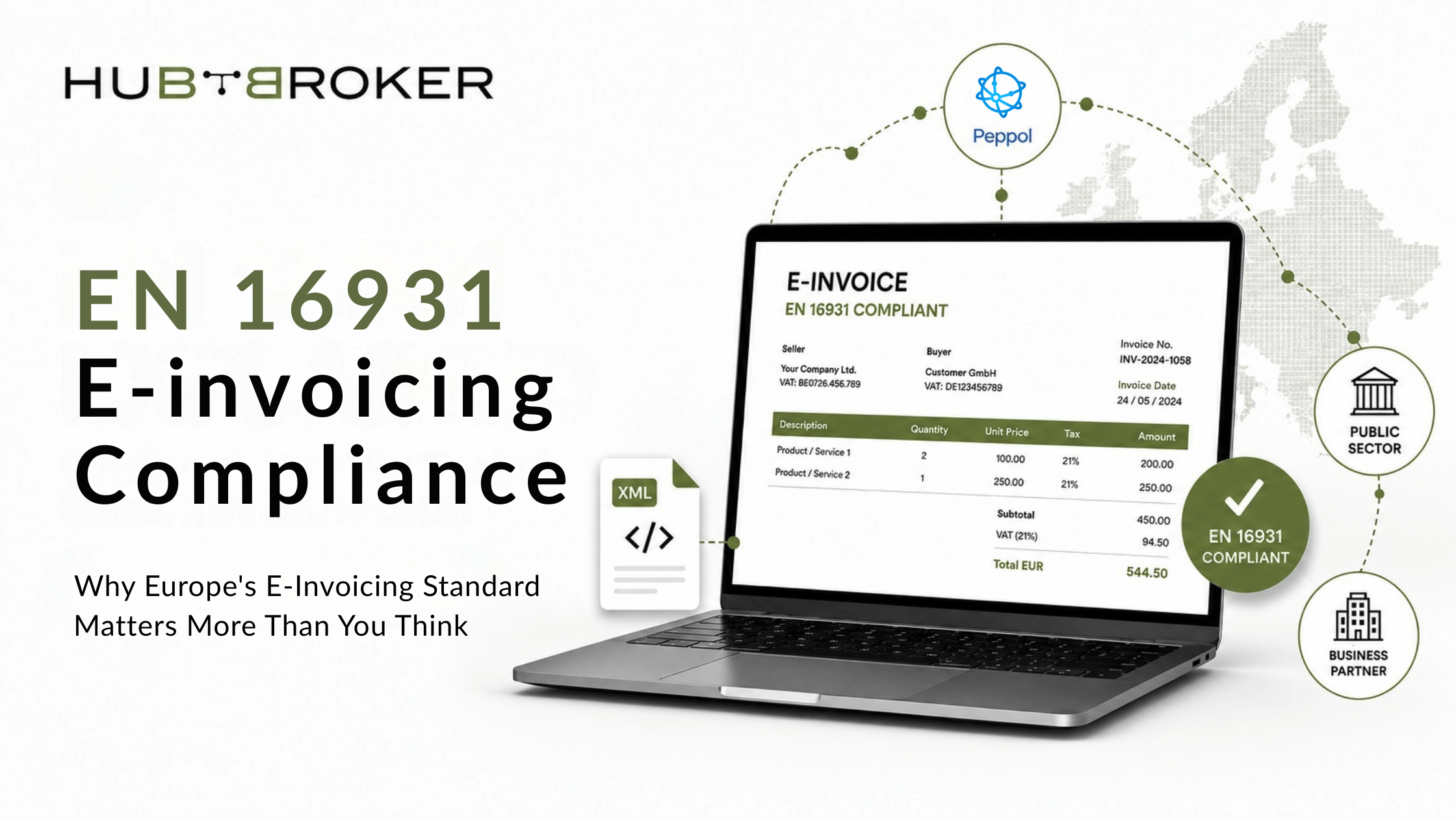
EN 16931 is the European standard that creates a common structure for electronic invoice data across EU countries, ERP systems, and e-invoicing platforms. Instead of finance teams manually re-entering invoice information, the standard allows invoice data to move automatically between systems in a consistent and interoperable format.
For CFOs, finance leaders, and IT teams, EN 16931 is no longer just a technical specification. It is becoming the operational foundation for compliant, scalable, and automated invoice exchange across Europe.
What Information Does EN 16931 Standardize?
EN 16931 defines how key invoice information should be structured so systems can interpret the data consistently.
This includes:
Supplier and buyer details
VAT numbers
Invoice dates
Payment terms
Invoice line items
Tax categories
Totals and currency codes
Credit note references
The goal is simple: reduce manual processing, improve interoperability, and support automated invoice exchange across European business networks.
Why EN 16931 Matters for European Businesses
EN 16931 matters because European e-invoicing is moving from “nice to have” to “must be ready.”
Many countries are introducing or expanding e-invoicing rules for public sector and private sector transactions. For companies operating across Europe, this creates a serious challenge: each country may have its own mandate, platform, or local format, but EN 16931 acts as a common foundation.
For business teams, the impact is practical:
Fewer invoice rejections
Less manual data entry
Better VAT and audit readiness
Faster invoice processing
Easier cross-border invoicing
More scalable ERP and finance automation
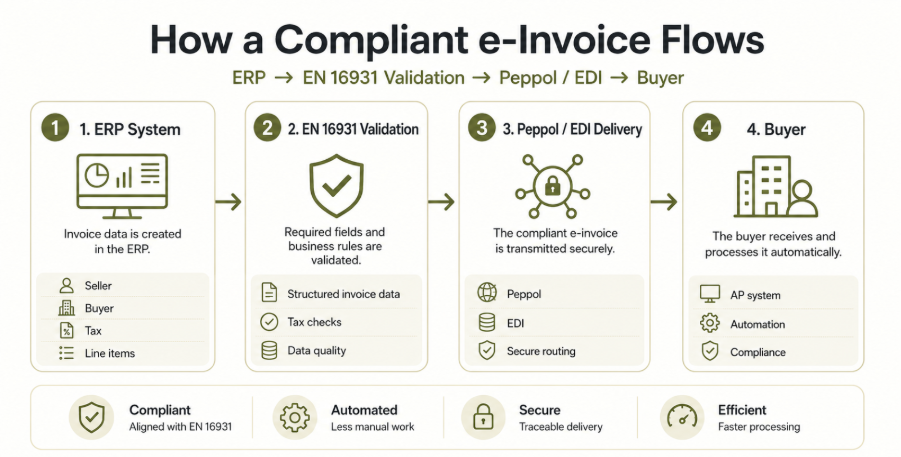
For IT teams, EN 16931 also creates a clearer structure for integration. It helps define what invoice data must be generated, validated, transmitted, and received.
EN 16931 vs PDF Invoices: What’s the Difference?
A PDF invoice is designed for people to read. An EN 16931-compliant eInvoice is designed for systems to process.
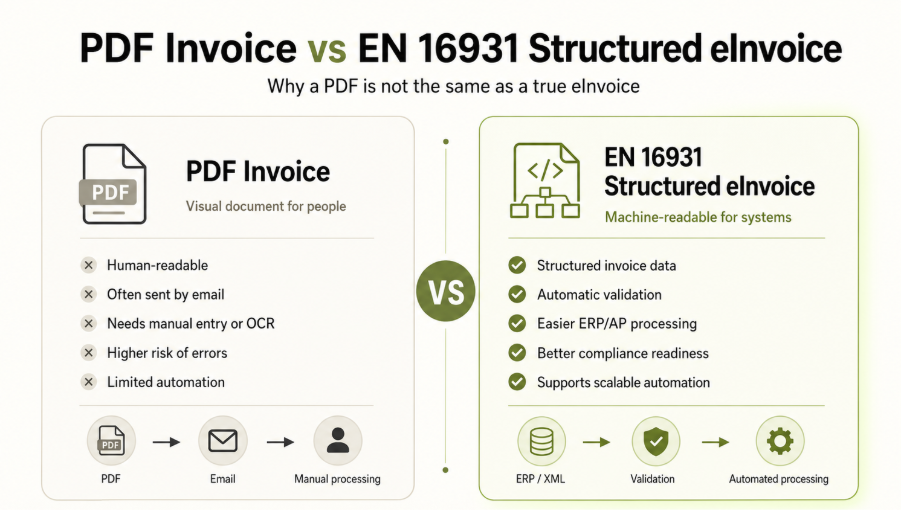
This does not mean PDFs are useless. Businesses may still need a visual version for review or archiving. But for automation and compliance, the structured invoice data is what matters.
The European Commission explains that eInvoices contain data in a structured form and can be automatically imported into AP systems. Visual formats are secondary.
How EN 16931 Connects with Peppol, UBL, and CII
This is where many businesses get confused.
EN 16931 is the standard. It defines the required invoice data model.
UBL and CII are technical formats that can represent invoice data.
Peppol is a network and delivery framework commonly used to exchange structured e-invoices between businesses, public authorities, and service providers.
A simple way to understand it:
EN 16931 defines what invoice data should contain.
UBL or CII defines how that data is technically formatted.
Peppol BIS Billing 3.0 defines how compliant invoice documents are exchanged through the Peppol network.
Peppol’s official BIS Billing 3.0 documentation includes UBL invoice and credit note syntax, EN16931 model binding, and Peppol billing rules.
So, if your company wants to send compliant e-invoices through Peppol, you need more than just an invoice file. You need the correct structure, format, validation, and transmission setup.
Implement EN 16931 E-Invoicing with Confidence
Adopt the European e-invoicing standard to ensure compliance, structured data exchange, and smoother invoice processing.
Contact Us to Know More
What Should Businesses Check Before Claiming EN 16931 Compliance?
Before saying your invoice workflow is EN 16931-ready, check these five areas.
1. Can your ERP create structured invoice data?
Your ERP may generate invoices, but can it create structured XML invoice data that follows EN 16931 requirements?
This matters for systems such as Microsoft Dynamics 365, Business Central, SAP, Oracle, and other ERP platforms.
2. Are mandatory invoice fields mapped correctly?
Incorrect field mapping can lead to validation errors or invoice rejection.
Common areas to review include VAT IDs, buyer references, payment terms, tax category codes, line-level details, and invoice totals.
3. Can invoices be validated before sending?
Validation should happen before an invoice reaches the customer, public authority, or Peppol network.
The European Commission provides validation artefacts that allow invoices to be automatically checked against standard rules.
4. Can you send invoices through the required network?
Some customers may require Peppol. Some countries may require a national platform or certified provider. Some trading partners may still use EDI.
Your compliance setup should handle the right delivery route, not just the right invoice format.
5. Can you receive supplier invoices in different formats?
Outgoing compliance is only half of the work. Finance teams also receive supplier invoices as PDFs, XML files, Peppol invoices, and EDI documents.
A strong setup should support both sending and receiving.
Common EN 16931 Mistakes Businesses Make
Many companies run into problems because they treat EN 16931 as a small technical update.
Common mistakes include:
Assuming PDF invoices are compliant eInvoices
Leaving compliance only to IT without finance involvement
Ignoring country-specific rules
Not testing credit notes and negative invoices
Forgetting invoice validation before transmission
Building a one-country setup that cannot scale across Europe
Not connecting e-invoicing with ERP, EDI, Peppol, and AP automation
The better approach is to treat EN 16931 as part of a wider finance automation and compliance strategy.
How HubBroker Helps with EN 16931 E-Invoicing
HubBroker helps businesses manage structured invoice exchange across ERP systems, Peppol, EDI, and document automation workflows.
With HubBroker, companies can connect their existing finance systems to compliant e-invoicing processes without forcing teams to handle everything manually.
HubBroker can support:
ERP integration for invoice data exchange
Peppol Access Point connectivity for sending and receiving e-invoices
EDI software solutions for trading partner communication
PDF to XML conversion for supplier invoice workflows
Intelligent Document Processing for invoice capture and automation
Validation and routing of structured invoice data
Cross-border e-invoicing workflows for European compliance
FAQ About EN 16931
What is EN 16931 in simple terms?
EN 16931 is the European standard that defines the structure of an electronic invoice. It helps invoice data move between systems in a consistent, machine-readable way.
Is a PDF invoice EN 16931-compliant?
Usually, no. A PDF is mainly a visual document. EN 16931 is about structured invoice data that systems can process automatically.
Is EN 16931 only for public sector invoicing?
EN 16931 is strongly linked to public procurement and B2G e-invoicing, but it is also increasingly relevant for B2B e-invoicing across Europe. The European Commission notes that the European standard can support both B2G and B2B communication.
Does EN 16931 mean I must use Peppol?
Not always. EN 16931 defines the invoice structure. Peppol is one common network used to exchange compliant e-invoices.
Can my ERP generate EN 16931 invoices?
Some ERP systems can generate structured invoice data, but businesses still need correct mapping, validation, transmission, and country-specific compliance checks.
Final Thoughts: EN 16931 Is the Base Layer of European E-Invoicing
EN 16931 is not just another technical standard. It is becoming the common language of e-invoicing in Europe.
For CFOs and finance directors, it supports compliance, automation, and better control over invoice processes. For IT teams, it provides a clearer structure for ERP integration, validation, and network connectivity.
But compliance does not happen by simply exporting an invoice file.
You need the right data structure, correct field mapping, validation, delivery network, and a process for handling supplier invoices across multiple formats.
Not sure if your current invoice workflow is EN 16931-ready?
Contact HubBroker today. Our team can help you review your ERP setup, Peppol readiness, invoice formats, and automation opportunities so your business can move toward compliant European e-invoicing with confidence.
