
E-Invoicing for Accounts Receivable: Faster Delivery, Fewer Disputes, Smoother Cash Flow
Just because you created an invoice on time doesn't mean you will be able to collect it on time. The invoice can reach the wrong person, have an incorrect PO number, or be rejected even before it reaches accounts payable for processing.
And this is exactly where e-invoicing accounts receivable workflows change the game. By treating invoice creation and collection as part of one integrated process, structured e-invoicing allows invoice validation, delivery, status handling, and ERP integrations.
What Causes Issues in Invoice Delivery for Accounts Receivable?
The problem for many accounts receivable departments occurs after the invoice leaves the ERP system.
A finance department may create an invoice within the company, but then send it manually to the customer via email, manual upload to customer portal, PDF, spreadsheets, or some customer-specific process.
Potential problems include:
Invoice delivered to the wrong contact
Missing purchase order reference
Incorrect customer and tax information
Incomplete required invoice fields
Missing customer-specific formatting requirements
Duplicate submittals
Invoice rejections discovered in payment follow-up
The outcome of this process is an issue of invoice delivery the gap between invoice issued and invoice accepted for processing.
While the AR team is busy tracking down the problems, they could spend their time on invoices that require commercial follow-up.
How Can E-Invoicing Accelerate Invoice Delivery?
E-invoicing accounts receivable processes allow a company to switch the process from the document exchange to structured data exchange.
Instead of sending PDF invoices via email, invoice information could be sent electronically in machine-readable format between business systems. This allows for invoice data validation and invoice routing according to the customer's preferences.
This means that e-invoicing can help an AR team find problems early in the process.
Based on the customer network and workflow, AR teams may get better visibility on whether an invoice was delivered, rejected, or needs to be corrected.
For a business that exchanges invoices using Peppol standard, a Peppol Access Point is the key to exchanging structured documents across Peppol network.
While it is good that the invoice reaches the customer faster, it becomes more important to understand that it was not successfully delivered.
Can E-Invoicing Help to Reduce Invoice Disputes and Late Payments?
Not all invoice disputes can be avoided.
Customers can still disagree on the quantity, delivery conditions, contractual terms, pricing, or any other commercial issues. However, e-invoicing helps to reduce preventable administrative invoice disputes caused by incomplete or incorrectly formatted invoices.
Validation rules can find problems such as:
Missing PO number
Incomplete buyer information
Required invoice fields
Invalid invoice structure
Duplicate documents
Incorrect data against customer requirements
Detecting these issues during invoice submittal process is far more valuable to an AR team than doing this after the invoice became overdue.
This is why businesses looking for e-invoicing solution should consider not only an electronic invoice generation capability but also validation, routing, exception handling, and ERP integrations.
What Changes for the AR Team?
Traditional AR Flow vs Connected E-Invoicing Flow:
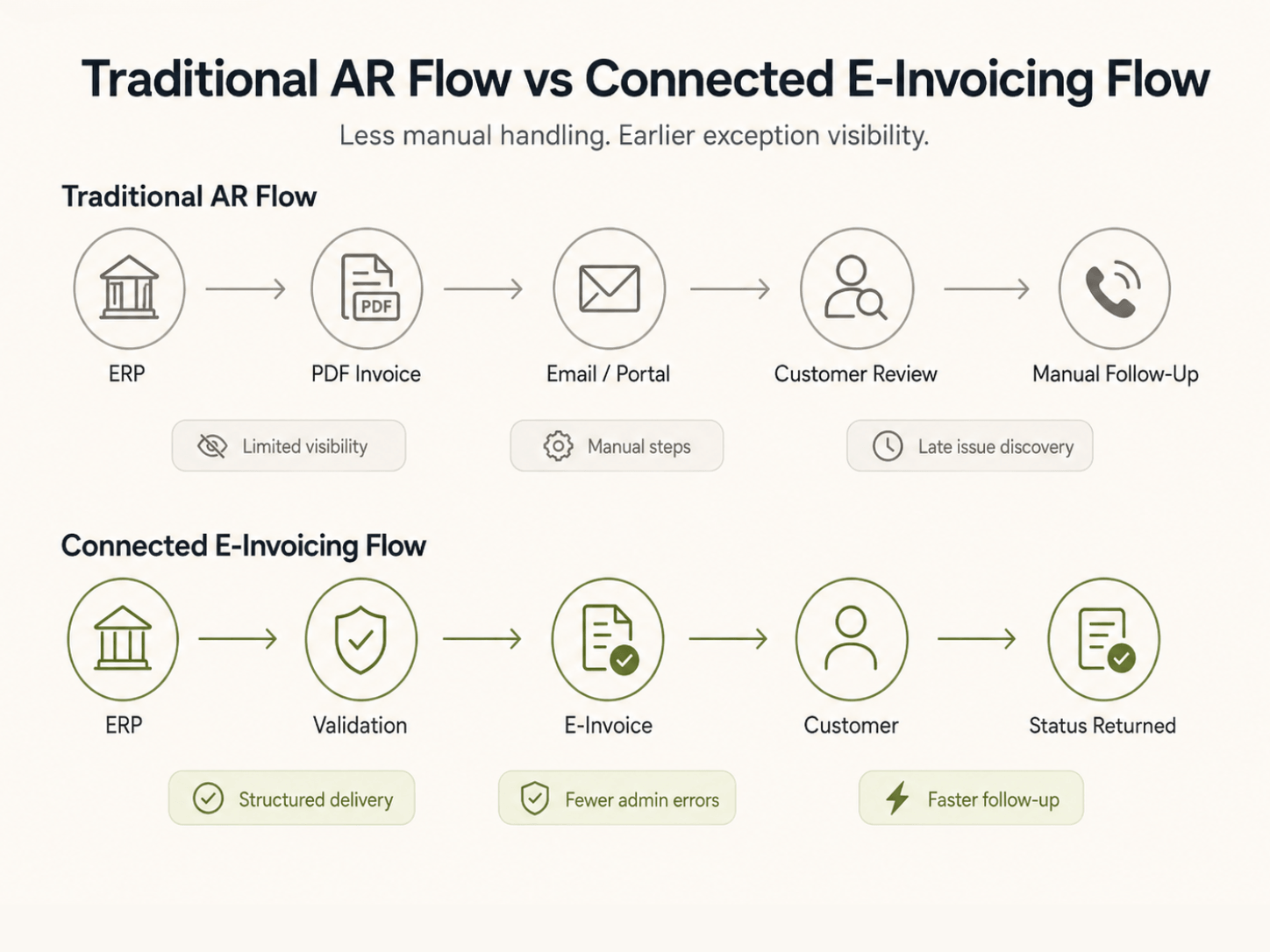
Thus, AR employees can spend more time on exceptions that require attention, which helps with accounts receivable automation without losing finance team control over the customer communications and collections.
In addition, this process creates a difference between two situations: an invoice that has been delivered to a customer but remains overdue, and an invoice that hasn't been delivered due to some submittal error. The difference is crucial in prioritizing collections efforts.
What Are the Requirements for the ERP and Other Systems?
Introduction of the e-invoicing process shouldn't lead to replacement of the ERP system used by the finance department.
The ERP is a place, where customer, order, tax, and invoice data originate. The challenge is to connect the information with external formats, networks, APIs, EDI connections, and customer endpoints.
Typical architecture is:
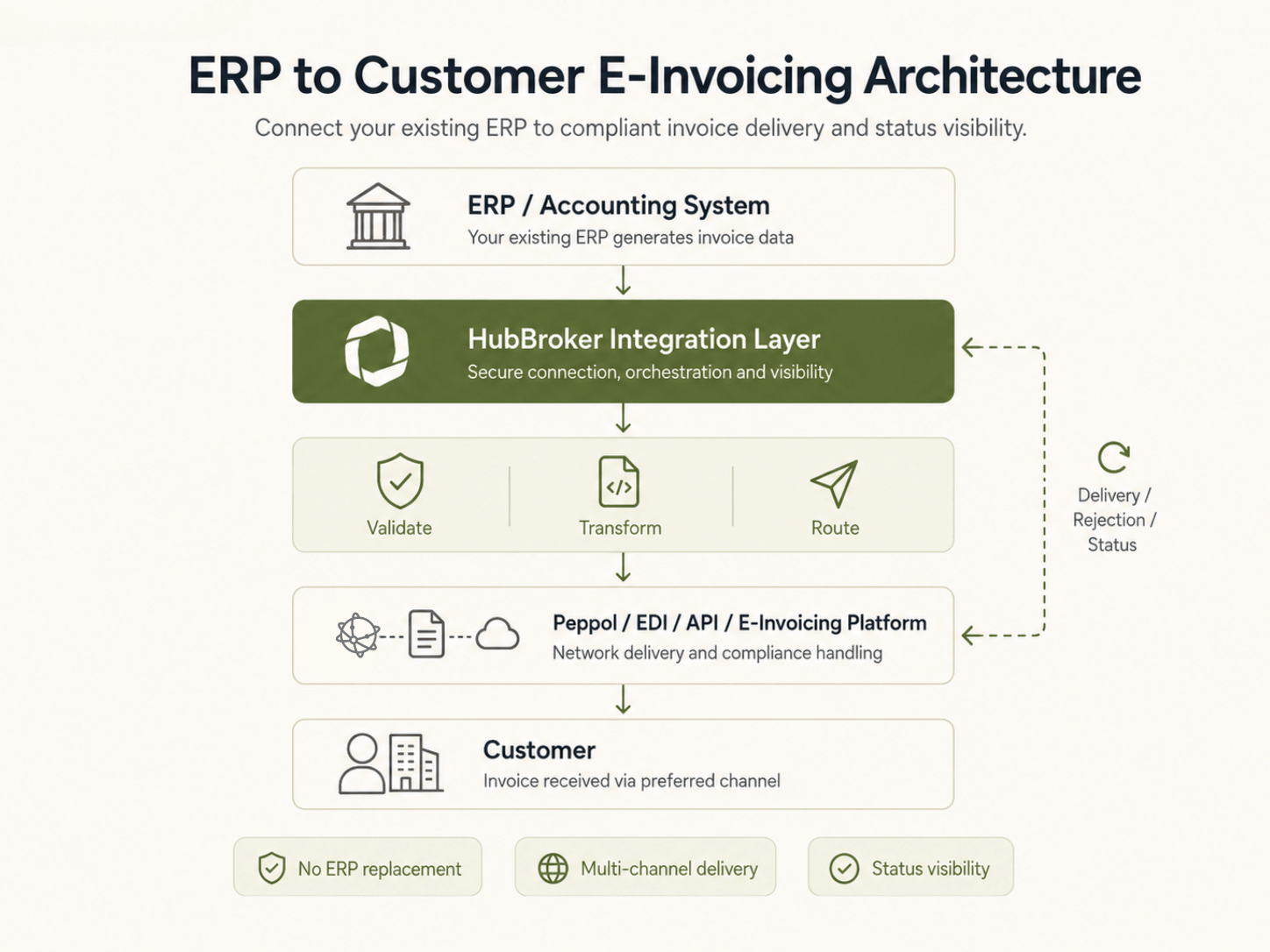
HubBroker's ERP EDI integration services are built to connect ERP environments with external business systems without introducing a new independent finance workflow. HubBroker's current platform combines ERP integrations with EDI, Peppol e-invoicing, APIs, and document automation.
This is especially important, when customers don't accept invoices in the same way. One of the buyers can use EDI, another - Peppol, and the third one - some other structured process.
The integration layer allows managing these requirements while keeping finance teams working with their familiar systems.
To learn more about ERP integrations, read the article EDI Integration With ERP.
What Should Finance Departments Review Before Automation of AR Invoicing?
Before implementing more invoice processing automation, map the entire invoice process, not only invoice creation.
Here are some questions to ask:
Which customers require structured invoices?
Which formats and delivery methods does each customer require?
Where is the invoice data coming from?
Which fields are causing the most problems and rejections?
How do you know, if an invoice was successfully delivered?
Can exceptions be routed back to the finance workflow?
How many manual steps are there between ERP invoice creation and customer delivery?
This exercise usually shows that the biggest AR issue is not invoice creation but lack of visibility between invoice delivery and its acceptance.
For businesses that plan larger e-invoicing projects, HubBroker's E-Invoicing Compliance Checklist for CFOs could be helpful in understanding ERP, validation, network, and finance process preparedness.
Accounts Receivable Becomes Faster Before Collections
The reason why e-invoicing changes the AR process lies in improved invoice delivery process.
Structure, validation, better exception handling, and ERP integration can help finance teams to reduce preventable invoice problems and distinguish the invoices that require collection attention.
The best approach here is not another invoice portal. It is the connection of e-invoicing with ERP and existing AR processes.
Discuss with HubBroker how to map the current invoice flow from ERP to customers and where e-invoicing can cut manual steps in AR process.
