
Brazil E-invoicing with Peppol NFE
Brazil has one of the most advanced and complex electronic invoicing systems in the world. For businesses operating in or trading with Brazil, compliance isn’t optional. You must follow strict government regulations to ensure invoices are legally valid.
But many global companies ask the same question:
Should we use Peppol or NF-e for Brazil?
The answer lies in understanding how both systems work and how they fit into your global invoicing strategy.
Understanding Electronic Invoicing Requirements and Regulations in Brazil
Brazil operates under a clearance-based e-invoicing model, meaning invoices must be approved by tax authorities before being issued. This ensures real-time tax reporting and reduces fraud.
Unlike other regions where invoices are simply exchanged between buyer and supplier, Brazil requires direct interaction with government systems, making compliance more complex but also more transparent.
What Is NF-e and How It Works in Brazil
NF-e (Nota Fiscal Eletrônica) is Brazil’s official electronic invoice format. It is mandatory for reporting goods and services transactions to tax authorities.
Businesses must generate invoices in XML format and submit them to SEFAZ (Brazil’s tax authority). Only after approval does the invoice become legally valid.
Key Features and Benefits of Brazil’s NF-e System
The NF-e system ensures tax compliance and operational efficiency through:
Real-time validation by tax authorities
Mandatory digital signatures for authenticity
Standardized XML formats for consistency
Reduced paperwork and manual processing
This system helps both businesses and governments maintain accurate financial records.
What Is Peppol and How It Supports Global E-Invoicing
Peppol is a global framework that enables standardized electronic document exchange between businesses and governments.
Widely used across Europe, it simplifies cross-border invoicing by using structured formats and secure networks. Businesses connect via certified access points to exchange invoices seamlessly.
Simplify Brazil E-Invoicing with Peppol and NF-e
Manage Brazil’s e-invoicing requirements with reliable Peppol connectivity, NF-e support, and ERP-integrated invoice automation from HubBroker.
Contact Us to Know More
Peppol vs NF-e: Comparing Core Features and Compliance Requirements
While both systems deal with e-invoicing, they operate very differently:
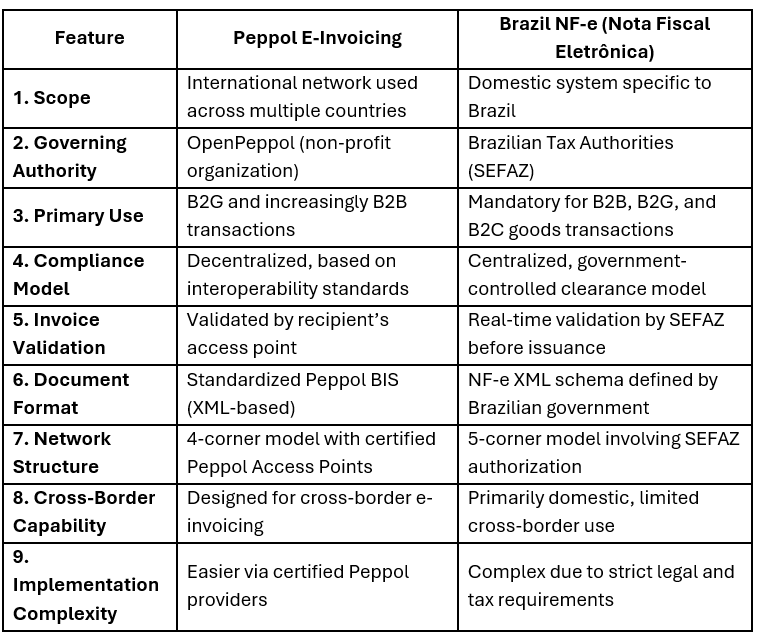
Understanding these differences is critical for global compliance.
Can You Use Peppol for E-Invoicing in Brazil Today
The short answer is no Peppol cannot replace NF-e in Brazil.
However, it can still be part of your global invoicing strategy. Many businesses use Peppol for international transactions and then convert those invoices into NF-e format for Brazilian compliance.
Step-by-Step Process to Send Electronic Invoices in Brazil
To send compliant invoices in Brazil, businesses must follow these steps:
Generate invoice data in XML format
Digitally sign the invoice
Submit it to SEFAZ for validation
Receive authorization from the government
Share the approved invoice with the buyer
Skipping any step can result in non-compliance.
Documents Impacted in Peppol vs NF-e: Understanding the Scope of Each System
Documents Affected in Peppol E-Invoicing
1- Invoice
Standard electronic invoice exchanged via Peppol network.
2- Credit Note
Used to correct or reduce invoice values digitally.
3- Debit Note
Adjusts invoices by adding additional charges.
4- Purchase Order
Buyer’s request for goods/services in structured format.
5 - Order Response
Supplier confirmation or rejection of purchase order.
6 - Despatch Advice
Details of shipped goods sent to buyer.
7 - Receipt Advice
Confirms goods/services received by buyer.
8 - Catalogue
Supplier’s product/service listing shared electronically.
Documents Affected in Brazil NF-e E-Invoicing
1- NF-e (Nota Fiscal Eletrônica)
Mandatory electronic invoice approved by SEFAZ.
2- NFC-e (Consumer Invoice)
Used for retail transactions with end consumers.
3- CT-e (Transport Document)
Covers transportation of goods across locations.
4- MDF-e (Manifesto Eletrônico)
Consolidates multiple transport documents.
5- NFS-e (Service Invoice)
Electronic invoice for service-based transactions.
6- Carta de Correção (CC-e)
Used to correct errors in issued NF-e.
7- Evento de Cancelamento
Cancels an authorized NF-e within legal timeframe.
8- GNRE (Tax Payment Guide)
Document for interstate tax payments (ICMS).
Common Challenges Businesses Face with Brazil’s E-Invoicing Compliance
Brazil’s system can be difficult to manage, especially for international companies.
Common challenges include:
Complex and frequently changing tax regulations
Strict validation rules and rejection risks
Localization requirements for invoice formats
Integration issues with ERP systems
These challenges make automation essential.
How EDI Integration Simplifies Brazil and Global Invoicing
EDI (Electronic Data Interchange) solutions help businesses automate and streamline invoicing processes.
With EDI integration, companies can:
Automatically generate and send invoices
Convert formats between Peppol and NF-e
Ensure compliance with local regulations
Integrate seamlessly with ERP systems
This reduces manual work, errors, and processing delays.
Best Practices for Ensuring Compliance with Brazil’s NF-e Requirements
To stay compliant and efficient:
Keep up with regulatory changes
Use certified digital certificates
Validate invoice data before submission
Automate invoicing workflows
Work with experienced integration providers
These practices help minimize risks and improve efficiency.