











Belgian E-Invoicing Mandates with Scalable Peppol Access Point
HubBroker adaptive platform combines e-invoicing automation and Peppol access point connectivity—processing PDFs, EDI, and compliance docs in one unified workflow that scales with every mandate.
Is E-Invoicing Mandatory in Belgium? Here’s What You Need to Know
- B2G Peppol Mandate: B2G invoices must be sent via Peppol network.
- B2B eInvoicing Expansion: B2B structured eInvoicing is becoming mandatory.
- PDF Not Compliant: PDF invoices are not legally compliant.
- Structured UBL Format: UBL format is required for compliance.
- Risk of Non-Compliance: Non-compliance may cause rejection and delays.
- Certified Access Point Required: Must connect via approved Peppol provider.
- Real-Time Invoice Validation: Invoices are auto-checked before delivery.
- ERP System Integration: ERP must support structured data exchange.
- GDPR & Data Security: Invoice data must meet EU security rules.
- Cross-Border Compatibility: Peppol enables EU-wide invoice exchange.
Automate E-Invoice Processing end to end
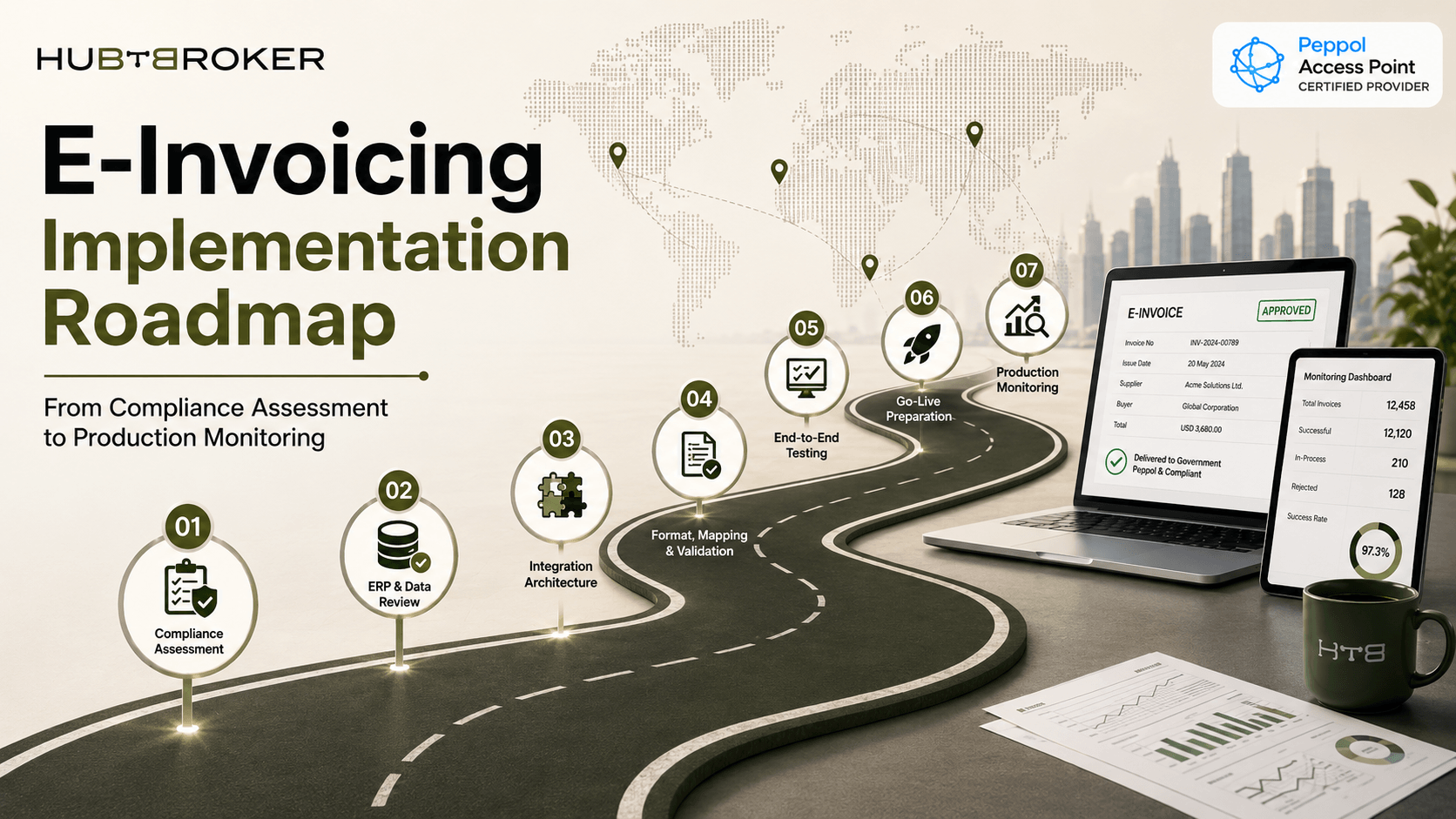
1️⃣ ERP Invoice Generation:
Automatically generate structured e-invoices directly from your ERP without manual data entry or duplication.
2️⃣ Peppol Format Conversion:
Convert invoices into compliant Peppol BIS / UBL formats instantly to meet Belgian eInvoicing standards.
3️⃣ Automated Data Validation:
Validate invoice data in real time to prevent errors, rejections, and compliance issues before submission.
4️⃣ Secure Peppol Transmission:
Transmit invoices securely through the Peppol network with full encryption and delivery confirmation.
5️⃣ Real-Time Status Tracking:
Track invoice delivery, acceptance, or rejection status with instant updates synced back to your ERP.
6️⃣ Digital Archiving & Compliance:
Store invoices securely with audit-ready records to meet Belgian and EU regulatory requirements.
Integrate Your ERP with Belgium’s Peppol Framework for Automated E-Invoicing
Supported EDI Documents and Data Formats
EDIFACT
X12
XML
CSV
JSON
Why Choose Us?
Your Data Security is Our Top Priority
Your data is end-to-end encrypted
We maintain the highest levels of information security
Get complete control of your data
You are in full control of your data and who has access to it. Manage users and data easily.
Multi-region data architecture
Choose where you want your data to be stored and for how long.
Measure automation success with audit logs
Our granular analytics help you keep improving your processes with time
Trusted by Businesses across Belgium for Compliant E-invoicing
Our Client Testimonials
Industries We Serve with Expertise and Innovation
Retail and eCommerce
Manufacturing
Logistics and Transportation
Wholesale and
Distribution
Automotive
Healthcare and Pharmaceuticals
Food and Beverage
Public Sector and
Government
Trusted Trading Partners Already Connected with HubBroker
Grow Your Business with HubBroker Partnerships
Germany
January 1, 2025
All businesses with a registered VAT ID must be able to receive e-invoices. File format XRechnung and ZUGFeRD received via E-mail or Peppol.
Belgium
January 1, 2026
All Belgian VAT-registered entities must issue and receive e-invoices. Non-established VAT-registered entities only required to receive. File format BIS3 received via Peppol.
Italy
January 1, 2019
All VAT-registered businesses operating must issue and receive e-invoices. File format FatturaPA received via SdI.
Poland
February 1, 2026
Mandatory for companies with annual turnover > PLN 200 million. From April 1, 2026: Mandatory for all other VAT-registered businesses. File format FA(2) received via KSeF.
Spain
January 1, 2027
Mandatory for companies with annual turnover > €8M. File format Facturae received via FACeB2B.
UAE
July 1, 2026
Phased mandatory e-invoicing from 2026, starting with large taxpayers and later covering all VAT-registered businesses. Based on a centralized clearance model using structured XML invoices via accredited service providers.
Schedule a Free Call and Get a Live Demo!
FAQs
What’s the difference between EDI and e-invoicing?
Electronic data interchange (EDI) is the computer-to-computer exchange of any document – purchase order, invoice, shipping notice, sales order, etc. – in a standard electronic format between businesses. They are written in a format that has to be agreed upon by participating businesses and meet the requirements of the respective industry and country. EDI systems can be complex and costly.
E-invoicing focuses exclusively on the exchange of invoices in a structured, machine-readable format. E-invoices are defined in standardized formats and exchanged by standard protocols, supported by common invoice processing systems. E-invoices have to meet the regional regulatory requirements such as EU initiative VAT in the Digital Age (ViDA).
What’s the difference between a PDF invoice and an e-invoice?
A PDF invoice is a digital representation of a paper document, easy for humans to read. While an e-invoice is created and exchanged in a structured, machine-readable format. Not so easy for humans to understand. However e-invoices often contain the human readable invoice representation as well as an additional layer embedded inside (e.g., PDF invoice embedded in the e-invoice structure).
Multiple vendors or one unified platform?
There are pros and cons for each method. Country-specific e-invoicing solutions bring regulatory compliance, customized features for each country’s unique business practices, and local support. But the cons outweigh. Managing multiple solutions and vendors across different countries, training for various systems, integration challenges, scalability limitations, and data security.
A unified AP solution manages e-invoicing across countries. Processing all invoice types, from PDFs to e-invoices. One partner, approval route, and set of business rules. Plus in the long-term it’s cheaper. For more information, check out Delivering E-invoicing Solutions with a Unified AP platform.
Will it be one e-invoicing format across all EU countries?
The European Commission’s VAT in the Digital Age proposal states that its goal is to create an accord in terms of Digital Reporting Requirements (DRR) and an effective VAT control system in the EU.
Countries are currently rolling out their own requirements, which vary country to country. Each with a different timeline. Some countries are already there – Brazil, Indonesia, Italy, Germany, with others like Belgium, France and Poland following the trend in 2026.
Will HubBroker expand e-invoicing to other countries?
Absolutely! Hubbroker already supports e-invoices across Europe, and as new country mandates roll out, you’ll be able to activate the relevant e-invoicing module to stay compliant without disruption. Our platform is built to handle diverse e-invoicing standards worldwide. If you operate in a specific country and need clarity on local regulations, our experts are ready to guide you.
Why is a unified PDF and e-invoice platform important?
Most companies live in a hybrid reality, receiving both PDFs and e-invoices. A unified platform eliminates the need for separate, disconnected workflows. Hubbroker provides a single, consistent process for your AP team, reducing complexity, lowering costs, and providing a single source of truth for all invoice data.
What happens if an e-invoice is missing data or has errors?
This is a common problem that Hubbroker is built to solve. Our platform can use information from an attached PDF to fill in missing fields in the e-invoice data. For errors, it validates against business rules and compliance mandates, flagging exceptions for review or automatically notifying the sender.