
SAP Business One and German E-Invoicing: What to Fix Before January 2027
From 1 January 2027, a PDF invoice sent by an affected German company stops being a valid VAT invoice. Not "discouraged". Not "phased out". Invalid and the buyer's input VAT deduction goes with it.
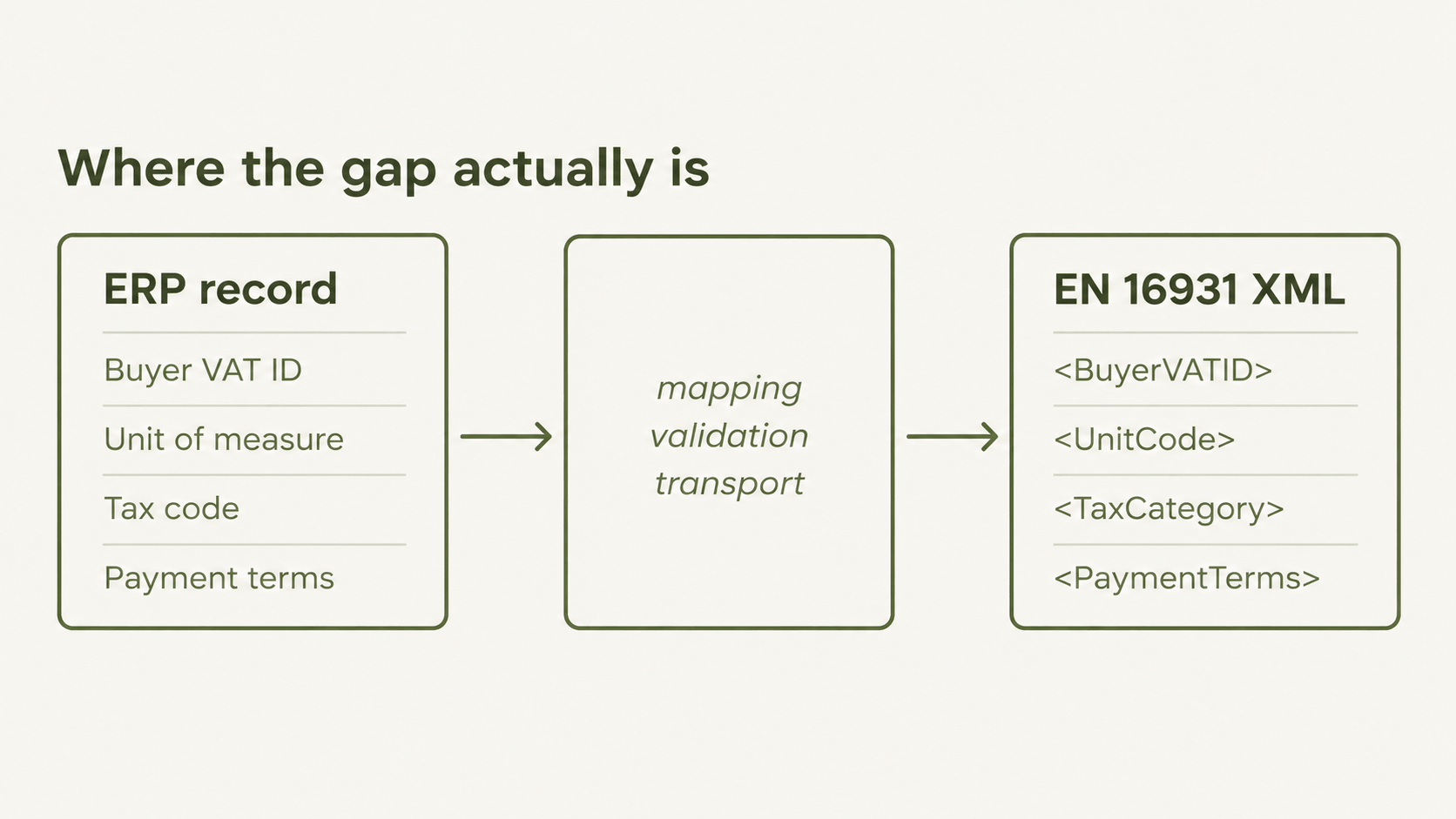
If you run SAP Business One in Germany, that matters more than it looks, because SAP B1 XRechnung output is not something the standard installation gives you. B1 produces a beautifully formatted Crystal Reports PDF. The German tax authority wants structured XML. Those are two different things, and the gap between them is your project.
You have roughly four months.
What changes on 1 January 2027 (and what already changed)
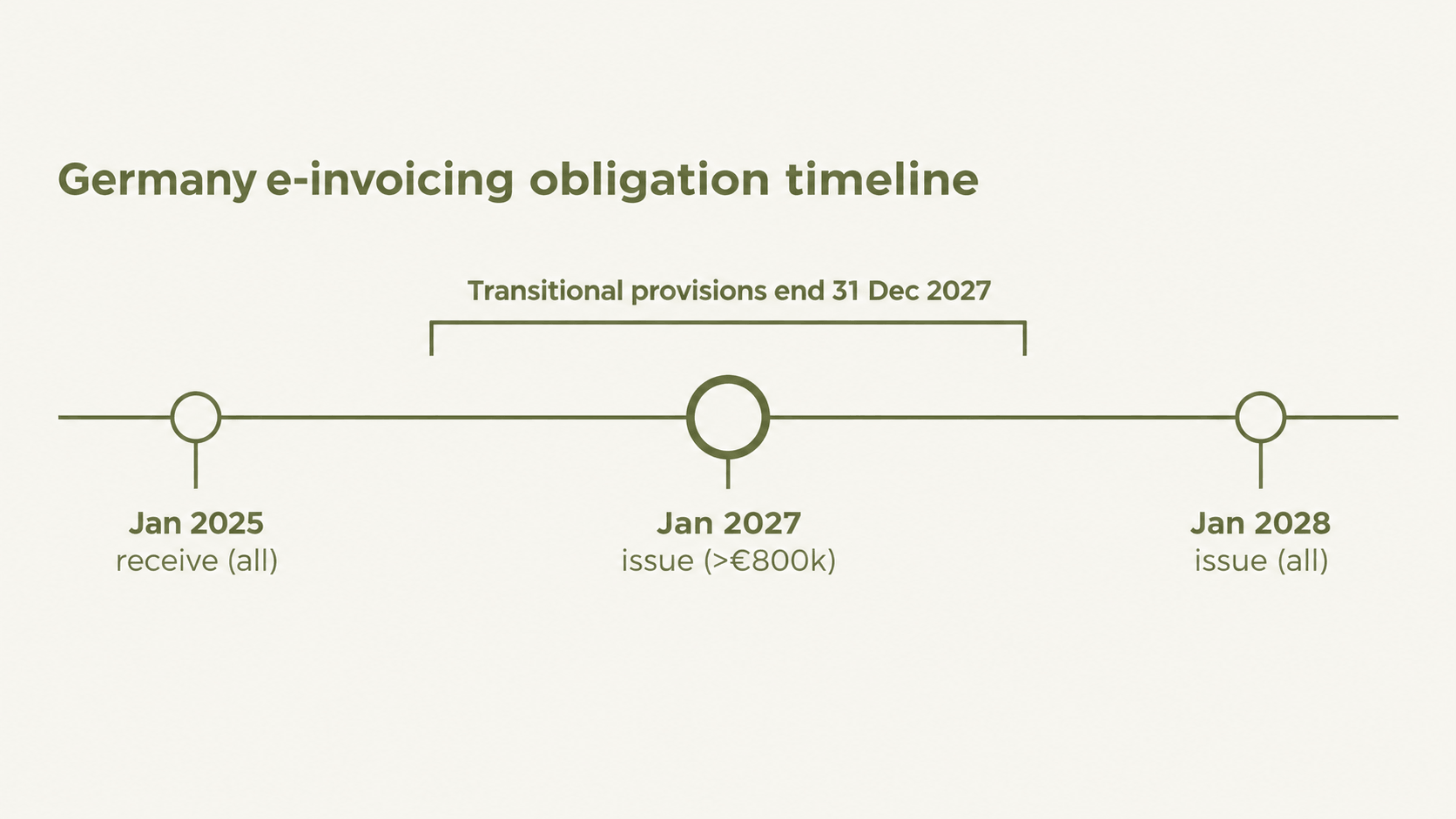
Germany's B2B mandate comes from the Wachstumschancengesetz, passed by the Bundesrat in March 2024. It runs in three steps.
The three phases
1 January 2025 (done): every German business must be able to receive structured e-invoices. If your AP team is manually keying inbound XML, or bouncing it back to suppliers, you are already non-compliant in practice.
1 January 2027: mandatory issuance for companies with prior-year turnover above €800,000.
1 January 2028: mandatory issuance for everyone else.
What is in scope
Domestic B2B only. B2C is out. Pure cross-border transactions are out. B2G has its own long-standing framework and its own rules. Kleinunternehmer are exempt from the issuance obligation.
The transitional provisions expire
The transitional arrangements that let smaller companies and existing EDI users carry on with non-EN 16931 formats run out at the end of 2027. If your German EDI flows use a partner-specific layout that is not EN 16931-compliant, that is a 2027 conversation, not a 2028 one.
Why standard SAP Business One is not ready
A PDF is a layout, not an invoice
Crystal Reports gives you a document a human can read. XRechnung and ZUGFeRD 2.x are structured representations of invoice data, validated against EN 16931 business rules. There is no setting in SAP B1 that turns one into the other. The mapping has to happen somewhere, and the question is only whether it happens inside a bolt-on add-on or in an integration layer above the ERP.
The master-data gaps that break validation
This is where most projects lose their timeline. EN 16931 validation fails on things nobody has looked at in years:
VAT identification numbers missing or wrong on business partner records
unit-of-measure codes in B1 that don't map to UN/ECE Recommendation 20
tax codes that produce a VAT breakdown the schema won't accept
payment terms and bank details held as free text rather than structured fields
Leitweg-ID where you also invoice public-sector buyers
Fix these in September, not in December.
XRechnung or ZUGFeRD?
Both are EN 16931-compliant, so both satisfy the law. XRechnung is a pure XML CIUS, widely required by German public buyers. ZUGFeRD 2.x is a hybrid: a PDF/A-3 with the XML embedded, which some commercial buyers prefer because the human-readable page survives. Your buyers decide, not you. Expect to support both.
Your SAP B1 XRechnung readiness checklist
Outbound: map B1 invoice data to EN 16931
Sales invoices, credit memos, and down-payment invoices all need mapping. Credit memos and corrections are where teams find out their numbering and reference logic doesn't produce a valid document.
Inbound: receive, validate, archive
Receipt has been mandatory since 2025 and is the half that gets forgotten. Inbound structured invoices need to be validated, matched against purchase orders in B1, posted as AP invoices, and archived in their original structured form for the German retention period. The XML is the original not your printout of it.
Transmission: Peppol, email, or portal
Germany's model is decentralised. There is no central clearance platform for B2B, so transmission is agreed bilaterally: Peppol, email, portal upload, or an existing EDI channel. Peppol is the practical default for anyone invoicing across borders or into the public sector, and it is what certified Peppol Access Point is built for.
Validation before the Finanzamt finds it
Validate against EN 16931 and the relevant CIUS before sending. A rejected invoice is an unpaid invoice, and a technically invalid one is a VAT exposure for your customer.
Doing this without touching your ERP
You do not need to change ERP for this. SAP Business One stays your system of record for sales, purchasing, and posting. Mapping, format conversion, validation, and transport sit in an integration layer above it, reading and writing B1 records through the same interfaces your existing EDI flows use.
That is the model behind SAP Business One EDI integration and our wider e-invoicing solution: one connection out of B1, then German XRechnung, Peppol BIS, and partner EDI formats handled on the other side of it without add-ons stacking up inside your ERP.
A realistic four-month plan
September: confirm whether you cross the €800,000 prior-year threshold. Inventory your German B2B customers and what format each will accept. Audit business partner and item master data.
October: clean master data. Decide XRechnung, ZUGFeRD, or both. Pick your transmission channels.
November: build and test outbound mapping. Test inbound receipt and PO matching. Run documents through an EN 16931 validator, not just a visual check.
December: pilot with two or three live customers. Confirm archiving. Write the exception process for when a validation fails at 17:00 on a Friday.
January: live, with monitoring not with hope.
Four months is enough if master data starts now. It is not enough if master data starts in November.
FAQ
Does the €800,000 threshold use prior-year turnover? Yes the obligation from 1 January 2027 applies to companies whose turnover in the previous year exceeded €800,000. Confirm the exact calculation basis with your tax advisor, particularly for group structures and partial years.
Is a PDF ever acceptable after January 2027? For domestic B2B invoices from an affected company, no. A plain PDF is not a structured e-invoice. A ZUGFeRD 2.x file looks like a PDF but carries compliant XML inside it that is a different artefact.
XRechnung or ZUGFeRD what should SAP B1 send? Whichever your buyer requires. Public-sector buyers typically want XRechnung. Commercial buyers vary. Build for both rather than negotiating format with every customer.
Do we need Peppol for German B2B? Not legally. Germany's B2B model has no central platform and transmission is agreed between the parties. Peppol is often the simplest route in practice, especially if you also invoice public buyers or trade into Belgium, France, Poland, or the Nordics.
We're under the threshold can we wait until 2028? You can wait on issuance. You cannot wait on receipt, which has been mandatory since January 2025. And your larger customers will start sending you structured invoices from January 2027 whether or not you are ready to process them.
Where to start
If you are running SAP Business One in Germany and are not sure whether your B1 data would survive an EN 16931 validation, that is the first thing worth checking and it takes an afternoon, not a project.
Our team works with SAP B1 customers across Europe on exactly this. If it would help to talk through your setup before you commit to an approach, get in touch.
