
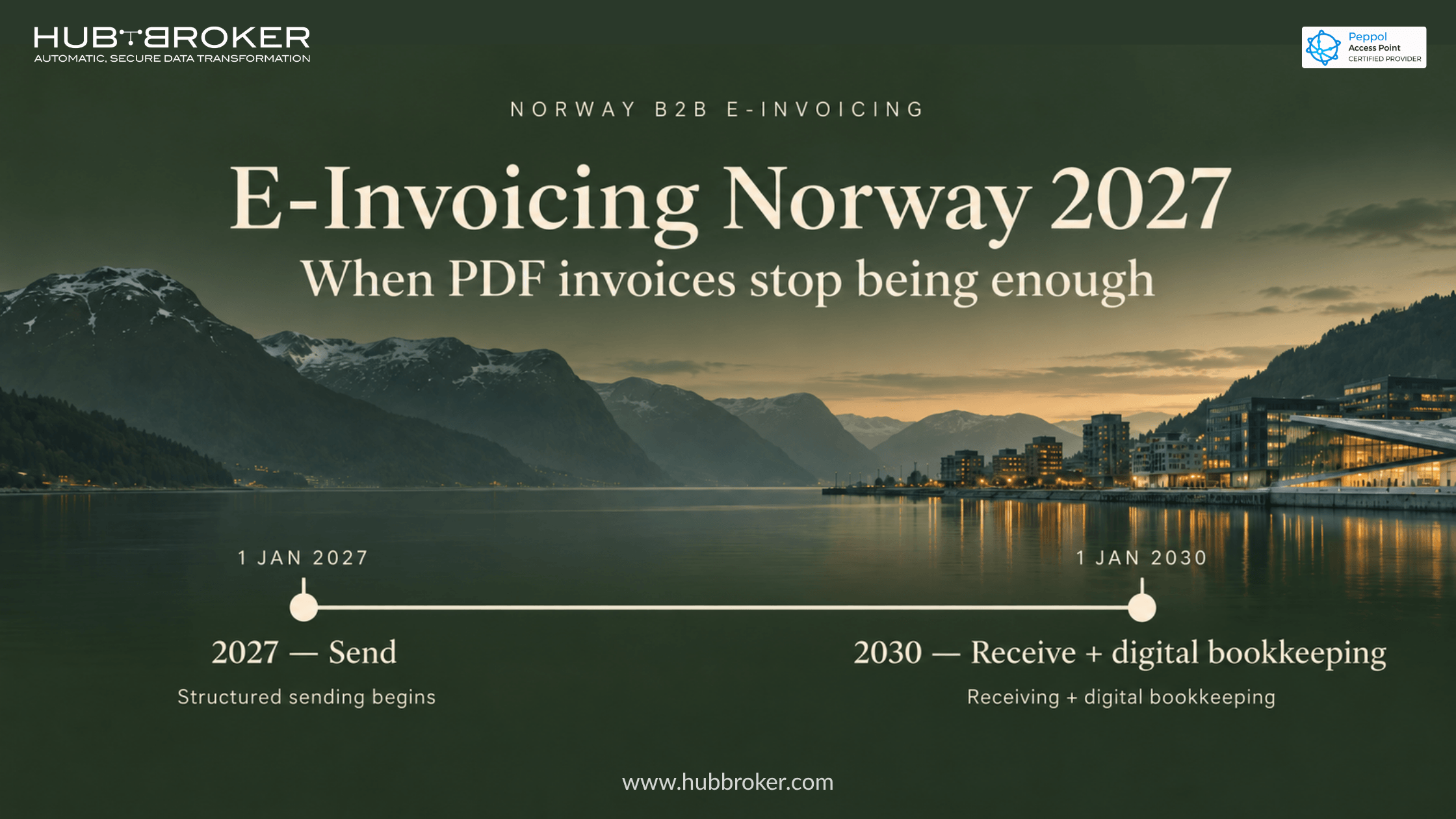
E-Invoicing Norway 2027: Your PDF Invoices Stop Counting on 1 January
On 1 January 2027, a PDF attached to an email stops being a valid B2B invoice in Norway. Companies with a bookkeeping obligation will have to send structured electronic invoices to each other, and the deadline was pulled forward a full year from the original proposal. Most Norwegian companies assume their public-sector setup already covers it. For a lot of them, it doesn't. Here's what E-Invoicing Norway 2027 actually requires, and where the gaps usually sit.
What changes on 1 January 2027
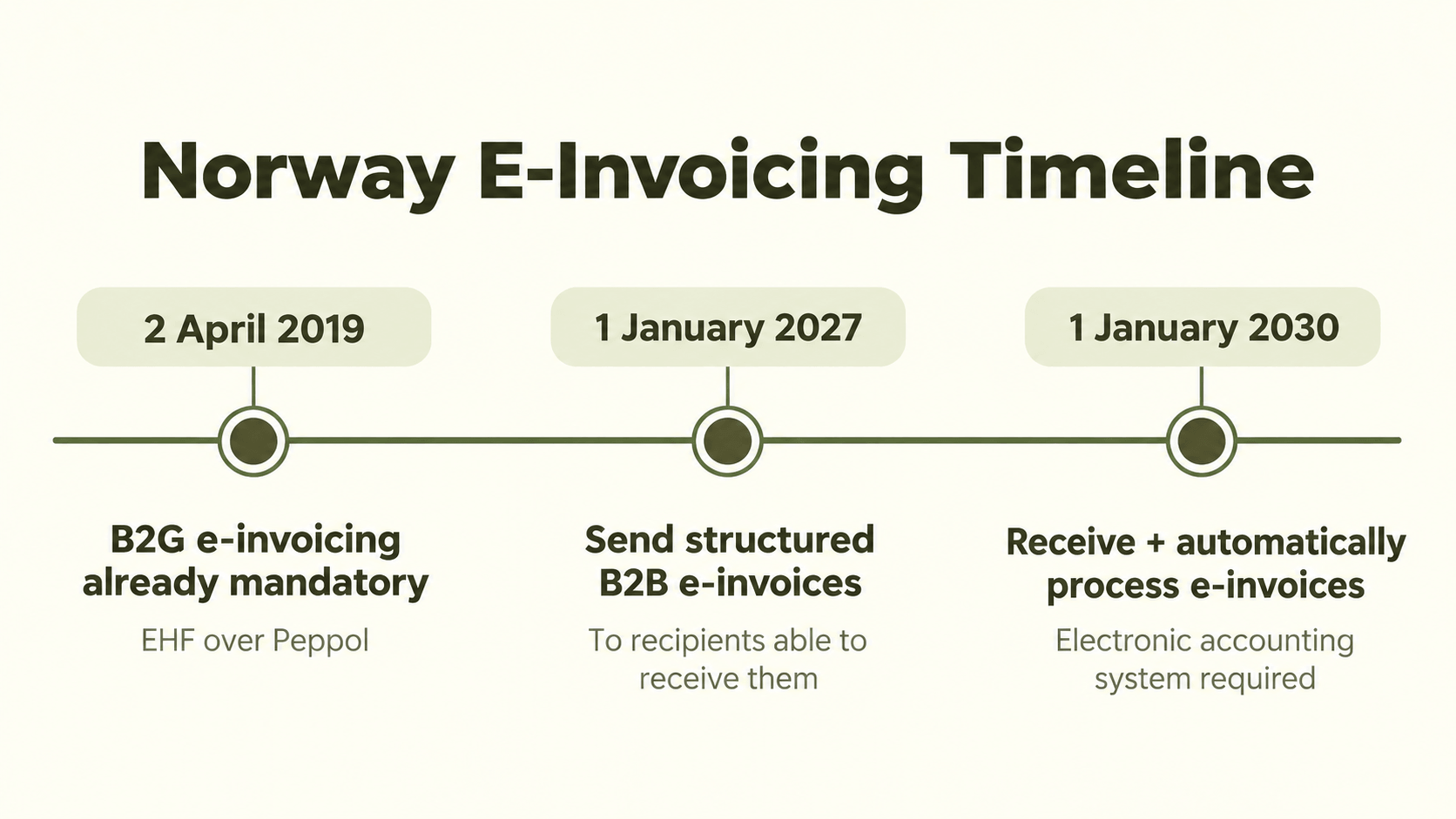
The Storting adopted amendments to bokføringsloven under Prop. 44 L (2025–2026), introducing two obligations on a phased timeline.
From 1 January 2027, businesses that are bokføringspliktige must issue invoices to other bokføringspliktige businesses in a structured electronic format. The obligation is on sending. The general obligation to receive comes later.
The requirement is conditional: it applies when the recipient is set up to receive e-invoices. In practice that means the buyer is discoverable on the Peppol network with an active invoice profile.
Why a PDF doesn't qualify
A PDF is digital, not structured. Your customer's system can't read the line items, VAT codes, or references without someone retyping them or running OCR. A structured e-invoice carries the same data as machine-readable XML that posts directly into the buyer's ledger. That distinction is the entire point of the mandate.
The second deadline: digital bookkeeping from 2030
From 1 January 2030, bokføringspliktige businesses must use an electronic accounting system capable of receiving and automatically processing structured e-invoices. Spreadsheets and word processors will no longer qualify as bookkeeping systems.
Timeline at a glance
Who is in scope, and who isn't
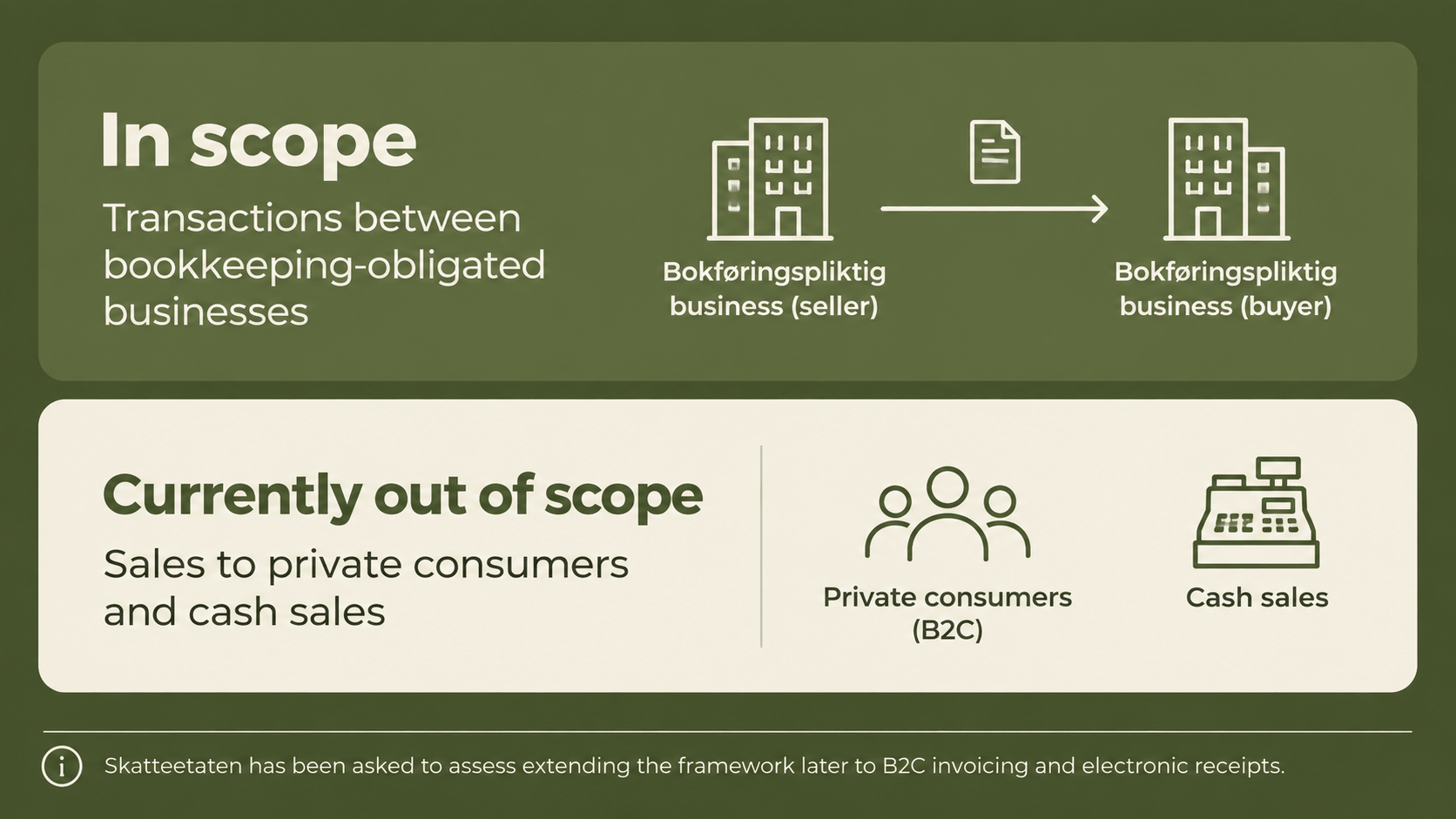
The mandate covers transactions between bookkeeping-obligated businesses. Sales to private consumers and cash sales sit outside the current scope, though the tax authority has been asked to assess extending the framework later to B2C invoicing and electronic receipts.
Possible exemptions for the smallest businesses are among the details left to secondary legislation.
EHF, Peppol and ELMA: the terms you'll hear
EHF - Elektronisk handelsformat, Norway's standard for structured business documents. For invoicing it's built on Peppol BIS Billing 3.0.
Peppol network - the infrastructure that routes documents between senders and receivers through certified Access Points. Peppol BIS defines how the documents are structured; the network moves them.
Peppol Access Point - the certified provider that connects your business to the network and handles sending and receiving on your behalf.
ELMA - Elektronisk mottakeradresseregister, Norway's national SMP. It lists which businesses can receive which document types, and at which Access Point address.
One nuance worth knowing: a lookup in ELMA alone is no longer a complete way to check whether a Norwegian company can receive documents, because Norwegian organisations may be registered with other SMPs. Proper discovery goes through the Peppol SML.
The detailed technical requirements sit in forskrift and are not final yet. Both dates depend on that secondary legislation being adopted.
Norway isn't starting from zero
Norway has run mandatory B2G e-invoicing since 2019, and adoption of EHF in the private sector is already high. VAT reporting to Skatteetaten is electronic. The 2027 mandate builds on infrastructure that exists.
Note what the mandate is not: there's no clearance step, no real-time reporting of each invoice to the tax authority. Norway stays on a post-audit model. If you've been reading about KSeF in Poland, this is a different animal.
What this means for your ERP
"We already send EHF to the municipality" is not the same as being ready for 2027. The usual gaps:
Partner coverage. B2G means a handful of known recipients. B2B means your whole customer base, with recipient capability changing over time.
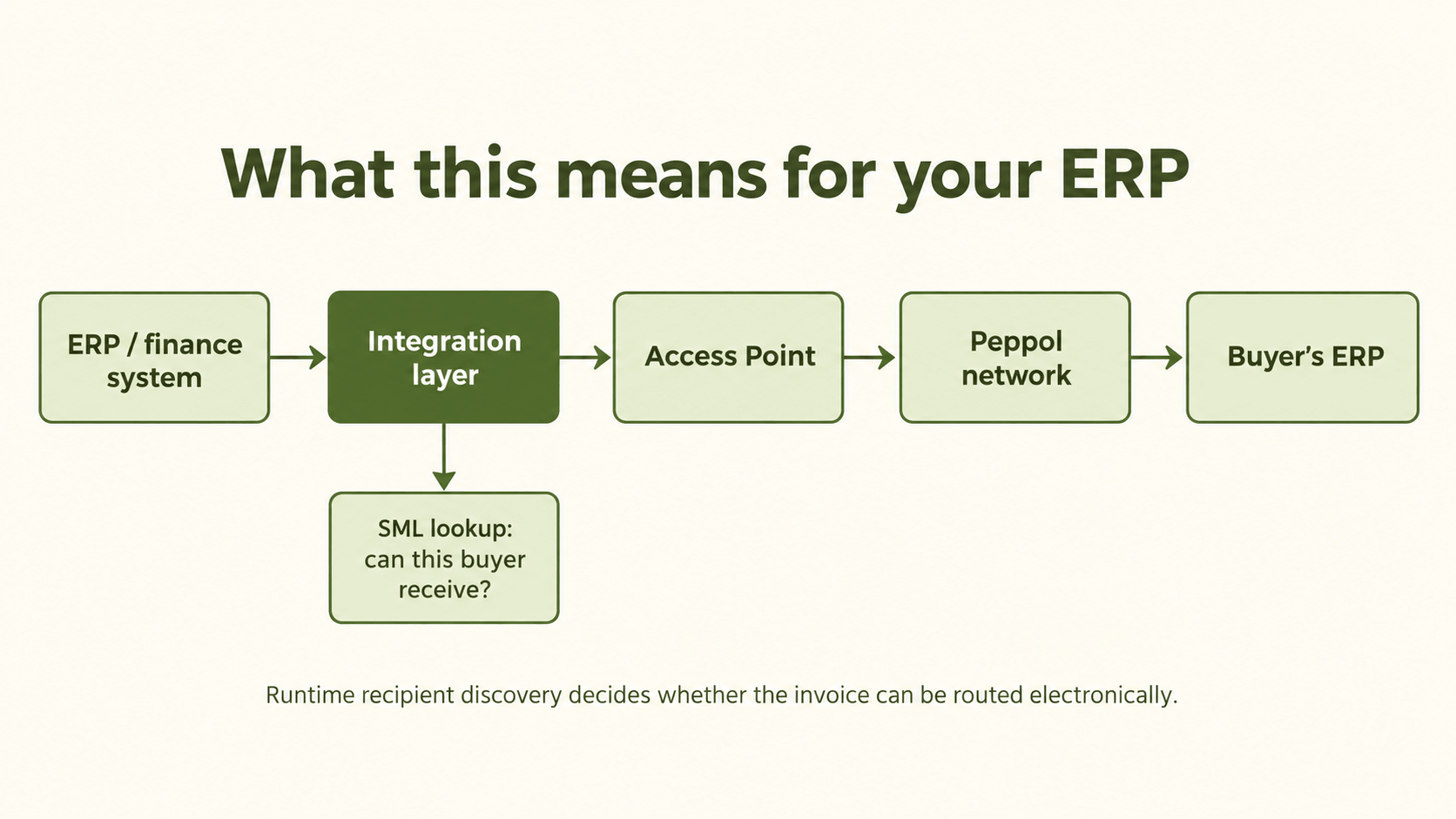
Recipient lookup. Someone has to check, per invoice, whether the buyer can receive electronically and route accordingly. That's a runtime lookup, not a one-off data cleanup.
Master data. Organisation numbers and Peppol identifiers on customer records need to be right, or invoices fail routing.
Validation. Peppol BIS and Norwegian rules reject invoices on missing VAT fields and reference errors. Better to catch that before sending.
Inbound handling. By 2030 you need automated processing of incoming e-invoices, not a person opening attachments.
None of this requires replacing your ERP. HubBroker sits as an integration layer on top of Microsoft Dynamics 365, Business Central, SAP Business One, Visma e-conomic, Uniconta and others, connecting them to Peppol through a certified Peppol Access Point while your finance team keeps working in the system they already use.
What to do before 2027
Confirm whether your ERP or finance system can produce EHF / Peppol BIS Billing 3.0 outbound.
Audit customer master data for organisation numbers and Peppol identifiers.
Check how many of your Norwegian customers are already reachable on Peppol.
Choose an Access Point and plan the outbound go-live well before the deadline.
Track the forskrift as the technical requirements are published.
FAQ
When does B2B e-invoicing become mandatory in Norway? From 1 January 2027, bokføringspliktige businesses must send structured e-invoices to other bokføringspliktige businesses that can receive them. From 1 January 2030, receiving e-invoices and using an electronic accounting system also become mandatory. Both dates are subject to secondary legislation.
Is a PDF invoice an e-invoice in Norway? No. A PDF is a digital document, not structured invoice data. From 2027 it won't meet the requirement for invoices in scope.
Do we have to use Peppol and EHF? Peppol and EHF are the established Norwegian infrastructure, and the mandate is expected to build on them. The binding technical requirements are set in forskrift, so confirm the final specification rather than assuming.
Does the mandate cover invoices to customers outside Norway? The obligation is aimed at domestic transactions between bookkeeping-obligated businesses. Cross-border treatment should be confirmed against the final regulation, and separately against EU developments under ViDA.
We already send EHF to the public sector. Are we compliant? Partly. The format and Access Point connection carry over. What changes is scale and variability: your entire B2B customer base, recipient lookups per invoice, and by 2030 automated inbound processing.
Getting ahead of it
The companies that had an easy time with the Belgian and French mandates were the ones that started 12 months out, not 12 weeks out. If you invoice Norwegian businesses and want to know where your current setup sits, our team can walk through it with you see our e-invoicing solution or get in touch.
