
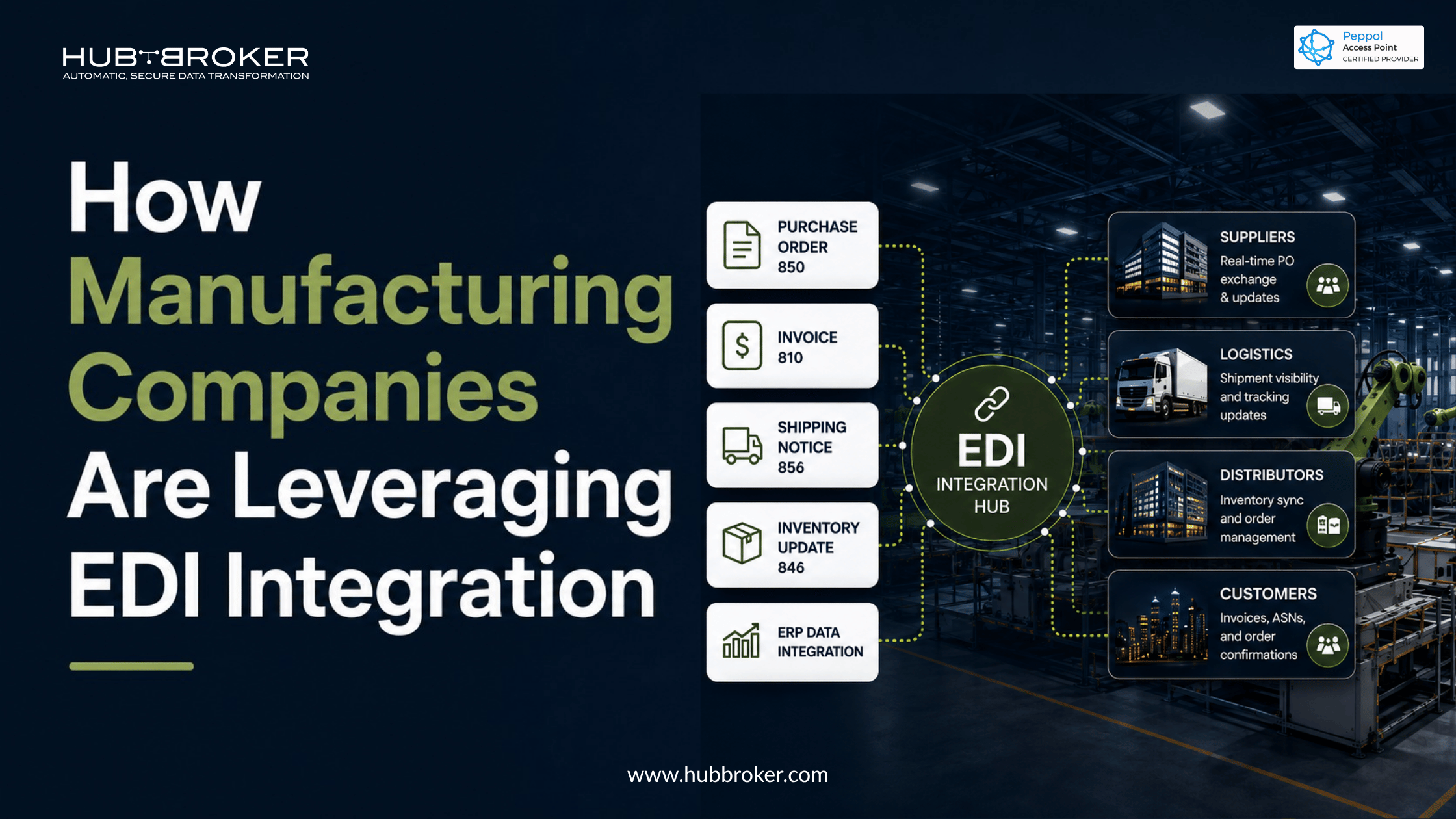
How Smart Manufacturers Are Leveraging EDI Integration for Better Control
Manufacturing moves fast. Orders change, suppliers send updates, warehouses need accurate delivery details, and finance teams need invoices processed without delay.
But in many manufacturing companies, business documents still move through emails, PDFs, spreadsheets, and manual ERP entry. That creates a simple but costly problem: the production floor may be modern, but the document flow behind it is still slow.
This is where EDI integration for manufacturing is becoming more important. Manufacturing companies are using EDI integration to automate how purchase orders, invoices, shipping notices, order confirmations, and supplier documents move between systems.
Instead of people copying data from one place to another, EDI allows business documents to move directly between customers, suppliers, logistics partners, and ERP systems.
What Is EDI Integration in Manufacturing?
EDI integration in manufacturing means connecting business systems so companies can exchange structured documents automatically with their trading partners.
For example, when a customer sends a purchase order, the order can flow directly into the manufacturer’s ERP system. When goods are shipped, an advanced shipping notice can be sent automatically. When an invoice is ready, it can be created and exchanged in the right format without manual retyping.
Manufacturers commonly use EDI integration for:
Purchase orders
Order confirmations
Advanced shipping notices
Delivery notes
Supplier invoices
Inventory updates
Product catalogues
Payment-related documents
The main goal is simple: reduce manual work, improve accuracy, and keep business documents moving at the same speed as the supply chain.
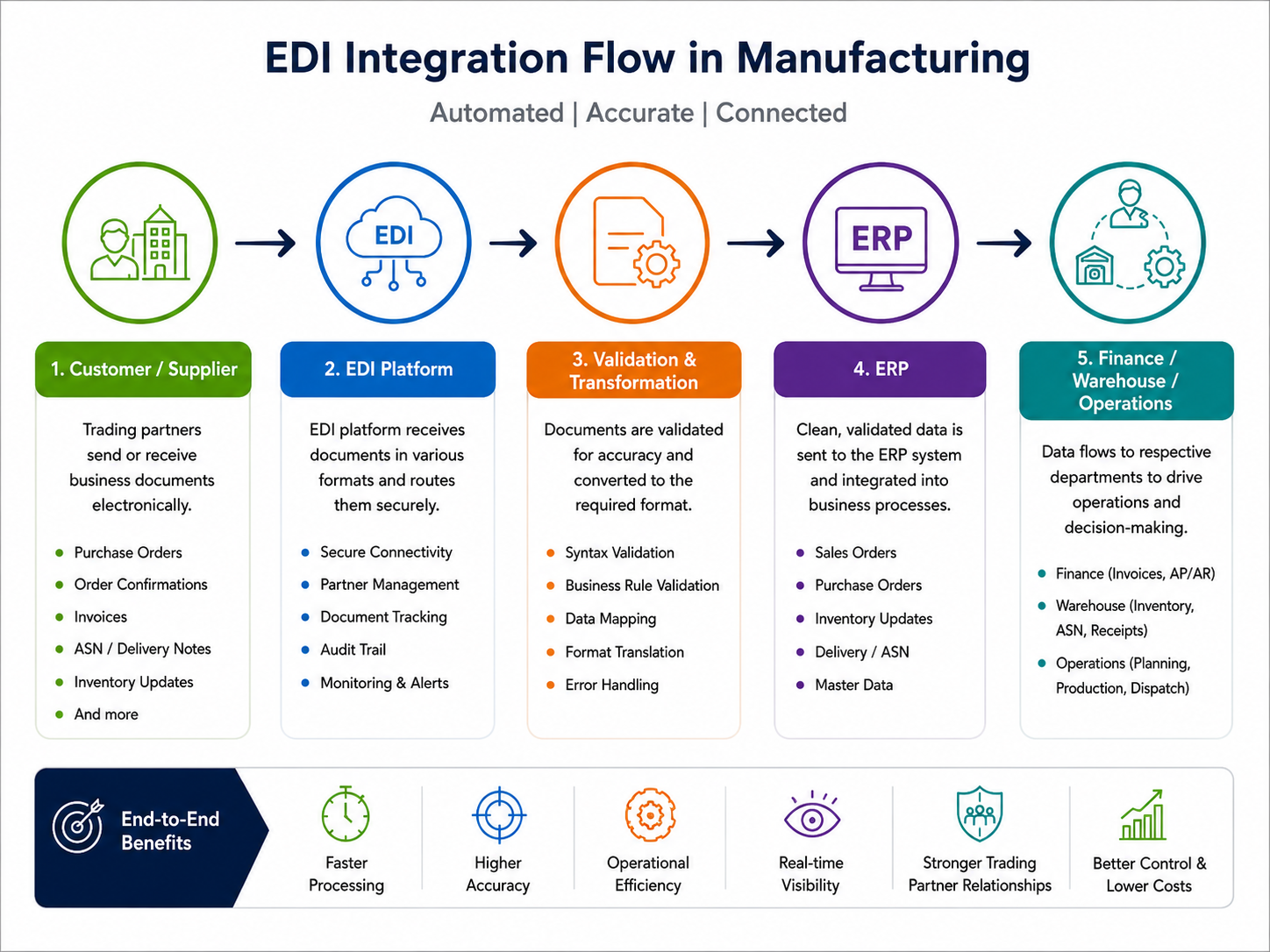
Why Are Manufacturers Moving Toward EDI Integration?
Manufacturing companies are dealing with more pressure than before. Customers expect faster confirmations. Suppliers need clear instructions. Finance teams want fewer invoice errors. IT teams need systems that connect properly instead of depending on manual uploads and email attachments.
Manual document handling may work when volumes are low. But as order volumes grow, it quickly becomes a bottleneck.
One wrong quantity in a purchase order can affect production planning. One delayed invoice can slow down payment processing. One missing shipping update can create confusion between the warehouse, customer service, and the buyer.
With manufacturing EDI integration, companies can reduce these gaps by automating repeated document exchange between systems and trading partners.
How Manufacturing Companies Use EDI Integration in Daily Operations
1. Automating Purchase Orders
Purchase orders are one of the most common EDI use cases in manufacturing.
Instead of receiving orders by email and entering them manually into ERP, manufacturers can receive structured purchase orders directly from customers or distributors. The data can be validated and passed into the ERP system automatically.
This helps teams process orders faster, reduce typing errors, and respond to customers with more confidence.
2. Sending Order Confirmations Automatically
After receiving a purchase order, manufacturers often need to confirm quantities, prices, delivery dates, and product availability.
With EDI integration, order confirmations can be sent automatically or with minimal manual review. This reduces back-and-forth emails and gives customers a clear update on what has been accepted.
For manufacturers managing multiple customers and delivery timelines, this can save hours of repetitive communication.
3. Improving Shipping and Delivery Updates
Manufacturers also use EDI to send advanced shipping notices and delivery information before goods arrive.
This helps customers and warehouses prepare for incoming shipments. It also reduces disputes because both sides have clearer information about what was shipped, when it was shipped, and what should be received.
For companies with complex logistics, this visibility can improve planning across warehouse, transport, and customer service teams.
4. Automating Supplier Invoice Processing
Supplier invoices often create pressure for finance teams. When invoices arrive through email or PDF, someone usually needs to check, enter, match, approve, and process them.
EDI integration helps supplier invoices move directly into finance or ERP workflows. When connected with purchase orders and delivery data, it can also support faster matching and fewer invoice exceptions.
This gives finance teams better control and reduces the time spent on repetitive invoice handling.
5. Connecting EDI With ERP Systems
EDI becomes more valuable when it is connected directly with ERP systems such as Microsoft Dynamics 365 Business Central, SAP, Oracle, or other manufacturing platforms.
With ERP EDI integration, sales orders, purchase documents, invoices, shipping updates, and inventory data can move between trading partners and internal systems without duplicate work.
This helps manufacturers create a cleaner flow between sales, operations, warehouse, finance, and customer service.
Gain Better Control with EDI Integration
Help your manufacturing business improve visibility, reduce manual errors, and automate order, invoice, and shipment workflows with HubBroker’s EDI integration solutions.
Contact Us to Know More
What Problems Does EDI Integration Solve for Manufacturers?
EDI integration helps solve many common manufacturing document problems:
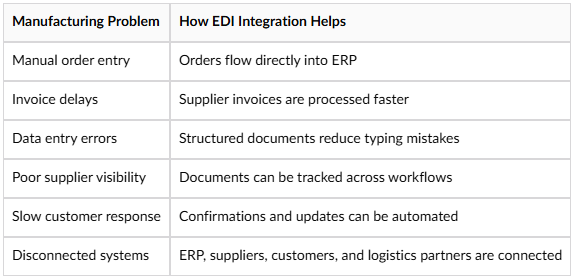
The biggest benefit is not only speed. It is control. EDI gives manufacturers a more reliable way to manage the documents that keep production, delivery, and finance moving.
What Should Manufacturers Look for in an EDI Integration Partner?
Not every EDI setup is the same. Manufacturing companies should look for a partner that understands both document exchange and business system integration.
A good EDI integration partner should support:
ERP integration
Multiple EDI formats
Trading partner onboarding
Document validation
Error monitoring
Invoice and order automation
Scalable workflows for more partners and countries
Support for EDI, XML, PDF, API, and Peppol-related requirements
The right partner should not only connect systems. They should make the process easier to manage as your business grows.
How HubBroker Helps Manufacturing Companies With EDI Integration
HubBroker helps manufacturing companies automate business document exchange between customers, suppliers, distributors, logistics partners, and ERP systems.
With HubBroker’s EDI Integration solutions, manufacturers can reduce manual document handling, connect ERP systems, automate order and invoice workflows, and manage document transformation between different formats.
HubBroker also supports broader document automation needs through solutions such as EDI Integration, ERP Integration, PDF to XML conversion, Intelligent Document Processing, and Peppol Access Point services.
For manufacturing teams that still depend on email-based orders, manual invoice entry, or disconnected supplier workflows, this creates a more controlled and scalable way to manage business documents.
FAQ
What is EDI integration in manufacturing?
EDI integration in manufacturing is the automated exchange of structured business documents between manufacturers, suppliers, customers, logistics partners, and ERP systems.
Which documents can manufacturers automate with EDI?
Manufacturers can automate purchase orders, invoices, order confirmations, delivery notes, advanced shipping notices, inventory updates, and supplier documents.
Can EDI integration connect with ERP systems?
Yes. EDI integration can connect with ERP systems so orders, invoices, shipping updates, and other documents move directly into business workflows.
Is EDI only for large manufacturers?
No. EDI is useful for any manufacturer that handles repeated document exchange, growing order volumes, customer EDI requirements, or supplier document complexity.
Ready to Reduce Manual Manufacturing Document Work?
EDI integration is no longer just an IT project. It is a practical way for manufacturing companies to improve order processing, invoice handling, supplier communication, customer updates, and ERP data flow.
If your team is still spending too much time entering orders, checking invoices, or chasing document updates through email, it may be time to review where EDI integration can help.
Contact HubBroker today to discuss how EDI integration can connect your ERP, suppliers, customers, and trading partners in one streamlined workflow.
