











ERP Integration Services

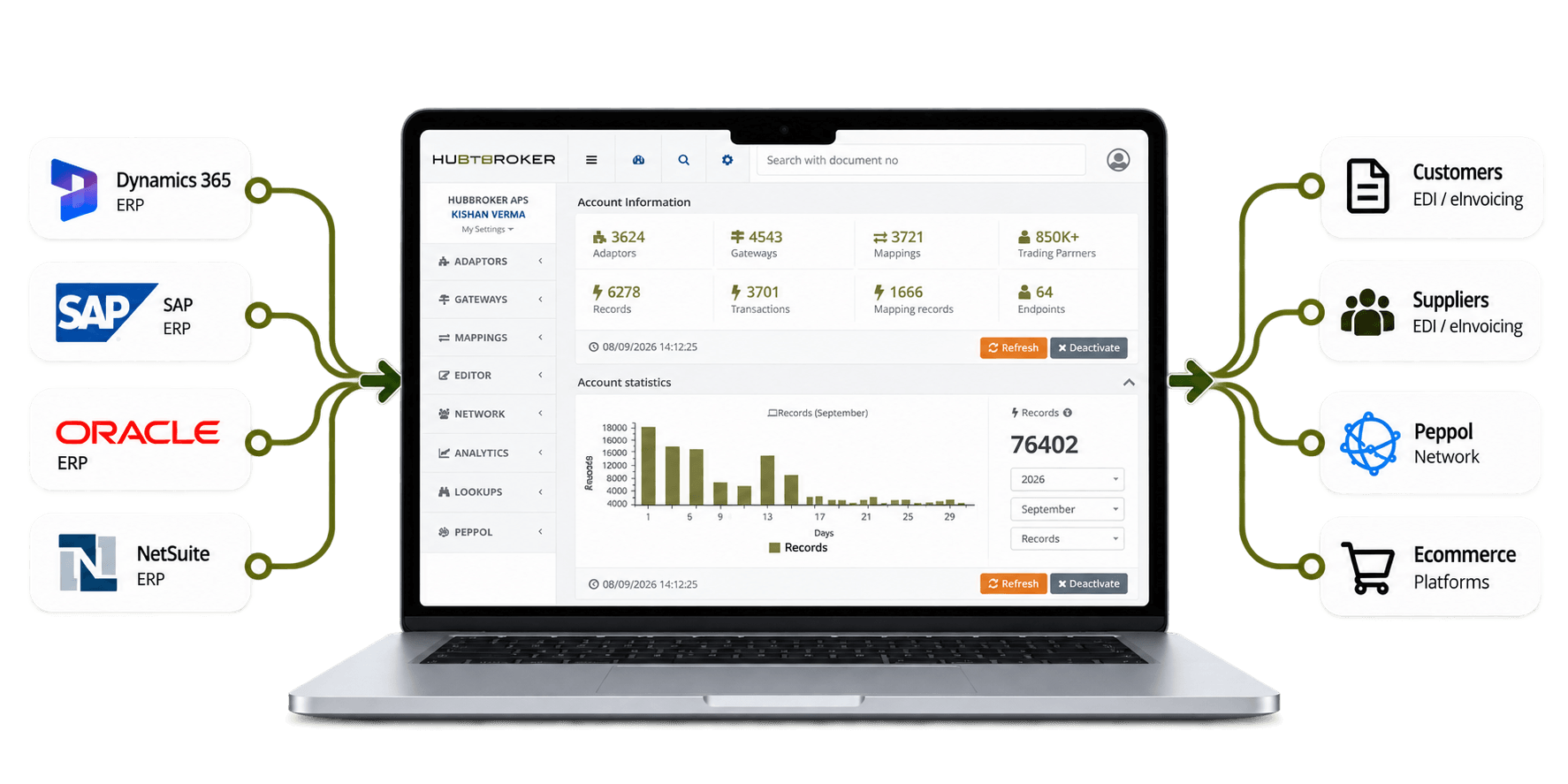
HubBroker's ERP EDI Integration Services connect your ERP system to trading partner EDI flows, so orders, invoices, and dispatch documents move automatically between finance, operations, and partners.

ERP Integration service (1).png
Titgemeyer.png
wexe_a_logo.svg.png
ABc.png
Ammega.svg
Atea.png
Frame_1000009461.png
fujitsu_logo.svg
langkilde__Son.png
Nature_Source.png
orkla_logo.svg
Proshop.png

Simplifying ERP Integrations with HubBroker

The Challenges Businesses Face

Manual ERP Data Entry

Manual entry of orders and invoices into the ERP system

Disconnected Partner Flows

Trading partner documents handled outside the ERP

Costly Custom Integrations

One-off ERP integrations built for each new partner

Slow Order-to-Cash Cycles

Delays in order, dispatch, and invoicing inside the ERP

Weak Compliance Coverage

Gaps in Peppol, tax, and audit coverage from the ERP

How HubBroker Solves It

Direct ERP Document Flow

Orders and invoices flow directly into and out of your ERP

Connected Partner Network

Built-in validation against format and partner rules

Reusable Integration Patterns

Standard ERP mappings and templates speed up onboarding

Faster Order-to-Cash

Documents move into ERP fast, accelerating invoicing flow

Built-In Peppol and Audit

Certified Peppol Access and audit trails inside the ERP

Want To See How HubBroker Simplifies Integrations?

Let's schedule a demo and discover how our integration platform connects your apps and automates processes.

Delivering Impact Across The World

15+

Years Experience

500+

Projects Delivered

2000+

Global Clients

40+

Countries

HubBroker ERP Integration Process

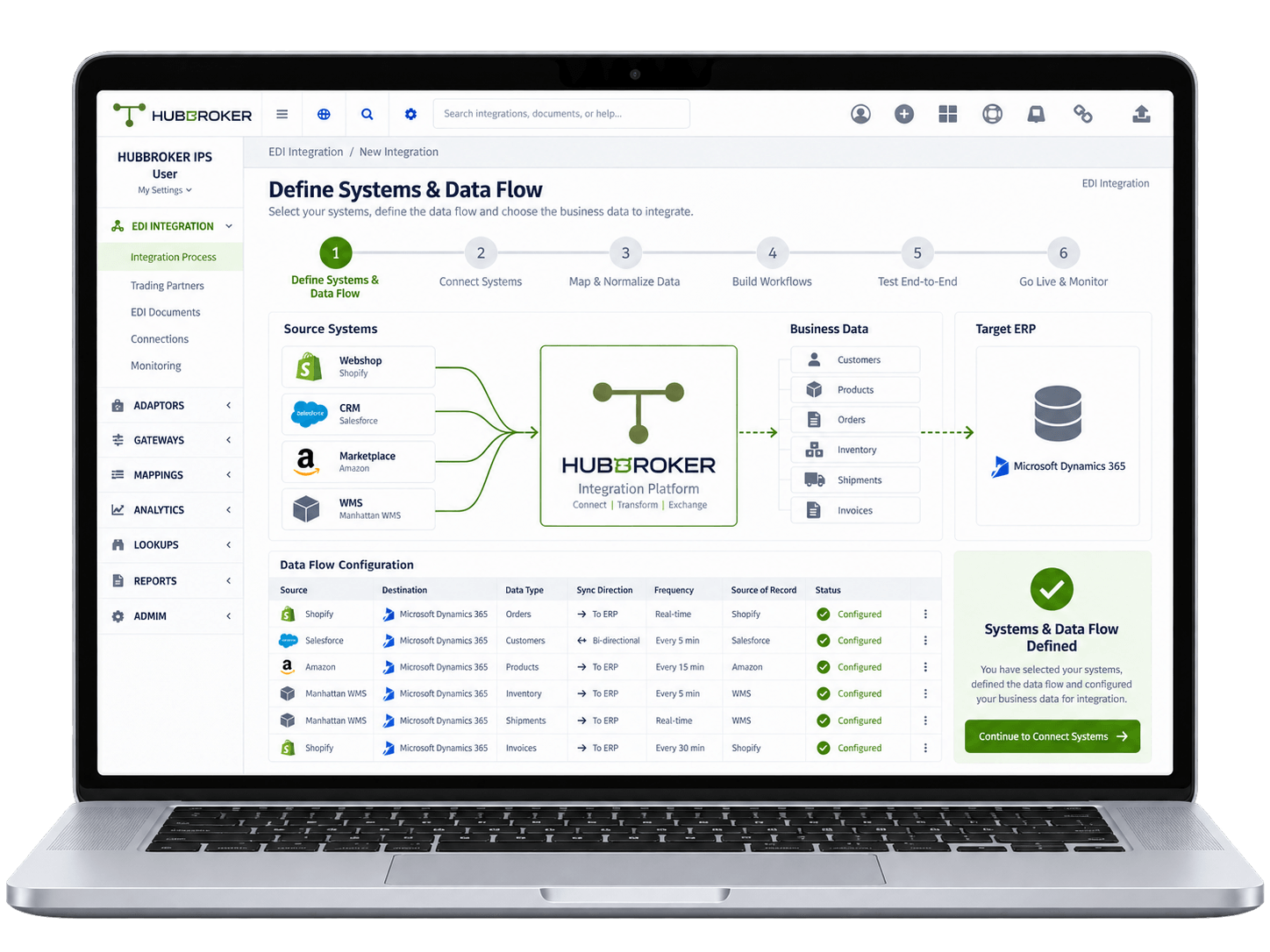
Define Systems & Data Flow

First, identify which systems need to connect with the ERP and what business data should move between them, such as customers, products, orders, inventory, shipments, and invoices. Define where each data comes from, where it needs to go, whether the flow is one-way or two-way, and how often the information should be updated.

Define Systems & Data Flow

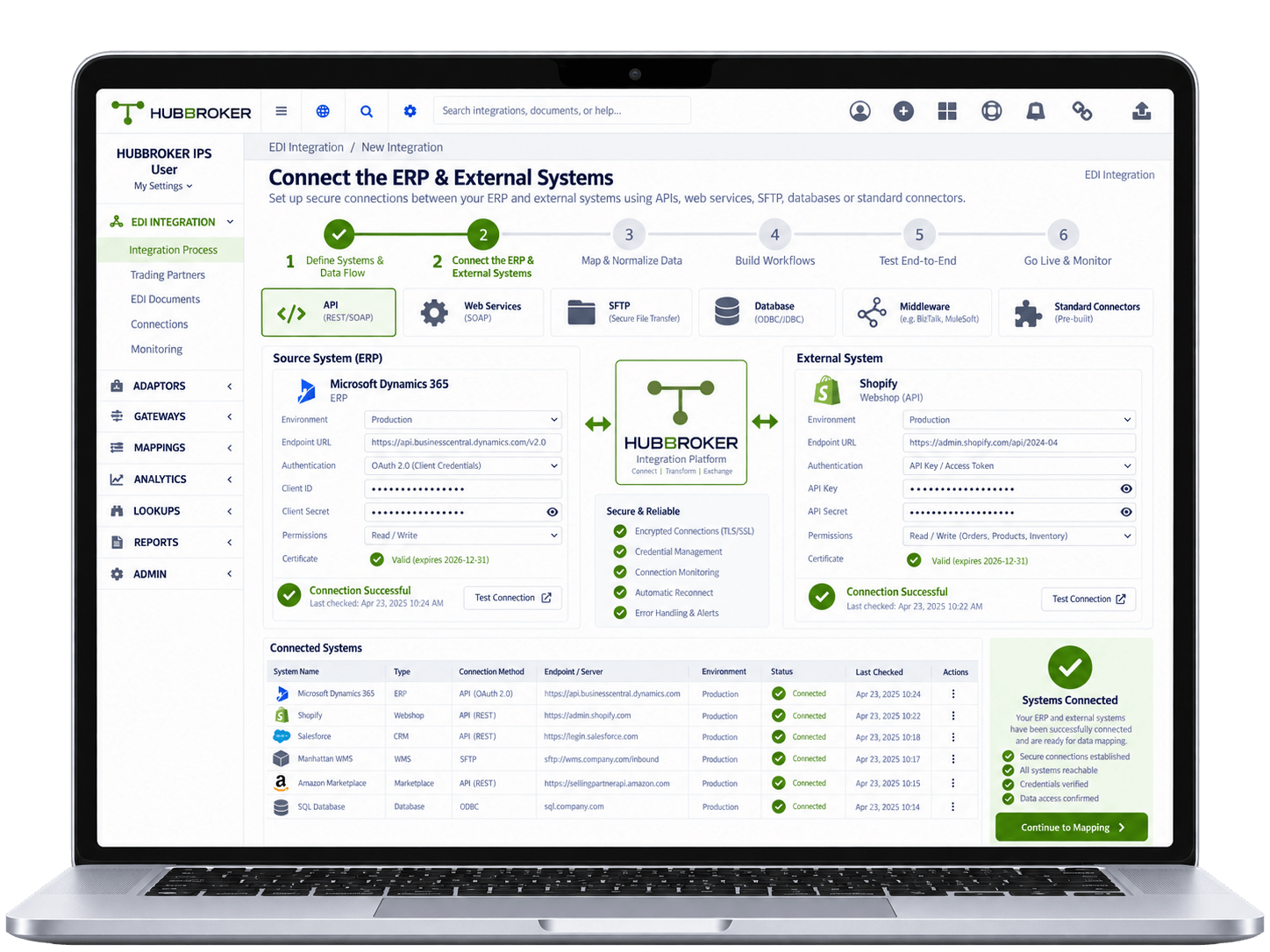
Connect the ERP & External Systems

Connect the ERP with external applications using APIs, web services, SFTP, databases, middleware, standard connectors, or another supported integration method. Set up the required credentials, endpoints, permissions, test environments, and system access so data can move securely between the connected applications.

Connect the ERP & External Systems

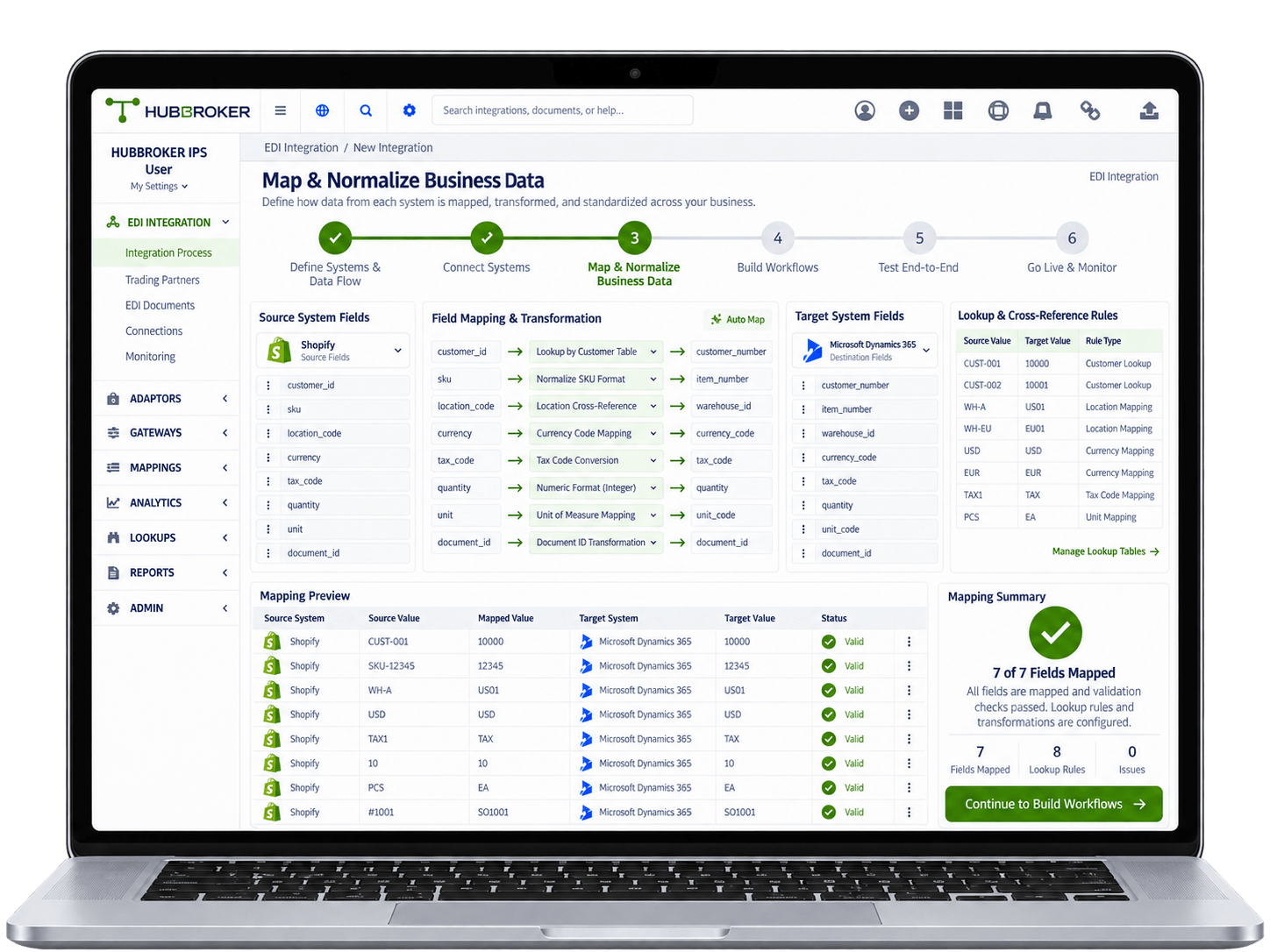
Map & Normalize Business Data

Match the fields used by both systems so customer numbers, SKUs, warehouse locations, currencies, tax codes, quantities, and document IDs are connected correctly. Different systems may use different codes or names for same customer, product, or location, so lookup and cross-reference rules may also be needed.

Map & Normalize Business Data

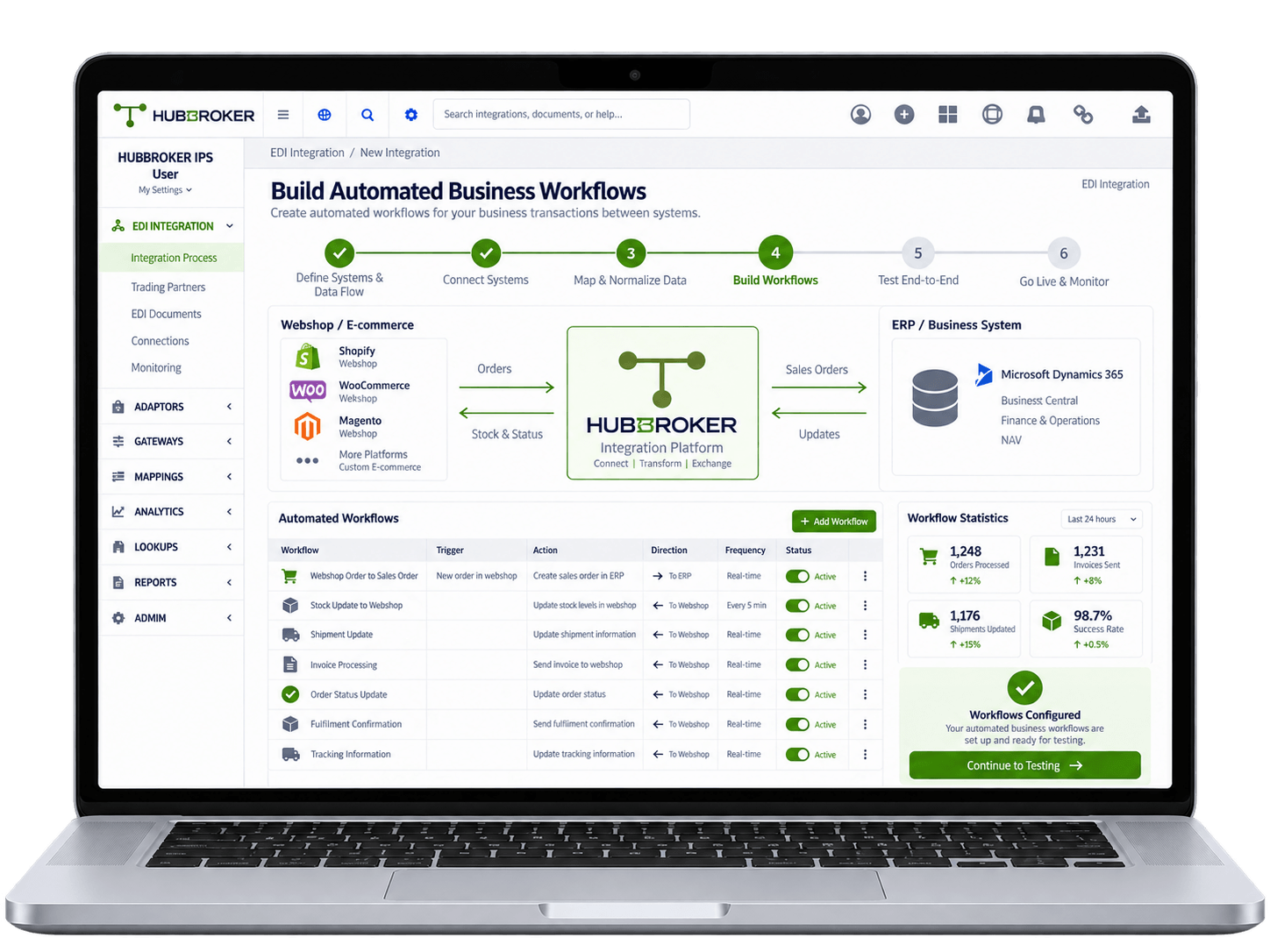
Build Automated Business Workflows

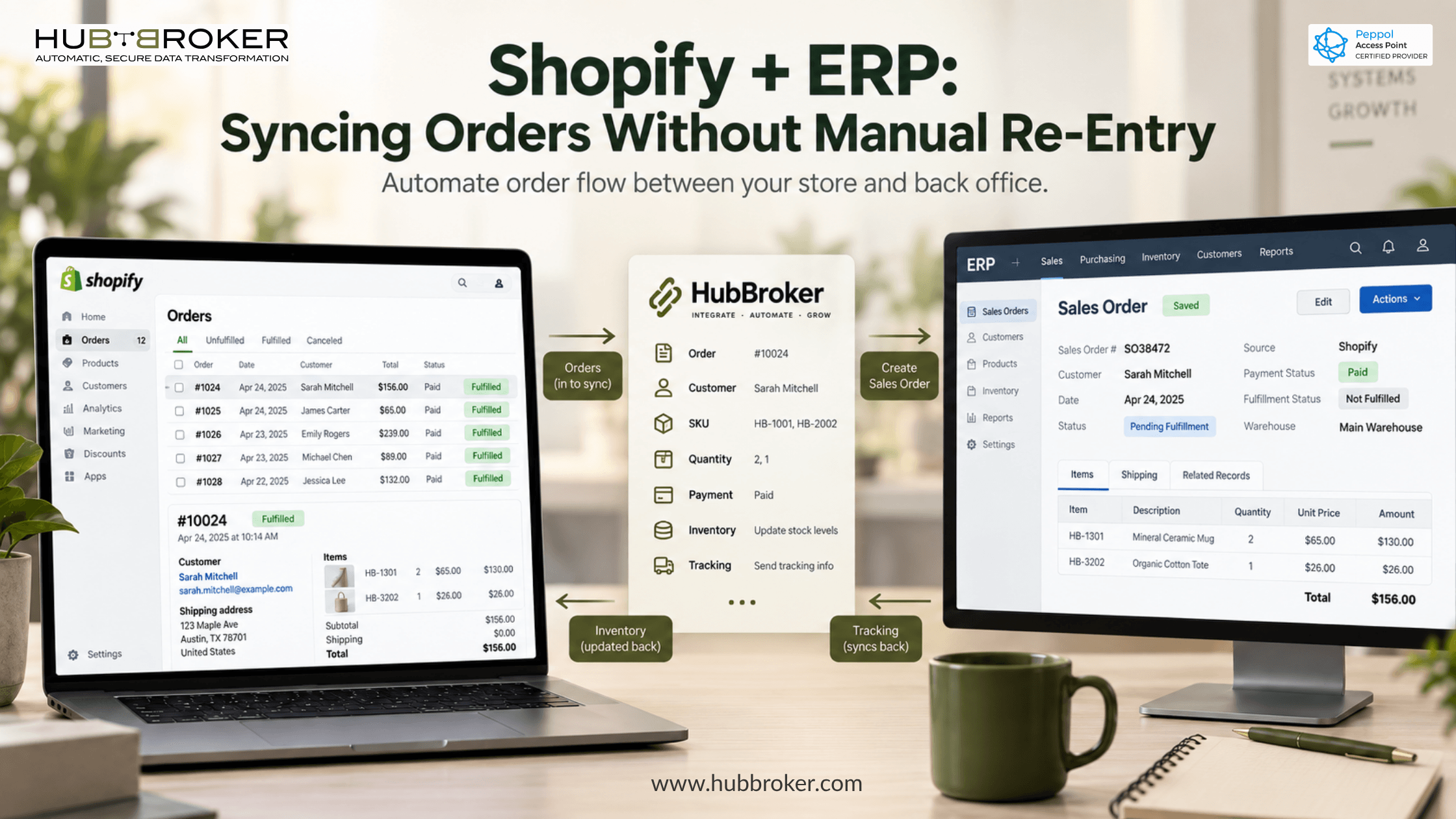
Configure how real business transactions should move between the connected systems based on the actual process your company uses. For example, a webshop order can create a sales order in ERP, ERP stock can update the webshop, and warehouse shipments can update order information back in ERP.

Build Automated Business Workflows

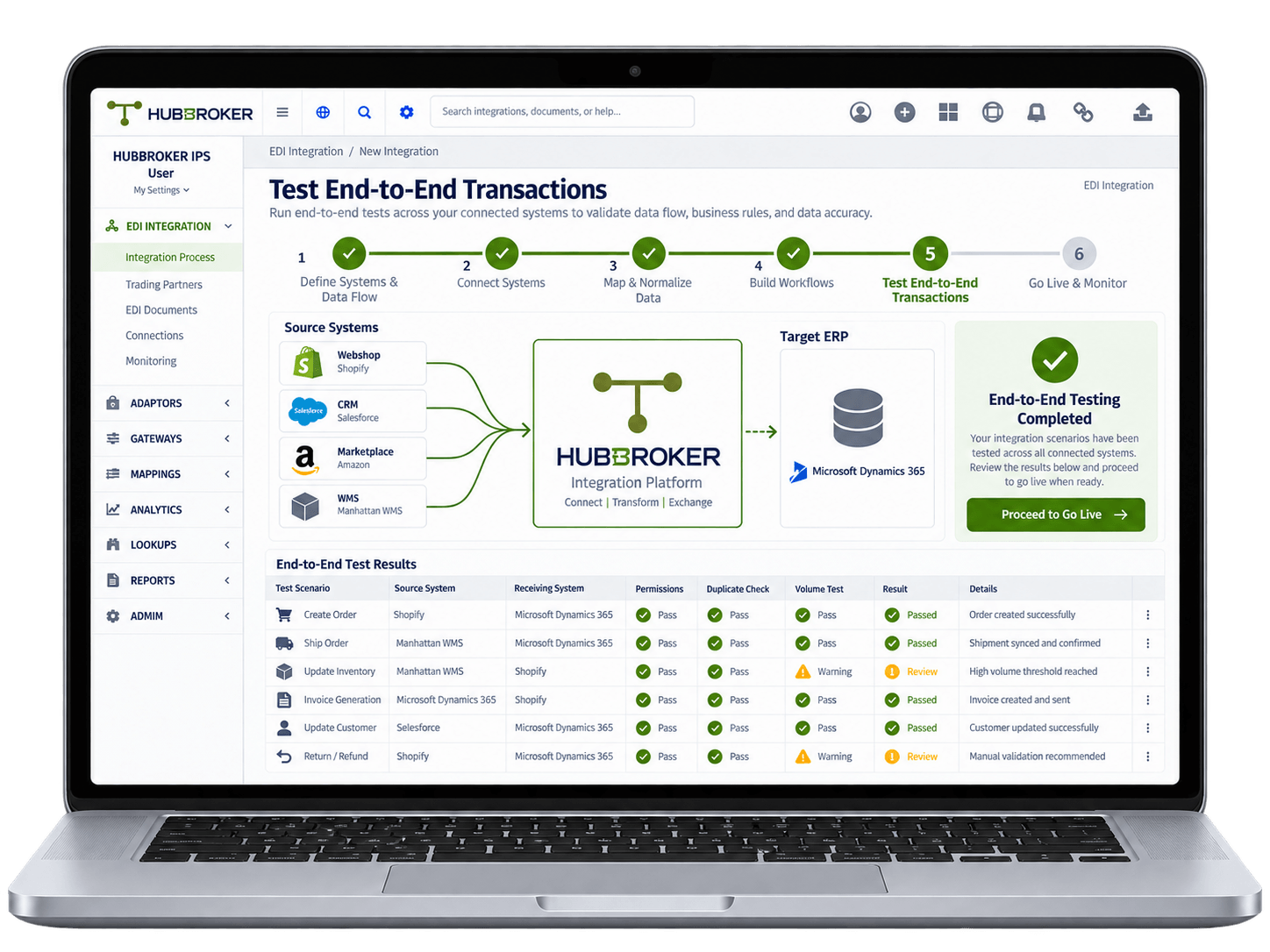
Test End-to-End Transactions

Run realistic business transactions through every connected system to make sure the complete integration works properly from start to finish. Check field mappings, system permissions, duplicate records, transaction volumes, failed requests, and how the receiving system processes the data.

Test End-to-End Transactions

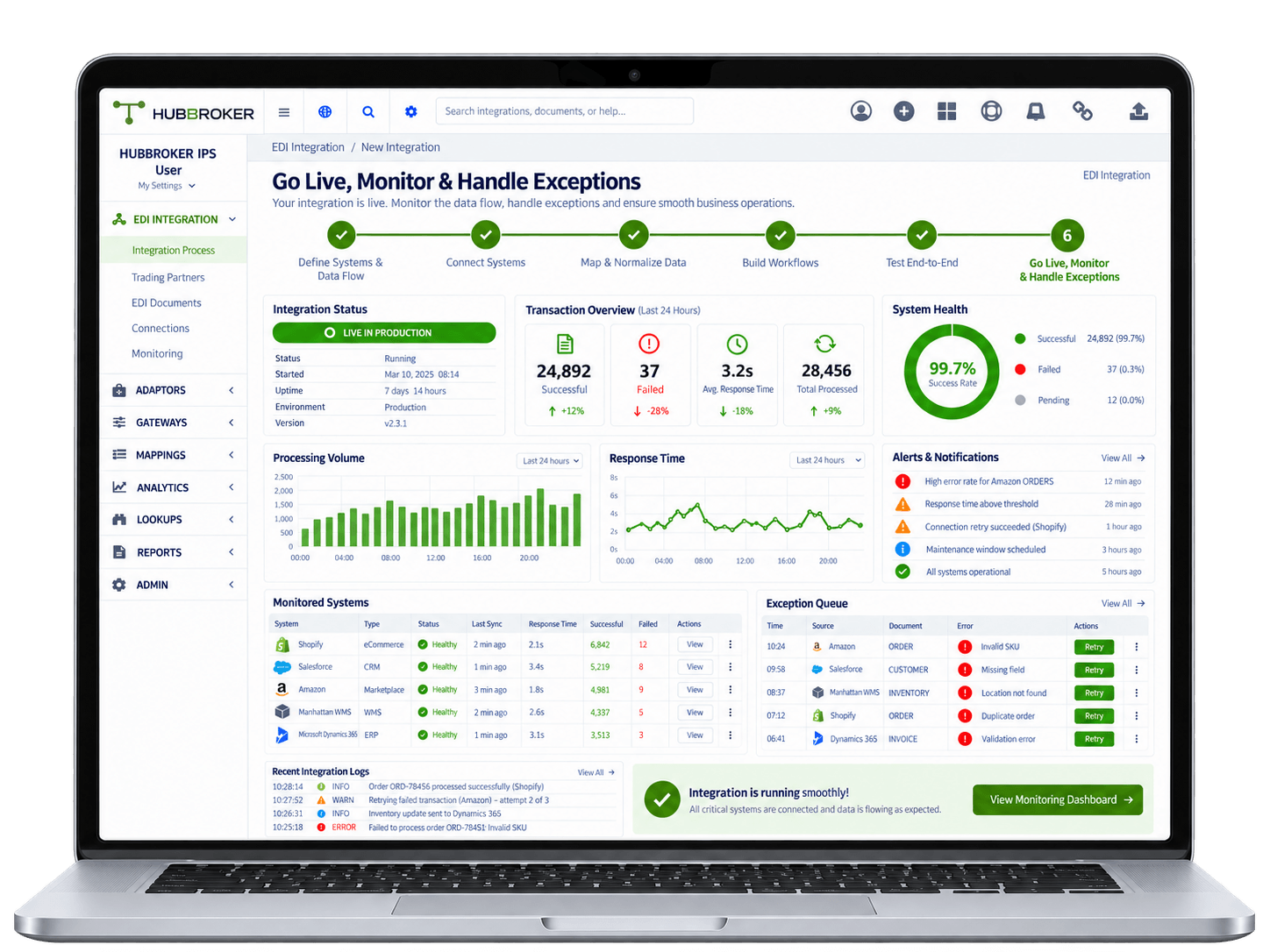
Go Live, Monitor & Handle Exceptions

Once testing is completed and approved, move the integration into production and start processing real business transactions. Monitor synchronization status, processing times, failed transactions, system responses, and other integration activity so problems can be found quickly.

Go Live, Monitor & Handle Exceptions

Secure, Scalable ERP Integration

Automate the Apps That Matter to You

Key Benefits of ERP Integrations Service

Less Manual ERP Entry

Customer orders, supplier invoices, and dispatch documents flow into your ERP automatically, so finance and operations teams stop rekeying the same data across multiple business systems.

Faster Order-to-Cash Cycles

Orders received via EDI land directly in your ERP sales documents, so confirmation, picking, dispatch, and invoicing all start sooner, helping the business respond faster to demand.

Stronger Master Data Quality

Customer, supplier, and item data is validated as part of every EDI exchange, so your ERP stays clean and reporting reflects the true state of customer and supplier activity over time.

Quick Partner Onboarding

New customers, suppliers, and retailers can be added to your ERP EDI flow without custom development, using reusable mappings, partner profiles, and predefined document templates.

Peppol-Ready Compliance

Send and receive Peppol-compliant e-invoices and orders directly from your ERP, meeting B2G and EU mandates without separate portals, manual uploads, or third-party invoicing tools added.

Full Document Visibility

Track every EDI document, status, and exception from within your ERP context with logs, audit trails, and dashboards, so finance, IT, and operations teams share one accurate view.

Supported Documents

Why Businesses Choose HubBroker for ERP EIntegration Service

Designed Around ERP Realities

Our integration follows how real ERPs actually handle sales, purchasing, inventory, and posting, so your team is not forced into workarounds or parallel systems for daily document work.

Strong ERP Connector Coverage

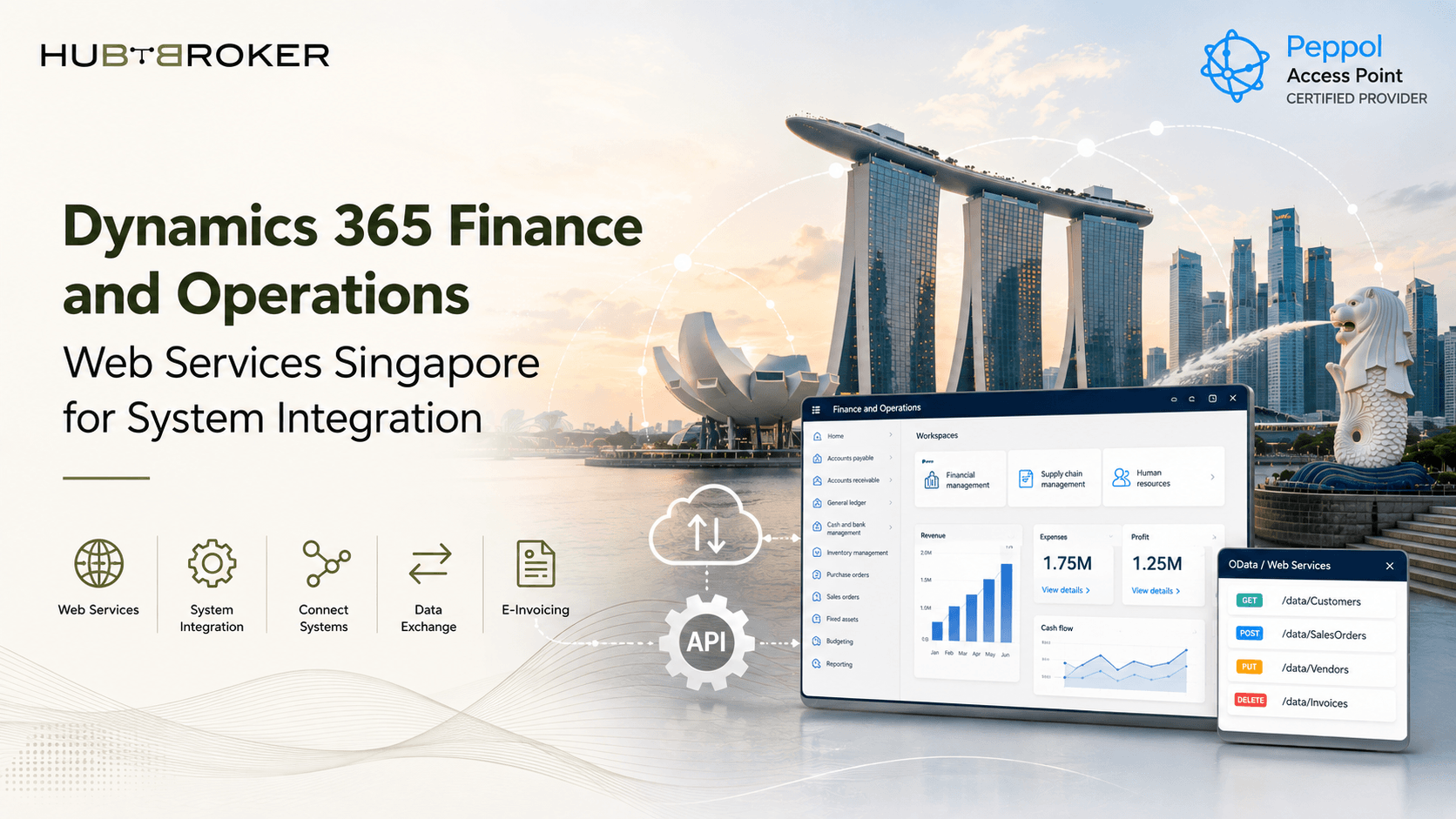
Pre-built connectors for Business Central, SAP B1, D365 F&O;, Visma e-conomic, Uniconta, Rackbeat, and others let you go live faster than a custom-built ERP integration usually allows.

Certified Peppol Access Included

ERP EDI customers get certified Peppol Access Point connectivity included, so e-invoicing, B2G mandates, and EU regulatory needs are handled inside the same integration setup.

Repeatable Implementation Approach

Our ERP EDI projects follow a documented path from requirement review through testing and go-live, so IT, finance, and operations stakeholders share clear timelines and scope.

Hands-On Support Across Regions

Teams in Denmark and India support ERP EDI customers directly on partner onboarding, format changes, and ERP-side issues, giving you a single point of contact rather than handoffs.

EDI Plus IDP, Peppol, APIs

ERP integration covers EDI, intelligent document processing, Peppol e-invoicing, and ERP API integration through the same HubBroker platform, so automation grows with the business.

Frequently Asking Questions

Technology alone does not guarantee outcomes; success depends on execution across four critical areas: leadership, data, business processes, and governance. Organizations that prioritize these pillars reduce risk, accelerate adoption, and increase the likelihood of lasting results.

ERP integration is the process of connecting an Enterprise Resource Planning (ERP) system—which manages core business operations like accounting, HR, and inventory—with other third-party software. It bridges disparate tools to automate workflows, eliminate manual data entry, and establish a single, unified source of truth across an organization.

An ERP (Enterprise Resource Planning) integration connects your central ERP database with other business applications (like CRM or e-commerce) so data flows automatically. This eliminates manual data entry, prevents errors, and creates a "single source of truth" across departments.

Industries We Empower Together

HubBroker solutions support businesses across industries where reliable data exchange, automation, compliance, and partner connectivity are essential.

Retail and eCommerce

Support fast-moving order, invoice, inventory, and marketplace workflows with automated document and system integrations.

Manufacturing

Help manufacturers connect suppliers, customers, ERP systems, and logistics partners for smoother production and supply chain operations.

Logistics and Transportation

Enable structured data exchange for shipping, delivery, tracking, invoicing, and partner communication across logistics networks.

Healthcare and Pharmaceuticals

Support secure and accurate document exchange where compliance, reliability, and process efficiency are critical.

Finance and Banking

Help financial businesses improve document processing, data accuracy, reporting flows, and secure business communication.

Wholesale and Distribution

Automate order-to-cash and procure-to-pay workflows across customers, suppliers, warehouses, and ERP systems.

Got Questions? We're Here To Help

+45 25943777 contact@hubbroker.com

Denmark Office

Bredgade 45B 1260 , København K Capital Region, Denmark

India Office

D-1010, The First, B/H ITC Narmada, Ahmedabad, Gujarat, 380015, India

START GROWING YOUR BUSINESS WITH US

This site is protected by reCAPTCHA and the Google Privacy Policy and Terms of Service apply.