
KSeF Is Live in Poland: What Enforcement Means for Your ERP in 2027
Most companies with a Polish entity got through 2026 the same way: connect to KSeF, get invoices clearing, move on to the next thing.
That worked, because 2026 was the free year. No financial penalties for KSeF errors, tokens and certificates both accepted, cash-register invoices allowed to carry on as they were. Plenty of finance teams have been running a KSeF ERP integration that technically works and quietly leaks rejections nobody watches, offline uploads nobody confirms, KSeF numbers nobody writes back into the ERP.
On 1 January 2027 that stops being free.
KSeF is already mandatory 2026 was the transition year
Poland's Krajowy System e-Faktur has been the compulsory route for issuing invoices for most of this year.
What has been in force since February and April
Taxpayers whose 2024 gross sales exceeded PLN 200 million came into scope on 1 February 2026. Everyone else registered for VAT in Poland followed on 1 April 2026. Receiving through KSeF has applied to every VAT-registered entity since February.
The invoice format changed at the same time. FA(3) replaced FA(2) on 1 February 2026 and is the only schema KSeF accepts. PDFs are not invoices any more the XML in KSeF is the original, and the PDF your customer looks at is a visualisation of it.
The last group joins in January
Sellers whose monthly invoiced sales come to PLN 10,000 gross or less have been allowed to issue outside KSeF through 31 December 2026. They join on 1 January 2027.
What actually changes on 1 January 2027
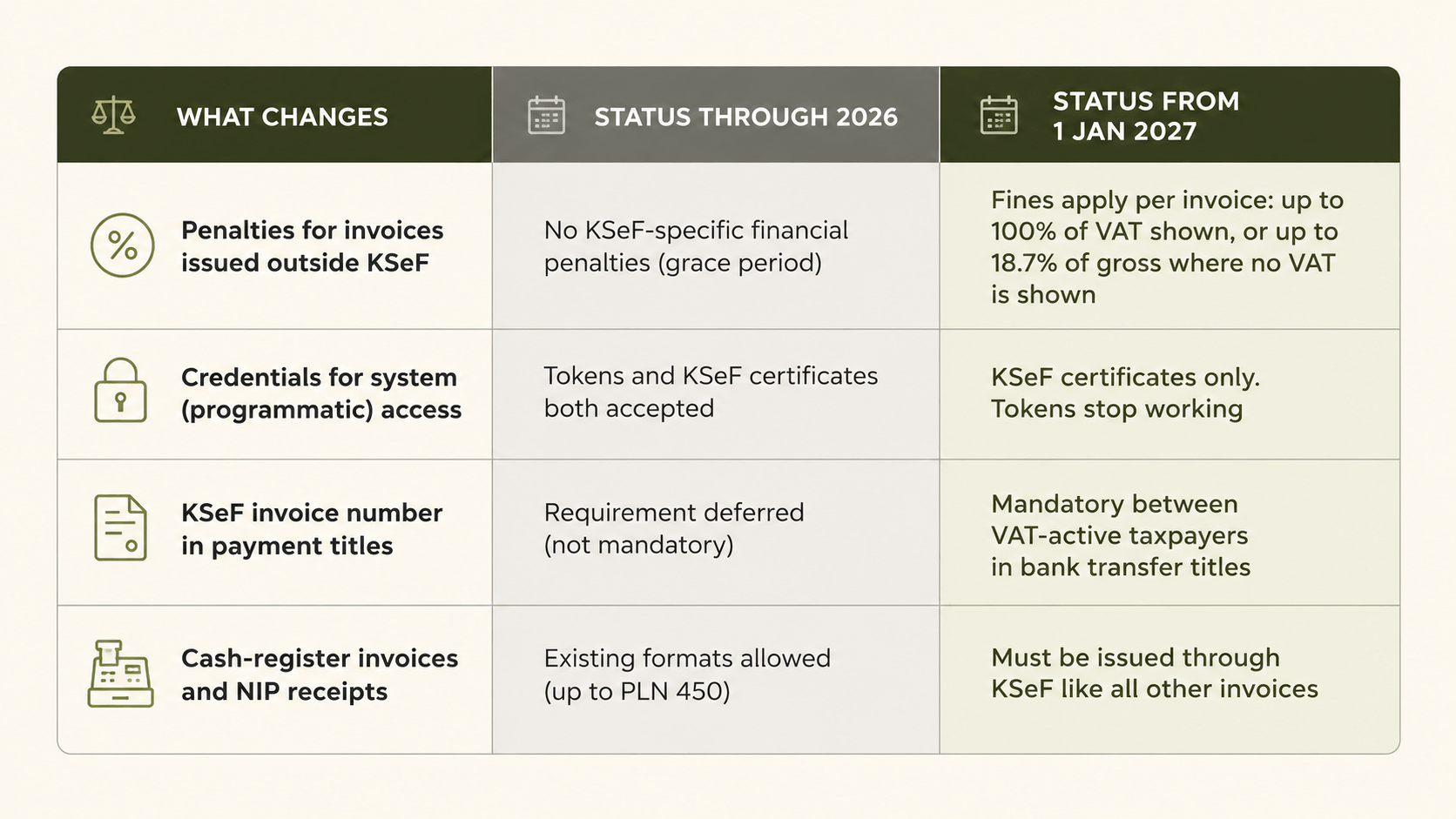
Four things land on the same date, and only one of them is the headline.
Penalties start
From 1 January 2027, an invoice issued outside KSeF can attract a fine of up to 100% of the VAT shown on it. Where no VAT is shown zero-rated exports, exempt supplies the fine can reach 18.7% of the gross invoice value. These are per-invoice penalties, so at volume they compound quickly.
Tokens stop working
Authorization tokens have been valid alongside certificates through 2026. From 1 January 2027, KSeF certificates are the only programmatic credential the system accepts. Certificates have been obtainable since November 2025 and run for up to two years.
If your integration authenticates with a token, it goes dark on 1 January. This is the single most likely cause of a hard outage, and it is entirely avoidable.
KSeF numbers move into payment titles
The requirement to quote the KSeF-assigned invoice number in bank transfer payment titles between VAT-active taxpayers was deferred through 2026. It applies from 1 January 2027. That means the KSeF number has to reach the people and systems making payments not sit in a log.
Cash-register invoices lose their exemption
Existing formats for cash-register invoices and NIP receipts up to PLN 450 have been permitted through 31 December 2026. After that they go through KSeF like everything else.
Why this is an ERP problem, not an accounting problem
None of the above is solved in the finance team's inbox. It is solved in the flow between your ERP and KSeF.
Rejections are silent failures
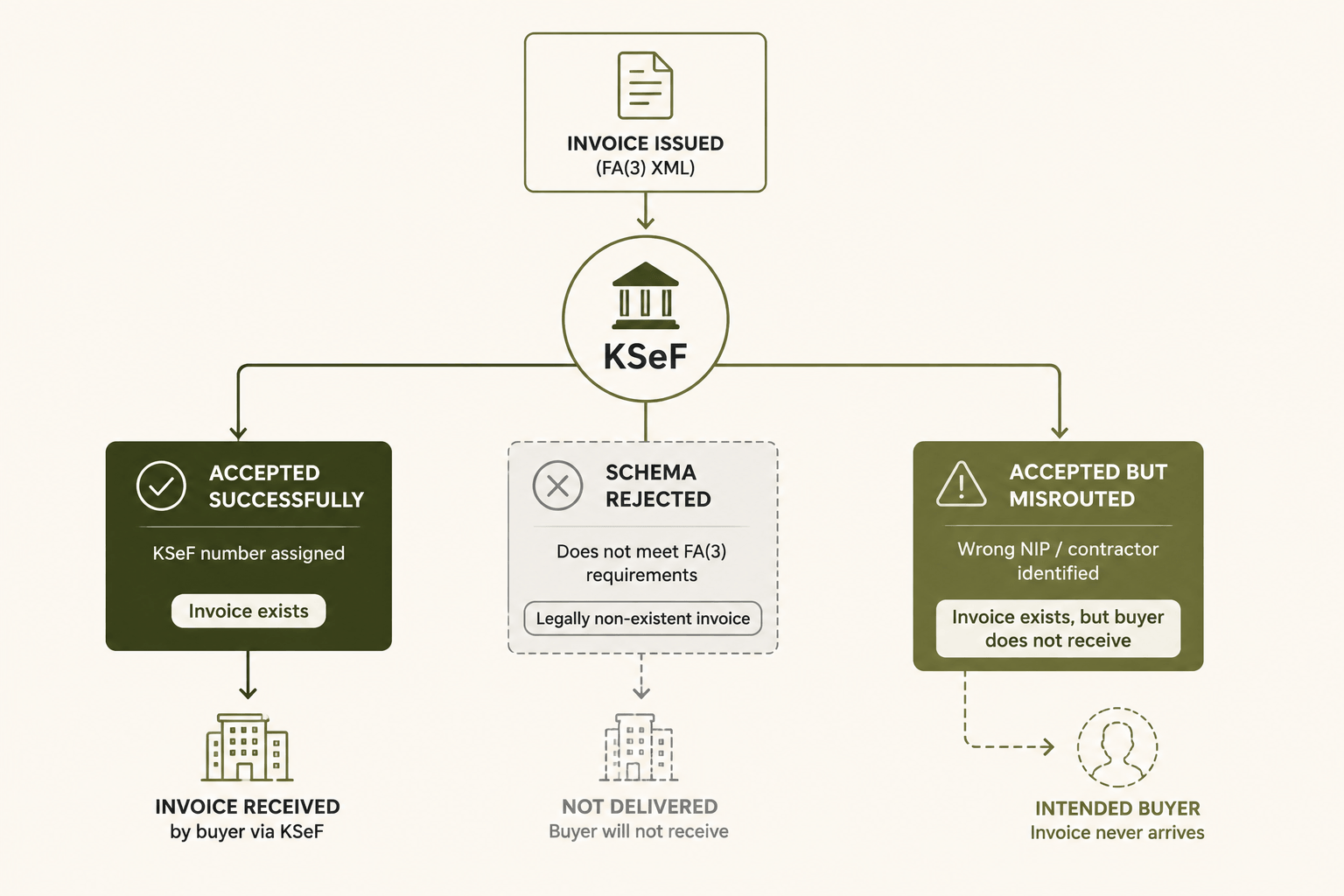
FA(3) has hundreds of fields, some always mandatory, some conditional on the transaction. A file that violates the schema is rejected outright and a rejected invoice legally does not exist. No KSeF number, no fixed issue date, and your customer never sees it.
The worse case is subtler: a wrong contractor NIP. KSeF accepts the invoice, assigns a number, and the intended recipient never receives it. Nobody notices until someone chases the payment.
The offline window is short
Offline modes exist for downtime, but invoices issued that way have to be transmitted within the permitted period generally 24 hours or the next working day. From 2027, missing that window is a penalty event. Somebody, or something, has to be tracking the queue.
The KSeF number needs somewhere to live
Once payment titles depend on it, the KSeF number stops being metadata and becomes part of your order-to-cash data. It has to be written back to the ERP record and reachable by AR, AP and treasury.
A readiness checklist for the next four months
Migrate every machine-to-machine connection from token to KSeF certificate, and test it in production before December
Re-run FA(3) validation across your real invoice mix, not just a clean sample corrections, prepayments, VAT groups, exports
Add NIP validation upstream, in the ERP, before the invoice leaves
Build monitoring on rejections and on the offline upload queue, with alerts that reach a named owner
Write KSeF numbers back to the ERP invoice record and expose them to payment processes
Move cash-register invoice flows into KSeF
Decide who owns a failed invoice at 17:00 on a Friday
Where an integration layer fits
You do not need a new ERP for this. You need the connection between the ERP you have and KSeF to be reliable, monitored and owned.
That is the layer HubBroker operates. Our ERP integration and e-invoicing services sit between systems like Microsoft Dynamics 365 F&O or SAP Business One and the national platform, handling format transformation, validation, error handling and audit trail without touching how your finance team works. We covered the underlying KSeF integration risks in more detail earlier this year.
Poland is also not a standalone project. Domestic invoicing runs through KSeF; cross-border invoicing runs through Peppol, which is where our certified Peppol Access Point comes in see the Poland Peppol registration guide for how the two fit together. France went live in September 2026, Germany's B2B mandate follows in January 2027, and the EU's ViDA reporting requirements arrive in 2030. The architecture you settle on now is the one you will be living with.
FAQ
Is KSeF mandatory now? Yes. Issuing through KSeF has been mandatory since 1 February 2026 for taxpayers with 2024 gross sales above PLN 200 million, and since 1 April 2026 for all other VAT-registered businesses in Poland. Receiving has been mandatory since February 2026.
Do penalties apply to invoices issued during 2026? KSeF-specific financial penalties apply to violations from 1 January 2027. The 2026 calendar year was a grace period. Ordinary VAT consequences disputes over deduction, refund timing were never suspended.
Will our tokens keep working in 2027? No. Tokens are valid through 31 December 2026. From 1 January 2027, KSeF certificates are the only accepted credential for system access. Migrate before December.
Can we stay on FA(2)? No. FA(3) has been the only schema KSeF accepts since 1 February 2026, including for corrections to invoices originally issued under FA(2).
Does a foreign company with a Polish VAT number need KSeF? Scope depends on whether the entity has a fixed establishment in Poland for VAT purposes. This is a case-by-case determination check it with your Polish tax advisor rather than assuming.
Do we have to replace our ERP? No. KSeF is a connectivity and data-quality obligation. An integration layer between your existing ERP and KSeF handles it without an ERP project.
If you have a Polish entity and you are not certain what happens to your invoice flow on 1 January, a 30-minute look at the current setup will tell you. Get in touch and we will walk through it with you.
