
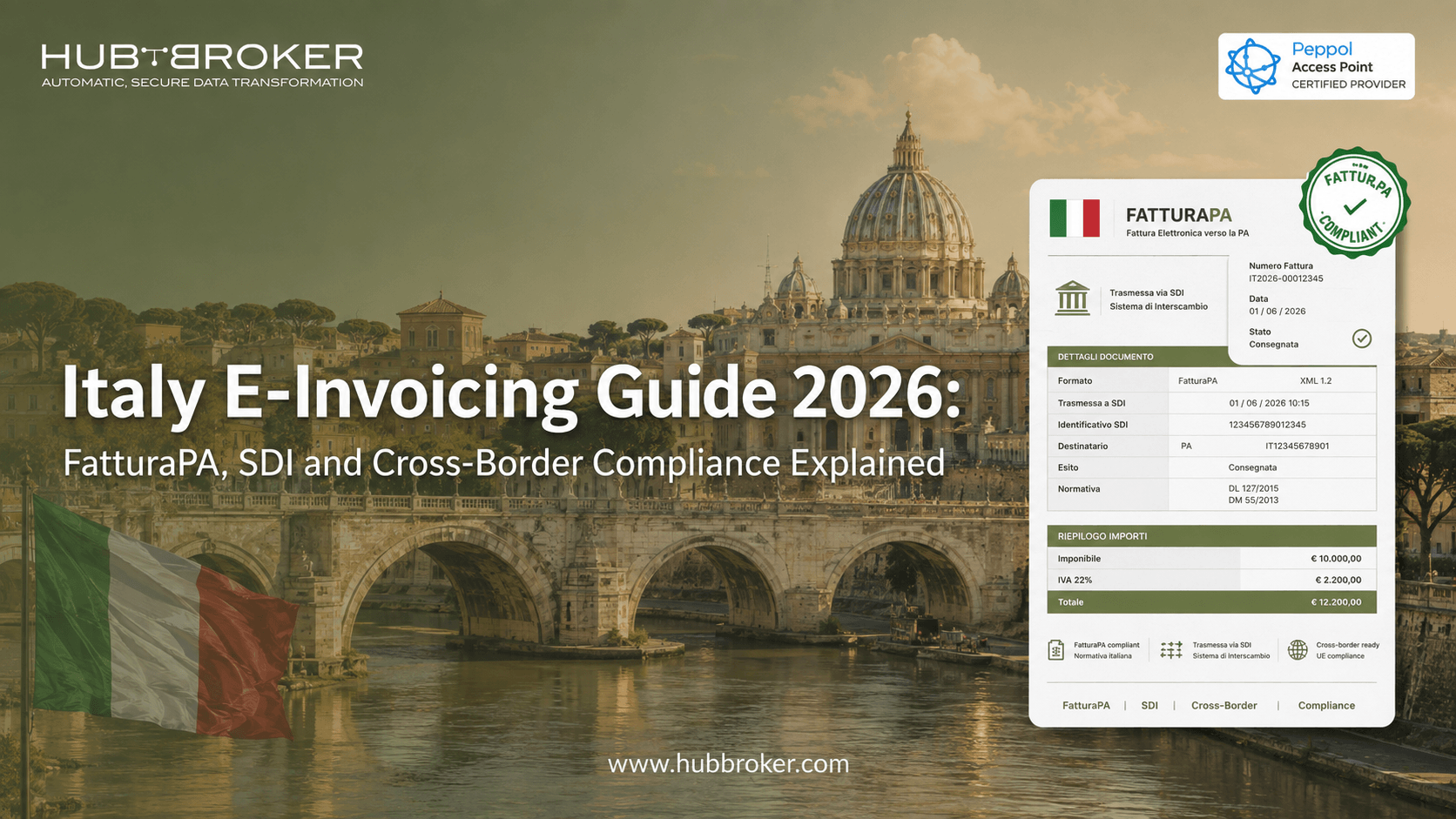
Italy E-Invoicing Guide 2026: FatturaPA, SDI and Cross-Border Compliance Explained
Italy has one of the most established electronic invoicing systems in Europe. However, many companies still find FatturaPA formats, SDI validations and cross-border reporting rules difficult to manage. Under Italy e-invoicing 2026 requirements, businesses need more than a PDF invoice. Invoice information must be created in the correct structured format, submitted through the required system and stored according to Italian regulations.
This guide explains the main requirements and how businesses can simplify compliance.
What Is E-Invoicing in Italy?
Electronic invoicing in Italy means creating an invoice as structured XML data and transmitting it through the Sistema di Interscambio, commonly called SDI. Italy has mandatory e-invoicing requirements for B2G, B2B and B2C transactions. Since January 2024, the obligation generally applies to Italian businesses regardless of their size, including businesses that were previously excluded based on turnover. A normal PDF sent by email is not treated in the same way as a compliant electronic invoice. The structured invoice must pass through SDI before it is delivered to the customer.
What Is FatturaPA and How Does It Work?
FatturaPA is Italy’s structured XML invoice format. It contains information such as:
Supplier and customer details
Italian VAT numbers
Invoice number and date
Product or service information
VAT rates and tax amounts
Payment details
Document and transaction codes
The format was originally introduced for invoices sent to public authorities. It is now also used across Italy’s wider e-invoicing framework. FatturaPA follows technical rules defined by the Italian Revenue Agency. For public-sector invoicing, Italy also supports requirements connected with the European EN 16931 standard. Incorrect XML fields, missing VAT codes or invalid customer information can cause the invoice to be rejected by SDI.
What Is the SDI System in Italy?
SDI, or Sistema di Interscambio, is the central exchange system managed by the Italian Revenue Agency. When a company submits an invoice, SDI performs several checks before forwarding it to the recipient. It checks whether the file structure is valid, mandatory information is included and the recipient details are correct.
The normal process looks like this:
The supplier creates a FatturaPA XML invoice.
The invoice is submitted to SDI.
SDI validates the invoice.
SDI sends a delivery or rejection notification.
The accepted invoice is delivered to the customer.
Because SDI is part of Italy’s clearance model, businesses need to track both the invoice and its status notification. Creating the file is only half of the work.
Is E-Invoicing Mandatory in Italy in 2026?
Yes. Electronic invoicing remains mandatory in Italy in 2026 for most domestic B2B, B2C and B2G invoices involving Italian-established or Italian VAT-registered businesses. Italy has received EU authorisation to continue its mandatory SDI e-invoicing system until 31 December 2027. Companies should still check the treatment of each transaction.
The correct process may depend on:
Where the supplier is established
Where the customer is established
Whether the transaction is domestic or cross-border
Whether the company has an Italian VAT registration
Whether reverse-charge rules apply
Foreign companies should not assume that every invoice sent to an Italian customer must follow exactly the same process as a domestic Italian invoice.
How Does Cross-Border E-Invoicing Work in Italy?
Cross-border transactions require businesses to report relevant foreign invoice data electronically through SDI. For purchase invoices received from foreign suppliers, an Italian business may need to create an integration or self-invoice document using the relevant document type, such as TD17, TD18 or TD19, depending on the transaction.
For sales to foreign customers, the invoice must include the appropriate foreign customer information and routing details. Businesses also need to apply the correct VAT treatment and Natura code where VAT is not charged. Cross-border reporting is one of the most common areas where errors happen because ERP systems may not automatically create the correct Italian document types.
How Long Must Electronic Invoices Be Stored in Italy?
Sending an invoice through SDI does not complete the compliance process. Electronic invoices must also be stored using a compliant digital preservation process. This is commonly called conservazione digitale or conservazione sostitutiva. The process should protect the authenticity, integrity and readability of the invoice during the required retention period.
Simply saving the XML file in a normal computer folder may not meet all Italian preservation requirements.
How Can Businesses Automate Italy E-Invoicing Compliance?
Manual invoice preparation can work for a small number of transactions. But it becomes risky when a company manages multiple customers, currencies, VAT treatments or ERP systems.
An automated e-invoicing solution can:
✔ Convert ERP invoice data into FatturaPA XML
✔ Validate invoices before SDI submission
✔ Send invoices securely to SDI
✔ Receive delivery and rejection notifications
✔ Process cross-border document types
✔ Update invoice status inside the ERP
✔ Support compliant invoice archiving
HubBroker helps businesses connect their ERP and financial systems with Italy’s e-invoicing framework. Our solution can automate invoice conversion, SDI communication, status tracking and integration with your existing business processes.
Prepare for Italy E-Invoicing 2026
Italy’s system is already active, but compliance requirements will continue developing alongside the EU’s VAT in the Digital Age programme. The main EU digital reporting requirements for cross-border B2B transactions are planned from July 2030, so companies should also consider long-term European interoperability when selecting a solution.
Businesses should review their invoice formats, SDI connections, cross-border transactions and digital storage setup now.
Contact HubBroker to simplify Italy e-invoicing compliance and connect FatturaPA and SDI directly with your ERP system.
