

September 2027: The Small and Micro Enterprise Wave Nobody Has Planned For
For most French businesses, the e-invoicing headlines peaked this summer. Large companies and ETIs started issuing structured invoices on 1 September 2026, and every business in scope had to be able to receive them from that date. For many owners of smaller firms, it felt like the finish line.
It wasn't. For France e-invoicing in 2027, small business owners have a different date to plan around: 1 September 2027. That is when the issuance obligation reaches PME, TPE and micro-entreprises. From then on, your outgoing invoices have to change, not only your inbox. Eleven months out, very few small businesses have set aside time or budget for it.
What changes on 1 September 2027
Two obligations start on the same day, and they apply to more businesses than most owners expect.
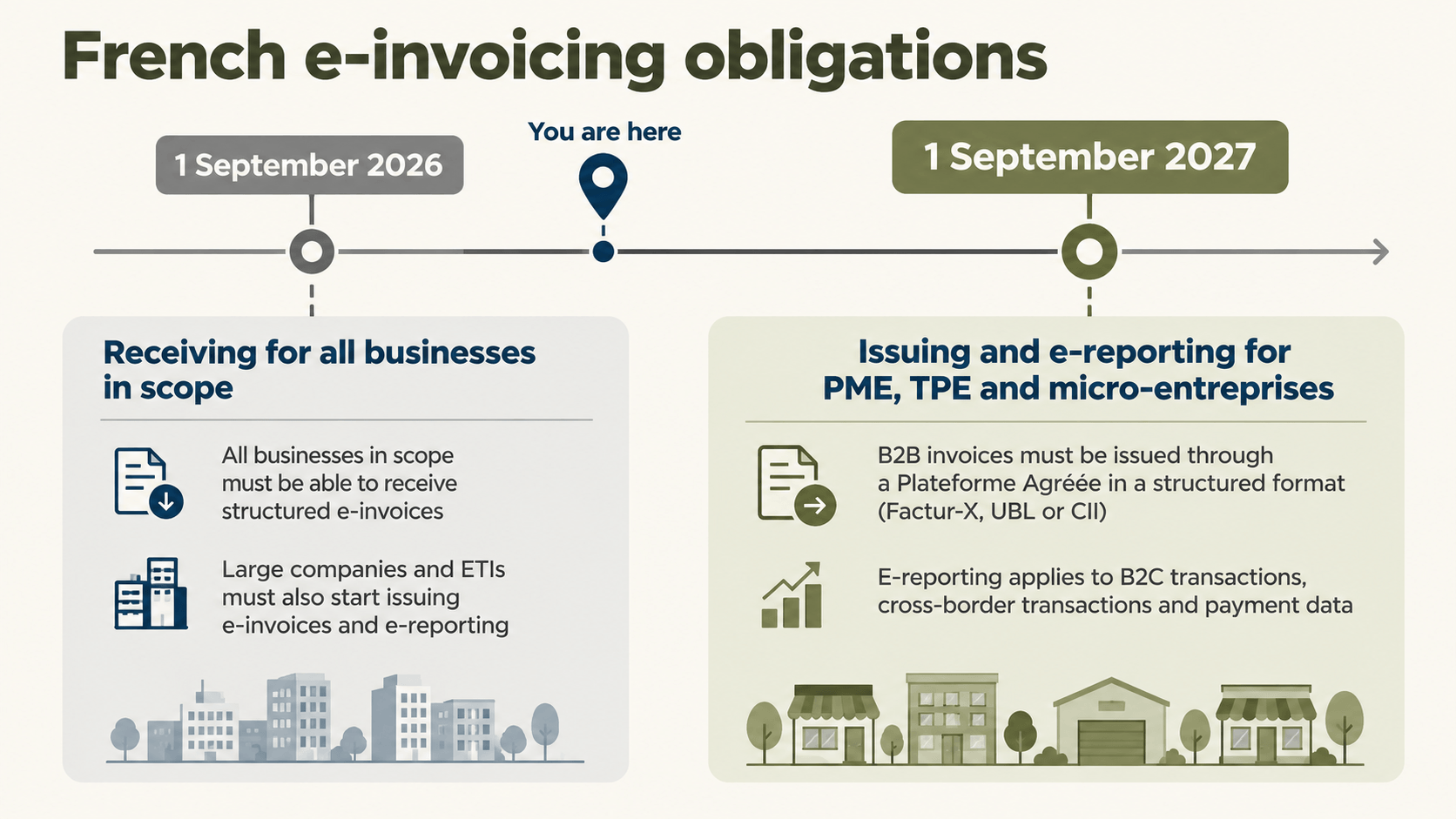
Issuing: your B2B invoices go through a Plateforme Agréée
From that date, invoices you send to French business customers must pass through a Plateforme Agréée (PA) in a structured format: Factur-X, UBL or CII. A PDF attached to an email no longer meets the obligation for those sales. If you want the architecture behind this (the Y-model and the roles of the PA and the PPF), our France e-invoicing mandate guide covers it.
E-reporting: the obligation that catches B2C businesses
E-reporting starts on the same date. Sales to consumers, cross-border transactions and payment data have to be reported to the tax administration through your platform. A business that sells only to private customers, and never issues a single e-invoice, therefore has an obligation too.
Who is in scope
The reform covers VAT-liable businesses established in France. That includes micro-entrepreneurs under the franchise en base de TVA. They don't charge VAT, but they are assujettis, so both receiving and issuing apply to them.
Why this wave is bigger than the first
The government puts the reform's reach at more than 10 million economic actors. The first issuance wave covered a relatively small group of large companies and ETIs. Almost everyone else goes live together in September 2027.
The onboarding queue
Platforms, software vendors and experts-comptables will receive most of their onboarding requests in the same few months. An owner who starts in spring 2027 joins the back of that queue.
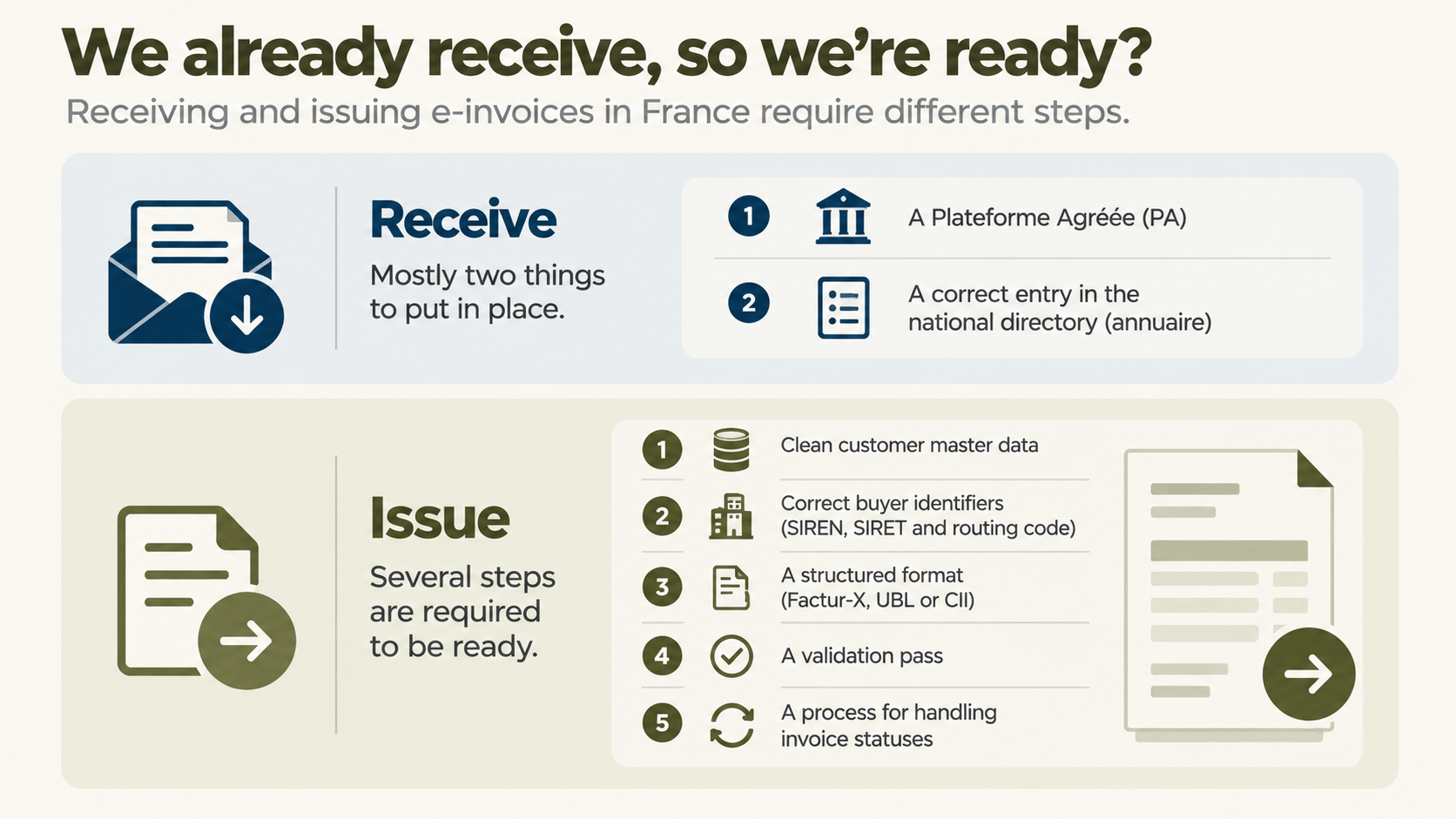
"We already receive, so we're ready"
This is the most common misreading of the reform. Receiving mostly requires a PA and a correct entry in the national directory. Issuing is harder. You need clean customer master data, the right buyer identifiers (SIREN, SIRET and sometimes a routing code) and a structured file that passes validation. You also need a process for the statuses that come back. Our posts on how the annuaire routes French invoices and on invoice lifecycle statuses show where issuing projects tend to fail.
What happens to your PDF invoice after September 2027
Article 1737 of the Code général des impôts sets a fine of €50 per invoice not issued in electronic form, capped at €15,000 per calendar year. A business sending 300 invoices a month would reach that cap in one month of non-compliance.
The commercial cost can outweigh the fine. Your customers' accounts payable systems are being built around structured data. A PDF that cannot be matched automatically goes into a manual queue, and manual queues pay late.
If your current tool only produces PDFs, you have two routes. One is to generate Factur-X, a PDF with embedded XML (see our comparison of Factur-X profiles). The other is to convert existing output through PDF to XML invoice conversion before it reaches your platform.
The knock-on effect for larger buyers
If you run a larger company, this wave affects you too. Most of your small French suppliers will switch at the same time. You should expect more supplier questions, more identifier mismatches and more exceptions between September and December 2027. Plan your AP team's capacity for that period now, not in August.
A 12-month preparation plan
Here is a realistic sequence that avoids the spring 2027 rush.
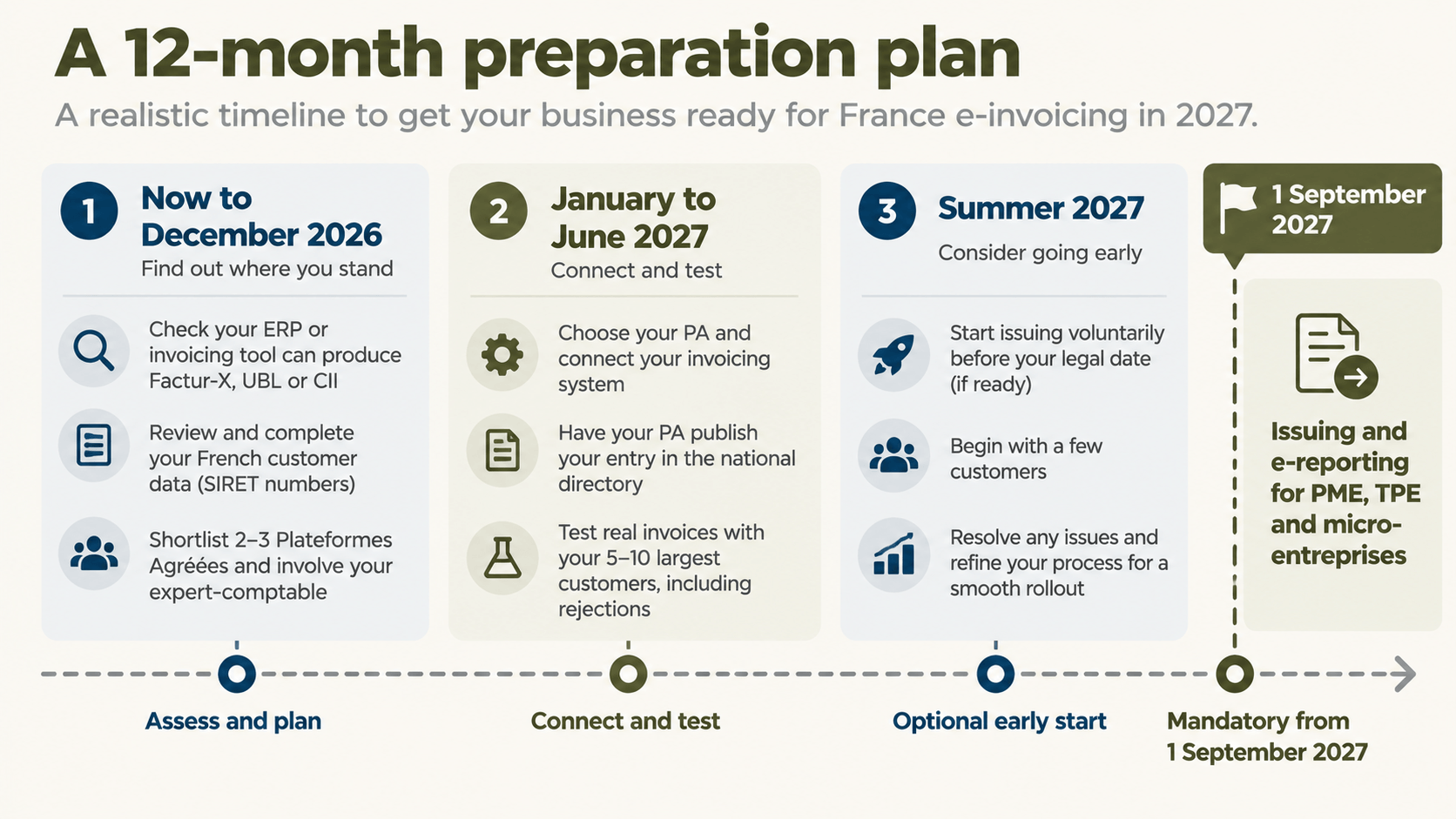
Now to December 2026: find out where you stand
Check whether your ERP or invoicing tool can produce Factur-X, UBL or CII. Review your French customer records and confirm you hold SIRET numbers, not only SIREN. Shortlist two or three PAs, and bring your expert-comptable into the conversation early.
January to June 2027: connect and test
Choose your PA and connect your invoicing system to it. Your PA publishes your entry in the directory. Test real invoices with your five to ten largest customers, including rejection and correction scenarios.
Summer 2027: consider going early
The DGFiP's guide pratique confirms that businesses can start issuing e-invoices voluntarily before their legal date, and can do so progressively. Starting with a few customers in June gives you a quiet run before September.
Keep your ERP, add the compliance layer
Most small businesses do not need a new ERP for this. They need their existing system to produce clean, structured invoices and exchange them with a PA. HubBroker provides that integration layer. It connects Business Central, SAP Business One, e-conomic, Uniconta and other systems to your chosen platform, with mapping, validation and status updates flowing back into the ERP. See our ERP integration services for how the connection is built.
FAQ
Can I keep using a paper invoice book after September 2027? Not for B2B sales to French VAT-registered customers. From 1 September 2027, those invoices must be issued electronically through a PA.
I only sell to consumers. Does September 2027 affect me? Yes. You won't issue B2B e-invoices, but e-reporting of your B2C transaction and payment data applies from the same date.
What happens if we aren't ready? The fine for not issuing electronically is €50 per invoice, capped at €15,000 per year. The administration described its approach to the 2026 start-up phase as tolerant. Don't assume the same approach will apply in 2027.
Can we start before our legal deadline? Yes. Voluntary early issuance is permitted and can be phased in customer by customer.
Do we need to replace our ERP? Usually not. In most cases the gap is closed in an integration layer between your ERP and your PA.
What about invoices to customers outside France? Cross-border sales fall under e-reporting rather than domestic e-invoicing. Our article on e-reporting in France explains how that data flows.
Start the conversation early
Eleven months sounds like plenty of time until you count the onboarding queue ahead of you. If you want to know what your current setup needs before September 2027, talk to our integration team.
