
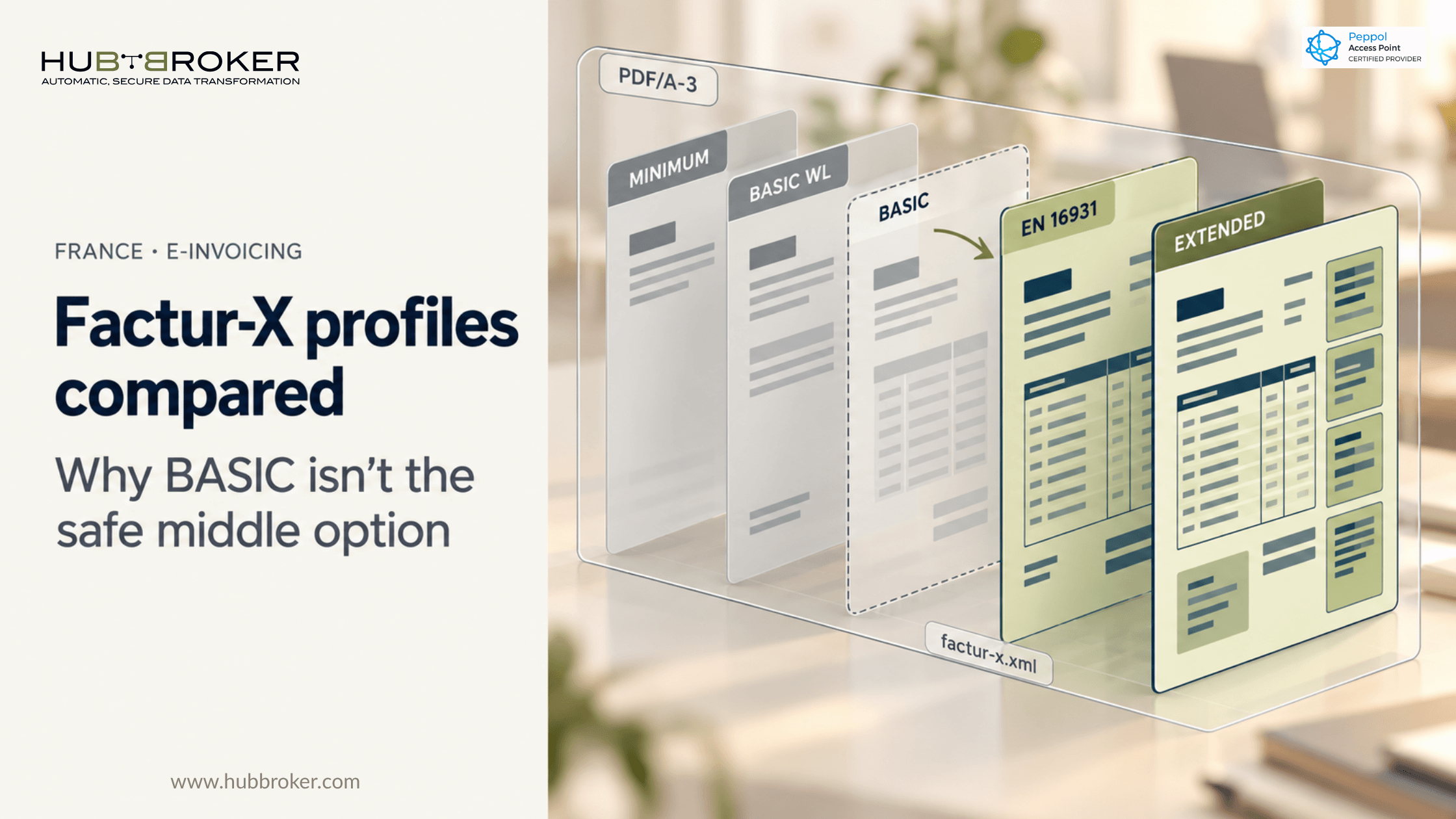
Factur-X Profiles Compared: BASIC, EN 16931 and EXTENDED
Ask an ERP consultant which Factur-X profile a French client should send, and the most common answer is "BASIC, to be safe." It sounds sensible: line items, a small field set, EN 16931 compliant.
Under France's e-invoicing reform, it's the wrong answer on paper. Choosing between factur-x profiles is a mapping decision. It determines which ERP fields you have to populate, which validation rules fire, and whether the receiving platform accepts the invoice at all.
Here is how the profiles compare, and how to pick one for a real ERP project.
What Factur-X is, in one paragraph
Factur-X is a hybrid invoice: a readable PDF/A-3 with an embedded UN/CEFACT CII XML file named factur-x.xml. It is technically the same standard Germany calls ZUGFeRD. The profile declared in the XML sets how much structured data the file carries and which business rules the file is validated against. If you are new to the format, start with our [Factur-X format explainer LINK TBC].
The five factur-x profiles at a glance
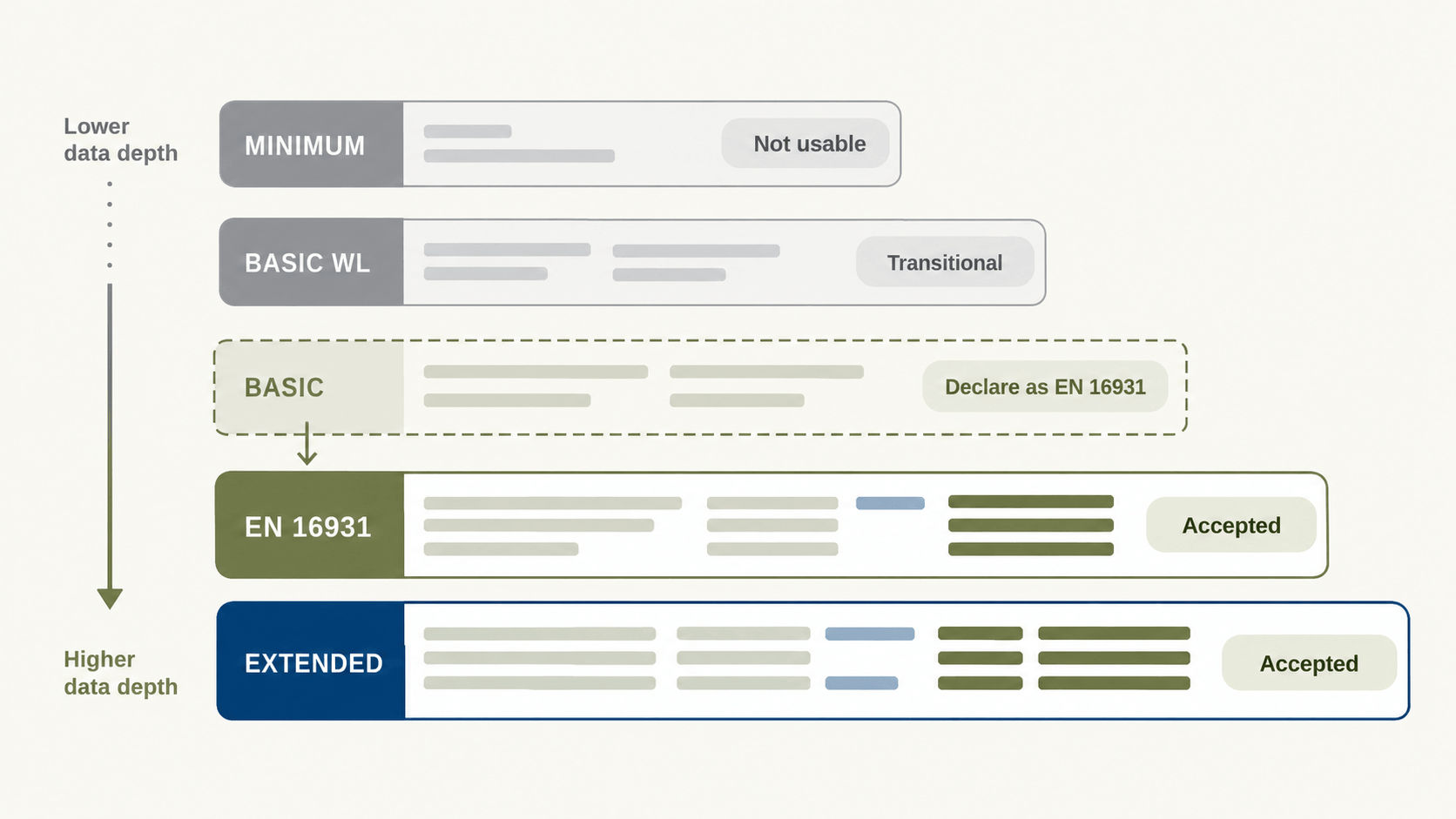
MINIMUM and BASIC WL: header-level data only
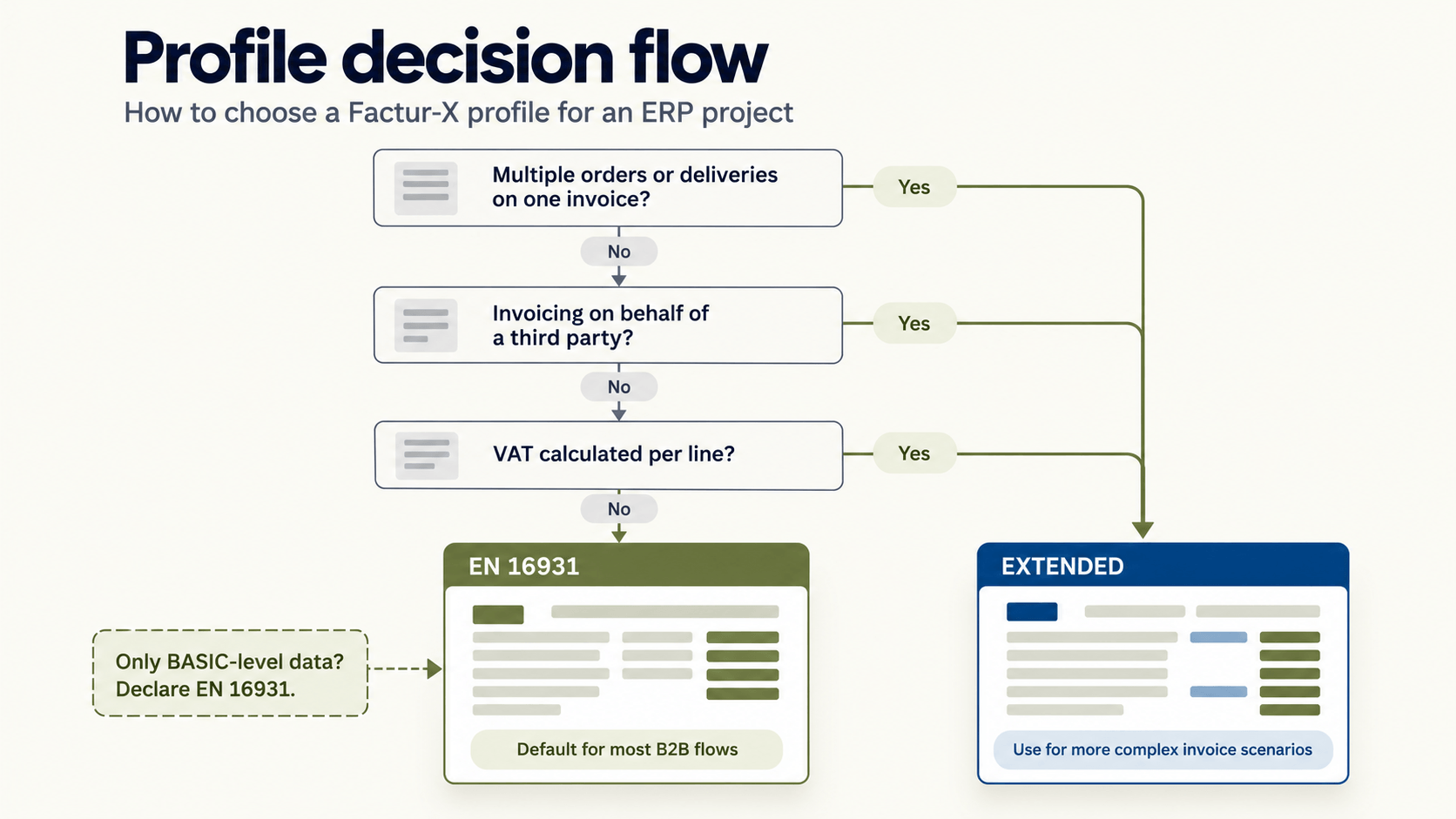
MINIMUM carries the bare data needed for Chorus Pro. It cannot be used under the French reform because there isn't enough structured data in it.
BASIC WL ("without lines") is BASIC minus line data and document-level allowances and charges. It isn't strictly EN 16931 conformant, because invoice lines are mandatory in the norm. France permits it at the start of the reform, currently only until 1 September 2027, pending confirmation in updated texts.
BASIC: compliant, but not retained
BASIC is a subset of EN 16931 containing the mandatory data and business rules. Every valid BASIC invoice is also a valid EN 16931 invoice. For that reason, the French specification does not retain BASIC for the reform and recommends declaring those invoices as EN 16931 instead.
In practice, you can keep a lean BASIC-sized data set. Change the profile identifier (BT-24), then apply the French business rules.
EN 16931: the default for most B2B flows
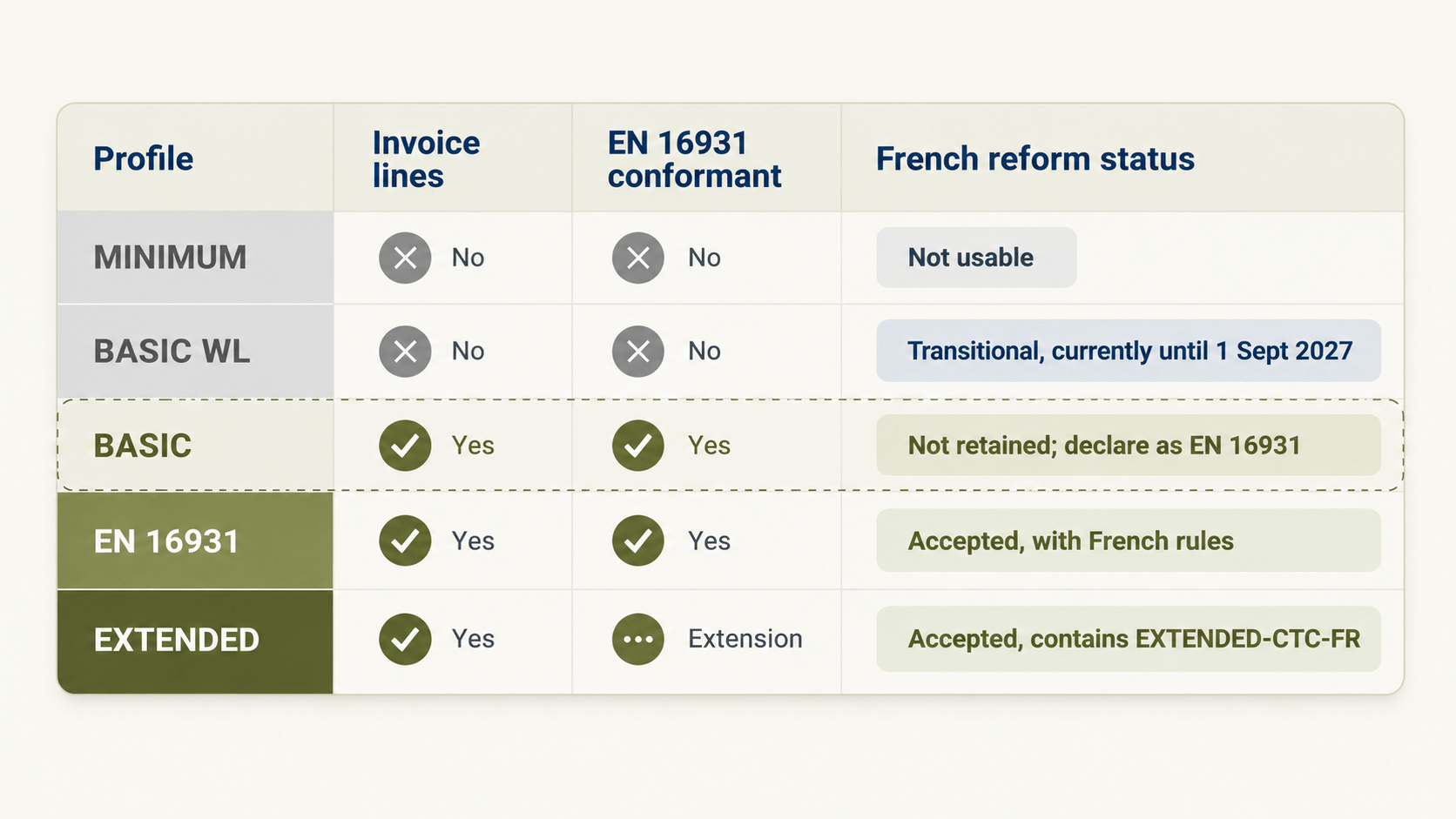
The EN 16931 profile covers the full European semantic model. In France, it is used with additional French business rules on top. The norm assumes one invoice relates to one order and one delivery, which covers most standard B2B invoicing.
EXTENDED: when one order and one delivery isn't reality
EXTENDED adds third parties (invoicer, buyer's agent, payer, seller's agent), line-level references, multi-order and multi-delivery invoices, and rounding tolerances for line-level VAT calculation. France's own extension, EXTENDED-CTC-FR, is a subset of Factur-X EXTENDED.
How to choose a profile for a client's ERP
Map what the ERP can actually output
Start with the data, not the profile name. Pull a sample of real invoice types (standard, credit note, down-payment, final invoice) and check which fields the ERP populates at header and line level.
This differs by platform and version. Test the specific system rather than assuming, whether it's Business Central, Dynamics 365 Finance & Operations or SAP Business One. Our guide to Dynamics 365 e-invoicing gaps covers the typical shortfalls.
Match the receiver, not just the rulebook
A buyer running three-way matching may need order and receipt references per line. EN 16931 carries those only at document level.
When EXTENDED is worth the mapping effort
Choose EXTENDED when the client invoices several orders or deliveries on one document, bills on behalf of another party, uses kits or sub-lines, or calculates VAT per line. Otherwise, EN 16931 is less mapping and less to maintain.
Factur-X profiles and the French e-invoicing reform
Factur-X is one of three accepted formats alongside UBL and CII, exchanged through a Plateforme Agréée. Our overview of the France 2026 e-invoicing mandate explains the PA and PPF roles. Clients on smaller ERPs should also read what e-conomic users need for France.
Common mapping mistakes consultants see
XML data missing from the PDF. Everything in factur-x.xml must also appear in the readable PDF.
Declaring BASIC in BT-24. Declare EN 16931 and apply the French rules.
Missing electronic addresses. French rules make buyer and seller electronic addresses mandatory. They have to exist in ERP customer and vendor master data.
Stale validation artefacts. Validate against the latest published schematron for each profile.
Where an integration layer fits
HubBroker sits between the ERP and the exchange network. It maps existing ERP data into the right profile, validates it before sending, and handles format conversion without replacing the ERP. See our e-invoicing solution and PDF to XML invoice conversion for inbound flows.
FAQ
Is Factur-X the same as ZUGFeRD?
Technically, yes. They are the same Franco-German standard under two names.
Can a BASIC WL invoice be used for the French mandate?
Only temporarily, currently until 1 September 2027, subject to confirmation in updated texts.
Which profile should I default to?
EN 16931 for most B2B flows. Move to EXTENDED when invoices cover multiple orders or deliveries, or involve third parties.
Does EXTENDED conform to EN 16931?
It is an extension of the model. It adds data and relaxes some calculation rules.
How do I validate a Factur-X file?
Check PDF/A-3 conformance, the XSD, and the schematron for the declared profile, including the French rules.
Ready to check your client's invoice output?
If you're scoping a French rollout, we can review a sample of your client's ERP invoice output and show which profile it maps to cleanly. Book a demo.
