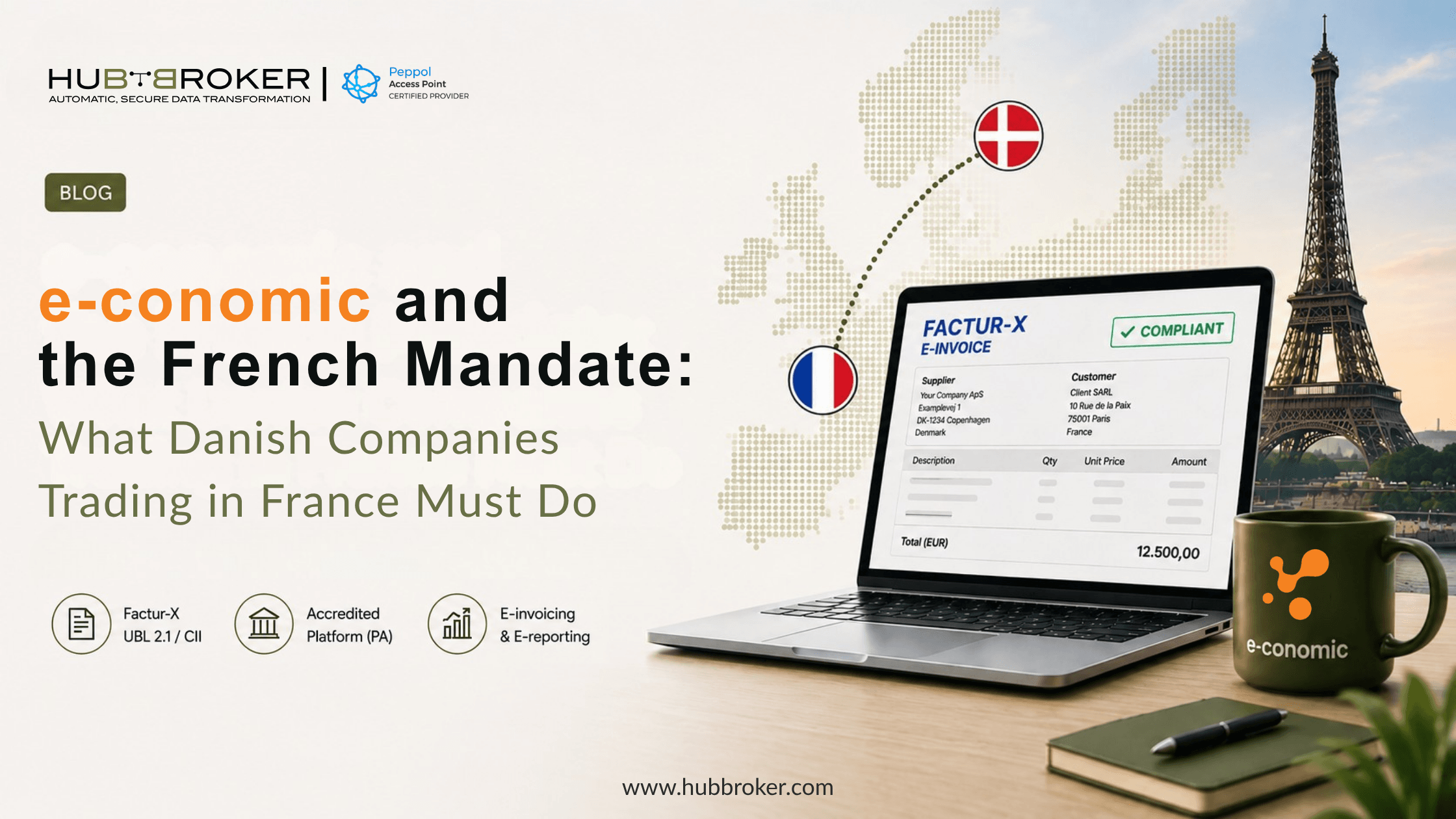
e-conomic and the French Mandate: What Danish Companies Trading in France Must Do
France switches on 1 September 2026. Most Danish finance teams have heard that much, and most have drawn one of two conclusions: either "this doesn't apply to us, we're Danish" or "we need to be fully compliant in three weeks."
Both are usually wrong.
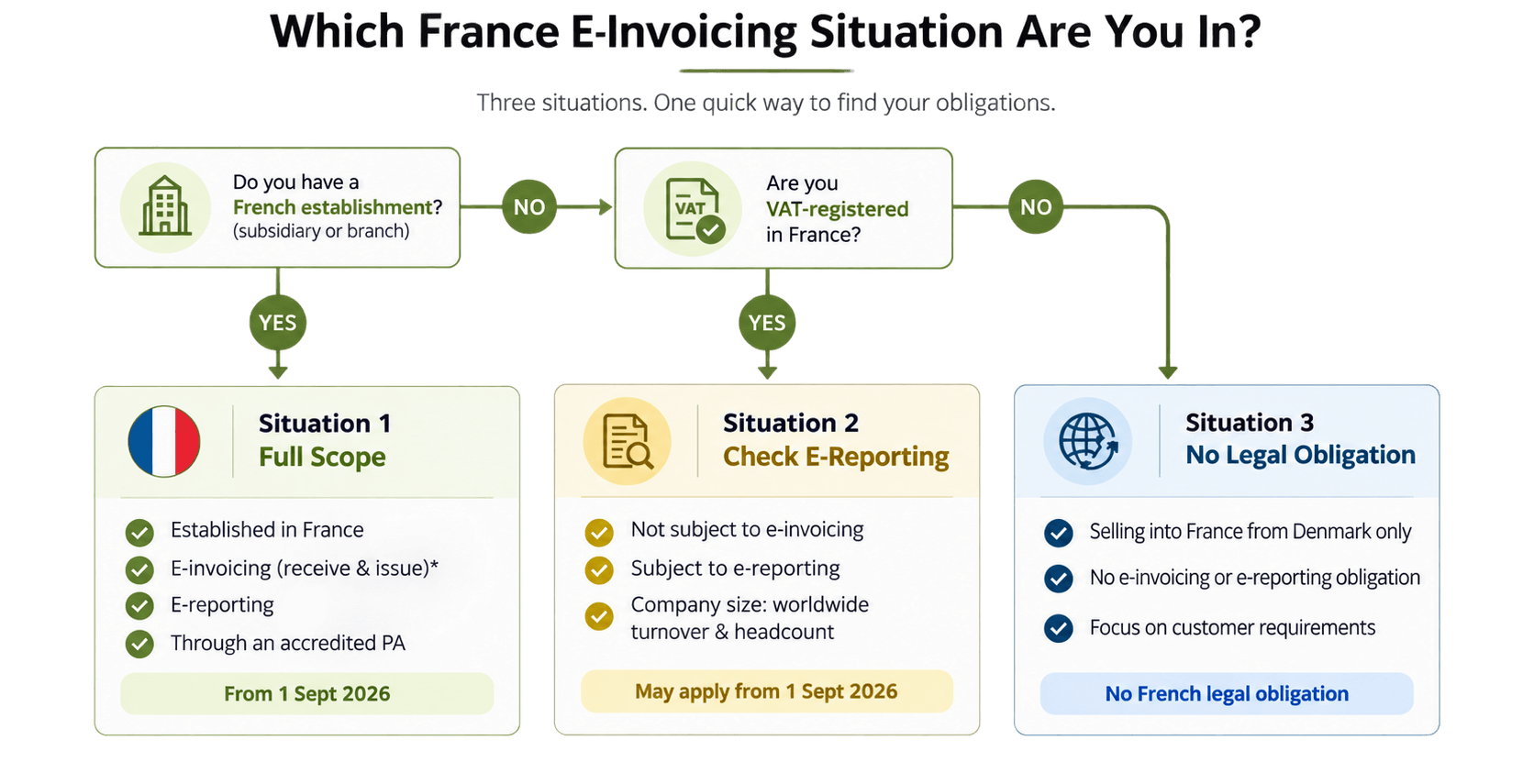
The rules turn on where your business is established, not where your customer sits. So before anyone panics or relaxes, work out which of three situations you're actually in. Then the question of e-conomic e-invoicing France becomes a short, answerable one rather than a fire drill.
What Actually Changes in France on 1 September 2026
France is moving domestic B2B invoicing onto a five-corner model. Invoices between French-established businesses have to be exchanged as structured data through an accredited platform a Plateforme Agréée, or PA in one of three formats: Factur-X, UBL 2.1 or CII.
A PDF attached to an email is not an e-invoice under these rules, however tidy it looks.
From 1 September 2026, French-established businesses must be able to receive structured e-invoices. Large enterprises and ETIs (intermediate-sized companies) must also issue them and meet e-reporting obligations. Small and micro enterprises follow in September 2027.
That's the French picture. Now the Danish one.
Three Situations Danish Companies Trading in France Fall Into
1. You Have a French Subsidiary or Branch: Full Scope
You're established in France. Full scope from 1 September: receive structured invoices, issue them if you're GE or ETI, and route everything through a PA.
This is the smallest group of Danish companies and the only one with a hard e-invoicing obligation next month.
2. You're VAT-Registered in France With No Permanent Establishment
This catches more Danish exporters than people expect call-off stock, installed goods, certain services performed on French soil.
You are not subject to e-invoicing. You may well be subject to e-reporting: transmitting transaction data, and sometimes payment data, to the French tax authority through an accredited platform.
Two details that catch finance teams out. First, company size for e-reporting purposes is assessed on worldwide turnover and headcount, not French activity a Danish group with modest French sales can land in the September 2026 wave. Second, reporting on reverse-charge purchases and intra-Community acquisitions is deferred to September 2027, which buys time but doesn't remove the obligation.
3. You Sell Into France From Denmark Only: No Legal Obligation
Intra-Community supplies and exports sit outside both e-invoicing and e-reporting. No French legal obligation applies to you.
What does apply is commercial. Your French customers are rebuilding their AP intake around structured invoices arriving through a PA. Once that's live, a PDF from Denmark becomes the exception that gets pulled out of the automated flow and handled manually which means slower approval, slower payment, and a procurement conversation you'd rather not have.
Where e-conomic Reaches Its Limit on French Invoicing
None of this is a criticism of e-conomic. It's a Danish accounting system built to run Danish accounting well, and it does.
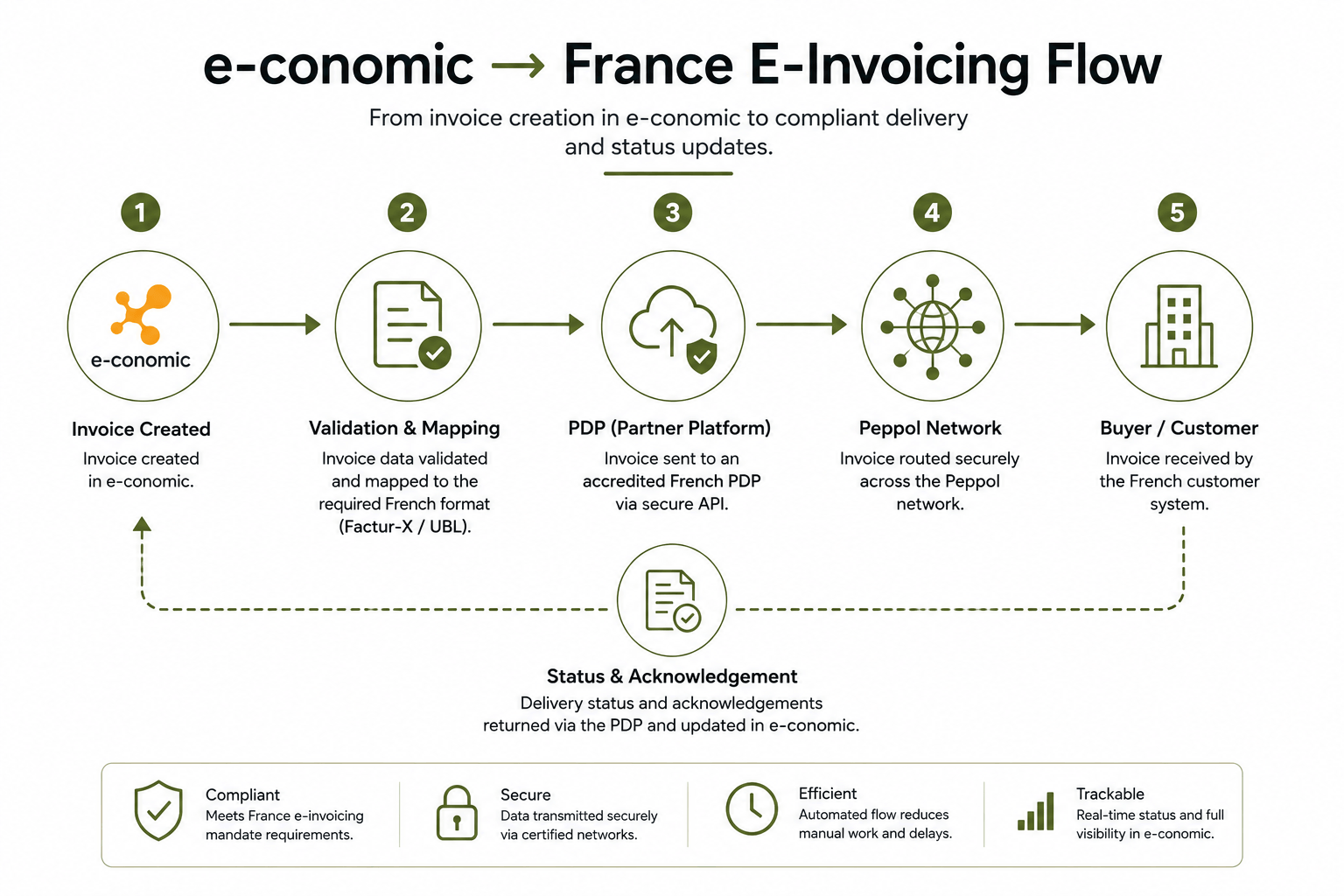
But it doesn't natively produce Factur-X or CII output, it has no connection to a French PA, and it has no mechanism for extracting e-reporting data or writing invoice lifecycle statuses back into your ledger. If you're in situation 1 or 2, the gap is compliance. If you're in situation 3, the gap is your customer relationship.
e-conomic e-invoicing France in Practice: The Integration Layer
The fix isn't replacing your accounting system three weeks before a deadline. It's putting an integration layer between e-conomic and the French ecosystem.
HubBroker's e-conomic integration pulls invoice data out of e-conomic, maps it to the format the receiving side requires, routes it through the right channel, and writes delivery and status information back. Your finance team keeps booking invoices exactly as they do today.
For cross-border European invoicing more broadly, the same platform connects you to the Peppol network through a certified Access Point and handles B2B and B2G e-invoicing compliance across the markets you sell into. Companies including Orkla, Atea and Proshop run European invoice flows this way.
Your Five-Step Checklist Before 1 September
Confirm with your tax adviser whether you're established in France, VAT-registered only, or neither. This single answer determines everything else.
If VAT-registered, assess your size on worldwide figures not French revenue.
Map every transaction flow where French VAT is due.
Ask your five largest French customers which platform they'll receive through and which format they want.
Decide how invoices leave e-conomic in that format.
Steps 1 to 4 cost you a week. Step 5 is where we come in.
FAQ: e-conomic e-invoicing France
Does the French mandate apply to Danish companies? Only if you're established in France through a subsidiary or branch. Danish companies that are VAT-registered without a permanent establishment fall under e-reporting instead, and companies selling purely cross-border from Denmark fall outside both.
Is my e-conomic PDF invoice compliant in France? Not for transactions in scope of the mandate. A compliant French e-invoice is structured, machine-readable data in Factur-X, UBL 2.1 or CII, exchanged through an accredited platform.
What's the difference between e-invoicing and e-reporting? E-invoicing is the exchange of structured invoices between French-established businesses. E-reporting is the transmission of transaction data for everything outside that scope and it's the obligation most affected Danish companies will meet.
Do we need a French PA if we only sell from Denmark? Not for legal reasons. Your French customers may still ask you to send structured invoices through a network they can receive on.
Can e-conomic connect to a French Approved Platform? Not on its own. Handling e-conomic e-invoicing France requires an integration layer that converts, routes and reconciles between e-conomic and the French ecosystem.
What happens if we're not ready on 1 September? The DGFiP has signalled that businesses will be contacted before enforcement rather than penalised immediately. The commercial cost invoices stuck outside your customers' automated AP flow usually arrives sooner than the regulatory one.
Not Sure Which of the Three Situations You're In?
Most of the confusion clears up in twenty minutes with someone who has done this for other Danish exporters. Talk to our integration team about your e-conomic setup and tell us where your French customers sit.
