
E-Reporting in France: The Obligation Most Foreign Sellers Actually Have
"We're not established in France, so the reform doesn't apply to us"
It's the most common sentence in cross-border VAT right now, and it's half right.
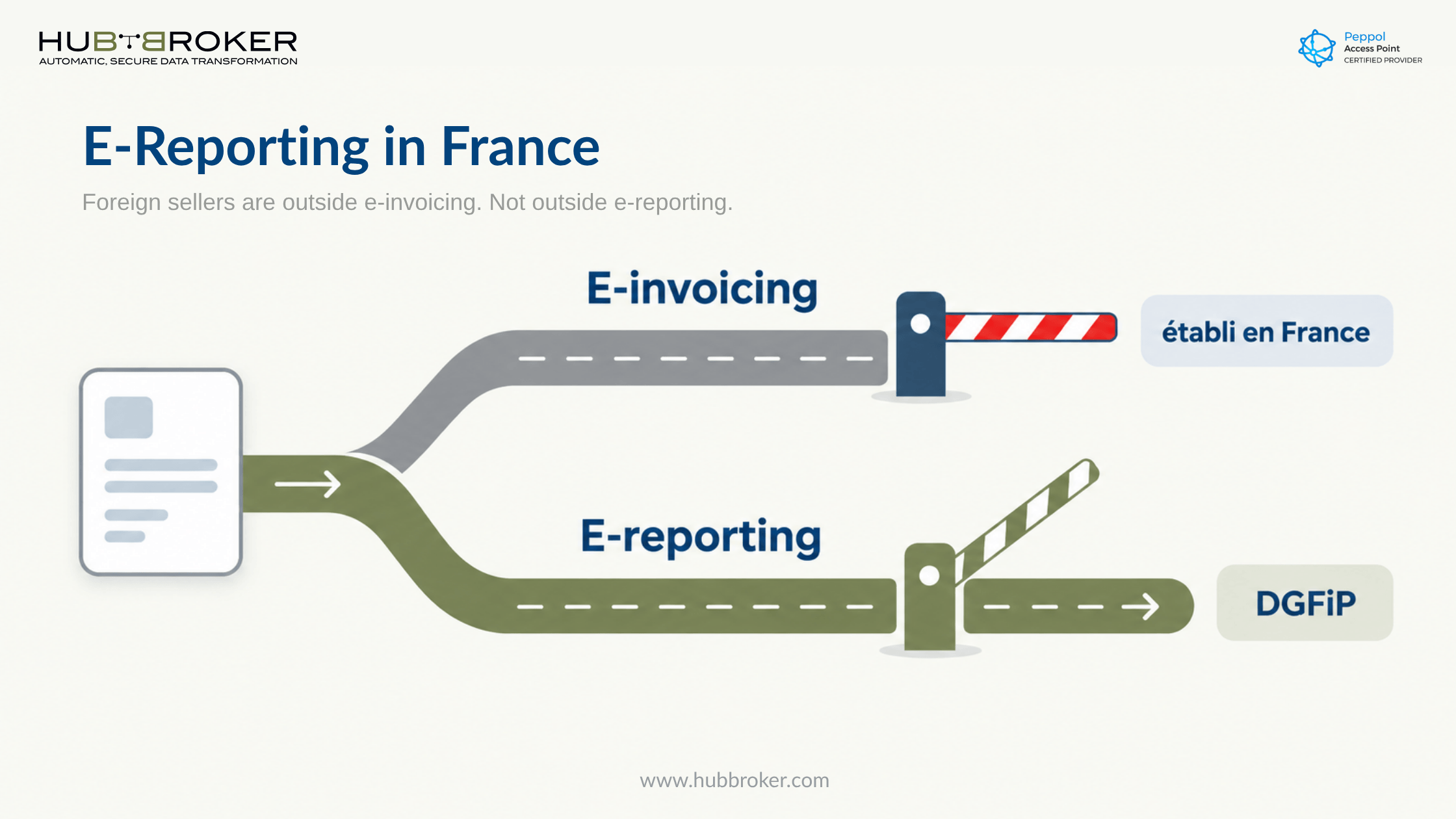
If your company has no permanent establishment in France, you genuinely are outside the French e-invoicing mandate. You don't have to issue structured invoices to your French customers. You don't have to be able to receive them. That part of the reform, set out in article 289 bis of the Code général des impôts, covers transactions between taxable persons established in France, and that's all it covers.
But the reform has two pillars, not one. The second is e-reporting article 290 CGI and it is aimed squarely at the operations the invoicing pillar can't see. Sales to consumers. Sales into France by companies that aren't there. And DGFiP has published a dedicated page for exactly your situation, which tends to settle the argument quickly.
The first wave went live on 1 September 2026. If you're a large enterprise or ETI selling into France, the question is no longer whether you'll be in scope. It's whether you already are and haven't noticed.
E-invoicing vs e-reporting: the distinction that decides everything
Two obligations, two different populations. Getting them straight takes about thirty seconds and saves a lot of wasted project budget.
E-invoicing (art. 289 bis CGI)
Structured invoices exchanged between French-established businesses, routed through an accredited platform. Formats, lifecycle statuses, the whole apparatus. Not your problem if you have no establishment in France. Our guide to the French 2026 mandate covers this pillar in detail if you need it for a French subsidiary.
E-reporting (art. 290 CGI)
Transmission of transaction data and in some cases payment data for operations that fall outside the invoicing flow. Amounts, VAT charged, dates. It is a reporting obligation, not an invoicing one. Nothing goes to your customer.
Side by side
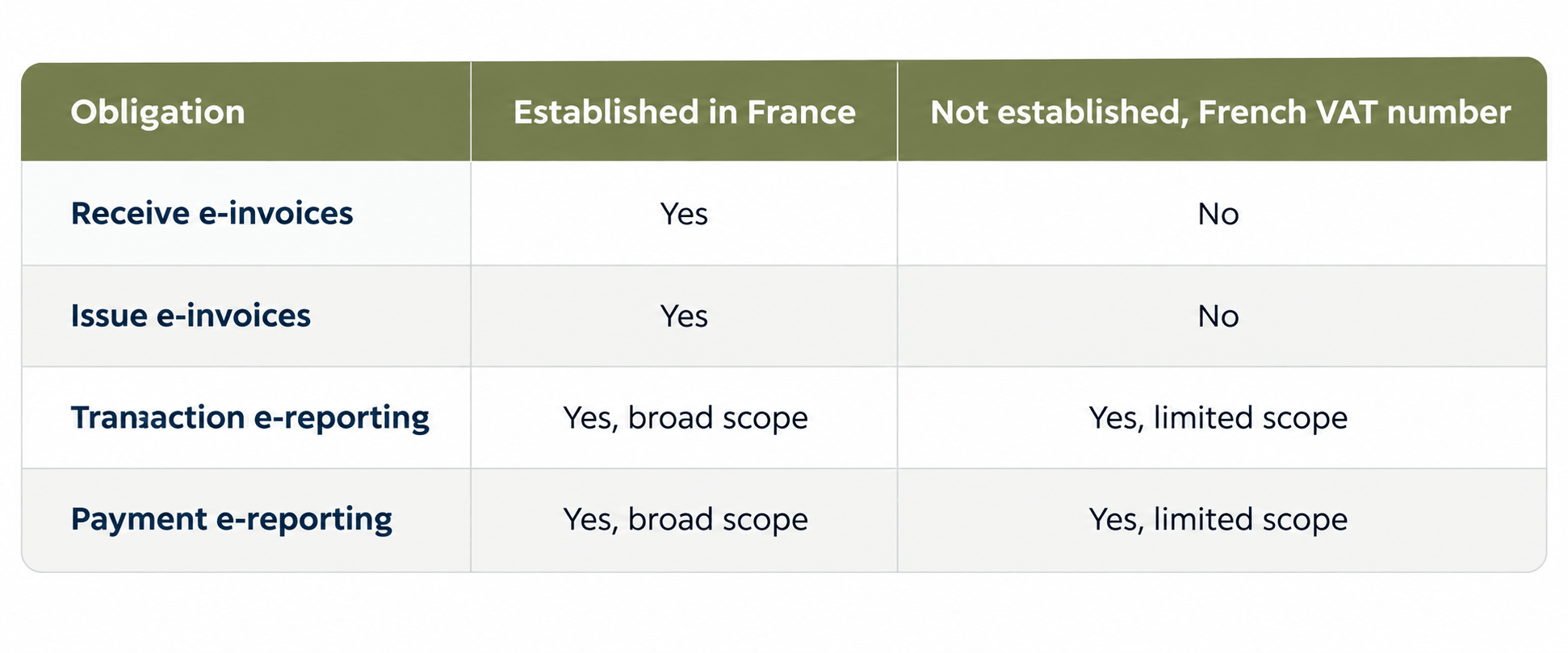
That "limited scope" column is where the real work is.
Who is actually in scope for e-reporting France?
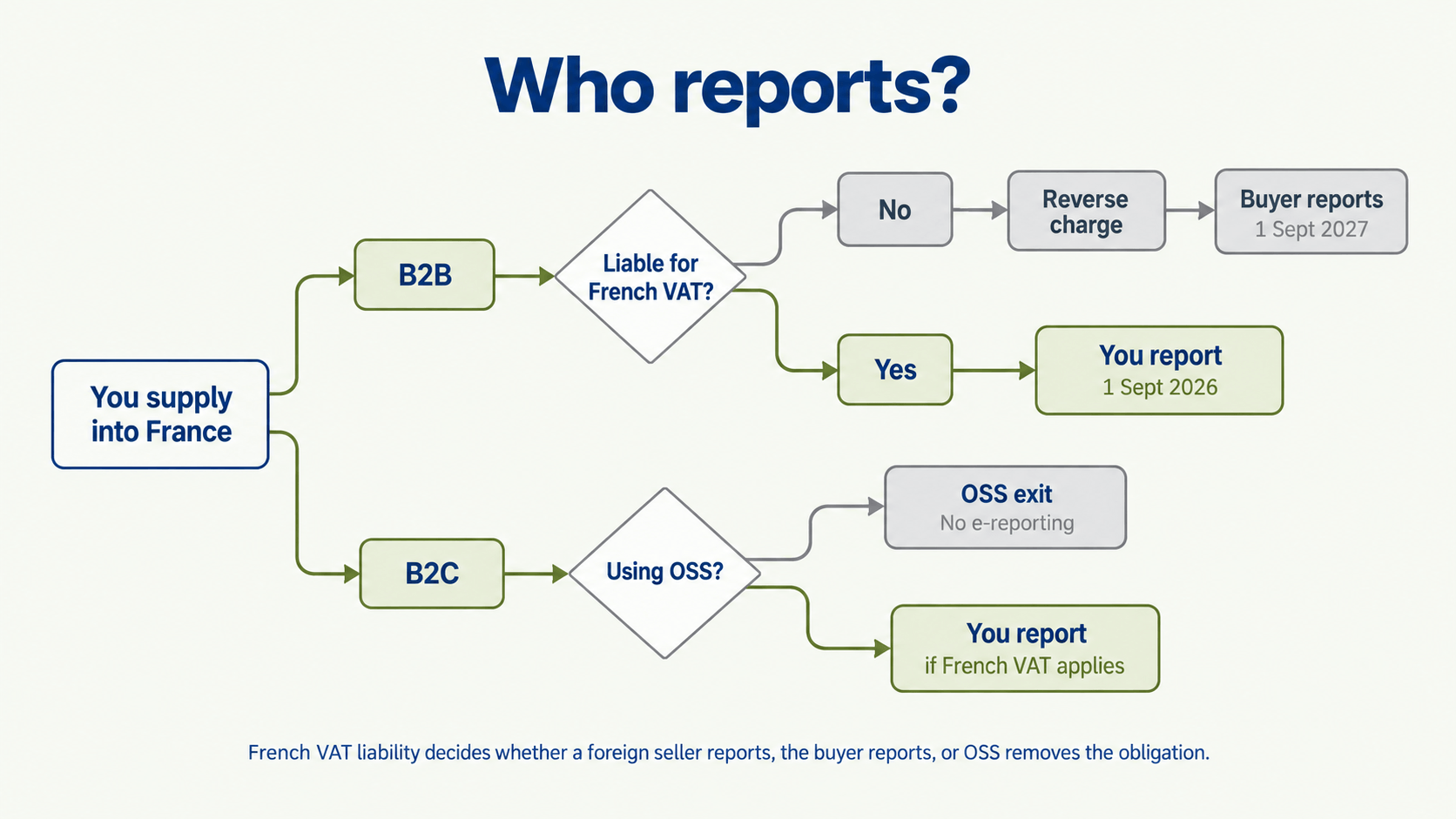
The test: are you the party liable for French VAT?
This is the whole thing. A foreign company falls under e-reporting when it carries out operations deemed located in France for which it is the person liable for French VAT under CGI rules.
Not "we have a French VAT number, therefore we report." Liability is the trigger.
The reverse-charge trap
Here's what most vendor content glosses over.
A non-established supplier is not liable for French VAT when the customer French or foreign, established or not holds a French VAT identification number. Reverse charge applies. In that case the obligation sits with the buyer, not with you.
So if you sell exclusively to French VAT-registered businesses, you may have far less to report than your advisors assumed.
The flip side: where your customer has no French VAT number, you are liable on supplies covered by article 259 A CGI, and you are in scope as the seller.
And if you're on the buying side acquiring goods in France, or services taxable in France, from a supplier who is neither established nor VAT-identified there you report as the buyer. That obligation starts 1 September 2027, for companies of every size.
B2C, and the OSS carve-out
Sales to non-taxable persons subject to French VAT are in scope. But operations with non-taxable persons are excluded where the non-established operator is registered with an EU VAT one-stop shop. If you're running OSS, check what's actually left before you build anything.
What never gets reported
VAT-exempt operations, including exports and intra-Community supplies
Operations exempt under articles 261 to 261 E CGI and dispensed from invoicing banking, insurance, medical, education, non-profit
Defence and security contracts under the public procurement code
Classified transactions, and those under a national-security confidentiality clause
Imports of goods
Tax teams routinely over-scope here. Your export flows are out. Your intra-Community supplies are out.
The timeline, and where you stand today
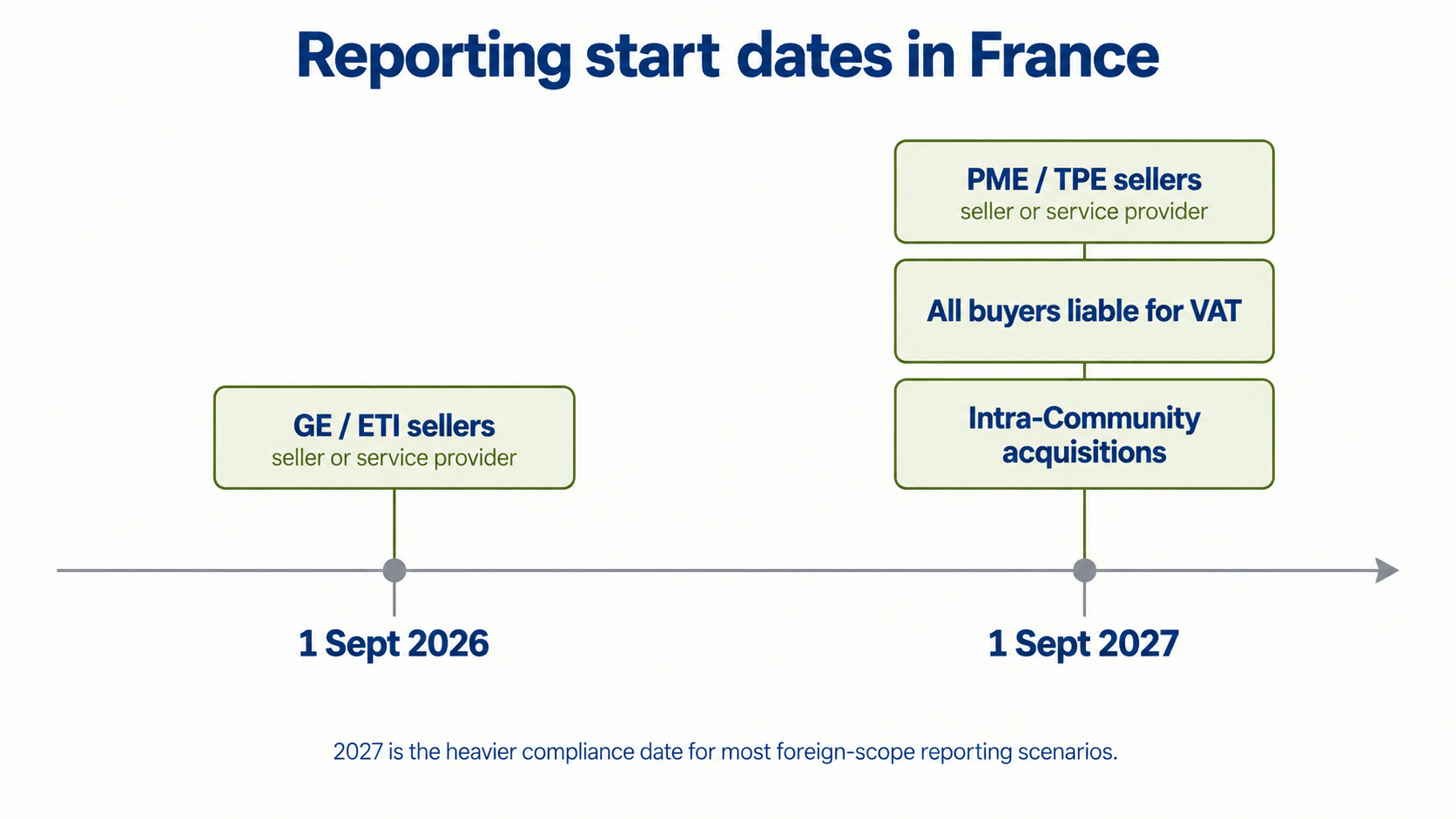
Smaller companies may opt in voluntarily from 1 September 2026.
How size is measured three details that catch people out
It's global turnover. Not your French turnover. For thresholds tied to revenue, DGFiP takes worldwide figures.
It's the legal unit. Assessed at SIREN level, per unité légale.
It's frozen at 1 January 2025. Size is assessed as at that date, on the last financial year closed before it or the first one closed after, if there wasn't one.
Thresholds: a PME has under 250 staff and turnover not exceeding €50m or a balance sheet total not exceeding €43m. An ETI is anything above that with under 5,000 staff, turnover not exceeding €1.5bn or balance sheet not exceeding €2bn. Above that, you're a grande entreprise. Note the escalation rule: exceed the headcount criterion and you move up a category outright.
What you actually have to transmit
Transaction data
For international B2B, the data set mirrors what's required under e-invoicing with one accommodation. If you have no SIREN, you supply a foreign intra-Community VAT number instead, or failing that, a foreign identification number. Use the SIREN where you have one.
For B2C, it's aggregated: daily totals of taxable operations, broken down by VAT rate, with the corresponding VAT amounts. Bases and rates, not individual receipts.
Payment data
This applies to services and to advance payments received on supplies of goods the operations where VAT becomes chargeable on collection. Client type is irrelevant: business or consumer, French or foreign, all the same.
It's sent by whoever receives the money, meaning the party that issued the invoice. Data points are the collection date, the amount received including VAT split by rate, and where relevant the invoice number.
Two exclusions: if you've opted to account for VAT on debits, and operations reverse-charged by the customer.
Frequency
Unlike e-invoicing, e-reporting isn't continuous. Transmission runs on a cycle driven by your French VAT regime, not by a universal calendar. Confirm yours before you design the extraction teams that assume monthly and turn out to be on a ten-day cycle discover it late and painfully.
You can't do this alone: the plateforme agréée requirement
Foreign companies in scope must appoint an accredited platform (plateforme agréée, formerly PDP) to transmit their data. DGFiP is explicit that the choice must be made before your applicable date.
The public portal isn't a workable route here, and its role was scaled back substantially during the reform anyway. In practice, a PA is the route.
When you're evaluating one, the questions that matter for a non-established filer aren't the ones on most comparison sheets:
Identifier handling. Can it transmit correctly when you have no SIREN, using a foreign VAT or identification number?
Scope logic. Can it distinguish reverse-charged operations from ones where you're liable automatically, per transaction? This is the single biggest source of over-reporting.
ERP connectivity. The data has to come out of your system in a structured form. If your French flows currently live in PDFs and email, that's a data-extraction project before it's a compliance one. Our EN 16931 implementation guide covers the structured-data groundwork, and if you run Dynamics, the Business Central integration notes and the wider Dynamics 365 compliance guide go further.
Evidence. Transmission receipts, status tracking, reprocessing of failures. You'll need these in an audit.
Reusability. France is one mandate among many. If you're also exchanging through Peppol, a single integration layer beats five point solutions see our Peppol Access Point comparison and the Peppol e-invoicing guide for how that architecture holds up across borders.
Penalties, and what enforcement actually looks like
Article 1788 D CGI sets the e-reporting penalty at €500 per transmission, raised from €250 by the 2026 finance law (loi n° 2026-103 of 19 February 2026), capped at €15,000 per calendar year. Accredited platforms face €750 per transmission under their own limb of the same article.
Read that carefully: the fine is per transmission, not per invoice. A single missed filing period can bundle thousands of operations into one €500 charge which sounds mild until you multiply by a ten-day cycle across a year.
DGFiP has signalled that the launch phase prioritises adoption over penalties, with tolerance for genuine technical error where a compliance effort is demonstrable. Worth understanding precisely: tolerance is a control posture, not a postponement. If you have no platform, you are non-compliant from 1 September 2026. The breach exists; the sanction is deferred.
Five-point readiness check
Map liability, not turnover. For every French flow, identify who is liable for the VAT. That determines who reports.
Split the customer base by French VAT number. It's the line between your obligation and your customer's.
Confirm your size category as at 1 January 2025, on global turnover, at SIREN level. This decides 2026 versus 2027.
Establish your transmission frequency from your French VAT regime.
Appoint an accredited platform and test with real volumes before your first cycle closes.
FAQ
Does e-reporting apply if we only have a French VAT number?
Not automatically. The trigger is being the party liable for French VAT on operations located in France, not registration itself. A French VAT number with no French-liable operations creates no e-reporting obligation.
We sell only to French VAT-registered businesses. Do we report?
Generally no, as the seller. Reverse charge shifts the VAT liability and the reporting obligation to your customer. Check every flow individually if any customer lacks a French VAT number, you're liable on those supplies.
Are our exports and intra-Community supplies in scope?
No. VAT-exempt operations, explicitly including exports and intra-Community supplies, are excluded from e-reporting. Imports of goods are excluded too.
Do we need a SIREN?
Not to comply. Where you don't have one, you provide a foreign intra-Community VAT number, or a foreign identification number if you have neither. If a SIREN exists, use it.
Can we keep our current invoicing setup?
Your invoices, yes you're not subject to the e-invoicing mandate. What changes is that transaction and payment data must reach DGFiP through an accredited platform, on schedule, in the required structure. That's an integration question, not an invoicing-format one.
We're an SME. Does 2027 mean we can wait?
As a seller, yes. But the buyer-side obligation on reverse-charged operations and intra-Community acquisitions starts 1 September 2027 for all sizes, and appointing a platform, mapping flows and testing takes longer than most teams plan for.
Not sure which side of the liability line your French flows fall on?
That's usually a mapping exercise, not a licensing decision and it's worth doing before you commit to a platform. We work with cross-border sellers on exactly this: connecting ERP data to compliant e-invoicing and reporting flows, across France, Peppol and the mandates coming behind them. If you'd like a second pair of eyes on your French flows, get in touch.
