

Global E-Invoicing Compliance Calendar 2026-2028: Deadlines Finance Teams Must Track
One finance team might be managing invoices for Belgium, France, Poland, the UAE and Singapore from same ERP environment. The challenge is not only creating and sending invoice. Teams also need to know when each local rule becomes mandatory, which format is accepted and where invoice data has to be sent. For finance and IT teams tracking e-invoicing deadlines 2026 2027 2028, there are now several confirmed dates to work with.
As of September 2026, some requirements are already active, while important 2027 and 2028 phases still need preparation.
Global E-Invoicing Compliance Calendar
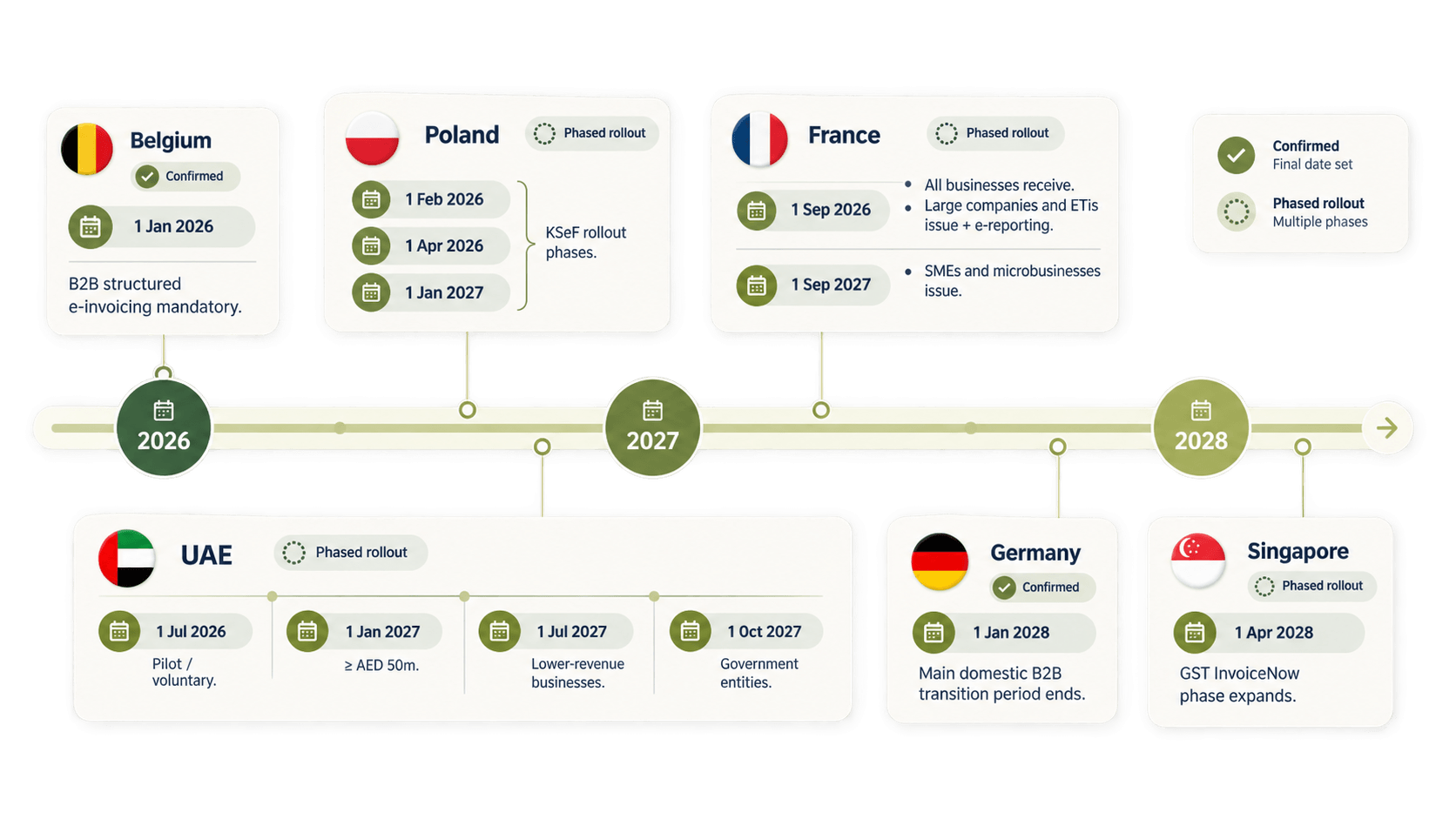
Dates that are still only proposals are not included in this calendar.
Why 2027 Becomes an ERP Integration Problem
The 2027 calendar shows why global e-invoicing compliance cannot be handled with one PDF export rule across every country. The basic invoice may look similar, but the technical process can be very different. Poland uses KSeF. France requires accredited platforms together with e-reporting. Belgium uses structured invoicing, with Peppol as standard route. The UAE e-invoicing model is also based on the OpenPeppol standard, while Croatia combines electronic invoice exchange with fiscalization. (UAE Ministry of Finance) An invoice may start inside SAP, Dynamics 365, Oracle, Business Central or another ERP.
After that, however, the correct local format, validation rules and routing still needs to be applied. That creates practical questions for IT teams.
✅ Which ERP fields are required for France?
✅ Which transactions should go through KSeF?
✅ Which customers need a Peppol route?
✅ And how should rejection or acceptance status come back into ERP?
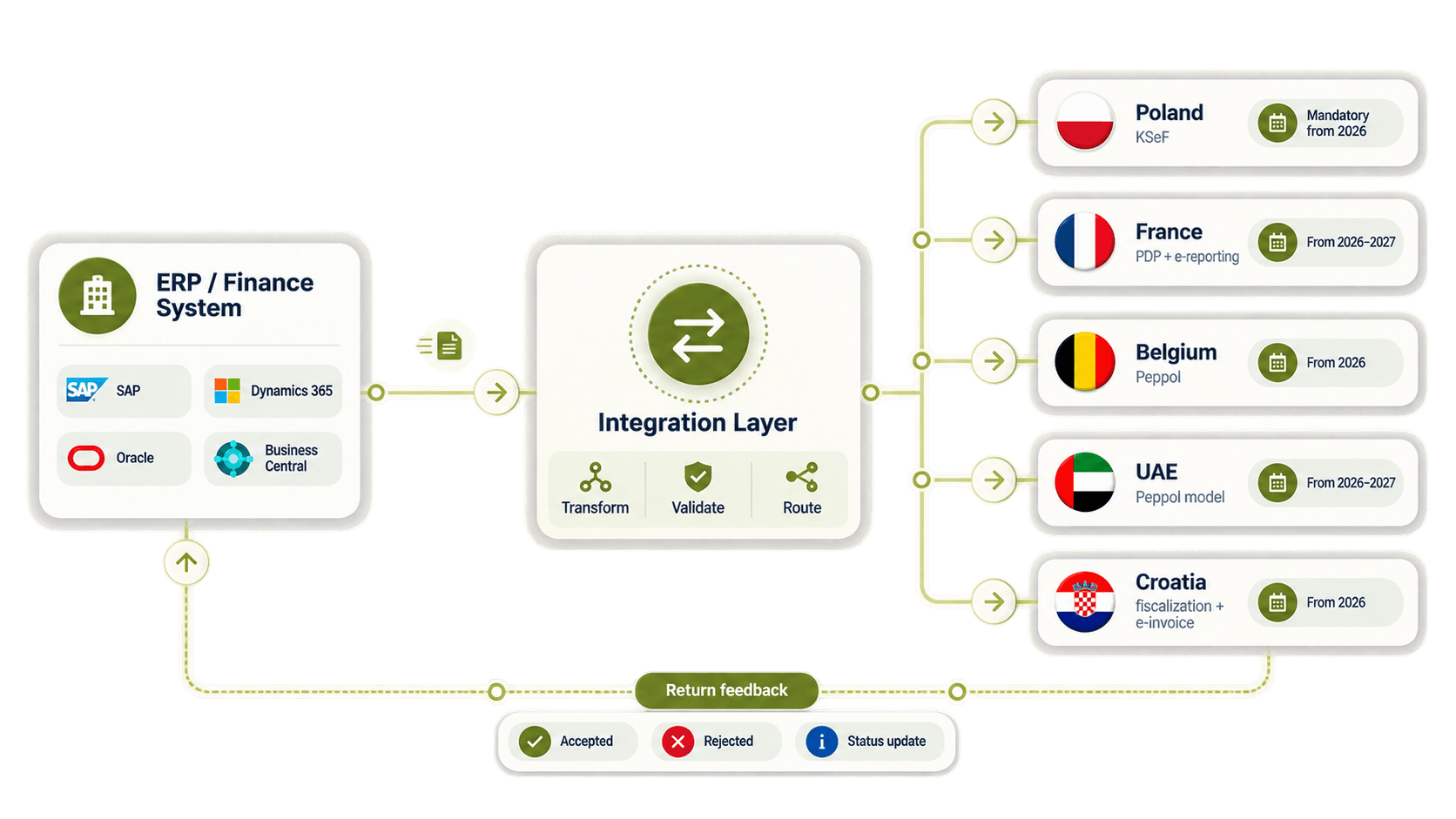
This is where country-by-country integrations can become difficult to manage.
What Changes Again in 2028?
The compliance calendar does not stop when the large 2026 and 2027 deadlines have passed. Germany reaches the end of its main domestic B2B transition period on 1 January 2028. This means businesses still using transition options need to make sure their systems can work with compliant electronic invoices before that date. Singapore also expands its GST InvoiceNow requirement from 1 April 2028, with further phases planned through 2031. IRAS expects the 2028-2031 expansion to bring around 90,000 additional businesses onto InvoiceNow.
This gives finance teams a useful signal about where invoicing is going. Electronic invoicing is becoming part of regular ERP and finance infrastructure, rather than something companies implement once for one tax deadline. A system built only for one country can therefore become difficult to maintain when the same company later needs to support Germany, Singapore, France or another market.
Finance and IT Readiness Checklist
Before the next e-invoicing mandate becomes active, finance and IT teams should check few basic areas.
➡ Map every legal entity and country where invoices are issued or received.
➡ Match each entity with correct deadline, threshold and obligation.
➡ Check customer, supplier, tax and invoice fields inside ERP.
➡ Confirm required XML format, tax platform, Peppol or clearance connection.
➡ Test invoice validation and rejection handling before production.
➡ Make sure invoice status can be written back to ERP where needed.
➡ Check how failed transactions will be corrected and processed again.
➡ Monitor official regulatory updates instead of depending only on an old compliance spreadsheet.
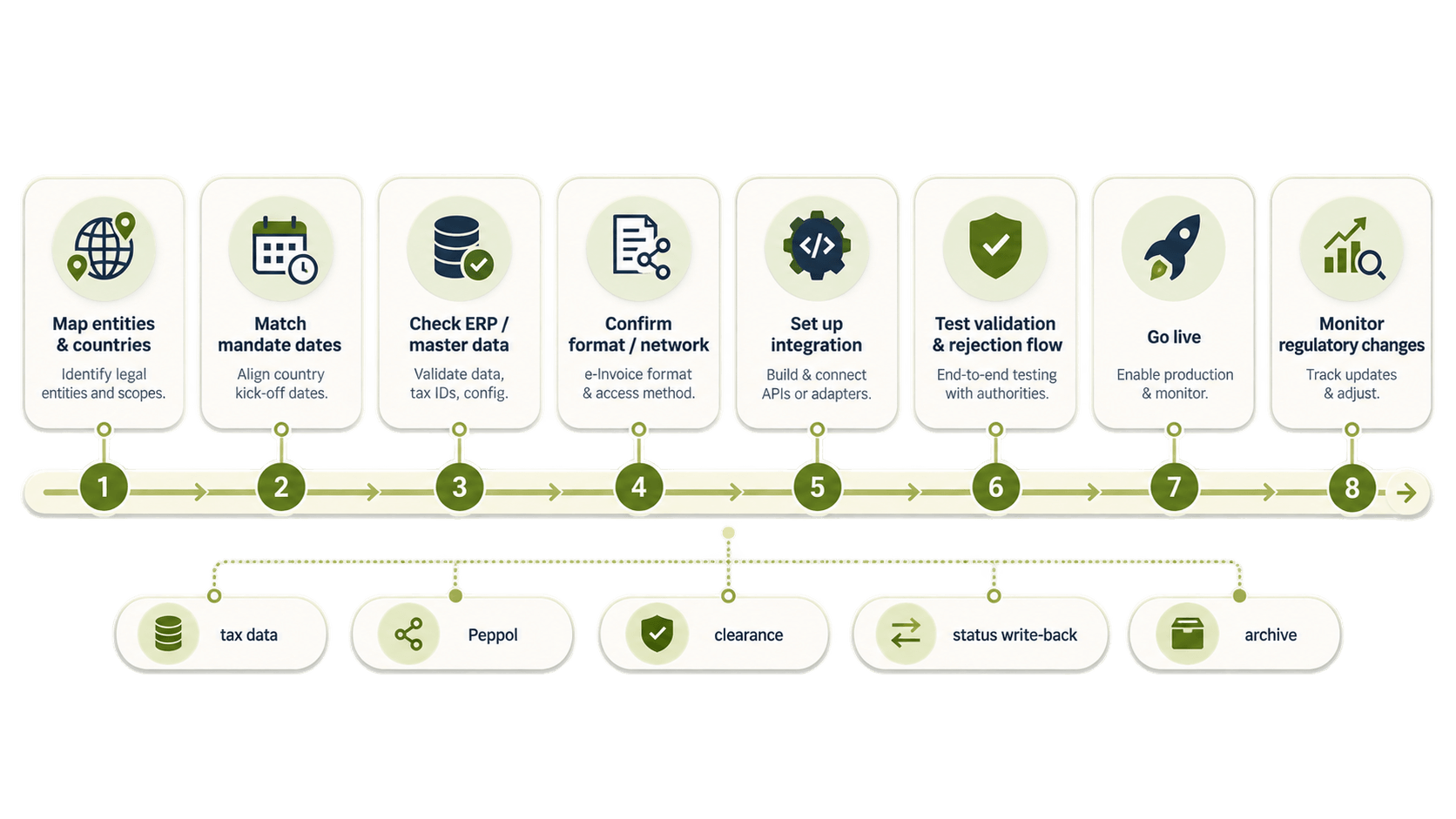
This work is usually easier when it starts before testing phase. For example, discovering that required tax data is missing from ERP master records just weeks before mandate can turn a compliance project into larger ERP cleanup exercise.
Plan Before the Deadline Becomes an ERP Issue
Different global e-invoicing requirements affect more than invoice format. They can change ERP mapping, document transformation, government connectivity, validation, monitoring, status handling and archiving. Managing a separate integration for every country may work at first. But it gets difficult quite fast when the same ERP needs to communicate with several national systems and e-invoicing networks.
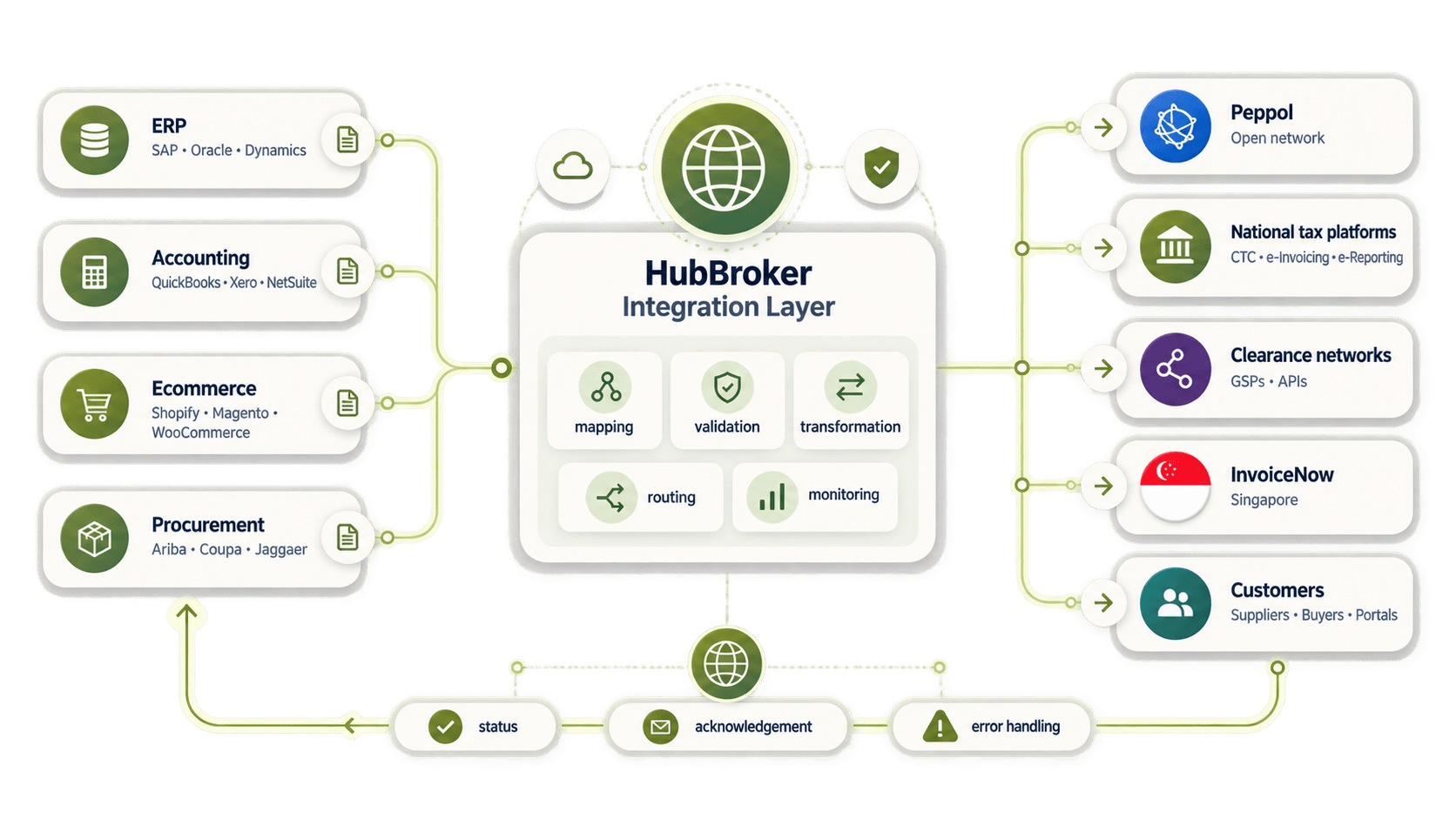
HubBroker can provide an integration layer between ERP or accounting systems and different national e-invoicing networks. This can help companies manage country-specific formats, document flows, validation, routing and status information without building every connection separately.
For finance and IT teams already preparing for 2027 or 2028, the practical first step is to map countries against ERP systems and identify where existing invoice processes do not meet local requirements. If upcoming e-invoicing deadlines 2026 2027 2028 are already on your roadmap,
HubBroker can help review your ERP connections, country requirements and current compliance gaps before they turn into production problems.
