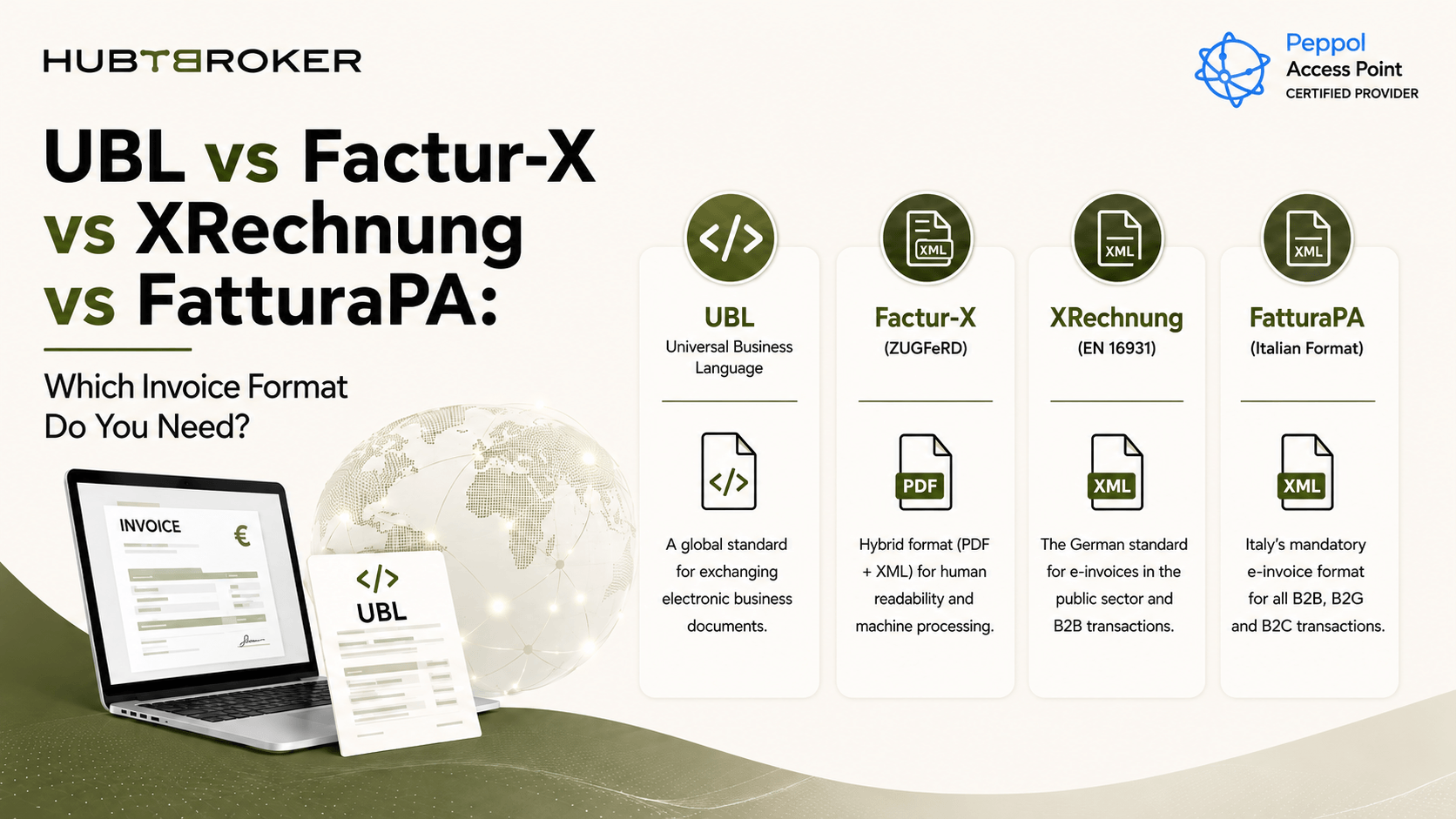
UBL vs Factur-X vs XRechnung vs FatturaPA: Which Invoice Format Do You Need?
Electronic invoicing across Europe is becoming more structured, but there is still no single invoice format used in every country. Businesses may need to work with UBL, Factur-X, XRechnung and FatturaPA, depending on where they operate and who receives the invoice. A simple e-invoicing formats comparison can help finance and IT teams understand which format is used in which market before making changes in ERP or invoicing workflows.
What Is the Difference Between UBL, Factur-X, XRechnung and FatturaPA?
The main difference is that these formats are used for different technical and country-specific purposes.
UBL is a structured XML format widely used for electronic business documents. UBL 2.1 is one of the syntaxes supported under the European e-invoicing standard EN 16931.
Factur-X is a hybrid electronic invoice used in the French framework. It combines a readable PDF/A-3 invoice with structured XML data inside the same file.
XRechnung is Germany’s structured e-invoicing specification. It can use both UBL and UN/CEFACT CII syntax and follows the main requirements of EN 16931.
FatturaPA is Italy’s XML-based electronic invoicing format. Invoices are exchanged through the country’s Sistema di Interscambio, also known as SdI.
UBL vs Factur-X: Which Format Is Better?
Neither format is always better. The right option mainly depends on the country, customer and receiving system.
UBL is fully structured XML, which makes it suitable for automated system-to-system invoice processing and electronic data exchange.
Factur-X gives both a readable PDF and structured invoice data. This can be useful when businesses still want a normal invoice view for people while also allowing software to process the invoice automatically.
For companies working across different European markets, an e-invoicing platform should ideally be able to convert invoice data into different required formats instead of making the ERP manage every format separately.
XRechnung vs UBL: Are They the Same?
No. UBL is a syntax, while XRechnung is a German e-invoicing specification.
XRechnung can use UBL as the underlying syntax. It can also use UN/CEFACT CII. Germany also applies additional rules and requirements on top of the European invoice standard. This is important for companies selling to German organisations. Simply creating a general UBL invoice does not automatically mean that invoice meets all XRechnung requirements.
Which E-Invoicing Format Is Used in France, Germany and Italy?
The table below gives a simple e-invoicing formats comparison.
Format | Country / Region | Structure | Typical Transport | Common Use Case |
|---|---|---|---|---|
UBL 2.1 | Europe / multiple countries | Structured XML | Peppol or other electronic networks | Cross-border and automated B2B/B2G invoicing |
Factur-X | France | PDF/A-3 + embedded XML | Approved platforms / supported channels | French e-invoicing where hybrid invoices are supported |
XRechnung | Germany | Structured XML using UBL or CII | Peppol and German receiving platforms | German B2G and structured e-invoice processes |
FatturaPA | Italy | Structured XML | Sistema di Interscambio (SdI) | Italian B2B, B2C and public-sector invoicing |
EN 16931 itself does not decide how the invoice should be transported. This means invoice format and transmission network should be treated as two separate things. Germany supports XRechnung through different electronic channels, including Peppol, while Italy requires electronic invoice files to go through SdI.
Which E-Invoice Format Do I Need for Europe?
For most businesses, the answer depends on where the customer is located, local rules and the system receiving the invoice.
For example:
➡ Selling into Italy may require FatturaPA and SdI
➡ German invoicing can involve XRechnung or Peppol-based workflows
➡ French invoicing can involve Factur-X, UBL or CII, depending on the required setup
➡ Cross-border Peppol transactions commonly use structured formats based on European standards
This is why companies operating in several countries should avoid creating a completely separate hard-coded invoice process for every market where possible.
Can One ERP Support Multiple E-Invoicing Formats?
Yes, but managing every country format directly inside an ERP can become difficult over time.
A better approach can be to send invoice data from the ERP in one consistent internal format. An integration or e-invoicing platform can then validate, convert and route the data into the required UBL, Factur-X, XRechnung, FatturaPA or other local format. This can reduce the amount of ERP changes required when a country updates its technical requirements. It also makes it easier to add new customers or markets without rebuilding the whole invoice process again.
Why Hire HubBroker for European E-Invoicing?
Managing different European invoice formats can create extra work for finance and IT teams. HubBroker helps connect existing business systems with electronic invoicing workflows, so businesses do not need to handle every format manually.
Why HubBroker? | How It Helps |
|---|---|
1. Multi-Format Support | Handle different electronic invoice formats across different markets. |
2. ERP Integration | Connect existing ERP and accounting systems with e-invoicing workflows. |
3. Format Conversion | Convert invoice data into formats required by customers and countries. |
4. Peppol Connectivity | Support electronic document exchange through Peppol workflows. |
5. API Integration | Connect invoicing processes with different business applications through APIs. |
6. EDI Experience | Manage structured document exchange together with e-invoicing. |
7. Invoice Automation | Reduce manual invoice preparation and data handling. |
8. European Coverage | Support businesses dealing with different European e-invoicing requirements. |
9. Scalable Setup | Add new customers, countries and invoice flows as business grows. |
10. One Integration Partner | Manage ERP, API, EDI and e-invoicing integration with one provider. |
HubBroker makes handling different invoice formats more simple, especially when your business is operating in several European countries.
Instead of changing your ERP every time a customer or country needs another format, HubBroker can help automate the conversion and exchange of electronic invoices through one connected setup.
