
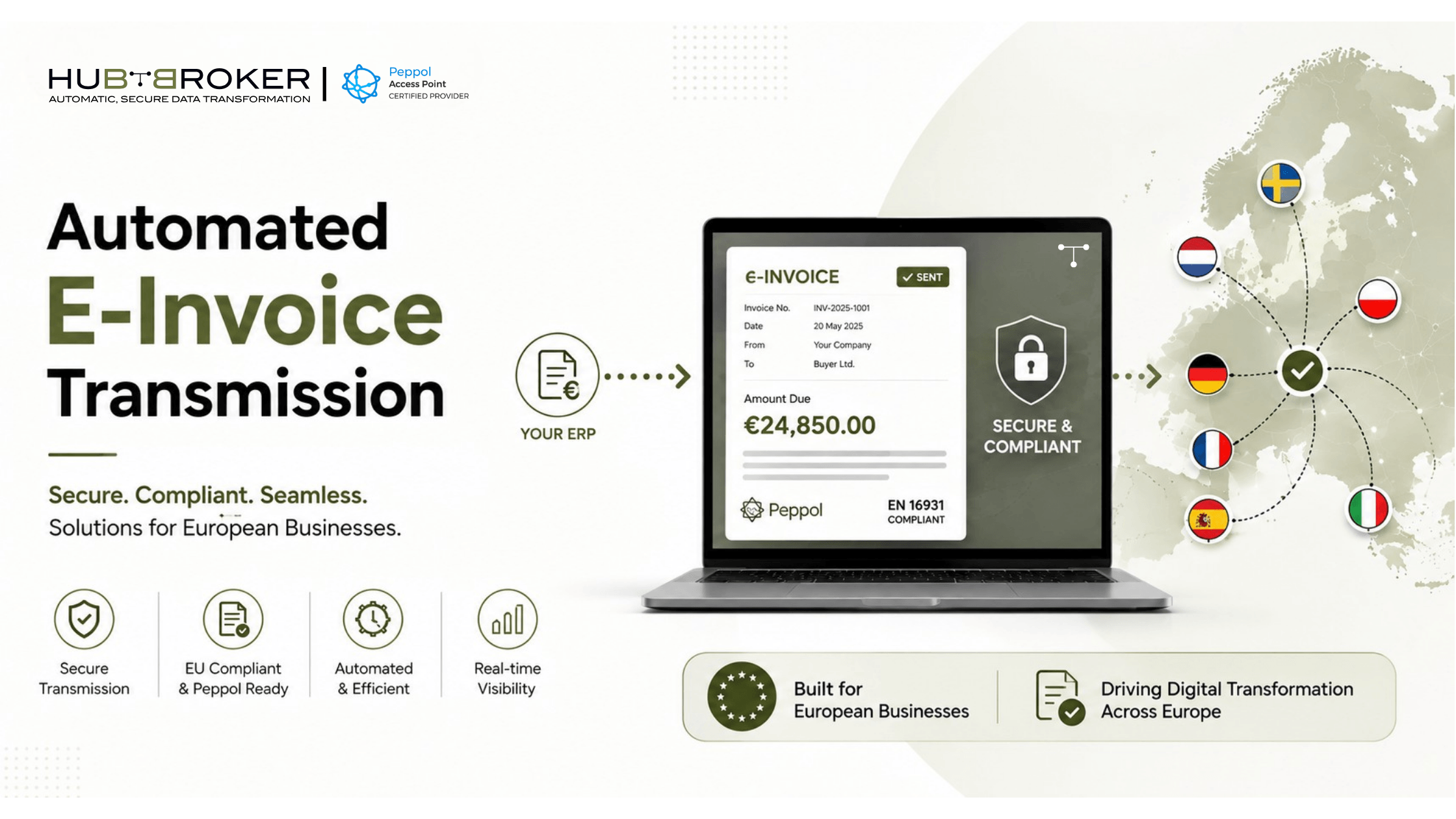
Automated eInvoice Transmission for EU Countries Secure Compliant Solutions for European Businesses
European businesses now need more than just sending PDF invoices by email. Automated eInvoice transmission changes invoice data into a structured format, checks it according to the country rules, and sends it directly into the customer’s accounting or ERP system.
This helps reduce manual work, invoice errors, rejected invoices and payment delays. It also lower the risk of missing important e-invoicing rules in different EU countries.
What Is Automated eInvoice Transmission?
Automated eInvoice transmission means creating, checking, sending, delivering and tracking structured invoices electronically without sending every invoice manually.
Invoice data moves from your ERP or finance system into an e-invoicing platform. The platform converts the data into the required format and sends it through Peppol, a national tax platform, an API or another approved invoice channel.
A normal PDF is mainly made for people to read. A structured eInvoice contains machine-readable data that business systems can understand. The customer can automatically import the invoice, match it with a purchase order, approve it and prepare the payment.
This saves time for both the sender and receiver.
Is eInvoicing Mandatory in EU Countries?
There is no single e-invoicing rule which works exactly same in every EU country. Each country can make its own rules for B2B, B2G, invoice formats, tax reporting and invoice archiving.
Belgium introduced structured B2B e-invoicing from 1 January 2026. German businesses need to be able to receive structured eInvoices since 1 January 2025, while the transitional rules for sending invoices are still continuing.
In France, all businesses must be able to receive electronic invoices from 1 September 2026.
At the EU level, the VAT in the Digital Age programme will introduce digital reporting requirements for cross-border B2B transactions from 1 July 2030.
Businesses working in several countries should choose a solution that can update invoice formats, mappings and compliance rules when the regulations changes. Using one flexible system is usually easier than managing a different portal for every country.
How Do You Send eInvoices Across Europe Automatically?
The automated eInvoice transmission process normally follow these five steps:
Your ERP or accounting system creates the invoice.
The e-invoicing platform receives the invoice data through an API, EDI connection, file upload or system connector.
The platform converts the invoice into the structured format required by the customer.
The system checks tax details, company identifiers, totals, mandatory fields and country-specific rules.
The invoice is transmitted and the delivery status is returned back to your system.
This workflow allow finance teams to manage both domestic and cross-border invoices through one process. They do not need to log in into different invoice portals for every country or customer.
The system can also show whether an invoice was sent, delivered, accepted or rejected. This make it easier for the finance team to solve problems before they cause payment delays.
Which eInvoice Format Is Used in Europe?
EN 16931 provides a common European foundation for structured electronic invoices. However, the actual invoice format and transmission method can be different from one country to another.
Common invoice formats and specifications include:
Peppol BIS Billing 3.0
UBL XML
XRechnung
ZUGFeRD
Factur-X
Country-specific tax platform formats
The European Commission published an updated EN 16931 version in May 2026. Migration planning is being handled by relevant organisations and national authorities.
This does not mean that every European business will send exactly the same invoice format. A company may need to use Peppol BIS for one customer, XRechnung for another customer and Factur-X for a business in another country.
A suitable e-invoicing provider should check the destination country, customer type, required invoice format and reporting rules before sending the invoice. This helps avoid rejected invoices and compliance issues.
How Does eInvoice Integration Work With ERP Systems?
ERP integration connects invoice creation, validation and delivery into one automated workflow.
When an invoice is created in the ERP, the data is automatically sent to the e-invoicing platform. The platform checks the data, converts it into the required format and delivers it through the correct network or government system.
The invoice status can then be sent back into the ERP. This means the finance team can continue working inside their normal business system instead of checking different platforms manually.
HubBroker supports EDI and API-based integrations, ERP connections, document conversion, secure cloud exchange and end-to-end process automation.
This allows businesses to continue using their existing finance and ERP systems while adding compliant eInvoice transmission around them. The company do not always need to replace its current ERP system just for supporting electronic invoicing.
How Much Does Automated eInvoice Transmission Cost?
The cost of automated eInvoice transmission depends on several things, including:
Monthly invoice volume
Number of countries
ERP integration requirements
Supported invoice formats
Invoice archiving
Implementation work
Testing and onboarding
Technical support
A basic invoice portal for a small and low-volume business will normally cost less than a fully automated multi-country ERP integration.
However, a cheaper portal may create more manual work. Employees may still need to upload files, check invoice statuses and correct rejected documents by hand. This can become costly when the invoice volume increases.
An automated setup can have a higher starting cost, but it may save more time and reduce errors over the long period.
Businesses should compare the total work involved, not only the monthly platform price.
Why Hire HubBroker for Automated eInvoice Transmission?
HubBroker helps businesses connect eInvoicing, Peppol, EDI, APIs and ERP workflows through one platform.
Your team do not need to manage a different system for every invoice route, customer or country. HubBroker can help create a more central process for sending and receiving business documents.
HubBroker supports:
✔ Customer and supplier onboarding
✔ Invoice format conversion
✔ ERP and accounting-system integration
✔ Peppol connectivity
✔ EDI and API connections
✔ Invoice validation
✔ Transmission monitoring
✔ Technical support
✔ Ongoing system maintenance
These services makes the e-invoicing project easier when several countries, invoice formats or business systems are involved.
HubBroker eInvoice service pricing is prepared according to the real project requirements. One fixed package may not be suitable for every company because each business have a different invoice volume, ERP setup and country coverage.
EU eInvoice factor | What HubBroker may provide | Expected cost impact |
|---|---|---|
Invoice volume | Sending and receiving capacity based on monthly documents | Low to high |
Country coverage | Compliance rules and transmission routes for different EU markets | Medium to high |
Invoice formats | Peppol BIS, UBL, XML, hybrid and local invoice formats | Medium |
ERP integration | API, EDI, file-based or accounting-system connectors | Medium to high |
Validation rules | Tax, identifier, invoice format and country-rule checks | Medium |
Network connection | Peppol registration, platform routing and system configuration | Medium |
Archiving and security | Invoice retention, access control and secure document handling | Low to medium |
Support and onboarding | Testing, implementation, go-live support and ongoing help | Low to high |
For getting an accurate HubBroker eInvoice service cost, businesses should provide details about their target countries, monthly invoice volume, ERP system, required invoice formats, archiving period and preferred support level.
Providing these details helps HubBroker understand the actual project scope and suggest a setup that match the company’s business and compliance needs.
