
Retail EDI Mandates: Your Biggest Customer Can Deregister You Faster Than a Tax Authority Can Fine You
A purchase order lands from one of your largest retail accounts. It arrives as an EDIFACT ORDERS file, dropped on an SFTP server. Nobody on your team can open it. Three days later the order is late, the retailer applies a deduction, and someone in finance is trying to work out why the invoice was rejected.
That is what retail EDI mandates look like when they go wrong. And here is the part most suppliers miss: right now there are two completely different kinds of mandate landing on the same invoice, and satisfying one does nothing for the other.
What retail EDI mandates actually are
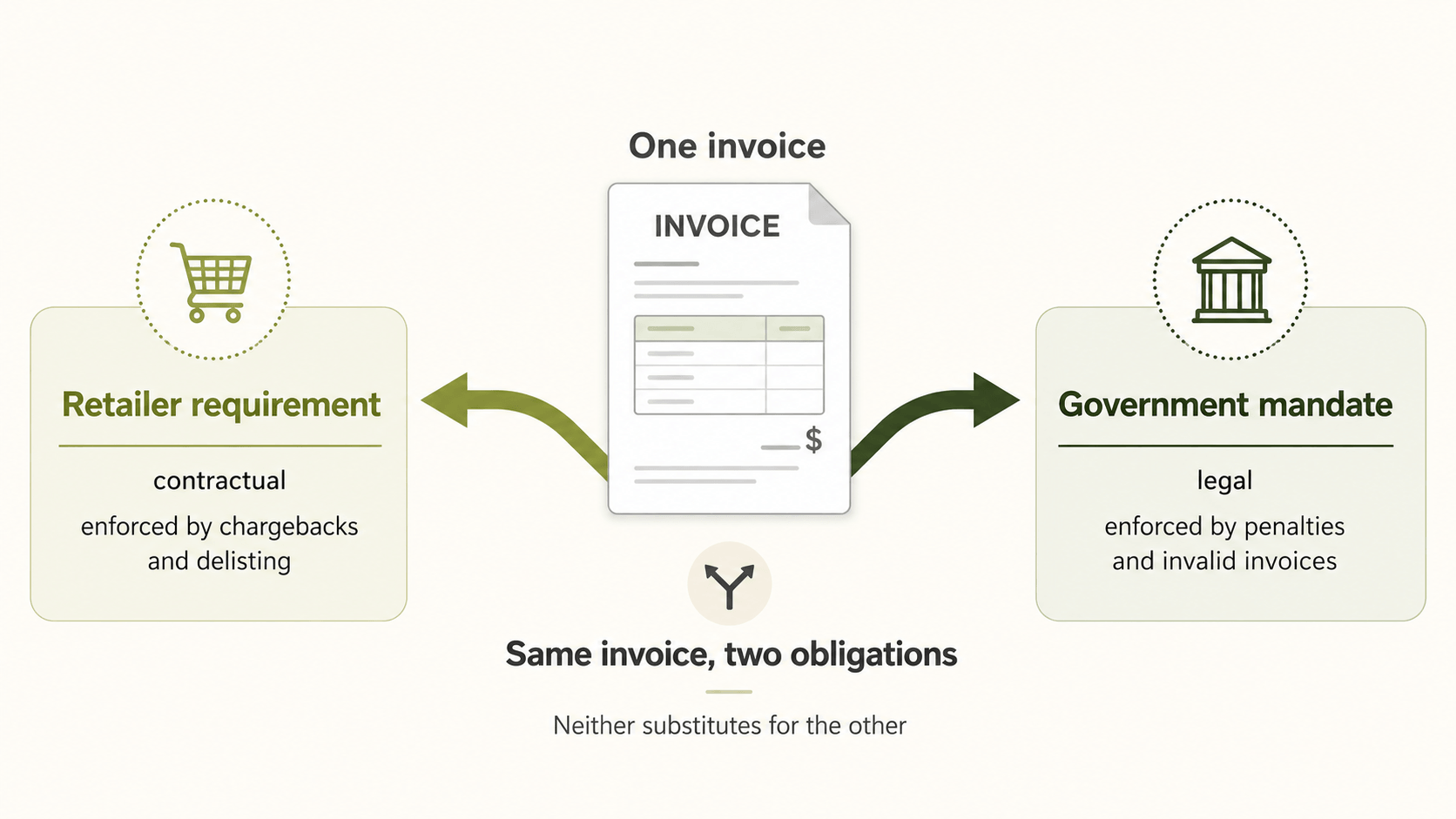
A retail EDI mandate is a commercial requirement. Your customer a grocery chain, a DIY group, a marketplace, a wholesaler tells you that from a given date, orders, dispatch notes and invoices must be exchanged electronically in their specified format. It is not law. It is a condition of continuing to trade with them.
That distinction matters, because the enforcement is different. A tax authority sends a penalty notice. A retailer reduces your order volume, applies chargebacks, or drops you from the assortment.
The documents retailers usually ask for
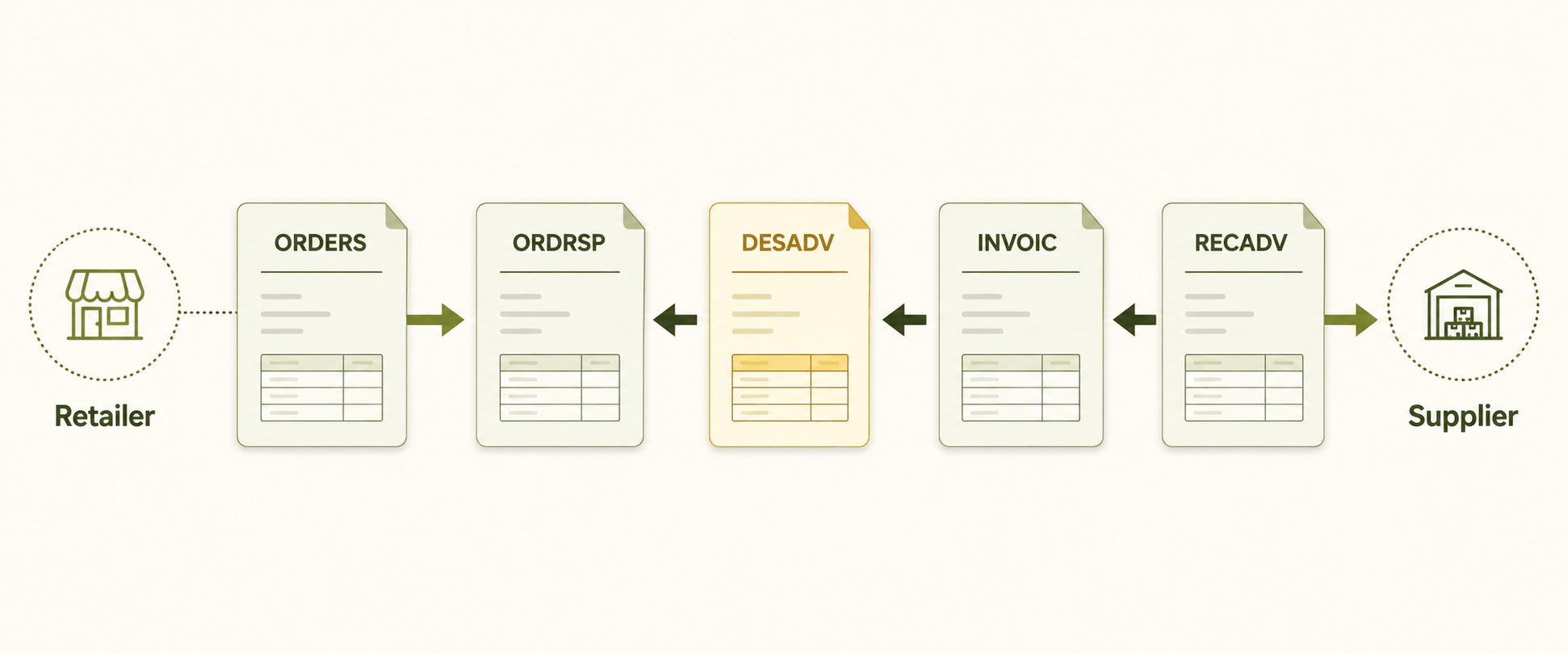
Most retail EDI mandates start with a small set and expand:
ORDERS - the purchase order coming to you
ORDRSP - your order confirmation back, often with substitutions and availability
DESADV - the despatch advice, usually with SSCC pallet labels for goods-in scanning
INVOIC - the invoice
RECADV - the receiving advice, telling you what the retailer actually booked in
The DESADV is where suppliers get caught out. Many can send an invoice electronically but cannot produce a compliant despatch advice with correct SSCC codes, and that is the message the warehouse depends on.
Formats and connections vary by retailer
Ask two retailers what "EDI" means and you get two answers. European grocery leans on EDIFACT with EANCOM subsets. North American partners use ANSI X12. Some retailers run proprietary XML through their own portal. A growing number accept Peppol.
Connection methods differ too: AS2, SFTP, VAN, API. There is no single build that covers every partner, which is why per-retailer point solutions get expensive fast.
Why non-compliance costs more than the project
The direct hits are the ones finance notices. Chargebacks for missing or late EDI documents are usually a fixed fee per order, and they accumulate quietly. Invoices that fail validation sit unpaid, so DSO drifts.
The indirect costs are larger. Onboarding scores affect promotional slots and range reviews. And every document handled manually pulls hours out of customer service and accounts payable hours that scale with your growth rather than shrinking.
Where retail EDI mandates collide with e-invoicing law
This is the part that catches suppliers who thought they had EDI solved years ago.
Your retailer wants a DESADV and an INVOIC in their format, over their channel. Your government now wants that same invoice reported or cleared through a national system. These are separate obligations, and meeting the retailer's spec does not discharge the legal one.
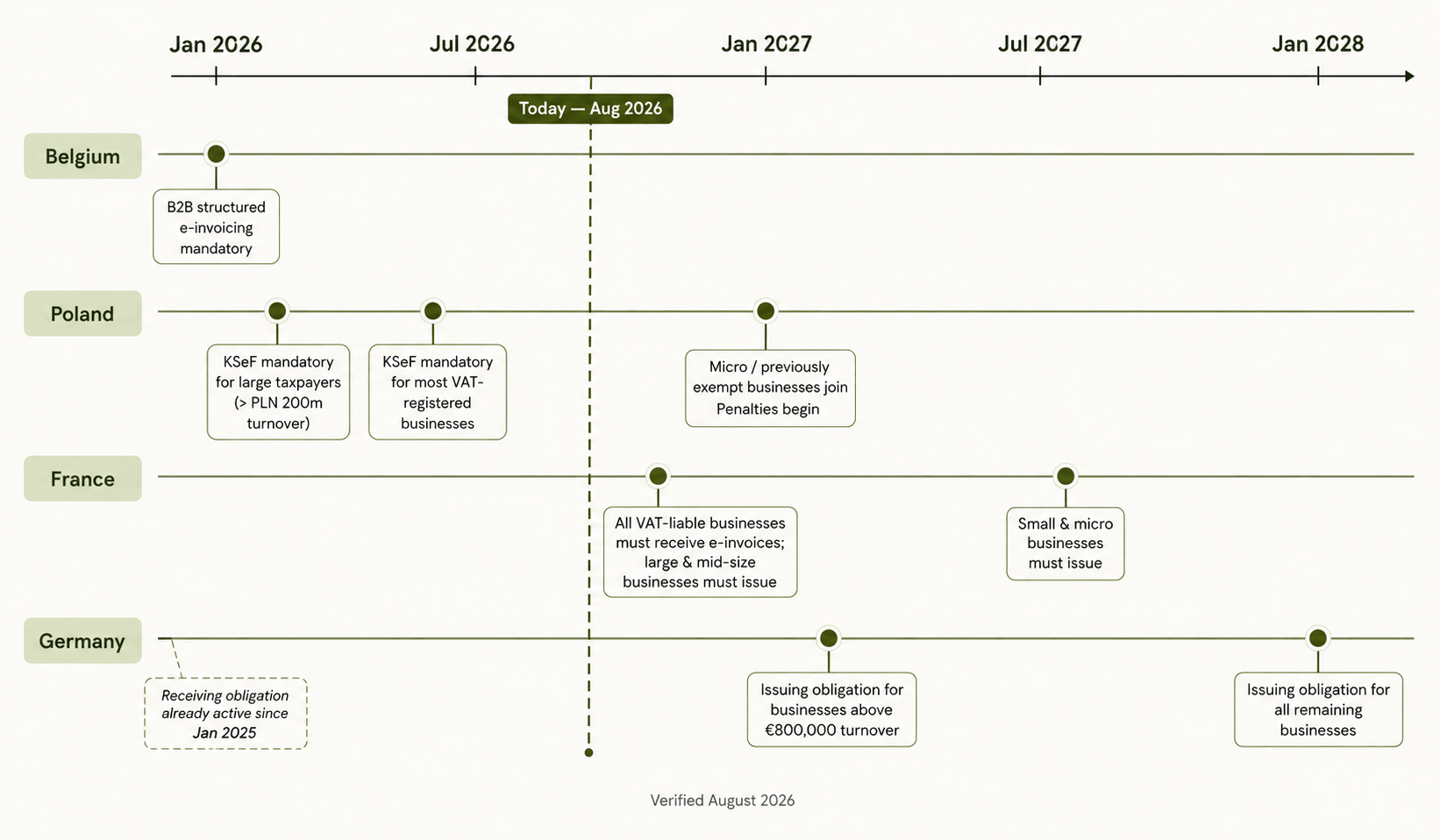
The current picture across HubBroker's core markets:
France - from 1 September 2026, every VAT-liable business in France must be able to receive structured e-invoices, with large and mid-size enterprises also required to issue. Small and micro businesses must issue from 1 September 2027.
Poland - KSeF became mandatory for large taxpayers (turnover above PLN 200 million) on 1 February 2026 and for most other VAT-registered businesses on 1 April 2026. Micro-entrepreneurs follow on 1 January 2027, which is also when penalties begin.
Germany - businesses have had to accept e-invoices since January 2025. The obligation to issue starts January 2027 for companies above €800,000 turnover, and January 2028 for everyone else.
Belgium - structured B2B e-invoicing via Peppol has been mandatory since 1 January 2026.
A Danish supplier selling into French and Polish retail now has retailer format specs, a French platform obligation and a Polish clearance obligation running at the same time.
What good looks like operationally
The suppliers handling this well are not running one project per retailer. They connect their ERP once to an EDI integration platform, then add trading partner profiles on top of that single connection.
Each new retailer becomes a mapping and a routing rule, not a new build. The certified Peppol Access Point and the e-invoicing compliance layer sit in the same place, so the legal obligation and the commercial one are handled together rather than by two vendors who do not talk to each other.
Your ERP does not change. Whether you run Dynamics 365 Finance & Operations, Business Central, SAP Business One or e-conomic, the ERP stays the system of record. The integration layer handles transformation, validation, routing and monitoring outside it.
Questions worth asking before you sign
How long does onboarding a new retail partner take, in practice?
Who maintains the mapping when a retailer changes its spec you or the provider?
Is the provider a certified Peppol Access Point in its own right?
Does the ERP connector already exist, or is it a custom build described as a connector?
What happens when a document fails validation at 2am who sees it?
FAQ
What is a retail EDI mandate? A requirement from a retail customer that trading documents such as orders, despatch advices and invoices are exchanged electronically in a specified format, as a condition of doing business with them.
Is EDI legally required? Retail EDI mandates are contractual, not legal. Government e-invoicing mandates are legal. Both can apply to the same transaction, and compliance with one does not cover the other.
What is the difference between EDI and e-invoicing? EDI covers the full trading document set between businesses. E-invoicing covers the invoice specifically, usually under tax rules that dictate format, transmission route and archiving.
How long does onboarding a new retail trading partner take? With reusable mappings and an existing ERP connection, most connections go live in weeks. First-time EDI setups take longer because the ERP integration has to be built once.
Can we meet retail EDI mandates without replacing our ERP? Yes. An integration layer sits between your existing ERP and each trading partner. This is an integration project, not an ERP migration.
Do we need a Peppol Access Point for retail EDI? Not for every retailer, but increasingly yes several European retailers and most public buyers now accept or require Peppol, and mandates in Belgium and elsewhere are built on it.
Where to start
If you are trading into European retail, the useful first step is a single view of every partner requirement and every legal obligation on the same page which retailers require what, which markets have a live mandate, and where the gaps are.
That mapping exercise usually takes an afternoon and tends to surface at least one obligation nobody had assigned an owner to.
Talk to HubBroker about your current retailer requirements, or book a 30-minute demo to see how the platform handles both sides in one place.
