
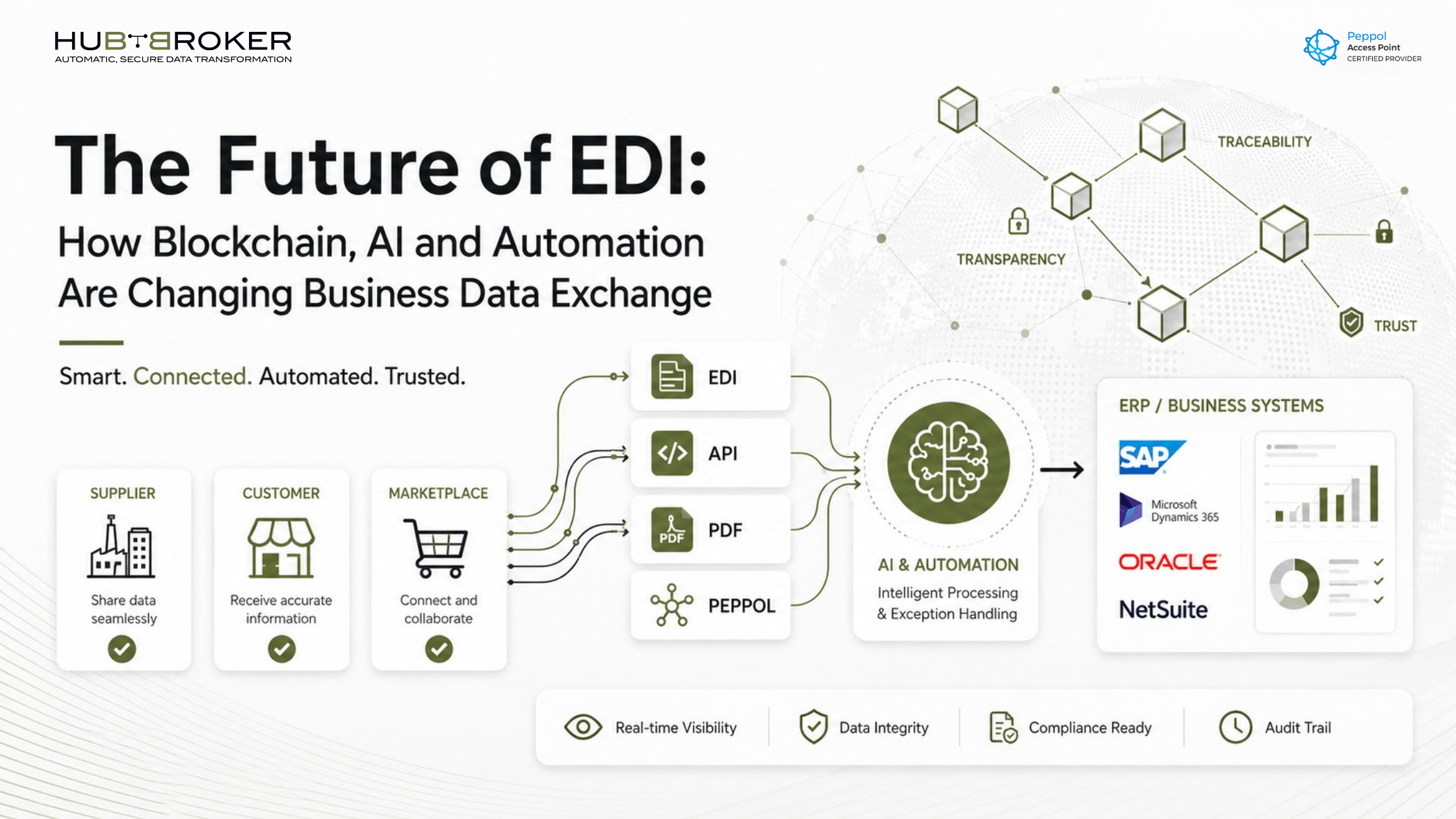
The Future of EDI: How Blockchain, AI and Automation Are Changing Business Data Exchange
EDI has been around for decades, but that does not mean it is outdated. In fact, many businesses still depend on EDI every day to exchange purchase orders, invoices, shipping notices, order responses, and other important documents.
What is changing is the way EDI fits into the modern business system. The future of EDI is not about replacing everything overnight. It is about making EDI faster, more connected, more visible, and easier to manage with technologies like blockchain, AI, APIs, Peppol, and automation.
EDI Is Not Dead. It Is Becoming Smarter
Many companies still use EDI because it solves a real business problem: structured document exchange between systems. A buyer sends an order. A supplier sends an invoice. A warehouse sends a shipment update. These documents need to move in a format that both sides can read.
The issue is not EDI itself. The issue is that many EDI setups are still too manual, too rigid, or too hard to monitor.
That is where modern EDI integration services become important. Instead of treating EDI as a separate technical process, businesses are now connecting it directly with ERP, eCommerce, WMS, finance, and supply chain systems.
Where Blockchain Fits into EDI
Blockchain in EDI is often discussed as if it will replace traditional EDI. In reality, that is unlikely for most businesses.
A better way to look at it is this: blockchain can support EDI by adding a stronger trust layer.
For example, blockchain can help with:
Traceability across supply chains
Shared transaction records
Better audit trails
Proof of product origin
Fewer disputes between trading partners
This can be useful in industries where trust, product history, and compliance are critical, such as manufacturing, logistics, pharma, retail, and food supply chains.
But blockchain alone does not fix messy data, poor mappings, missing fields, or supplier onboarding problems. Those still need proper EDI automation and integration.
The Real Challenge Is Still Data Flow
Most EDI problems are not caused by a lack of blockchain. They are caused by daily operational issues.
For example:
Suppliers send different file formats
ERP fields do not match partner data
Orders fail because master data is missing
Invoices need manual correction
Teams cannot see where a document failed
New partner onboarding takes too long
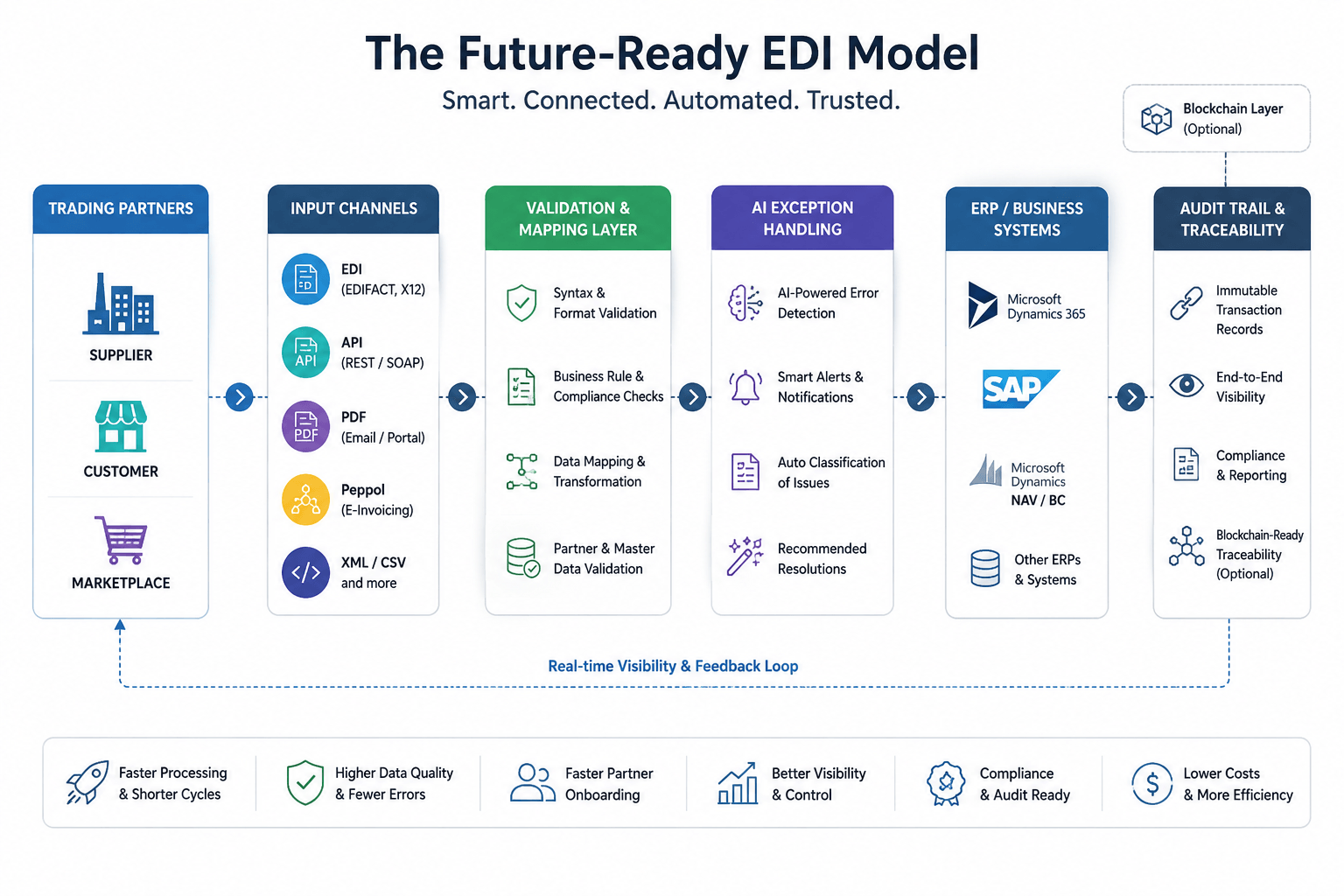
This is why the future of EDI depends on integration layers that can validate, map, transform, and monitor data before it reaches the ERP.
A strong ERP EDI integration setup helps businesses move data from trading partners into systems like Microsoft Dynamics, SAP, e-conomic, Uniconta, Rackbeat, and other platforms without repeated manual work.
Other Technologies Changing EDI
AI in EDI
AI in EDI can help teams detect unusual values, missing fields, duplicate documents, and repeated errors. It can also support exception handling, so users do not need to search through logs manually every time something fails.
For business teams, the benefit is simple: fewer interruptions and faster issue resolution.
APIs and EDI Working Together
APIs are not replacing EDI everywhere. Instead, many businesses now use EDI and APIs together.
EDI is still useful for standardized B2B documents. APIs are useful when systems need faster, real-time communication. A modern API integration strategy helps connect cloud apps, ERPs, marketplaces, and internal systems more flexibly.
IDP for PDF and Unstructured Documents
Not every supplier is ready for EDI. Some still send PDFs by email. That creates manual work for finance and operations teams.
With Intelligent Document Processing, businesses can extract data from PDFs and convert it into structured formats that can be validated and sent into the ERP.
Peppol and E-Invoicing Networks
Peppol and e-invoicing mandates are also pushing businesses toward structured document exchange. A Peppol Access Point can help companies exchange compliant documents with customers, suppliers, and public-sector networks.
What This Means for Business Buyers
For CFOs, COOs, IT heads, and supply chain managers, the future of EDI is not about chasing every new technology. It is about solving practical problems.
A future-ready EDI setup should help you:
Reduce manual order and invoice handling
Improve ERP data quality
Onboard partners faster
Handle different document formats
Track failed transactions clearly
Support compliance and e-invoicing needs
Scale without adding more manual work
This is where an iPaaS platform can help by connecting EDI, APIs, ERP systems, eCommerce platforms, Peppol, and document automation in one connected flow.
FAQ
Will blockchain replace EDI?
No. Blockchain is more likely to support EDI by adding traceability, auditability, and trust between trading partners.
Is EDI still relevant?
Yes. EDI is still important because many business documents need to move in a structured and reliable format between systems.
What is the biggest change in EDI?
The biggest change is the move from isolated EDI setups to connected automation using APIs, AI, Peppol, IDP, and ERP integration.
How can AI help EDI workflows?
AI can help identify errors, detect missing information, classify documents, and support faster exception handling.
How do I know if my EDI setup needs modernization?
If your team still rekeys data, fixes repeated mapping errors, waits too long for supplier onboarding, or lacks visibility into failed transactions, your EDI process is ready for review.
Final Thought
The future of EDI is not about replacing what already works. It is about making business data exchange faster, cleaner, and easier to control.
If your business wants to modernize EDI, connect ERP systems, support Peppol, automate document handling, or prepare for blockchain-ready traceability, HubBroker can help.
Contact HubBroker to discuss your current EDI workflow and see where automation can reduce manual work.
