
Luxembourg B2B E-Invoicing Mandate 2028 What Changes for Domestic Transactions
Businesses established in Luxembourg are preparing for a significant change in how they exchange invoices with domestic customers and suppliers. Under the proposed Luxembourg B2B E-Invoicing Mandate 2028, structured electronic invoices will gradually replace many traditional PDF and paper-based invoicing processes.
On 17 July 2026, Luxembourg’s Government Council approved a draft law extending mandatory electronic invoicing from public-sector transactions to domestic commercial transactions between businesses established in Luxembourg. The proposal must still complete the parliamentary process before becoming law.
For finance and IT teams, the mandate is not simply a change in invoice format. It may require new network connectivity, ERP integration, invoice validation and automated status monitoring.
When Will B2B E-Invoicing Become Mandatory in Luxembourg
The proposed mandate introduces the requirements gradually, giving businesses time to update their invoicing systems.
 The staged timeline means every affected business may need receiving capability from the beginning of 2028, even when its obligation to issue electronic invoices starts later.
Companies should treat these dates as proposed deadlines until the legislation and supporting regulations receive final approval.
Which Transactions Will the Luxembourg E-Invoicing Mandate Cover
The draft law is intended to cover domestic B2B transactions between businesses established in Luxembourg. It expands the country’s existing e-invoicing framework, which currently focuses primarily on invoices connected with public procurement and concession contracts.
The exact scope, exclusions and implementation details will become clearer as the legislation progresses. Businesses should therefore review:
Transactions between Luxembourg-established companies
Sales and purchase invoice processes
Credit note handling
ERP-generated invoice data
Supplier and customer identification details
Cross-border and domestic invoice routing
International transactions may continue to follow different VAT, reporting and e-invoicing requirements depending on the customer’s country.
Will Luxembourg Use Peppol for B2B E-Invoicing
The proposed technical framework is expected to build on Peppol, which Luxembourg already uses as its common delivery network for public-sector electronic invoicing.
The Government Council also approved a draft Grand-Ducal regulation intended to establish a common delivery network and alternative technical solutions. Its purpose is to avoid forcing businesses to operate several separate and incompatible invoice transmission systems.
Luxembourg’s existing B2G framework supports structured invoices based on the European EN 16931 standard. Peppol BIS Billing 3.0 using UBL is already accepted for public-sector invoicing.
 A PDF attached to an email may be digital, but it is not necessarily a structured electronic invoice that can be automatically validated and processed.
What Should Businesses Do to Prepare for the 2028 Mandate
Preparation should begin with an assessment of the full invoice lifecycle rather than only the invoice creation screen.
Businesses should identify how invoices are generated, approved, transmitted, received, validated, booked and archived. They should also check whether their ERP can import and export the required structured data without manual conversion.
A practical readiness plan should include:
Mapping domestic customers and suppliers affected by the mandate
Reviewing current PDF, XML and EDI invoice volumes
Assessing ERP and accounting system capabilities
Selecting a Peppol or e-invoicing service provider
Defining invoice validation and error-handling rules
Testing incoming and outgoing invoice flows
Training finance, IT and customer-service teams
Waiting until the final deadline could create pressure around ERP development, provider onboarding and trading-partner testing.
Luxembourg E-Invoicing Readiness Comparison
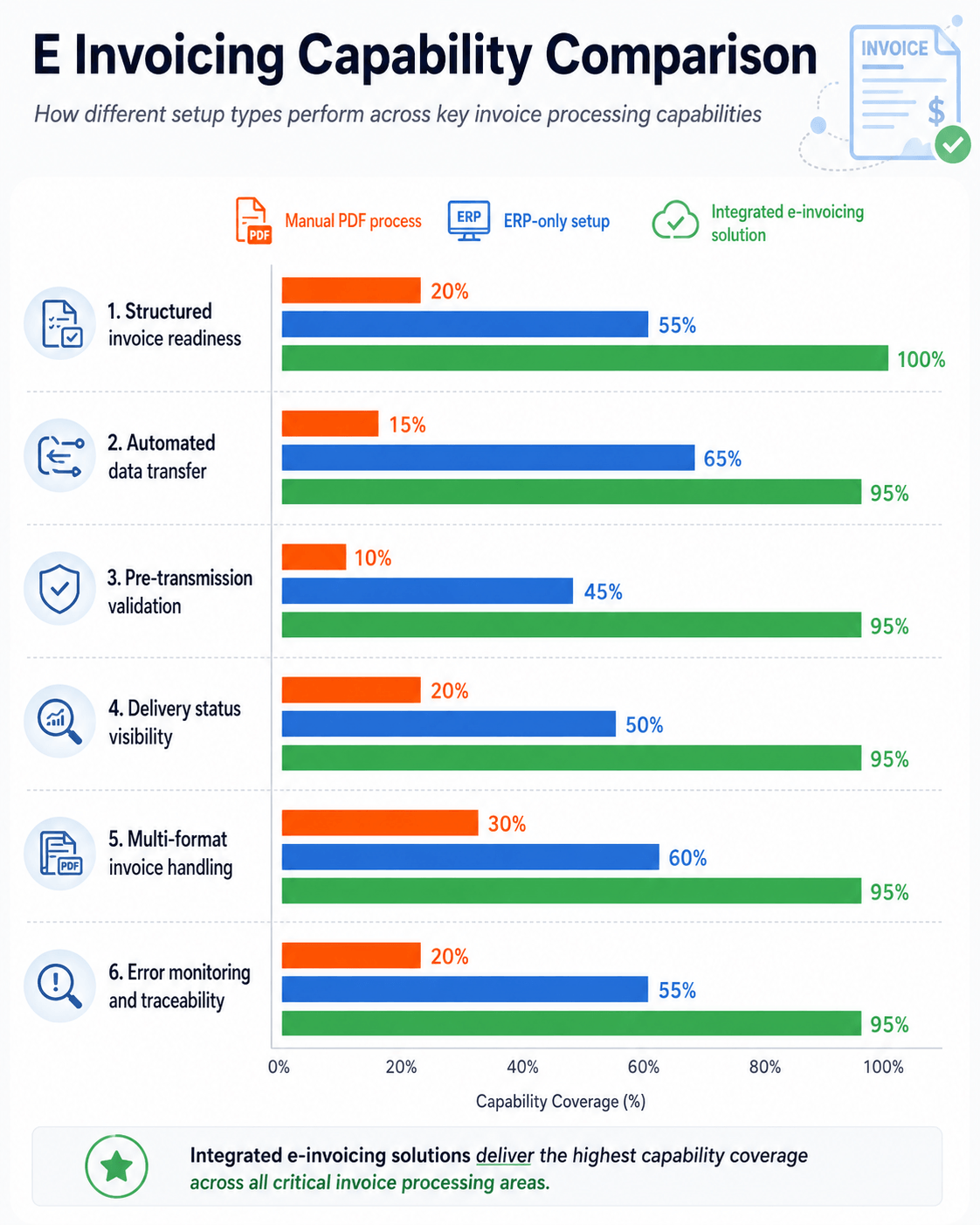
How Can ERP Integration Support Luxembourg E-Invoicing Compliance
An ERP may already hold the information required to create an invoice, but it does not always provide network connectivity, document conversion, Peppol routing or country-specific validation.
An integrated setup can extract invoice information from the ERP, convert it into the required structure, validate mandatory fields and transmit it through the selected network. Incoming invoices can follow the reverse process and enter accounts payable workflows without manual rekeying.
This approach can reduce duplicate data entry while giving finance teams clearer visibility into accepted, rejected and pending invoices.
Why Businesses Preparing for Luxembourg E-Invoicing Work With HubBroker
Businesses need more than a temporary invoice portal when preparing for a long-term compliance requirement. They need a solution that connects regulatory invoicing with their existing ERP, finance and document workflows.
HubBroker supports this transition through:
Certified Peppol Access Point connectivity for secure electronic document exchange
Direct ERP and finance-system integration to reduce manual uploads and downloads
Structured invoice validation to identify missing or incorrect data before transmission
EDI and e-invoicing in one platform for businesses managing several document channels
PDF-to-XML and intelligent document processing for suppliers that continue sending unstructured invoices
Status tracking and error monitoring for greater visibility across incoming and outgoing invoices
Multi-country e-invoicing support for organisations operating beyond Luxembourg
HubBroker combines Peppol connectivity, e-invoicing, EDI, API integration and intelligent document processing within one integration environment. This allows businesses to prepare for Luxembourg’s proposed requirements without creating a separate and disconnected process for every invoice channel.
The Luxembourg B2B E-Invoicing Mandate 2028 is still progressing through the legislative process, but the direction is clear. Businesses that assess their systems early will be better positioned to test their connections, resolve data-quality problems and move towards compliant automated invoicing before the proposed deadlines.
Prepare your Luxembourg invoice workflows before the implementation period begins.
Contact HubBroker to discuss Peppol connectivity, ERP integration and automated B2B e-invoicing.
