Germany B2B E-Invoicing: What Finance and IT Teams Need to Prepare
Germany’s move towards structured B2B e-invoicing is not only a Finance compliance task. It also affects ERP data, AP and AR processes, invoice formats, integrations, error handling and invoice storage. For companies working in Germany, Germany B2B e-invoicing preparation should answer two simple questions: can your business send and receive the right structured invoices, and can Finance and IT manage them properly from creation to storage?
What Is Changing With Germany B2B E-Invoicing?
Since 1 January 2025, an e-invoice under German VAT rules must be in a structured electronic format that can be processed electronically. A normal PDF invoice does not count as an E-Rechnung anymore. It is treated as an “other invoice.” German businesses also need to be able to receive structured e-invoices. For sending invoices, there is still a transition period. Other permitted invoice formats can continue through 2026.
During 2027, some smaller businesses with previous-year turnover up to €800,000 can continue using other permitted formats. Some EDI processes can also continue during this transition period. From 1 January 2028, after these transition periods end, affected domestic B2B transactions will generally need structured e-invoices, unless an exception applies. This gives businesses some time, but Finance and IT teams should not leave all preparation until the last moment.
PDF vs Structured E-Invoice: What Changes?
A PDF invoice is mainly made for people to read. A structured e-invoice contains invoice information in machine-readable format, which means software can read and process the data without someone entering everything manually. Germany commonly uses XRechnung and ZUGFeRD. XRechnung is a structured electronic invoice format. ZUGFeRD combines a readable PDF with structured XML data.
For Finance teams, this changes the invoice from only being a document to becoming data that can move directly between systems. This can reduce manual work, but only when ERP data and invoice mappings are correct.
What Finance Teams Need to Prepare
Finance teams should first look at their current AP and AR processes. Check where invoices are still coming through email, PDF, portals or other manual processes.
Finance should review:
➡ Which customers expect structured invoices
➡ Which suppliers will send structured invoices
➡ How incoming invoices are checked
➡ How invoices are approved and posted
➡ How rejected or incorrect invoices are handled
➡ What invoice information must be available before sending
➡ How invoices will be stored
➡ Who will handle invoice errors
This is important because a technically correct invoice can still cause problem if customer information, tax data or other required values are wrong. Finance team should also know what happen when an invoice cannot be processed automatically.
What IT and ERP Teams Need to Prepare
IT should check more than only whether the ERP can create an XML file. The complete invoice process should work from the ERP to the customer, and also from incoming invoice to posting and storage.
IT teams should check:
Invoice data extraction
Data mapping
XRechnung and other required formats
Incoming invoice processing
Validation rules
AP and AR integration
Error monitoring
Invoice status
Structured invoice storage
Germany does not require only one transmission method for B2B e-invoices. Depending on the agreement between businesses, invoices may be exchanged through email, electronic interfaces, portals or other supported methods. Because of this, IT team need to consider both ERP capability and customer or supplier connection requirements.
Is Your Current ERP Ready for German E-Invoicing?
Creating one structured invoice does not automatically mean your ERP is fully ready. Your system should be able to:
✔ Create complete structured invoice data
✔ Receive structured invoices
✔ Support required invoice formats
✔ Maintain invoice mappings
✔ Find validation errors
✔ Track failed invoices
✔ Handle invoice exceptions
✔ Keep invoice records properly
✔ Add new formats when needed
For example, your ERP may successfully create XRechnung files, but if the Finance team cannot see when one gets rejected, the process is still partly manual. The complete flow should work together.
Build, Extend or Use an E-Invoicing Integration Platform?
Businesses normally have few different options.
➡ Custom ERP Development
A company can build its own e-invoicing process directly inside the ERP. This gives control, but internal IT team need to maintain the integration, formats and future changes.
➡ ERP Extensions or Connectors
Existing ERP extensions can make implementation easier if they support the required German formats and your current ERP version. This can work well for a simple setup, but companies should check how flexible the connector is when new requirements are added.
➡ Middleware or iPaaS
Middleware or an iPaaS platform keeps format conversion, validation, routing and monitoring outside the main ERP. This can reduce the amount of custom changes inside ERP.
➡ Managed E-Invoicing
Businesses can also use a provider to manage the technical invoice connection and exchange process. This can be useful when the company does not want internal IT team to maintain all country and format requirements. The right option depends on invoice volume, ERP complexity, internal skills and how many countries the business operates in.
What Should Businesses Look for in a Germany E-Invoicing Solution?
A good solution should support the complete invoice process. Important things to check include:
German invoice format support
ERP compatibility
Incoming and outgoing invoices
Data validation
Format conversion
Invoice automation
Error handling
Status monitoring
Security
Invoice storage
Easy maintenance
For companies working in several countries, it is also useful if the same ERP connection can be reused while invoice formats and delivery methods change from country to country. This can avoid creating a separate ERP integration for every new market.
How Can an Integration Platform Simplify Compliance?
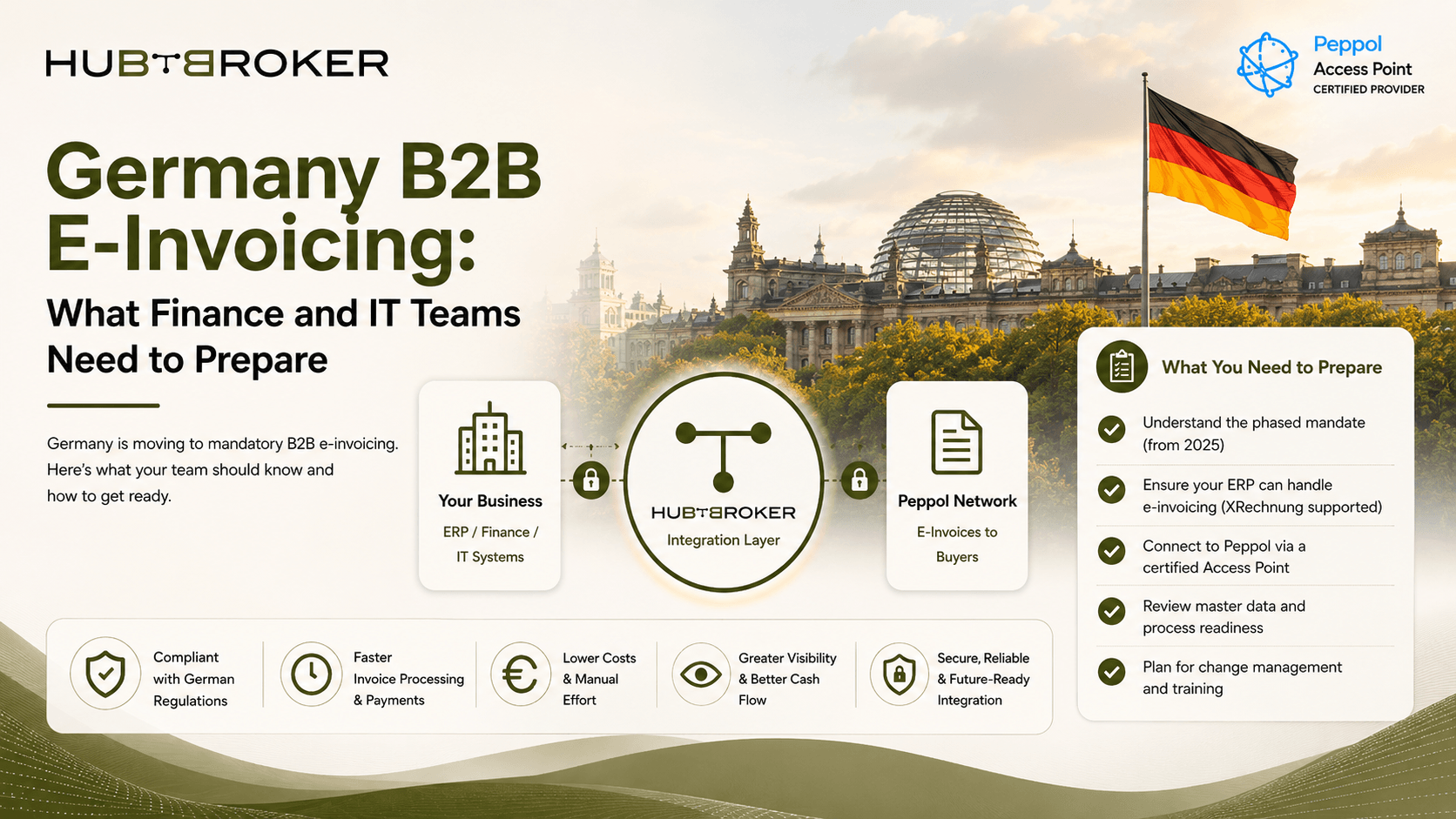
A simple architecture can look like this:
 Incoming invoices can follow the same process in reverse.
The integration layer can handle:
Invoice data mapping
Format conversion
Validation
Routing
Monitoring
Error handling
Status updates
This means the ERP does not need to manage every technical requirement directly. HubBroker provides e-invoicing, iPaaS, EDI, API integration, Peppol connectivity and ERP integration capabilities that can support this type of setup. For Finance team, this gives more visibility into invoice status. For IT team, it can reduce the number of separate integrations they need to maintain.
Prepare Finance, IT and ERP Together
Germany B2B e-invoicing is not something only Finance or only IT should manage. Finance understands invoice and tax processes, while IT understands ERP data, integrations and system errors. Both teams need to work together for the complete process. Businesses should use the transition period to test the full invoice flow, not only check whether the ERP can generate an XML file.
Test what happen when an invoice is created, sent, rejected, corrected, received, posted and stored.
Preparing for Germany B2B e-invoicing?
HubBroker can help connect your ERP with structured invoice formats and build a more automated e-invoicing process for your German operations.
