
Lessons from France 5 Mistakes German Companies Can Still Avoid
German companies have one advantage while Europe moves faster with e-invoicing: they can learn from countries that started large preparation earlier. France has already shown that e-invoicing is not only about file format. It also affects ERP data, supplier onboarding, invoice receiving, exception handling and who owns each part of the process.
For German e-invoicing preparation, Finance and IT teams still have time to avoid some common mistakes before the next mandatory issuing phases.
Mistake 1: When Should German Companies Start Preparing for E-Invoicing?
One common mistake is treating the legal deadline as the date when project should start. France’s rollout work has shown how much work happens before compliant invoice exchange is ready. Companies need to map ERP data, onboard suppliers and customers, test system connections, define exception handling and decide who owns each task.
Germany already requires domestic businesses to be able to receive e-invoices from 1 January 2025. During 2025 and 2026, issuers can still use paper invoices or, with recipient consent, other electronic formats such as PDF. From 2027, the transition becomes narrower for issuers with previous-year turnover above €800,000. Broader mandatory issuance follows from 2028.
The practical action is to build a proper test plan now. Test customers, suppliers, credit notes, different tax cases, corrected invoices and failed validations. Do not test only the successful “happy path” invoice. Testing real problems early gives Finance and IT more time to fix mapping, data and ownership gaps before statutory deadlines bring higher transaction volumes.
Mistake 2: Is a PDF an E-Invoice in Germany?
No. A normal PDF is not considered a German e-invoice because it does not contain structured data that allows automatic electronic processing.
Germany recognises structured formats that meet the required conditions, including XRechnung and qualifying ZUGFeRD versions. The BMF states that XRechnung and ZUGFeRD from version 2.0.1, apart from certain profiles, can meet VAT requirements. EN 16931 is also an important part of the structured invoice model.
France gives a useful lesson here. A document that looks correct to a person is not always same as a document that business systems can process automatically. German businesses should therefore test what their ERP or accounting system can actually receive, validate, display, archive and post. Being able to open an invoice on screen is not enough.
Mistake 3: How Should ERP Systems Prepare for German E-Invoicing?
Start with the source data, not with XML generation.
An invoice can be transformed into technically correct XML and still fail during processing because important business information is missing or wrong. Common problem areas include customer identifiers, VAT data, invoice references, payment information, product mapping, tax mapping, addresses and general master data. France-style implementation programmes have shown why companies need to prepare their source systems before focusing only on invoice transmission.
For German ERP readiness, Finance should normally own the accuracy of business data. IT should manage extraction, mapping, validation, transformation and technical integration. Compliance begins inside the ERP, not only at the final transmission step.
If incorrect VAT data is already stored in ERP, converting it into XML does not make it correct. The integration should help detect these issues before invoice reaches the customer.
Mistake 4: Why Is Outbound-Only E-Invoicing Preparation Incomplete?
Germany’s receiving requirement is already active, so preparing only outbound invoices leaves a large part of the process unfinished.
Companies should think about the full invoice lifecycle.
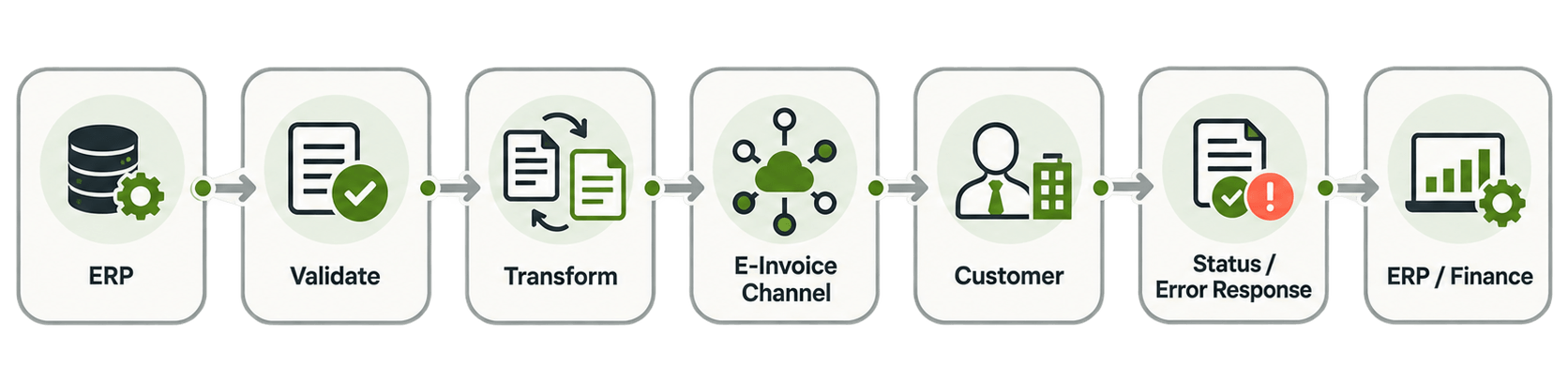
Inbound invoices need same attention:
Supplier → E-Invoice Channel → Validate → AP / ERP
Finance teams should know who manages rejected invoices, invalid fields, duplicates, missing references, routing problems and supplier questions. IT should provide monitoring and clear technical error information. France’s broader digital invoicing preparation shows why exception handling should be planned before transaction volume becomes high.
Receiving an XML file is only first step. Businesses also need a repeatable process to validate it, route it, investigate problems, correct errors and reconcile the final invoice.
Preparation Area | Risk / Lesson | Action for German Companies |
|---|---|---|
ERP master data | Poor customer, VAT, address, or payment data can cause validation failures. | Audit mandatory invoice fields and correct source data in the ERP. |
Invoice format | Treating PDF as a structured e-invoice can create compliance and processing issues. | Test XRechnung, applicable ZUGFeRD formats, and EN 16931-compatible output. |
Receiving | Focusing only on outbound invoices leaves AP processes unprepared. | Test how supplier e-invoices are received, validated, displayed, and posted into ERP. |
Invoice validation | Technically generated files may still contain incorrect or incomplete business data. | Add validation before invoices are transmitted or posted. |
Exception handling | Failed invoices can remain unresolved when ownership is unclear. | Define who investigates validation, routing, mapping, and business-data errors. |
ERP integration | Manual exports and imports increase operational effort. | Connect invoice creation and receiving directly with the ERP where practical. |
Status processing | Finance may not know whether an invoice was accepted, rejected, or failed. | Return processing and error statuses to the ERP or monitoring interface. |
Testing | Waiting until the mandatory phase reduces time to correct integration issues. | Test real customer, supplier, tax, credit-note, and exception scenarios early. |
Finance ownership | Technical teams cannot decide every invoice-data requirement. | Assign Finance responsibility for business data, tax information, and process rules. |
IT ownership | Finance teams cannot manage mappings, interfaces, and technical failures alone. | Assign IT responsibility for integration, transformation, validation, and monitoring. |
Multi-country setup | Country-specific connectors can create repeated ERP changes and mappings. | Assess whether a reusable integration layer is more suitable for European operations. |
Monitoring | Processing failures can be missed without central visibility. | Provide dashboards, logs, alerts, and searchable transaction statuses. |
Archiving | Successful transmission does not automatically solve invoice retention requirements. | Define how structured invoices and relevant processing information will be retained. |
Supplier onboarding | Different supplier formats and processes can slow inbound adoption. | Identify high-volume suppliers and test inbound invoice scenarios with them first. |
Customer onboarding | Customer-specific requirements may differ even within the same regulatory framework. | Collect customer routing, format, identifier, and reference requirements before rollout. |
Mistake 5: Should German Companies Choose E-Invoicing Software for Germany Only?
Not always.
A Germany-only connector may work fine for a company with limited local requirements. But companies working across France, Belgium, Poland, Italy, Denmark or other markets should check whether country-by-country integrations will create too many separate mappings, monitoring tools, support processes and ERP changes.
This can become difficult quite quickly. A reusable integration layer starts making more sense when company needs several ERP systems, Peppol, EDI, APIs, structured invoice formats, transformations, validations and status handling across different countries.
The main question is not only whether one Germany connection works. It is also whether the same setup can support future countries without rebuilding everything again.
How Can German Companies Build a More Flexible E-Invoicing Setup?
HubBroker can work as an integration layer between ERP systems and the required e-invoicing formats or networks.
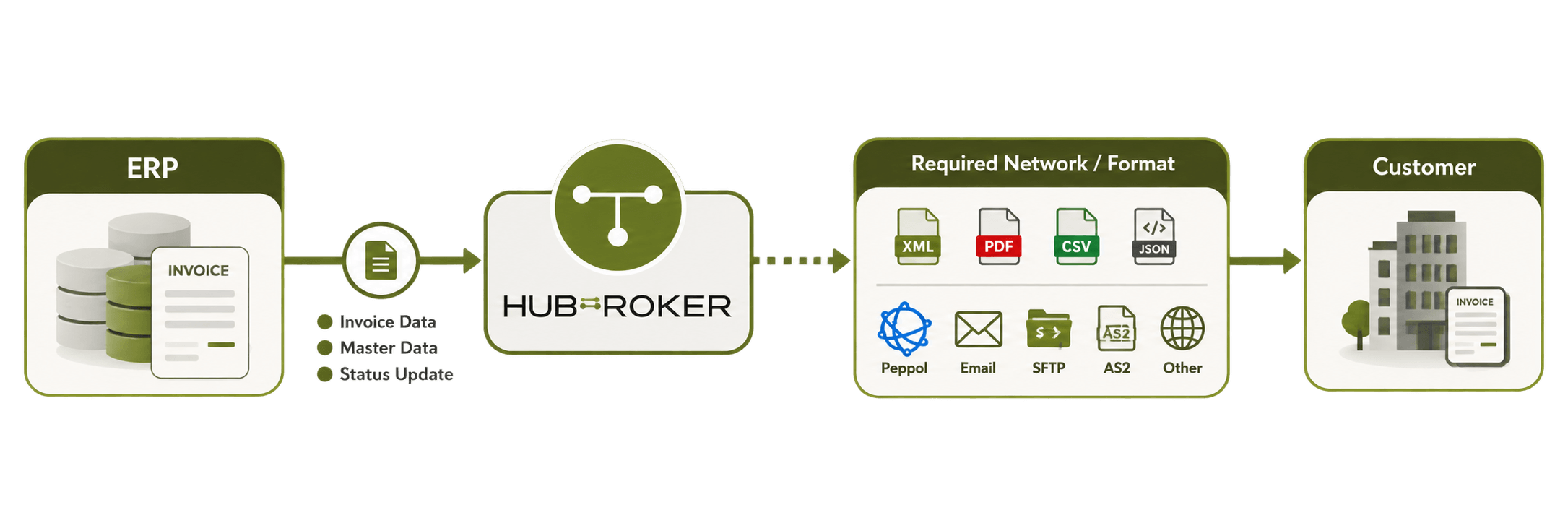
For incoming invoices:
Supplier Invoice → HubBroker → Validation / Transformation → ERP
This setup can support mapping, transformation, validation, workflow automation, invoice status handling, Peppol, EDI, APIs and multi-country integration. It does not mean every company needs exactly same architecture. The setup should depend on ERP environment, invoice volumes, countries and business requirements. Companies preparing for Germany’s 2027 and 2028 phases still have time to check practical gaps before production pressure becomes higher.
HubBroker can help review ERP data, invoice formats, inbound and outbound flows and integration architecture so Finance and IT teams can see what needs to be fixed first. If your company is preparing for German e-invoicing, talk to our team about your current setup and where the integration process may need improvement.
