
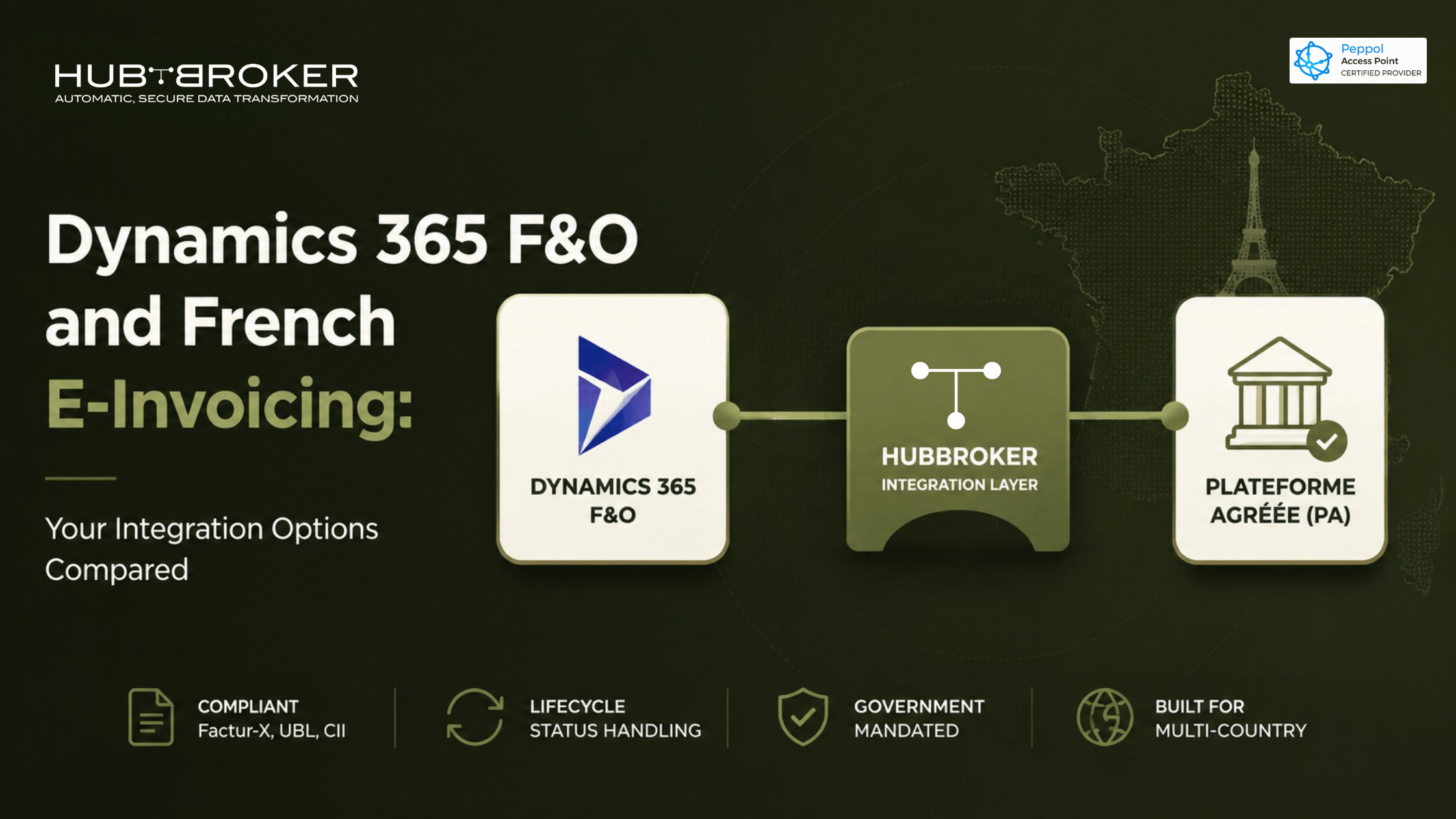
Dynamics 365 F&O and French E-Invoicing: Your Integration Options Compared
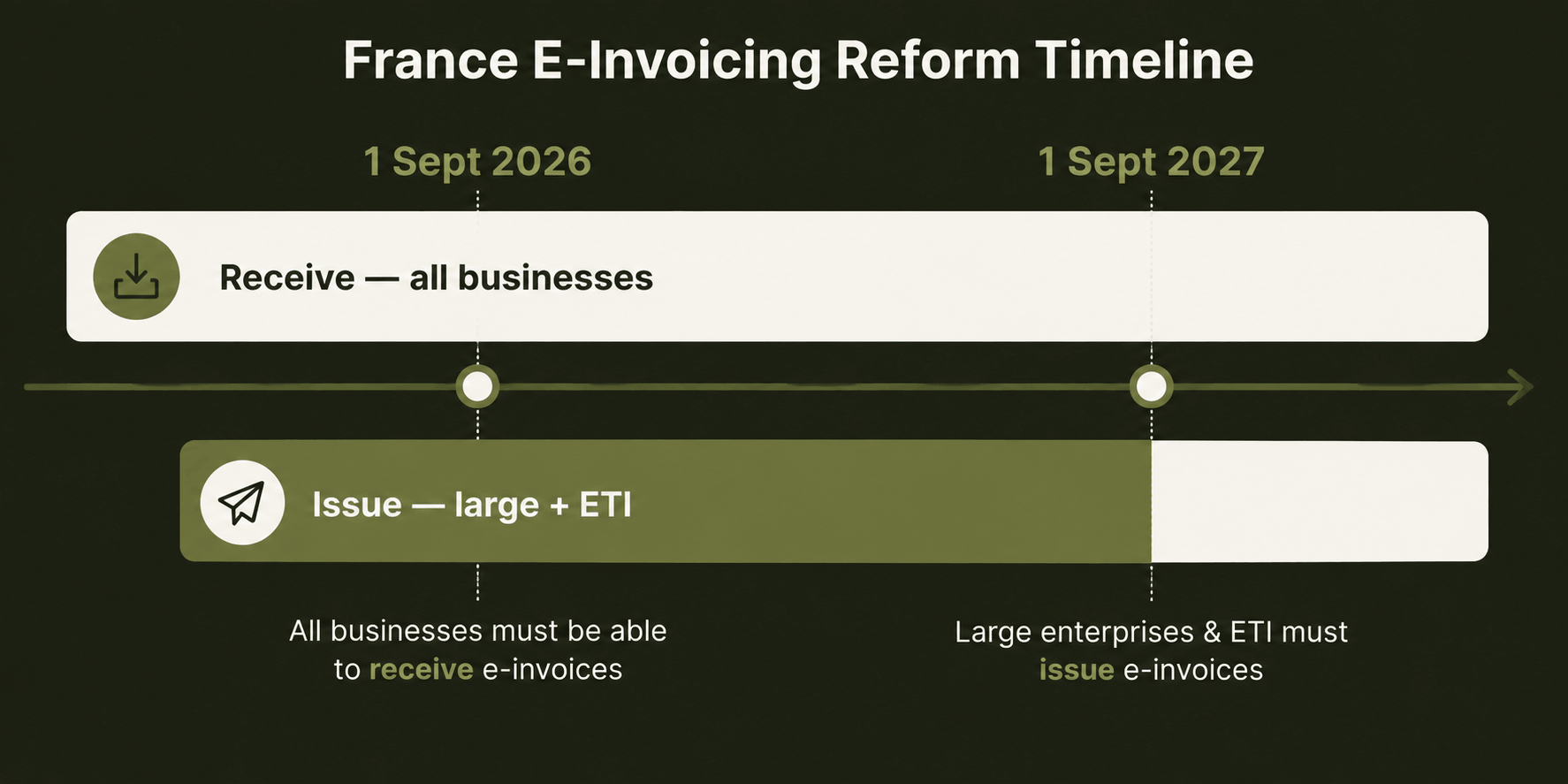
France's e-invoicing reform goes live on 1 September 2026. From that date, every business operating in France must be able to receive structured electronic invoices no exceptions for size. Large enterprises and ETIs must also issue them.
Here's the part most Dynamics teams discover late: D365 F&O can generate a compliant invoice file, but it cannot deliver one. France requires every mandated invoice to pass through a state-approved platform. Something has to sit between your ERP and that platform.
This post compares the four ways to build that connection, and what each one costs you eighteen months from now.
What France actually requires from your D365 F&O system
Reception first, issuance second
The reception obligation is the one that catches teams out. It applies to every business from day one, regardless of size or turnover. If a French supplier sends you a structured invoice on 2 September and your AP process expects a PDF in an inbox, that invoice has nowhere to land.
Issuance is phased. Large enterprises and ETIs start on 1 September 2026; SMEs and micro-enterprises follow on 1 September 2027.
Factur-X, UBL, CII and what F&O produces natively
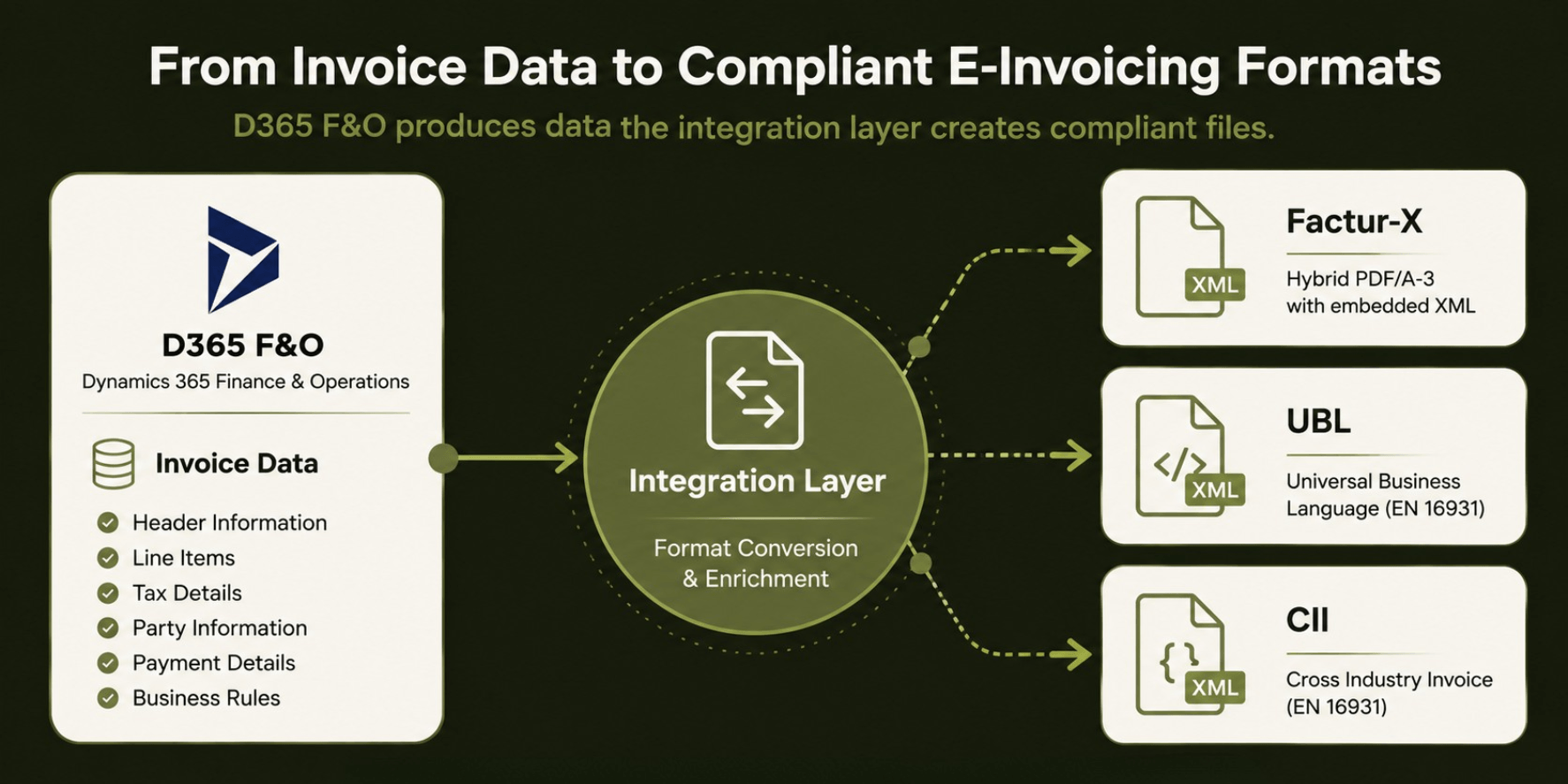
France accepts three structured formats: Factur-X, UBL, and CII, all aligned to EN 16931. Factur-X is the hybrid one a readable PDF with XML embedded, which suits AP teams who want a human-checkable document alongside machine-readable data.
D365 F&O generates invoice data. Turning that into a valid Factur-X or CII file with correct French mandatory fields is a mapping job, and it is where most of the effort actually sits.
Lifecycle statuses: the requirement nobody budgets for
France doesn't stop at delivery. Invoices carry a lifecycle submitted, received, rejected, approved, paid and those statuses have to flow back and be recorded. If your integration is one-directional, you've built half a solution.
One more terminology point worth correcting in your internal documents: the French government replaced "PDP" (Plateforme de Dématérialisation Partenaire) with "Plateforme Agréée" (PA) in the 2025 specification revisions. Same function, new name.
The four integration routes for D365 F&O e-invoicing France
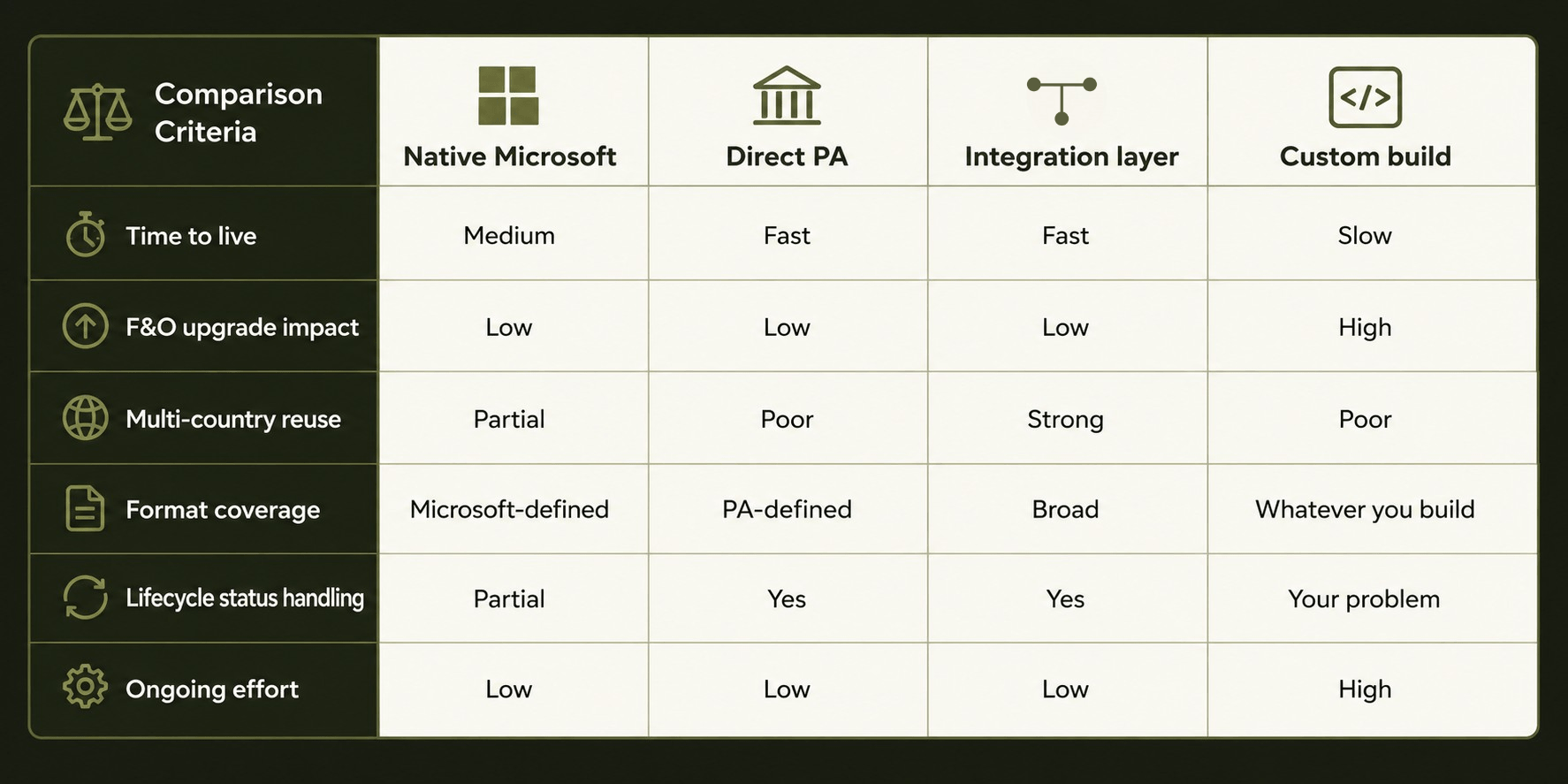
Option 1 - Microsoft's native Electronic Invoicing service
Microsoft offers e-invoicing capability within the Dynamics 365 platform, configured through Globalization Studio. It keeps everything inside the Microsoft stack, which appeals to IT teams protecting a single-vendor architecture.
The constraint is scope. It handles format generation well. It does not make you a Plateforme Agréée, so you connect it to one anyway and country coverage, format versions, and status handling depend on Microsoft's release cadence rather than yours.
Option 2 - Direct connection to a single Plateforme Agréée
Point F&O straight at one approved platform via its API. Fewest moving parts, clearest line of accountability.
It works when France is your only requirement and D365 F&O is your only system. It gets awkward when Germany arrives in 2027 and you're building a second, unrelated connection with a different vendor and a different mapping layer.
Option 3 - An integration layer in front of your chosen PA
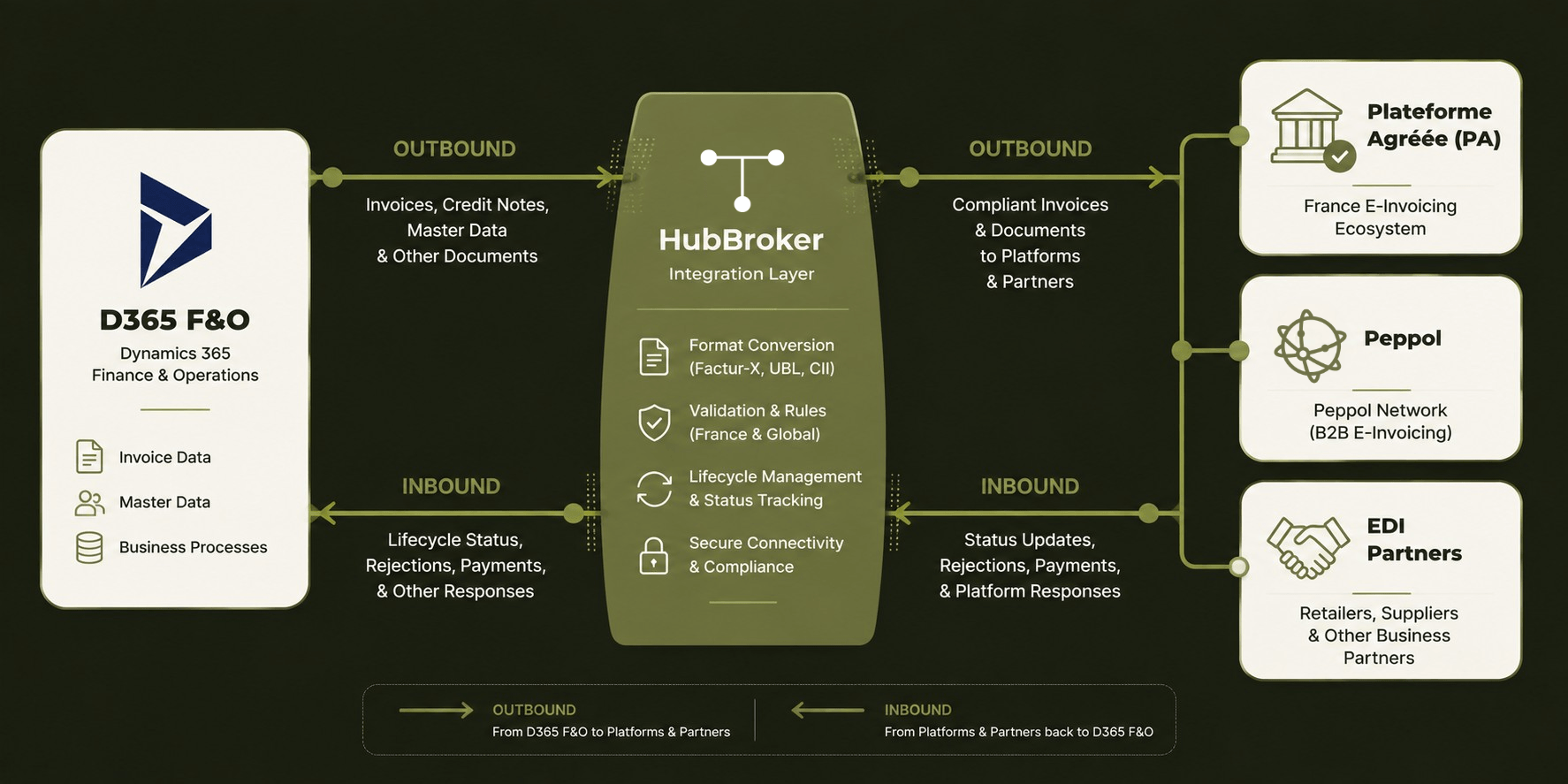
Put an integration platform between F&O and the French ecosystem. F&O sends its data once, in its own structures. The layer handles format conversion, validation, PA connectivity, status returns, and every other country you trade into.
The trade-off is an additional vendor in the chain. The return is that France stops being a project and becomes a configuration.
Option 4 - Custom X++ and Data Entity development
Build it in-house. Full control, no licence fee, and a permanent maintenance obligation. Every French specification update, every format revision, every new lifecycle status becomes a development ticket competing with everything else in your backlog.
Viable if you have dedicated D365 development capacity and one country to support. Expensive at scale.
Comparison: cost, time to live, and what breaks later
How to choose: three questions that decide it
One French entity, or a European rollout?
A single French subsidiary invoicing domestically has a genuinely simple problem. A group with entities in France, Germany, Belgium, and Poland has a portfolio problem, and solving it four separate times is how integration debt accumulates.
How much already sits outside F&O?
If your order and invoice flows already run through EDI with retail and industrial partners, adding French e-invoicing to that same flow costs far less than standing up a parallel compliance channel. Look at what's already connected before deciding.
What happens when Germany 2027 arrives?
Germany's B2B mandate follows. Belgium is live. Poland's KSeF timeline is moving. Choose the option that makes the second country cheaper than the first.
What this looks like with an integration layer
D365 F&O keeps doing what it does posting invoices, holding master data, running your finance processes. The integration layer sits on top and handles the rest: converting F&O invoice data to Factur-X, UBL, or CII, validating against French mandatory fields before transmission, routing through an approved platform, and writing lifecycle statuses back so your AR team sees invoice state inside the ERP.
The same layer carries your Peppol traffic, your EDI flows with retail partners, and inbound supplier documents arriving as PDFs through intelligent document processing. One connection to F&O, many obligations served.
No replacement of your ERP. No rebuild of your finance processes.
Frequently asked questions
Does D365 F&O handle French e-invoicing out of the box? Partially. It can produce electronic invoice formats through Globalization Studio, but it cannot transmit to the French ecosystem on its own. Delivery has to go through an approved platform.
Do I need to be ready by 1 September 2026 if I'm a small business? For receiving, yes. The reception obligation applies to all businesses from that date. Issuance for SMEs and micro-enterprises begins 1 September 2027.
What's the difference between a PDP and a Plateforme Agréée? Nothing functional. PA is the current official term; PDP is the previous name, replaced in the 2025 specification revisions.
Which format should we use Factur-X, UBL, or CII? All three are valid. Factur-X is common where AP teams want a human-readable document alongside the structured data. Confirm your trading partners' preferences before deciding.
Can one integration cover France, Germany, and Belgium? With an integration layer, yes the connection to F&O stays the same and country-specific rules are handled in the layer. With direct point-to-point connections, each country is a separate build.
Where to start
If your French entity isn't connected yet, the first step is mapping what F&O currently produces against what France requires usually a short exercise that makes the right option obvious.
We work with D365 F&O environments across Europe and can walk through your setup. Get in touch or see how the platform connects to D365 F&O.
