
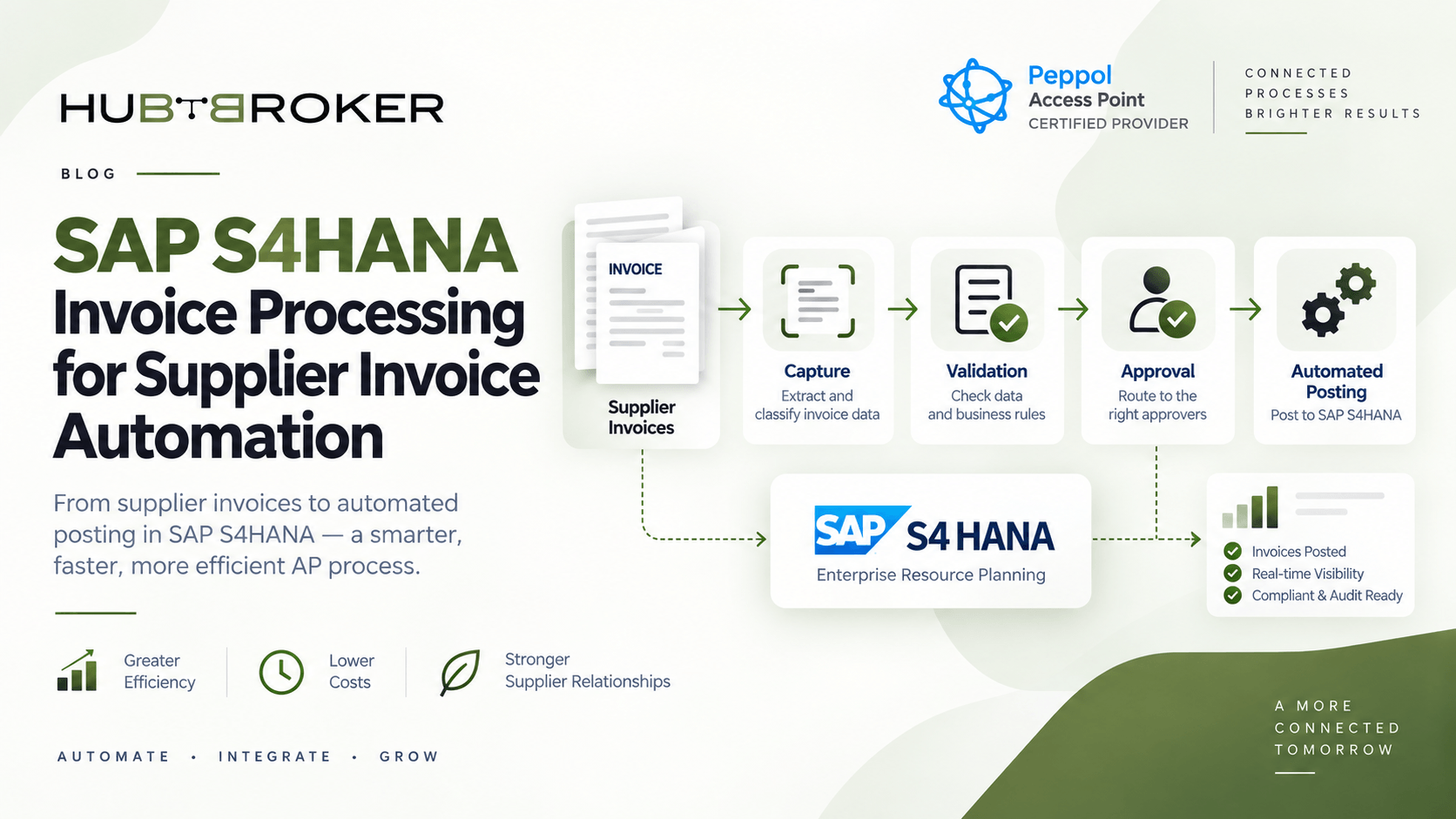
SAP S4HANA Invoice Processing for Supplier Invoice Automation
A German manufacturer receives 900 supplier invoices each month. Some arrive as PDF attachments, larger suppliers send XML or EDI, and another supplier uses Peppol. SAP S/4HANA is used for finance, but AP staff still check VAT data and find PO numbers. This is where sap s 4hana invoice processing becomes an automation project.
SAP s 4hana invoice processing: why is AP still typing invoices?
A PDF invoice cannot simply be posted because a document exists. Data must first be captured and checked. A practical flow is:
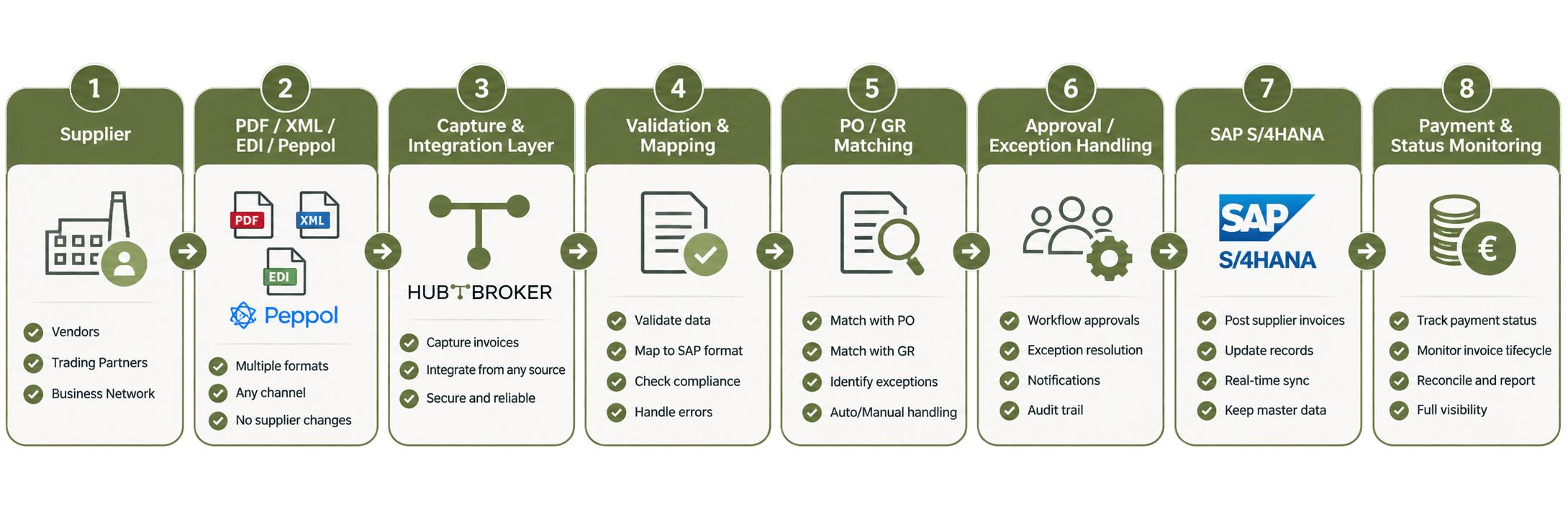
For a PDF supplier invoice, extraction reads supplier name, VAT number, invoice number, date, PO number, amount, currency and payment terms. Finance still checks unclear values before posting.
Supplier sent invoice without PO number - what happens next?
One missing PO reference can stop whole invoice. The integration process should flag it rather than guess. The same applies when supplier ID, VAT number, cost centre or GL account is missing. Another common case is matching. Invoice may show 110 units while the PO has 100, or unit price may differ. The invoice should move to exception handling, not silently post.
Goods receipt, PO line, price, tax and currency matter for automated matching.
Can Peppol invoices go directly into SAP S/4HANA?
They can move through an integration layer:
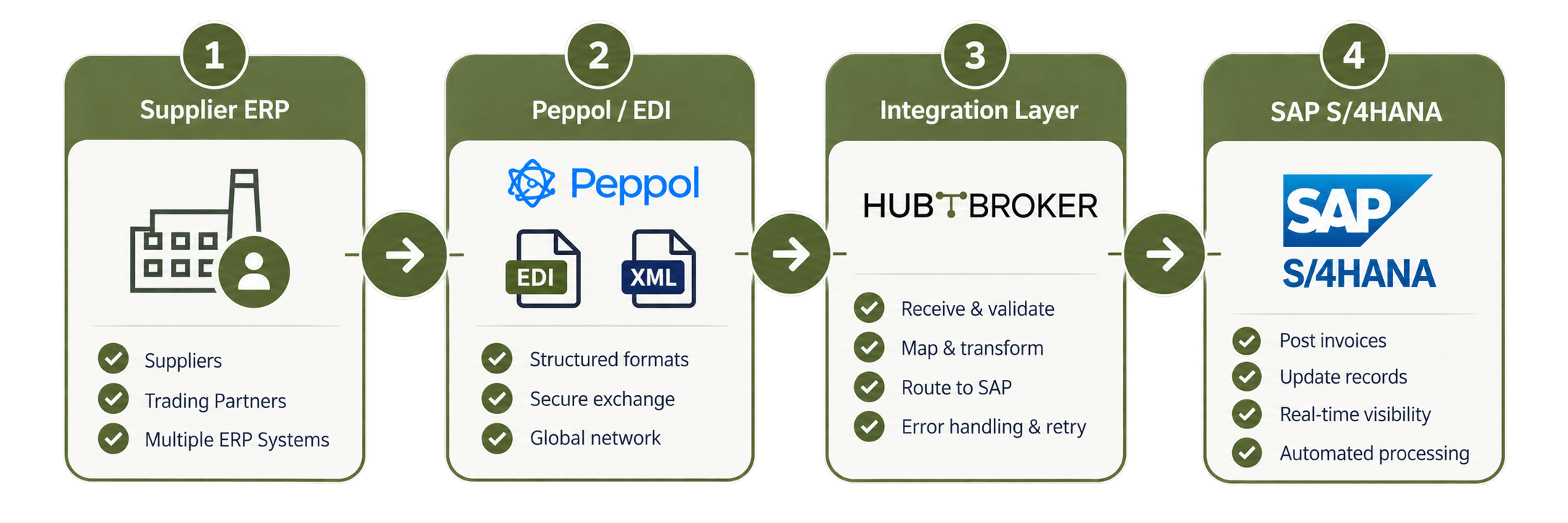
Structured data reduces re-keying, but validation is still needed. EN 16931 provides a common European semantic standard for e-invoices. EU rules are also changing country by country; ViDA allows Member States to introduce mandatory domestic e-invoicing under specific conditions, while cross-border B2B digital reporting starts from July 2030. There is not one identical B2B deadline for every European country.
We receive invoices from several European countries - should every format be separate?
A shared-service AP team may receive invoices from Germany, France, Belgium, Poland and Denmark. VAT data, identifiers, formats and delivery channels can differ. Central transformation can convert supplier formats into data SAP expects, while country-specific validation rules stay visible and maintainable.
European automation numbers worth knowing
Indicator | Verified figure | Why it matters |
|---|---|---|
EU enterprises using ERP/CRM/BI, 2025 | 53% | Business systems are already connected |
Large EU enterprises using ERP, 2025 | 89% | High ERP dependence |
Small EU enterprises using ERP, 2025 | 41% | Automation is not only for large firms |
EU enterprises using paid cloud, 2025 | 52.74% | More finance tools sit outside ERP |
Cloud users buying finance/accounting software, 2025 | 58.16% | Finance stacks are becoming connected |
EU enterprises using AI, 2025 | 19.95% | Automation tools are expanding |
EU SMEs with basic digital intensity, 2025 | 71% | Digital processes are becoming normal |
Eurostat is the source for these 2025 figures.
Use of ERP/CRM/BI applications by enterprises, 2025 (Eurostat):
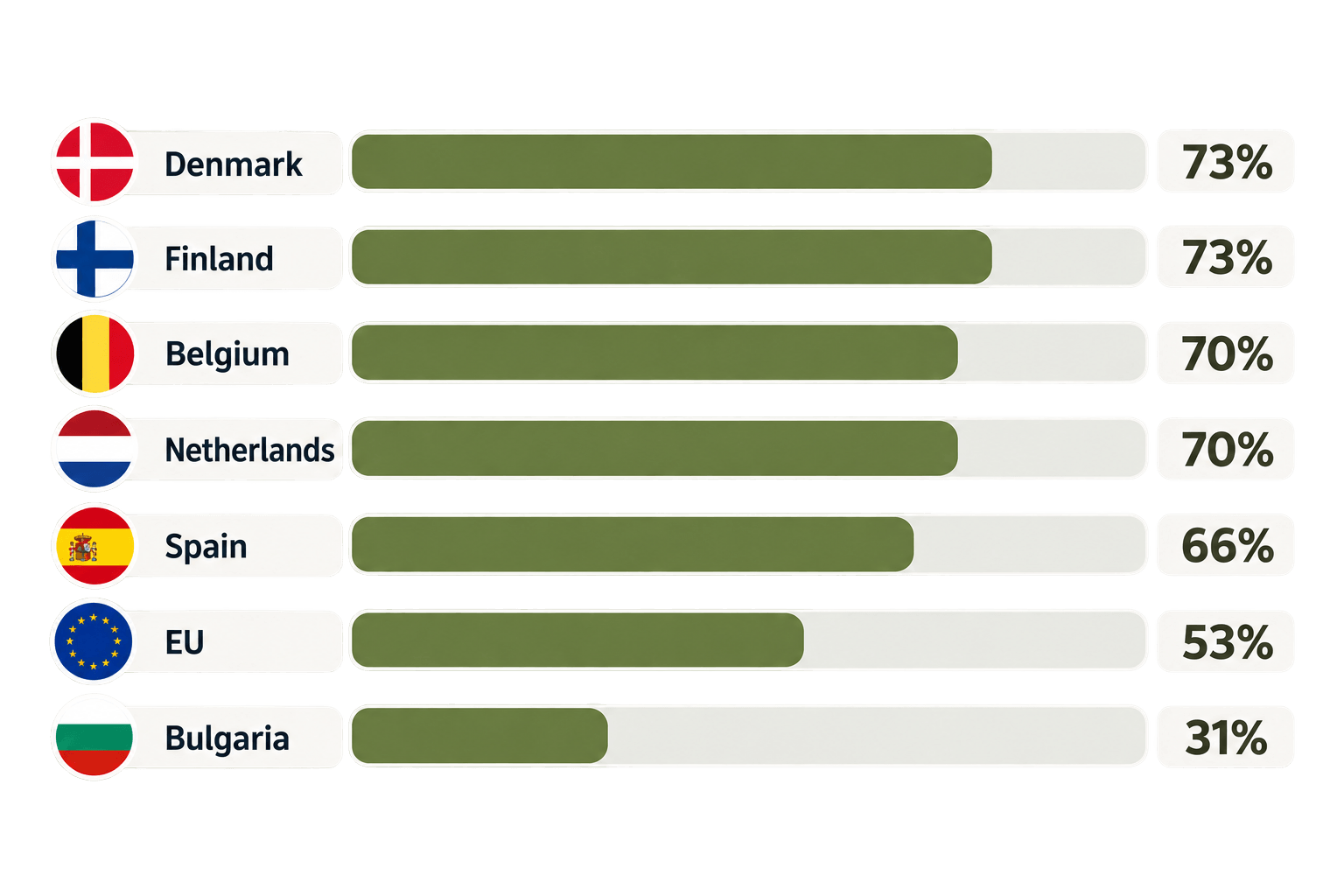
These percentages measure enterprises using at least one specialised e-business application: ERP, CRM or BI, using the same Eurostat survey population.
Who checks failures after automation goes live?
Automation still needs ownership. Duplicate invoice numbers, missing PO, wrong VAT, price mismatch, missing goods receipt, Peppol validation error or failed approval should create visible exceptions. Teams need routing, retry, logs and monitoring so finance know where invoice stopped.
Requirement | Direct/custom SAP | Integration platform |
|---|---|---|
One channel | Can work well | Also suitable |
PDF + XML + EDI + Peppol | More interfaces | Central handling |
Multi-country suppliers | More local logic | Shared layer |
Monitoring | Depends on setup | Central view |
New suppliers | More configuration | Reusable onboarding |
For sap s 4hana invoice processing, companies should compare how a solution receives invoices, validates fields, handles exceptions and shows status, not only whether it can post into SAP.
HubBroker can act as the integration layer for PDF, XML, EDI and Peppol supplier invoices, with mapping, validation, routing, monitoring and error handling. SAP S/4HANA remains the finance system, while supplier invoice automation manages how clean data reaches it. A supplier invoice is not automated just because it finally reaches SAP. It should be identified, checked, matched, routed and monitored. European businesses can discuss SAP S/4HANA supplier invoice automation with HubBroker for a setup that stays manageable as supplier volume grow.
