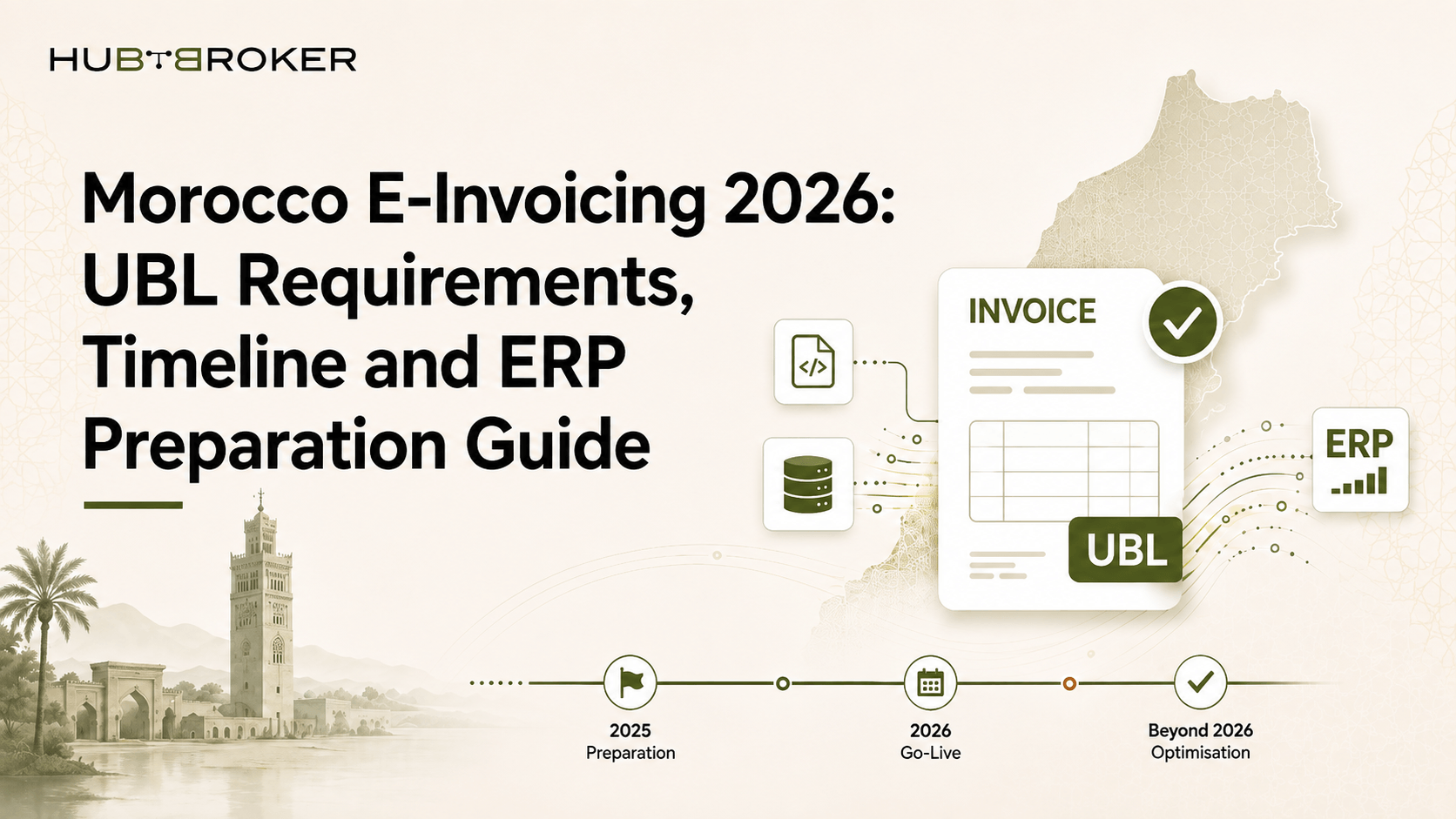
Morocco E-Invoicing 2026 UBL Requirements, Timeline and ERP Preparation Guide
Morocco e-invoicing 2026 is becoming an important compliance topic for businesses, finance teams and ERP managers operating in Morocco. The Direction Générale des Impôts (DGI) is moving toward a structured electronic invoicing system that will change how companies create, exchange and report invoices.
For businesses using SAP, Microsoft Dynamics 365, Oracle, Sage, Odoo or custom ERP software, preparing early for Morocco electronic invoice requirements can reduce last-minute technical and compliance problems.
What are the Morocco e-invoicing requirements for 2026?
The Morocco DGI e-invoicing framework is expected to move businesses away from relying only on traditional PDF or paper invoices toward structured electronic invoices that can be processed automatically.
Businesses should prepare for requirements around:
➡ Structured invoice data
➡ Supplier and buyer tax information
➡ Invoice and line-item details
➡ VAT information
➡ Electronic validation
➡ DGI platform connectivity
➡ Invoice status tracking
➡ Electronic invoice archiving
Final technical specifications and mandatory dates should always be checked against official DGI publications as the implementation framework develops.
Morocco e-invoicing 2026 timeline: what should businesses know?
Businesses should treat 2026 as an important preparation and implementation period for e-invoicing in Morocco.
Morocco e-invoicing factor | What businesses should know |
|---|---|
Legal framework | Electronic invoicing is supported under Morocco's tax framework |
2026 rollout | Progressive implementation is planned |
Large companies | Likely to be among earlier businesses affected |
SMEs | Expected to follow through phased implementation |
Invoice format | Structured electronic invoices will become important |
UBL 2.1 | Businesses should prepare for UBL/XML capabilities |
DGI integration | ERP and accounting systems may need platform connectivity |
Final deadlines | Verify final dates and thresholds with official DGI guidance |
Starting ERP preparation before mandatory deadlines gives businesses more time for mapping, integration and testing.
Is UBL 2.1 required for Morocco e-invoicing?
UBL 2.1 Morocco e-invoicing is an important technical topic for companies preparing their systems. UBL, or Universal Business Language, allows invoice information to be represented in structured XML instead of an invoice being only a visual PDF document.
A structured invoice can contain:
Supplier and customer details
Invoice number and date
Tax identifiers
Product or service lines
Quantity and price
VAT details
Currency
Invoice totals
Businesses should therefore make sure their ERP can generate, receive, validate and transform structured invoice data when final DGI technical specifications are confirmed.
How to prepare your ERP for Morocco e-invoicing 2026?
A good Morocco e-invoicing ERP integration starts with reviewing your existing invoice process.
Your technical and finance teams should:
✔Map ERP fields to the required electronic invoice structure.
✔ Clean supplier and customer master data.
✔ Validate tax and company identifiers.
✔ Prepare UBL/XML transformation rules.
✔ Build API or e-invoicing platform connectivity.
✔ Handle rejected invoices and validation errors.
✔ Support credit notes and invoice corrections.
✔ Store invoice status and audit information.
The goal should be to automate compliance without forcing finance teams to manually create XML files or re-enter invoice information.
What should Moroccan businesses check before implementing e-invoicing?
Local business processes can create additional challenges during Morocco electronic invoicing implementation. Companies in Casablanca, Rabat, Tangier, Marrakech and other Moroccan business centres should review how invoice information is managed across branches and departments. Important local factors include ICE information, tax identifiers, VAT data, MAD currency handling, invoice numbering and Arabic or French business information where applicable.
Manufacturers, retailers, wholesalers, logistics companies and service providers should also check whether different branches use separate ERP systems or manual invoicing workflows. Fixing these differences before integration makes electronic invoicing much easier later.
Why hire HubBroker for Morocco e-invoicing?
E-invoicing becomes difficult when your ERP format, government requirement and customer invoice format are all different. HubBroker helps businesses connect ERP systems with structured e-invoicing requirements through automated data mapping, validation and invoice exchange. Your finance team can continue working mostly inside existing ERP while HubBroker handle the technical integration in background.
For companies working across Morocco and Europe, HubBroker can also support wider e-invoicing and Peppol requirements, so you don't need to create completely separate invoice processes for every market.
HubBroker eInvoice service: factors and cost considerations
There is no single e-invoicing implementation cost because requirements depend on ERP systems, transaction volume, countries and integration complexity.
Important eInvoice factor | HubBroker service and cost consideration |
|---|---|
ERP integration | Depends on ERP and connector requirements |
Invoice volume | Pricing may vary with transaction volume |
UBL/XML mapping | Depends on number and complexity of mappings |
API connectivity | Based on available ERP and platform APIs |
Peppol connectivity | Relevant for applicable EU invoice flows |
Country compliance | Requirements differ across EU countries |
Validation & errors | Depends on required automation workflow |
Onboarding & support | Based on implementation and support scope |
These 8 e-invoicing factors are especially important for Moroccan companies also trading with European customers or suppliers. Rather than rebuilding your ERP every time a country introduces another mandate, an integration platform can provide one layer between your ERP, invoice formats and different e-invoicing networks.
Preparing for Morocco e-invoicing 2026? Contact HubBroker to review your ERP, UBL readiness and electronic invoicing integration requirements.
