
Choosing a Plateforme Agréée in France: 7 Questions to Ask Before You Sign
If you are working out how to choose a PDP in France, the first thing worth knowing is that the acronym in your search bar is out of date and that the platform you sign with will sit in your invoice path for years.
Platform choice in France is not a procurement formality. It is the routing layer for every domestic B2B invoice your French entity issues and receives. Get it wrong and you are unpicking mappings, identifiers and directory registrations while invoices queue.
Here are the seven questions worth asking before the contract goes to signature.
First: the term has changed from PDP to PA
France originally used Plateforme de Dématérialisation Partenaire PDP. The official designation is now Plateforme Agréée, or PA. The 2026 Budget Law replaced the term throughout the legislation, and a July 2026 decree formalised the rename in French law. The role and the certification process are unchanged.
Most buyers will keep saying PDP for a while, and search volume is still sitting on it. That is fine. But it gives you a free due-diligence signal: if a provider's French material has not caught up on terminology, ask what else in their compliance content is running behind the specification.
Platform choice is a compliance decision, not an IT one
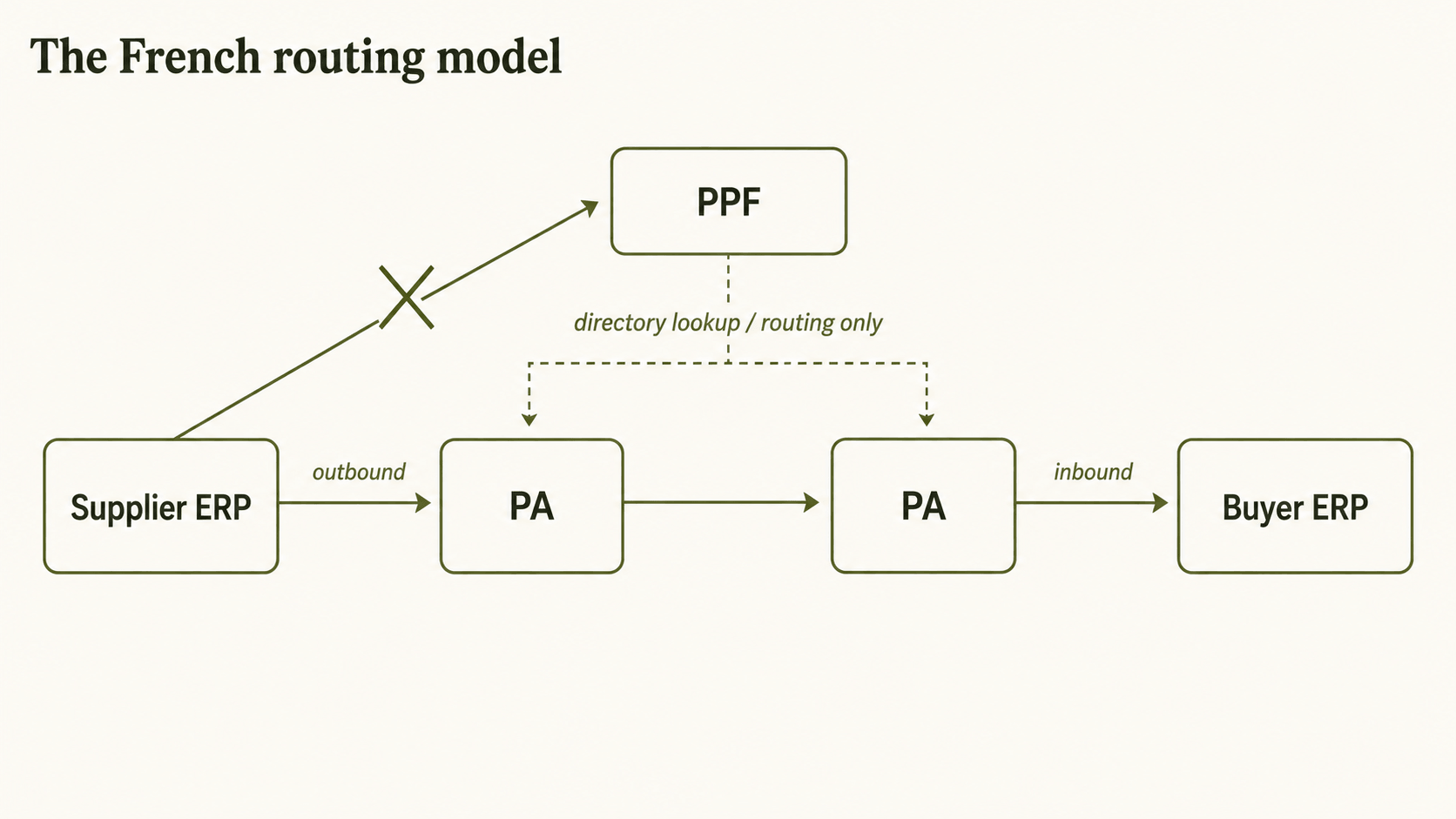
Under the French model, only registered platforms may transmit B2B e-invoices and forward reporting data to the tax authority. There is no direct-to-government route and no free public exchange option the Portail Public de Facturation (PPF) acts as the central directory for routing, not as a platform you can send through.
That changes who should be in the room. This is a finance and tax decision with an IT dependency, not the reverse.
The compliance calendar splits by company size: large enterprises and ETIs from September 2026, SMEs and micro-enterprises from September 2027. If you are in the second wave, you have a genuine selection window. Use it.
The 7 questions
1. Are you registered definitively, or under reserve?
Registration has been granted in stages, and "approved" has meant different things at different points. Ask for the current status in writing, and check it against the official DGFiP register yourself rather than taking the vendor's word or a logo on a slide.
Ask also what happens to your traffic if their registration lapses. A good answer describes a migration path. A vague answer is the answer.
2. Which formats do you handle natively, and which do you convert?
The mandate uses structured formats Factur-X, UBL and CII. Every platform will claim all three. The useful question is where conversion happens and what gets lost.
If your ERP emits one format and your customer's platform expects another, someone is converting. Ask to see how line-level detail, VAT breakdowns and attachments survive that conversion, on a real invoice from your own data, not a demo sample.
3. How do you handle invoice lifecycle statuses?
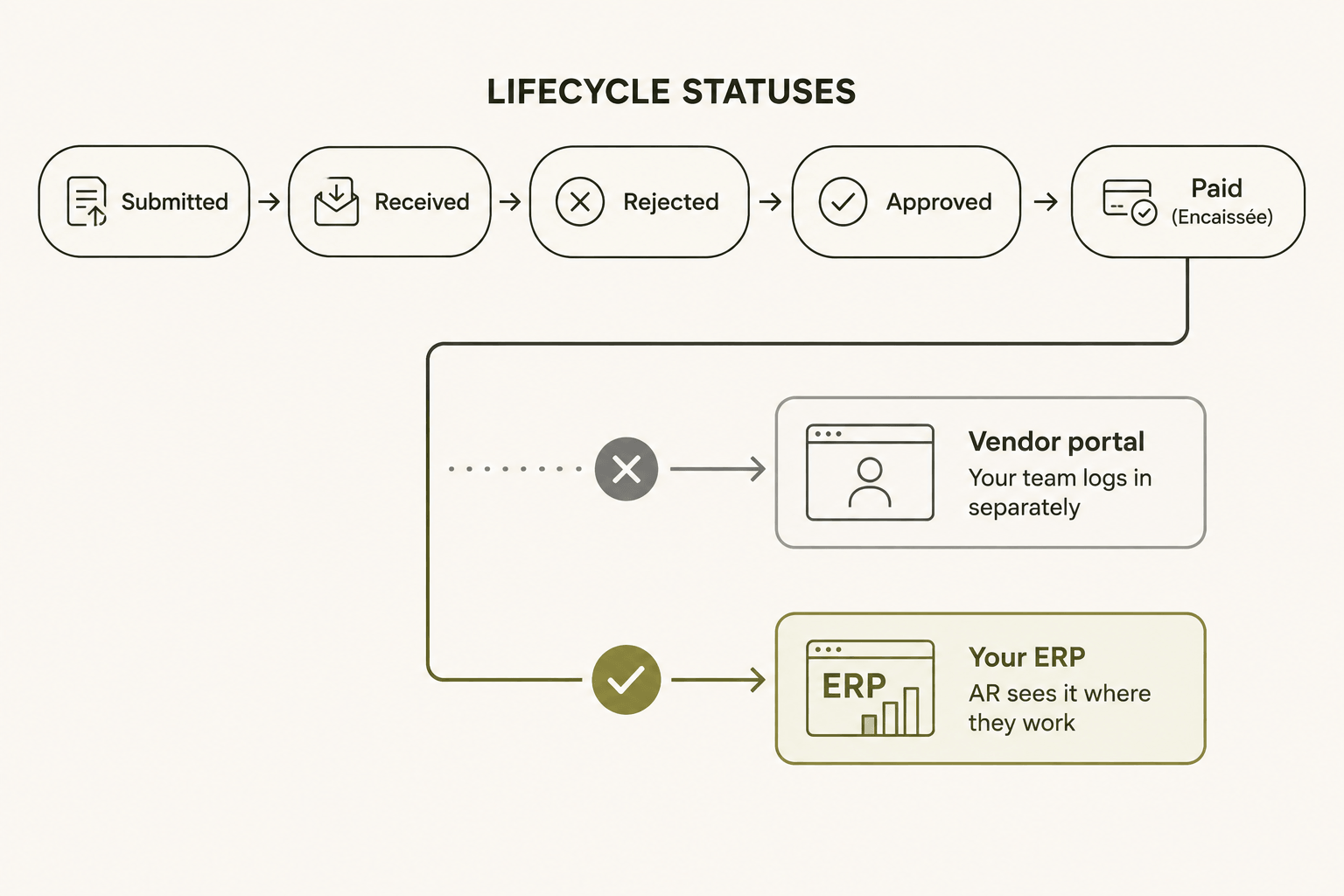
This is where French projects tend to hurt. Invoices carry status events through their life submitted, received, rejected, approved, paid. Some statuses are mandatory, some are optional, and they have to get back into your ERP to be worth anything.
Ask specifically: which statuses are written back into my finance system, and where does my AR team see them? If the answer is "in our portal", you have bought a second place for your team to work.
4. What happens to my e-reporting obligation?
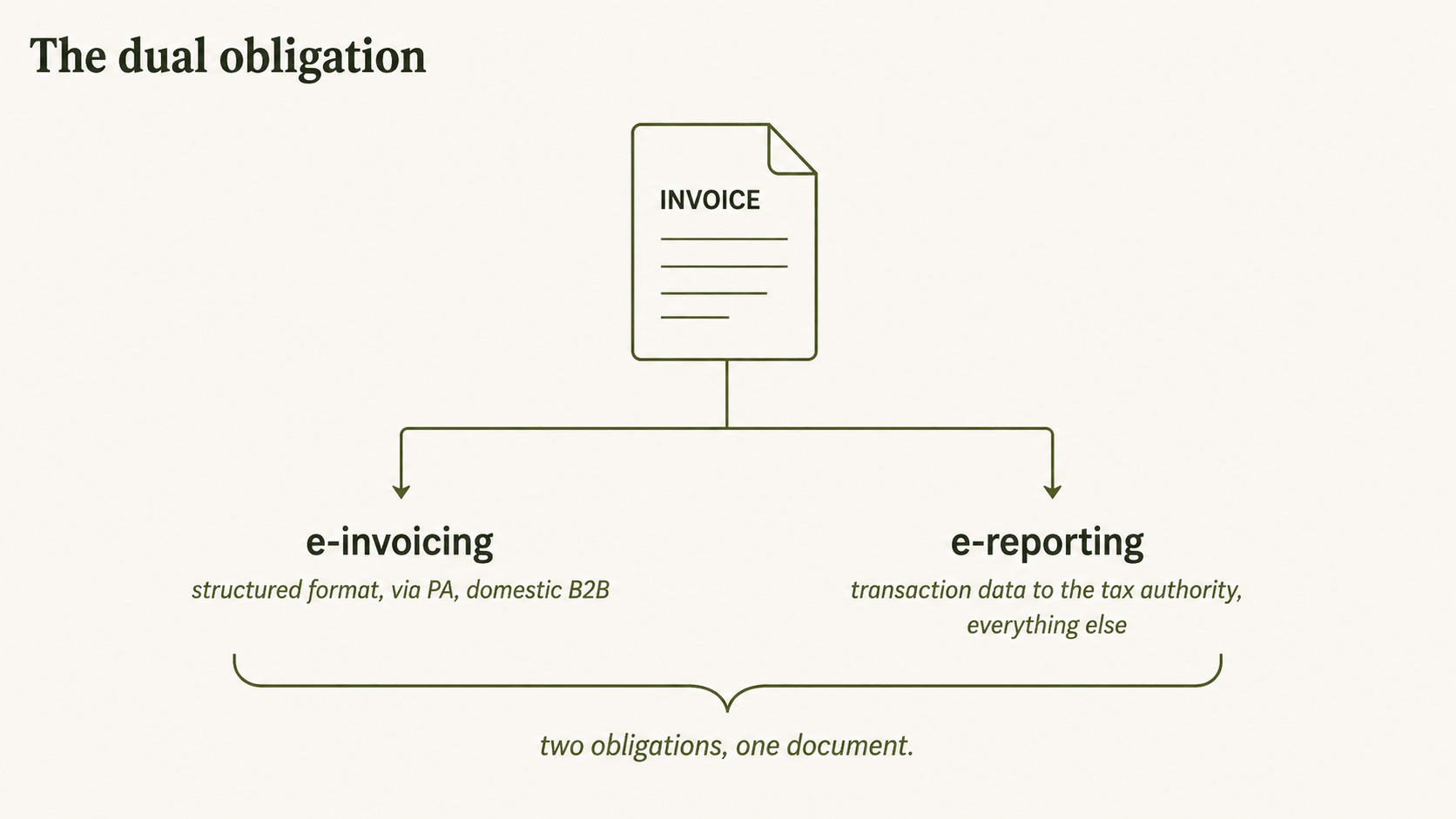
E-invoicing and e-reporting are two separate obligations. Not being caught by one does not exempt you from the other. Transactions outside domestic B2B scope B2C, exports, intra-EU supplies do not require a structured invoice but do require data to reach the tax authority.
Plenty of platform conversations cover invoicing thoroughly and treat reporting as a footnote. Ask which reporting flows are in scope of the contract, on what frequency, and who is accountable if a submission is rejected.
5. How does this connect to my ERP, and who owns the mapping?
A platform that is compliant but not connected just moves the manual work. Ask whether there is a real connector for your system Dynamics 365 F&O, Business Central, SAP Business One, e-conomic or whether "integration" means file drops and a scheduled job.
Then ask who owns the mapping when a partner changes a field. If the answer is your internal team plus a change request queue, price that in.
6. What is your position on Peppol and cross-border?
France is one country on a longer list. Belgium is live. Germany's B2B mandate arrives in 2027. Poland has its own timeline. ViDA sits over the top of all of it.
Peppol matters here because the DGFiP has taken on the Peppol authority role for France, and because most of your other European obligations will run over that network anyway. A platform that treats France as a closed local project leaves you buying the same capability again next year. If Peppol coverage matters to you, look at how a certified Peppol Access Point fits alongside the French requirement rather than competing with it.
7. What does exit look like?
Ask three things. What is the notice period and minimum term. How do I extract my archived invoices and in what format. What has to happen in the central directory if I move.
Ask them before signature, while you have leverage. Nobody negotiates exit terms once they are already live.
The mistake most buyers make
Treating France as a standalone compliance project.
The invoice that has to clear the French mandate is often the same invoice that has to satisfy a retail customer's EDI specification, a Peppol profile in another market, and a German requirement next year. Two obligations, one document. Suppliers who solve them separately end up with parallel invoice paths and no single view of what was sent.
Map your obligations across markets first. Then choose a platform that fits the map, not just the nearest deadline.
A shortlisting checklist
Registration status confirmed against the official DGFiP register, in writing
Format handling tested on your own invoices, not vendor samples
Lifecycle statuses written back into your ERP, not held in a portal
E-reporting scope named explicitly in the contract
Named connector for your ERP, with mapping ownership defined
Cross-border and Peppol coverage assessed against your next two mandates
Notice period, archive extraction format and directory handover agreed
FAQ
Is a PDP the same thing as a PA? Yes. Plateforme Agréée (PA) replaced Plateforme de Dématérialisation Partenaire (PDP) in French legislation. Same role, same certification process, new name.
Can I use Chorus Pro for B2B invoices? Chorus Pro remains the route for invoicing French public bodies (B2G). It is not the route for domestic B2B under the new mandate.
Do I need one platform or several? One is enough for most organisations. Groups with separate entities, ERPs or country operations sometimes use more than one. What matters is that your directory registration reflects reality, so invoices route to the right place.
Do I have to replace my ERP? No. The obligation is about how invoices are transmitted and reported, not which system produces them. An integration layer sits between your existing ERP and your chosen platform.
What if my customer uses a different platform? That is the design. Registered platforms interoperate and convert formats between sender and recipient, with the PPF acting as the central directory for routing.
Working out where you land
The seven questions above will tell you more about a provider than any capability matrix.
If your answer to question five is uncertain you know the mandate, you know your ERP, and you are unsure how the two connect that is the gap worth closing first. HubBroker builds the integration layer between your existing finance system and the platform you choose, so your French obligation runs on the ERP you already have.
Have a look at our e-invoicing solution, or talk to us about how your French entity connects.
