France E-Reporting vs E-Invoicing: Which Transactions Follow Each Workflow?
France’s electronic invoicing reform introduces two important processes that businesses need to understand: e-invoicing and e-reporting. Both are part of France’s VAT digitalisation system, but they apply to different types of transactions. Understanding France e-reporting vs e-invoicing is important if your company sells to French businesses, private customers or companies outside France. Choosing the correct workflow can also help your finance team prepare ERP, invoicing and data exchange processes before the new rules apply.
What Is the Difference Between E-Invoicing and E-Reporting in France?
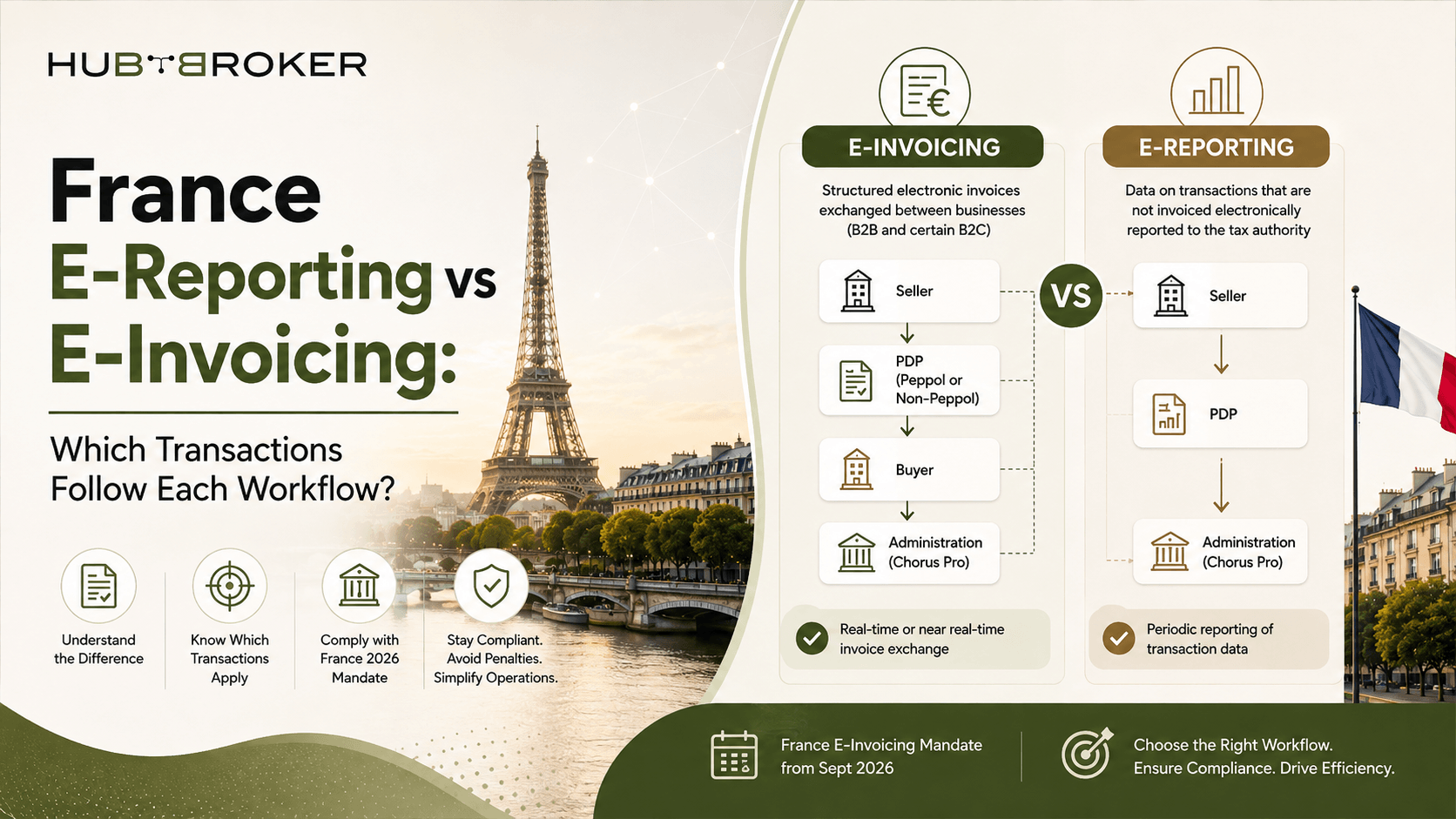
The main difference depends on who your customer is and where they are established. E-invoicing generally applies to purchases and sales of goods or services between businesses established in France and subject to French VAT. Invoice data is exchanged electronically through the French e-invoicing system. E-reporting applies to certain transactions which are outside the mandatory domestic B2B e-invoicing process. This includes transactions with private individuals and some transactions involving businesses outside France. Because of this, one company may have both e-invoicing and e-reporting obligations.
Which Transactions Require E-Invoicing in France?
A transaction generally follows the e-invoicing workflow when it is between VAT-taxable businesses established in France, falls under French VAT rules and French invoicing requirements apply. For example, if a French company provides services to another business established in France, the transaction will normally fall under e-invoicing when the required conditions are met. This means businesses need correct customer and VAT information inside their ERP or accounting system to decide the right invoice workflow.
Which Transactions Require E-Reporting in France?
E-reporting is mainly used for transactions that are not covered by mandatory domestic B2B e-invoicing, but the transaction information still needs to be reported to the French tax authority.
This can include:
B2C transactions with private individuals
Transactions with businesses established outside France
Exports
Intra-Community supplies and acquisitions
Certain transaction and payment information
France’s tax administration also identifies transactions with private individuals and businesses established outside France as common examples where e-reporting may apply.
Do B2C Transactions Need E-Invoicing or E-Reporting in France?
For transactions with private individuals, e-reporting generally applies instead of the domestic B2B e-invoicing workflow. For example, if a French retailer sells directly to consumers, the related transaction information may need to be reported through e-reporting. A company serving both businesses and private customers can therefore be subject to both systems.
Your ERP or accounting system should be able to identify whether the customer is B2B or B2C before deciding which workflow should be used.
Do International B2B Transactions Require E-Reporting in France?
When a French business sells to a professional customer established outside France, the transaction generally does not follow the normal French domestic B2B e-invoicing process. Instead, the required transaction information may need to be sent through e-reporting. Foreign businesses without a permanent establishment in France may also have e-reporting obligations for some transactions where French VAT applies.
Because of this, businesses should check customer location, VAT status and transaction type before deciding the invoice flow.
When Do France E-Invoicing and E-Reporting Become Mandatory?
France is introducing the reform in different stages.
From 1 September 2026, all businesses must be able to receive electronic invoices when their suppliers are required to issue them electronically. Large companies and intermediate-sized enterprises must also begin issuing eInvoices and follow the applicable e-reporting requirements. From 1 September 2027, the same issuance and applicable e-reporting requirements will extend to SMEs and micro-enterprises.
Preparing early gives businesses more time to review ERP integrations, customer data, invoice formats and existing finance processes.
France E-Invoicing vs E-Reporting: Which Workflow Should You Use?
A simple way to understand the difference is:
Transaction | Typical Workflow |
|---|---|
French business → French business | E-Invoicing |
Business → Private individual | E-Reporting |
French business → Foreign business | E-Reporting |
Relevant international transaction | E-Reporting |
The exact treatment can still depend on VAT rules and the type of transaction. Businesses with complex invoice flows should review their individual cases carefully.
Why Hire HubBroker for France E-Invoicing?
Preparing for France e-invoicing is not only about changing the invoice format. Businesses may also need to connect ERP systems, transform invoice data, automate workflows and manage different transaction types.
Why HubBroker? | How It Helps |
|---|---|
1. E-Invoicing Expertise | Helps businesses manage electronic invoice workflows. |
2. ERP Integration | Connect existing ERP and accounting systems with e-invoicing processes. |
3. API Integration | Automate invoice and business data exchange through APIs. |
4. EDI Capabilities | Manage EDI and electronic document exchange from one integration environment. |
5. Invoice Automation | Reduce manual invoice processing and repeated finance work. |
6. Format Conversion | Convert invoice data between different formats and systems. |
7. Scalable Integration | Support increasing transaction volumes as the business grows. |
8. International Support | Help with integration requirements across different markets. |
9. Less Manual Work | Reduce data entry and make invoice processing easier for finance teams. |
10. One Integration Partner | Manage ERP integration, API, EDI and e-invoicing with one provider. |
HubBroker makes the technical integration part easier, so finance and IT teams can spend less time manually managing invoice data between different systems.
If your organisation is preparing for France e-invoicing and e-reporting, HubBroker can help review your current invoice flow and build a more automated setup for the upcoming requirements.
