
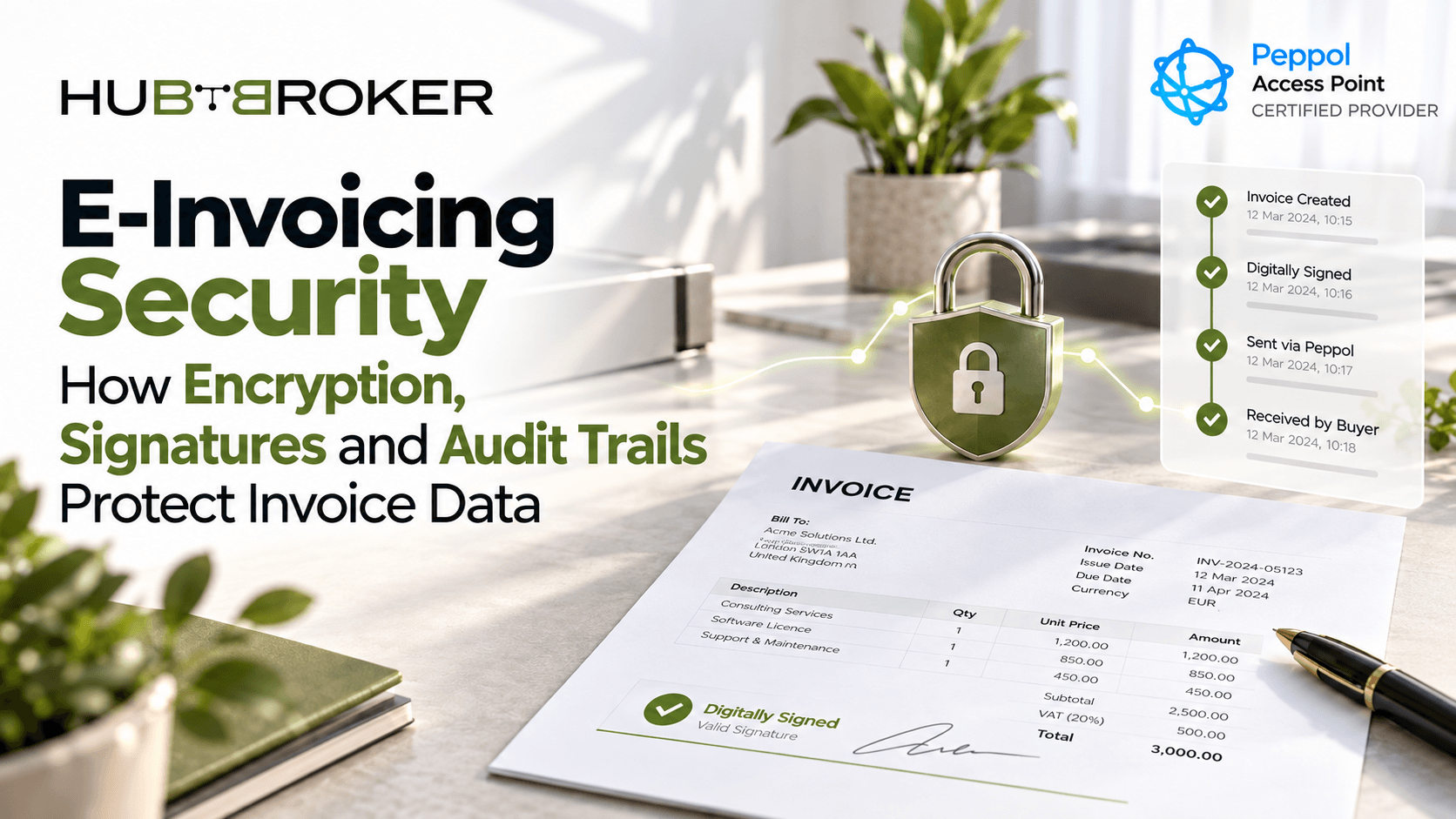
E-Invoicing Security How Encryption, Signatures and Audit Trails Protect Invoice Data
Electronic invoices can contain supplier names, bank details, tax information, order references and commercially sensitive amounts. Because of this, E-Invoicing Security needs more than just sending a document through HTTPS. Businesses need several layers of protection. Data should remain confidential, invoice origin should be trusted, changes should be detectable, access should be controlled and every important action should leave a clear record.
For European companies, these controls also need to work properly with ERP integrations, Peppol connections and data-protection responsibilities.
Is E-Invoicing Secure?
E-invoicing can be secure when different technical and operational controls work together. There is no single feature that makes an electronic invoice completely secure.
Encryption protects confidentiality. Signatures or electronic seals can help confirm origin and integrity. Access controls decide who can view or change information, while audit logs record what happened during the complete invoice process. European VAT rules require authenticity of origin, integrity of invoice content and legibility to be maintained from issue through the required storage period. Reliable business controls and audit trails can support these requirements. Digital signatures and EDI can also be used, but they are not mandatory for every European electronic invoice.
Security Control | What It Protects | Practical Value |
|---|---|---|
Encryption | Data in transit or storage | Reduces unauthorised exposure |
Signature or seal | Origin and integrity | Helps detect modification |
Access control | Systems and records | Limits viewing or changes |
Audit trail | Transaction history | Creates traceability |
Monitoring | Integration activity | Highlights errors or unusual activity |
The stronger setup normally combines several of these controls instead of depending on only one.
How Does Encryption Protect Electronic Invoice Data?
Encryption mainly protects confidentiality. When invoice data moves between ERP systems, integration platforms, networks and recipients, secure transport protocols such as TLS help reduce the risk of somebody reading the information during transmission. Encryption at rest deals with another risk. It protects stored invoice files or database information if somebody gets unauthorised access to the storage system.
These are two different controls for two different situations.
Transport encryption protects data while moving. Storage encryption protects data while it is saved. Encryption also has limits. It does not automatically prove who created the invoice. It does not confirm whether the correct person approved it, and it cannot always show whether information was changed before encryption happened. These risks need additional controls such as authentication, digital signatures, access management and audit logging.
What Do Digital Signatures Protect in an E-Invoice?
Digital signatures and electronic seals can help prove authenticity and integrity. They can provide evidence about where a document came from and help identify whether protected invoice content was changed after signing. They should not be confused with encryption. Encryption mainly protects confidentiality, while a digital signature mainly protects integrity and helps with authentication.
Certificates may also be used to verify identity and support signing processes. Within Peppol, security is also built in several layers. OpenPeppol documentation describes TLS certificates for transport-level server authentication and confidentiality, while OpenPeppol certificates are used to make sure authorised participants operate inside the network. Peppol also uses AS4 and certificate-based trust for secure exchange of business documents.
So the protection comes from transport security, network trust and controlled participants working together.
Why Are Audit Trails Important for E-Invoicing?
An e-invoicing audit trail gives Finance, IT and compliance teams a history of what happened to each invoice. It should make it possible to follow the document from creation to final processing.
A typical sequence can look like:
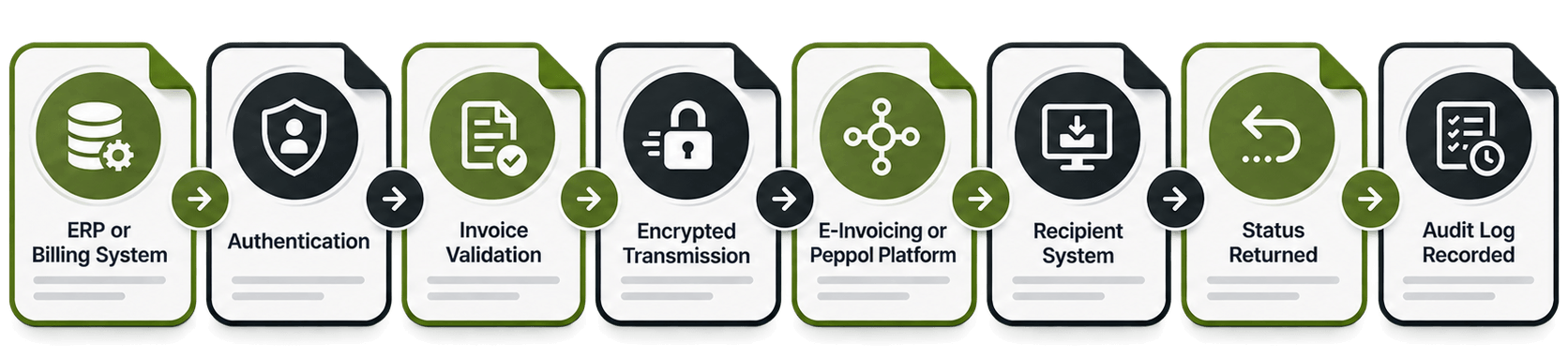
Useful audit information can include timestamps, document IDs, sender and recipient details, processing status, user or system actions, errors, retries and access events. This is useful for both daily operations and security investigations.
Teams can follow a process such as:
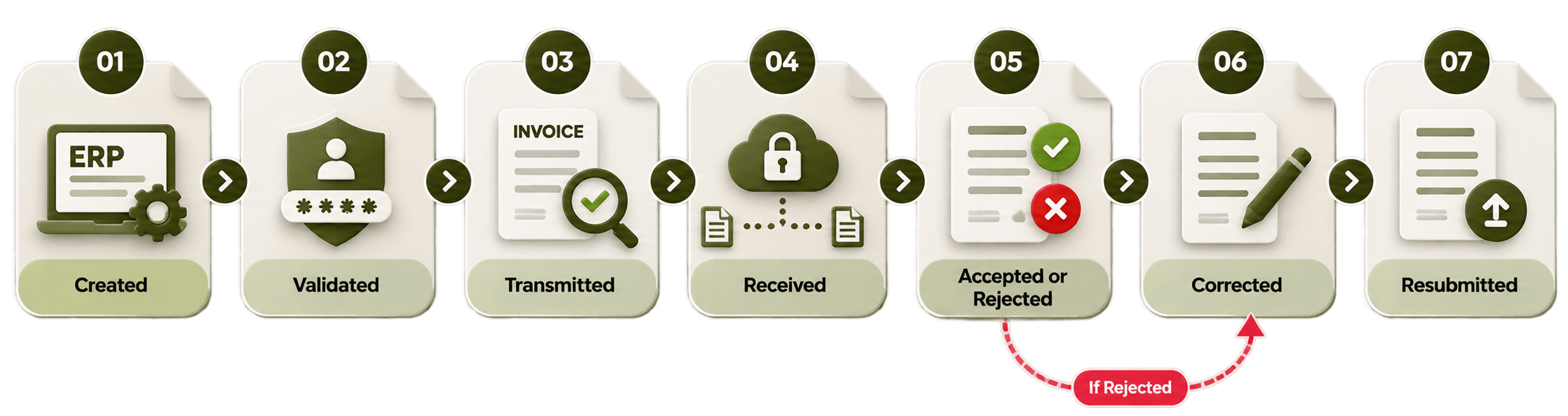
This makes it easier to investigate missing invoices, failed processing, unexpected document changes or unusual user activity. Without clear audit records, teams may only know that something failed without knowing where the problem actually happened.
How Can Businesses Protect E-Invoices From Fraud or Unauthorized Changes?
Security controls should be connected with the actual risk they are trying to reduce.
❌ Risk: Invoice information is intercepted while moving between systems.
✔ Control: Encrypted transport.
❌ Risk: Document content is changed after signing.
✔ Control: Digital signature and integrity validation.
❌ Risk: An unauthorised employee changes invoice or system settings.
✔ Control: Role-based access and audit logging.
Access controls should normally include proper user authentication, least-privilege permissions and limited administrator access. MFA can also be used where appropriate to add another protection layer for sensitive or administrative accounts. Monitoring should cover ERP integrations, APIs, failed transactions, retries and unusual system activity. The important point is that security should not stop at the invoice file itself. Systems, users, integration connections and administrative changes also need to be controlled.
What Security Features Should E-Invoicing Software Have?
Businesses should ask specific questions instead of accepting a simple claim that a platform is “secure.” Check whether invoice traffic is encrypted during transmission and how stored information is protected. Also review available authentication methods, user roles, permission controls and MFA support. Ask how certificates or signing processes are managed and whether important administrative actions are recorded.
Audit logs should be easy enough to review when a Finance, IT or compliance team needs to investigate an issue. Companies should also understand how integration errors are recorded, where customer data is stored, what retention controls are available and how security incidents are handled. Third-party and subprocessor risks should also be part of the assessment. For European organisations, GDPR responsibilities, Peppol connectivity where relevant, and country-specific invoice retention or compliance rules should also be reviewed.
Secure e-invoicing should protect the full invoice journey, not only the point where document is transmitted.
How Can HubBroker Support Secure E-Invoicing Workflows?
HubBroker can support controlled e-invoicing workflows through ERP integration, EDI, APIs, Peppol connectivity where applicable, data mapping, validation, workflow automation, status handling, monitoring and audit visibility. These capabilities can help businesses keep invoice exchange controlled and give Finance and IT clearer visibility into what happened during processing.
A secure workflow may include validation before sending, controlled transmission, status tracking, error monitoring and traceable transaction history. This makes it easier to identify where an invoice failed and which system or process handled it.
Evaluating E-Invoicing Security in Europe?
HubBroker can help review ERP-to-network invoice flows, identify control points for validation, transmission, monitoring and traceability, and design a more controlled electronic invoice exchange process.
