
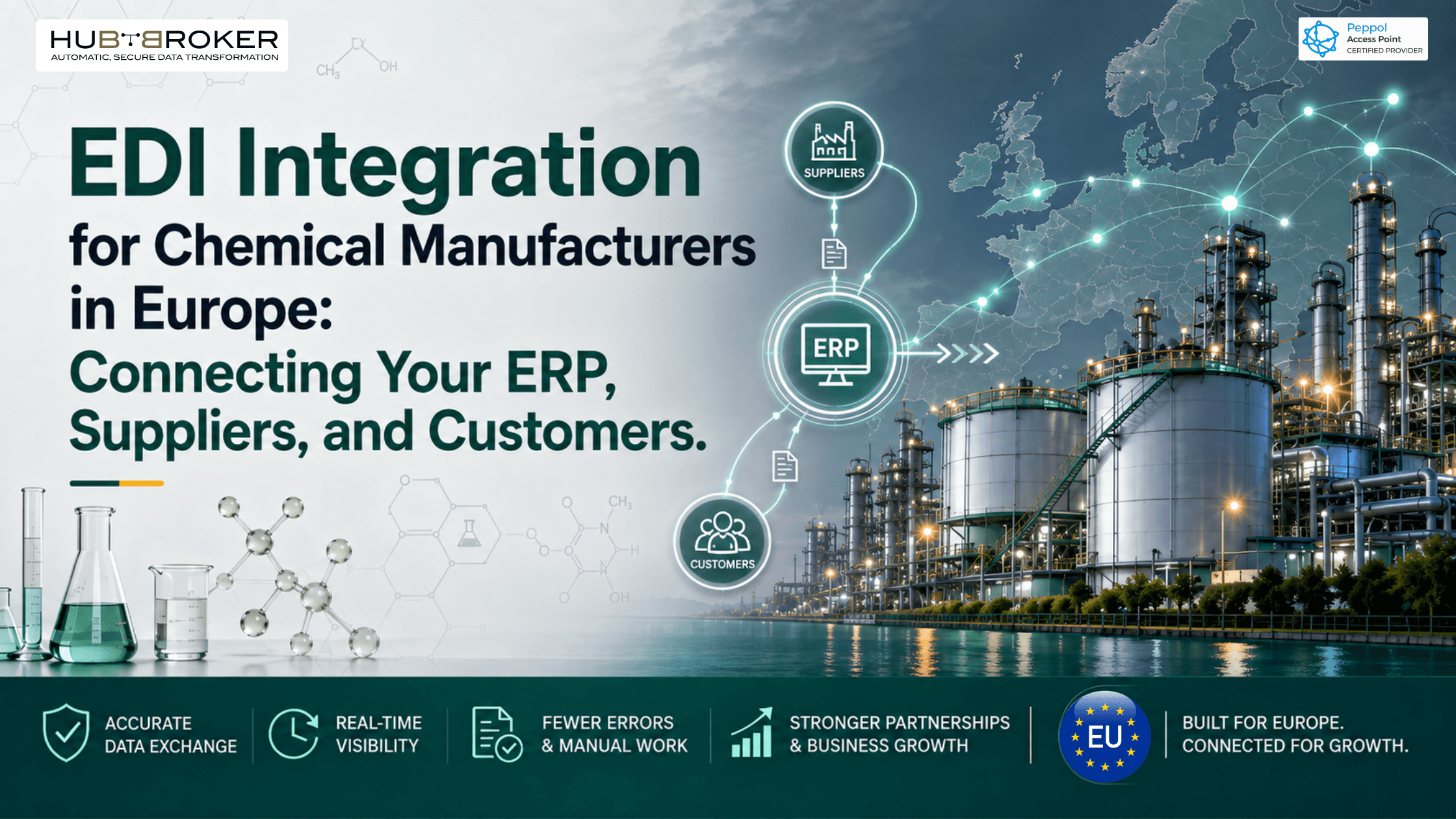
EDI Integration for Chemical Manufacturers in Europe Connecting Your ERP Suppliers and Customers
Chemical manufacturers in Europe work with many raw material suppliers, distributors, warehouses, transport companies and customers from different countries. Managing purchase orders, delivery documents, invoices and stock updates manually can take lot of time. It can also create data mistakes and delays.
Chemical manufacturing EDI integration connects your ERP system with suppliers and customers. It allow business documents to move automatically between different systems.
This can improve data accuracy, reduce manual work and create a more connected supply chain.
What Is EDI Integration in Chemical Manufacturing?
Electronic Data Interchange, also called EDI, helps chemical manufacturers exchange business documents electronically with their trading partners. These documents are sent in a structured format, which means computer systems can read and process them automatically.
Common EDI documents include:
Purchase orders
Order confirmations
Dispatch advice
Goods receipt messages
Invoices and credit notes
Inventory reports
Product catalogues
Transport instructions
Batch and certificate information
The EDI platform receives the document and checks the information. After this, it converts the document into the format required by the receiving ERP system. This helps companies using different ERP systems and document formats to communicate without entering the same data again and again.
How Does EDI Connect Chemical Suppliers to an ERP System?
EDI works like a connection between your ERP system and your supplier network. For example, your ERP can automatically send a purchase order when the stock level become low or when the production team need more raw materials.
The supplier can send back:
Order confirmations
Delivery updates
Dispatch details
Supplier invoices
All these documents can move through the same EDI connection. When the raw materials arrive, the goods receipt information can be matched with the original purchase order and supplier invoice. This make the checking process more easy for the purchasing and finance teams.
It also gives the production team better information about when the required materials will arrive. By using EDI, companies can reduce emails, Excel files and repeated updates inside the ERP system.
How Can Chemical Manufacturers Automate Customer Orders with EDI?
EDI can automate most parts of the customer order process. When a customer sends a purchase order, the EDI platform first checks the document information. It then converts the document into the format required by the manufacturer’s ERP system. After the document is received, a sales order can be created automatically in the ERP.
The system can also send documents back to the customer, such as:
Order confirmations
Dispatch advice
Delivery information
Electronic invoices
Credit notes
This helps chemical manufacturers process more customer orders without adding more administrative work. It also reduce common mistakes related to:
Product numbers
Order quantities
Delivery addresses
Customer references
Prices
Delivery dates
Employees do not need to type the same order information into different systems. This saves time and makes the complete order process more reliable.
Which ERP Systems Can Be Connected with EDI?
Chemical manufacturers in Europe use different ERP systems for production, purchasing, inventory, compliance, finance and customer orders. SAP is commonly used by large chemical companies because it can manage complex manufacturing processes and operations across many countries.
Microsoft Dynamics 365 and Business Central are often used by small and mid-sized manufacturers. These systems provide flexibility, customisation options and different integration methods. Oracle and Infor are also used by chemical manufacturers with process-based production and multiple locations.
Some smaller or older companies still use Sage, local ERP systems or customised legacy software. For EDI integration, the popularity of an ERP system is not the only important point. The available integration options are also very important. ERP systems with modern APIs, clear master data and standard document formats are normally more easy to connect. They can support faster onboarding of suppliers and customers.
Older or highly customised ERP systems can also be connected with EDI. However, they may need more document mapping, testing and configuration work.
 These percentages are only used for marketing illustration. They are not audited industry statistics.
The real integration effort depend on:
✔ ERP system and version
✔ Existing customisations
✔ Business workflows
✔ Document types
✔ Trading partner requirements
✔ Available APIs or connection methods
✔ Quality of master data
A technical assessment should be completed before confirming the final integration scope.
What Are the Benefits of EDI for Chemical Manufacturers?
Chemical manufacturing EDI integration can provide many operational benefits.
➡ Faster Document Processing
Purchase orders, order confirmations, invoices and delivery documents can move between systems automatically. Employees do not need to process every document manually.
➡ Fewer Data Mistakes
EDI reduces manual data entry. This helps avoid mistakes in product numbers, quantities, prices, addresses and customer references.
➡ Better Inventory Visibility
Supplier confirmations and delivery updates can be added directly into the ERP system. This gives the purchasing and production teams better information about available materials.
➡ Improved Document Tracking
EDI systems can record when a document was received, checked, converted and delivered. This makes it more easy to find missing or failed documents.
➡ Faster Trading Partner Onboarding
A flexible EDI platform can connect suppliers and customers using different formats and communication methods. This helps manufacturers onboard new European partners faster.
➡ Consistent Information
EDI helps keep the same information across the ERP system, supplier systems, customer systems and other business applications.
➡ Less Use of Emails and Spreadsheets
Important documents do not need to be shared only through emails, PDF files or Excel sheets. Structured documents can move directly between business systems.
➡ Easier Business Expansion
When entering a new country or working with a new customer, the manufacturer may need to support different document formats. An EDI platform can manage these differences without changing the complete ERP system.
EDI does not replace the ERP system. It extends the ERP by connecting it with the companies involved in the supply chain.
How Much Does Chemical Manufacturing EDI Integration Cost?
The cost of EDI integration is different for every company.
The final price depend on the number of trading partners, required document types, ERP complexity, transaction volume and support requirements.
EDI cost factor | Typical estimated cost |
|---|---|
Initial analysis and solution design | €1,000–€5,000 |
ERP connection development | €3,000–€20,000 |
Trading partner onboarding | €500–€4,000 per partner |
Document mapping | €500–€3,000 per document type |
EDI platform subscription | €300–€3,000 per month |
Transaction or data volume charges | €50–€1,500 per month |
Testing and partner certification | €500–€2,500 per partner |
Premium support and monitoring | €300–€2,000 per month |
Mapping changes and maintenance | €100–€1,500 per change |
These costs are only general budget estimates. They should not be used as a final project quotation.
A proper assessment is required to understand the ERP system, document flow, partner requirements and expected transaction volume.
Some companies may only need one ERP connection and few document types. Other companies may need connections with many suppliers, customers, warehouses and logistics providers.
Because of this, the project cost can change based on the actual business requirement.
A Better EDI Partner for Your Chemical Supply Chain
HubBroker helps chemical manufacturers connect their ERP systems with suppliers, customers, warehouses and logistics providers through a reliable EDI integration platform.
Our team can support:
ERP integration
EDI document mapping
Trading partner communication
Testing and validation
Partner onboarding
Connection monitoring
Error handling
Ongoing support
This means your internal team do not need to manage every document format and connection requirement by themselves. Whether your company uses SAP, Microsoft Dynamics 365, Business Central, Oracle, Infor, Sage or a customised ERP system, HubBroker can design a suitable EDI connection based on your current setup.
The solution can make document exchange more simple, reduce manual work and help your supply chain grow without adding unnecessary complexity.
👉 Contact HubBroker to discuss your chemical manufacturing EDI integration requirements.
