
ZATCA E-Invoicing Compliance: What Saudi Businesses Must Know
Saudi Arabia's ZATCA Fatoora e-invoicing mandate requires all VAT-registered businesses to generate and integrate compliant electronic invoices. The rollout happens in waves, with technical requirements including XML/PDF-A3 formats, QR codes, cryptographic stamps, and direct ZATCA portal connectivity. Non-compliance carries financial penalties. HubBroker provides ERP integration and ongoing support to help businesses meet these requirements.
Saudi Arabia's e-invoicing deadline does not wait for businesses to feel ready. The Zakat, Tax and Customs Authority (ZATCA) has been expanding its Fatoora e-invoicing mandate in waves since December 2021, and each new wave brings additional businesses into scope with strict technical and legal requirements that must be met before going live.
For business owners, IT managers, and financial controllers operating in the Saudi market, the question is no longer whether compliance is required. The question is whether your systems can meet the technical specifications and whether they can connect to ZATCA's platform on time.
This post covers what the Fatoora project requires, which businesses are currently affected, what the technical standards look like, and what happens to businesses that fall short.
What Is the Fatoora Project? An Overview of Saudi Arabia's E-Invoicing Mandate
The Fatoora project is ZATCA's national e-invoicing initiative, introduced through regulations published in December 2020 and enforced from December 4, 2021. The program replaces manual and PDF-based invoicing with structured, system-generated electronic invoices that meet defined technical standards.
Fatoora applies to all businesses registered for VAT in Saudi Arabia, including non-resident taxable persons who issue tax invoices in the Kingdom. The mandate covers tax invoices, simplified tax invoices, and their associated credit and debit notes.
The program is designed to reduce tax evasion, increase transparency in B2B and B2C transactions, and modernize the Kingdom's financial infrastructure in line with Vision 2030 objectives.
The Two Phases of ZATCA E-Invoicing
Phase 1 – Generation (December 2021)
Phase 1 required all VAT-registered businesses to stop issuing invoices in unsupported formats including handwritten documents and standard PDFs and to begin generating invoices using compliant electronic systems.
During this phase, businesses were not required to connect directly to ZATCA's platform. The core obligation was to issue invoices from a system capable of producing structured electronic documents with the required data fields, including seller and buyer information, invoice numbers, VAT amounts, and totals.
Phase 1 also introduced the requirement for QR codes on simplified invoices issued in B2C transactions.
Phase 2 – Integration (Ongoing Waves)
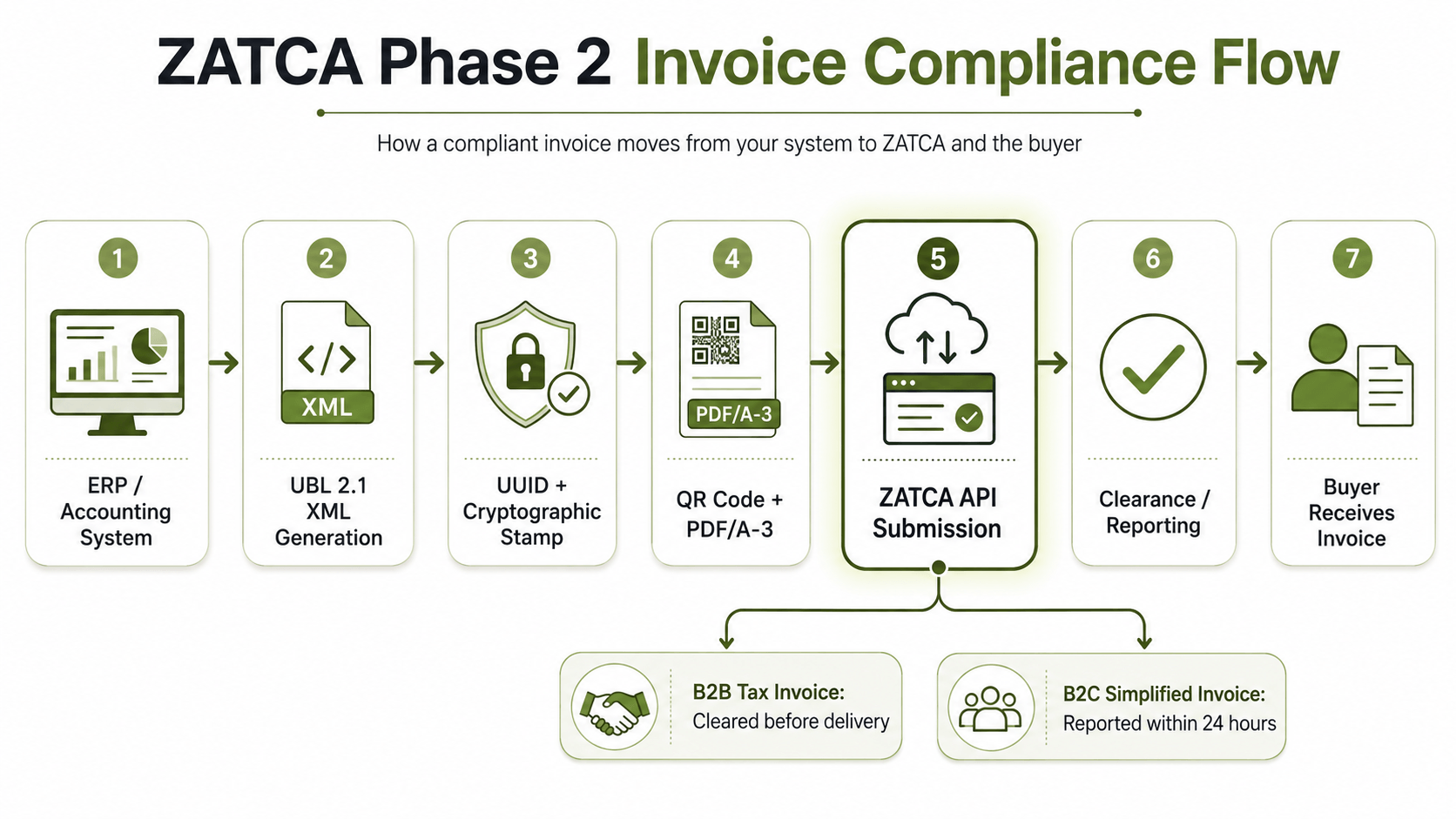
Phase 2 goes further. Businesses in scope must integrate their invoicing systems directly with ZATCA's Fatoora portal using the ZATCA API. Each tax invoice must be cleared by ZATCA before it is shared with the buyer. Simplified invoices must be reported to ZATCA within 24 hours of issuance.
Phase 2 is being rolled out in sequential waves based on annual revenue thresholds. ZATCA selects each cohort and notifies businesses at least six months before their integration deadline.
Current Timeline and Which Businesses Are Affected
Integration Waves and Criteria for Inclusion
ZATCA determines wave eligibility based on the VAT-registered taxpayer's annual taxable revenue. Early waves targeted the largest businesses in the Kingdom. As of 2025, the integration requirement has reached businesses with annual taxable revenues of approximately SAR 3 million and above, though ZATCA continues to announce new waves.
If your business has not yet received notification, that does not mean integration is not coming. ZATCA issues formal notification letters six months before the target integration date for each new cohort, giving businesses a defined preparation window. That window is shorter than many businesses realize once system assessment, configuration, testing, and approval are factored in.
Businesses should not wait for notification to begin evaluating their invoicing infrastructure. Systems that are not currently capable of meeting Phase 2 requirements will need significant changes, and those changes take time.
Technical and Legal Requirements for Compliance
XML and PDF/A-3 Format Requirements
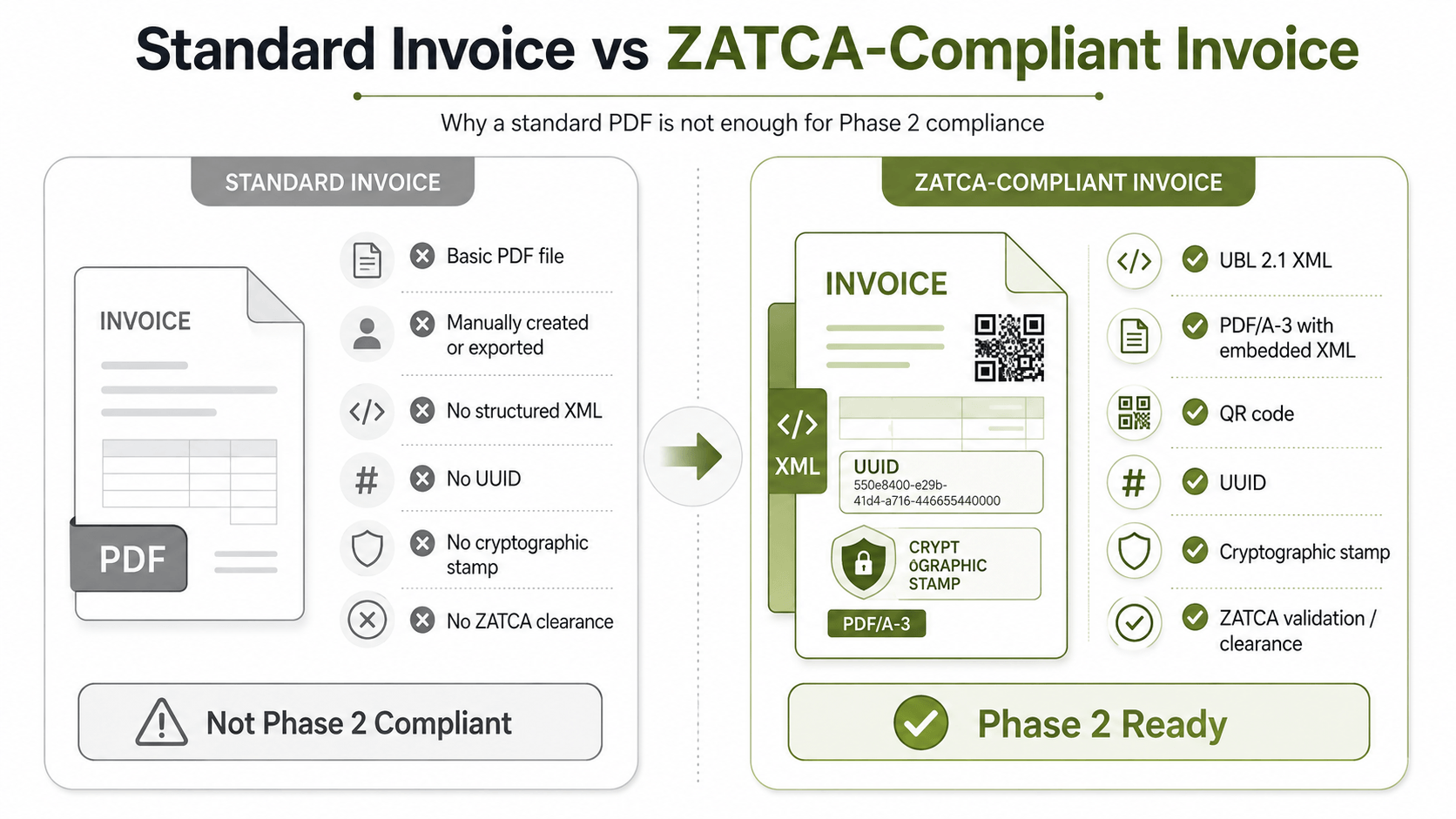
ZATCA requires that all Phase 2 invoices be generated in UBL 2.1 XML format. For tax invoices shared with buyers, the invoice must also be rendered as a PDF/A-3 file with the XML embedded within it. This dual-format requirement ensures that the document is both machine-readable for ZATCA's system and human-readable for the buyer.
Invoicing systems that generate standard PDFs or proprietary formats will not meet this requirement. The XML must follow ZATCA's published schema and include all mandatory data fields validated against ZATCA's business rules.
QR Code Requirements
All simplified tax invoices those issued in B2C transactions must include a QR code encoded with specific invoice data, including the seller's name, VAT registration number, invoice date and time, invoice total, and VAT total.
For tax invoices shared in B2B transactions, a different QR code format is used and applied after ZATCA clearance is obtained.
Cryptographic Stamp and UUID
Each invoice must carry a cryptographic stamp generated by the compliant invoicing system. This stamp authenticates the invoice and prevents unauthorized modification after generation. Every invoice must also be assigned a Universally Unique Identifier (UUID), a system-generated reference that supports ZATCA's audit trail.
These requirements mean that invoices cannot be generated in spreadsheets, word processors, or generic PDF tools. The invoicing system itself must be capable of generating and applying both the cryptographic stamp and the UUID during invoice creation.
ZATCA Portal Connectivity
For Phase 2, each invoice must pass through ZATCA's Fatoora platform via API. Tax invoices are cleared in near real-time before they are issued to buyers. Simplified invoices are reported in batch within 24 hours.
This API connection requires that your invoicing system be onboarded with ZATCA, a process that involves device registration, cryptographic key exchange, and compliance testing. ZATCA operates a Fatoora Simulation Environment where businesses and solution providers can test their integration before going live.
The Risks and Penalties of Non-Compliance
Failing to meet ZATCA's e-invoicing requirements carries direct financial consequences. ZATCA is authorized to issue fines for non-compliant invoices, failure to integrate within the required timeframe, and invoices that do not meet the technical specifications.
Fines for non-compliance with e-invoicing regulations can reach SAR 50,000, depending on the nature and frequency of the violation. Repeat violations may attract escalating penalties.
Beyond financial penalties, non-compliant businesses may face VAT assessments, delayed payment processing with government and large-enterprise buyers who require ZATCA-cleared invoices, and reputational risk in a market where compliance is increasingly a baseline expectation for commercial relationships.
The integration deadline ZATCA sets is binding. If your systems are not ready when your wave begins, the business continues to operate under non-compliance risk with each invoice issued from that point forward.
How HubBroker Can Help Automate Your ZATCA Integration
Meeting ZATCA's Phase 2 requirements involves more than updating an invoice template. It requires a compliant invoice generation engine, a stable API connection to the Fatoora platform, ongoing monitoring, and the ability to handle clearance rejections, error responses, and future regulatory updates.
HubBroker provides EDI and e-invoicing integration services that can support businesses working toward ZATCA compliance. The platform is designed to connect existing business systems to external compliance and data exchange requirements without requiring a full system replacement.
ERP and Accounting System Integration
Most businesses already manage their financial data in an ERP or accounting system. The challenge is not replacing that system it is connecting it to ZATCA's Fatoora portal in a way that meets all technical requirements.
HubBroker can integrate your existing ERP or accounting platform with the Fatoora API, handling the XML generation, QR code embedding, cryptographic stamping, UUID assignment, and clearance submission that Phase 2 requires. This means your finance team continues working in familiar systems while the compliance layer operates in the background.
The integration approach depends on your current system and how invoices are currently generated. HubBroker assesses your existing setup and maps the integration requirements before work begins, so the scope and any dependencies are understood from the outset.
Ongoing Compliance Support
ZATCA updates its technical specifications, business rules, and schema requirements over time. An integration that meets today's requirements may need adjustment when ZATCA publishes new validation rules or expands the mandate's scope.
HubBroker provides ongoing support so that your ZATCA integration continues to function as regulatory requirements evolve. This includes monitoring for rejection responses from the Fatoora platform, handling exception cases, and updating the integration when ZATCA publishes changes that affect your invoice format or submission process.
Take the Next Step Before Your Deadline Arrives
ZATCA's Fatoora mandate is not a future concern for most businesses operating in Saudi Arabia. The deadlines are already set. The technical requirements are defined. And the penalties for missing them are real.
The most practical step your business can take now is to assess whether your current invoicing system can meet Phase 2 requirements and to identify how far the gap is between where you are today and where you need to be before your integration date.
Contact HubBroker to discuss your current setup and what ZATCA integration will require for your business. The team can help you understand what your specific ERP or accounting system needs, how the Fatoora API connection works, and what a realistic timeline for compliance looks like given your wave deadline.
Frequently Asked Questions About ZATCA E-Invoicing Compliance
Who is required to comply with ZATCA's Phase 2 e-invoicing mandate?
All VAT-registered taxpayers in Saudi Arabia are subject to the Fatoora mandate. Phase 2 integration requirements are being rolled out in waves, with businesses selected based on annual taxable revenue. ZATCA notifies each cohort at least six months before their integration deadline. If your business is VAT-registered in Saudi Arabia, Phase 2 integration will apply to you at some point in the rollout schedule.
What is the difference between Phase 1 and Phase 2 of ZATCA e-invoicing?
Phase 1, effective from December 4, 2021, required VAT-registered businesses to generate invoices using compliant electronic systems rather than manual or PDF-only methods. Phase 2 adds the requirement to integrate those systems directly with ZATCA's Fatoora portal via API, so that tax invoices are cleared by ZATCA before being shared with buyers, and simplified invoices are reported within 24 hours of issuance.
What invoice formats does ZATCA's Phase 2 require?
Phase 2 requires invoices to be generated in UBL 2.1 XML format. Tax invoices shared with buyers must also be provided as PDF/A-3 files with the XML embedded. Standard PDFs, spreadsheet-generated documents, and proprietary formats do not meet ZATCA's Phase 2 technical requirements.
What happens if a business misses its ZATCA integration deadline?
Businesses that do not integrate by their ZATCA-assigned deadline face financial penalties that can reach SAR 50,000 per violation, depending on the nature and frequency of non-compliance. Invoices issued without Phase 2 clearance after the deadline create ongoing compliance risk. Some government and large-enterprise buyers may also require ZATCA-cleared invoices as a condition of payment processing.
Can HubBroker integrate with any ERP or accounting system for ZATCA compliance?
HubBroker works with a range of ERP and accounting platforms and assesses each business's current setup before defining the integration approach. The feasibility and scope of the integration depend on the specific system in use, how invoices are currently generated, and how the system can connect to external APIs. HubBroker reviews your environment and outlines what is required before work begins.
How long does it typically take to complete a ZATCA Phase 2 integration?
The time required depends on the complexity of your current invoicing system, the number of invoice types and document flows involved, and how much testing and adjustment is needed during the ZATCA simulation environment phase. Businesses should not assume the integration can be completed in days. Starting the assessment and scoping process well before the deadline helps reduce the risk of running out of preparation time.
