
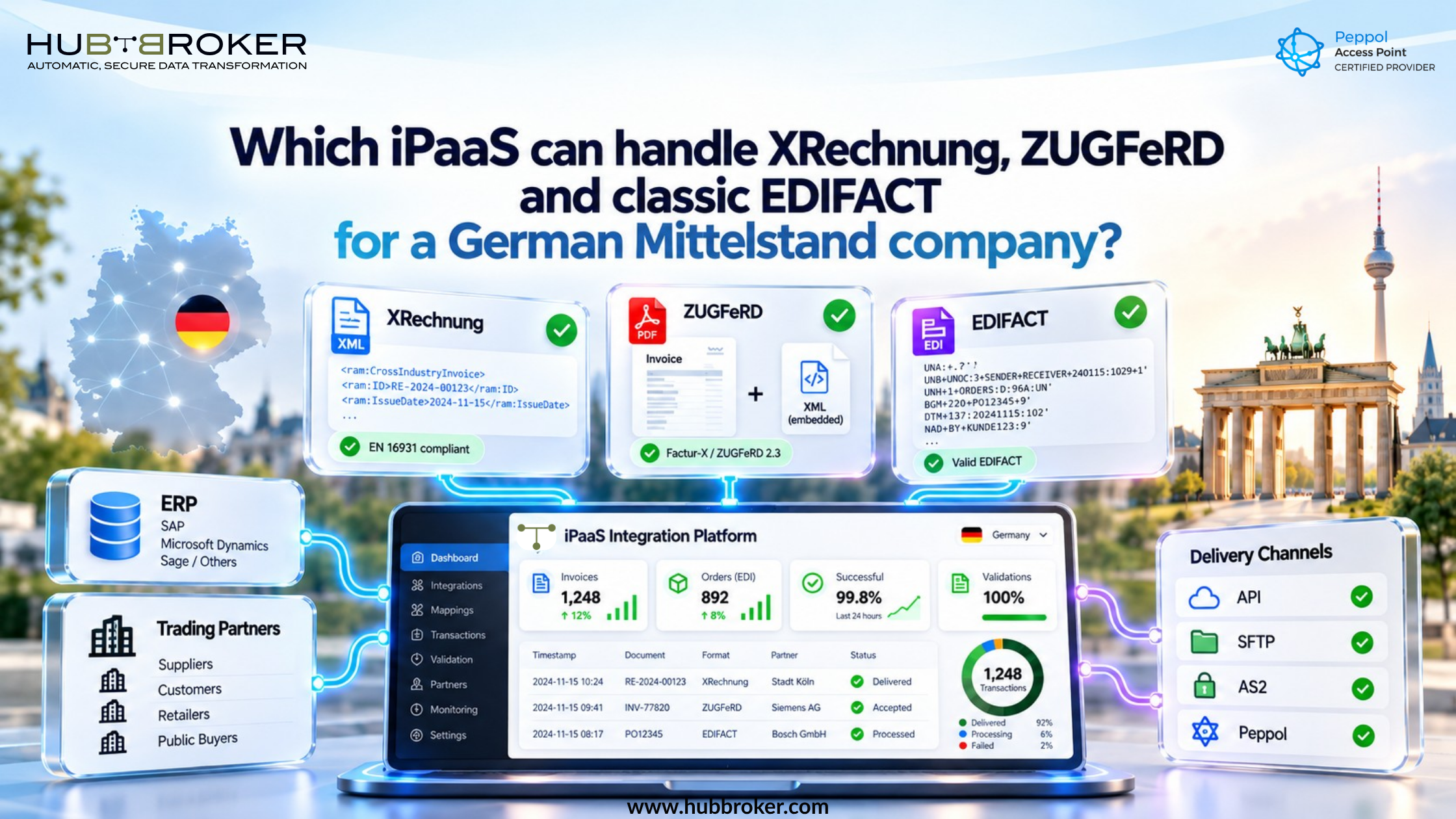
Which iPaaS can handle XRechnung, ZUGFeRD and classic EDIFACT for a German Mittelstand company?
A German manufacturer might receive EDIFACT orders from retailers, send XRechnung invoices to public buyers, and exchange ZUGFeRD invoices with suppliers. Running separate tools for each format makes everyday work harder.
So, which iPaaS can handle XRechnung, ZUGFeRD and classic EDIFACT without replacing an existing ERP?
Look for one platform that converts documents, connects trading partners, checks invoice rules, and shows where each transaction stands. Those features need to work together, not just appear on a product page.
Why these three formats belong in one integration strategy
XRechnung is a structured invoice specification commonly used for German public procurement. It follows the EN 16931 framework and is usually exchanged as XML. Some public buyers require a Leitweg-ID or particular submission channels. ZUGFeRD puts structured XML inside a readable PDF. Finance staff can open the invoice normally while software reads its data. But profile and version matter: not every ZUGFeRD file meets German electronic invoicing requirements.
EDIFACT covers more than invoices. Manufacturers and wholesalers use it for orders, dispatch notices, and other trading documents. Partners may insist on agreed message versions and field mappings. An automotive supplier, for instance, may need an EDIFACT dispatch notice linked to an order while issuing invoices in another format. Keeping these exchanges connected avoids unnecessary changes to established operations.
What German e-invoicing rules mean for established EDI connections
Since January 2025, German companies generally need to be able to receive compliant electronic invoices for domestic B2B business. Issuing requirements begin in January 2027 for companies whose previous-year turnover exceeds €800,000. Broader requirements follow in January 2028, with exceptions and transitional conditions.
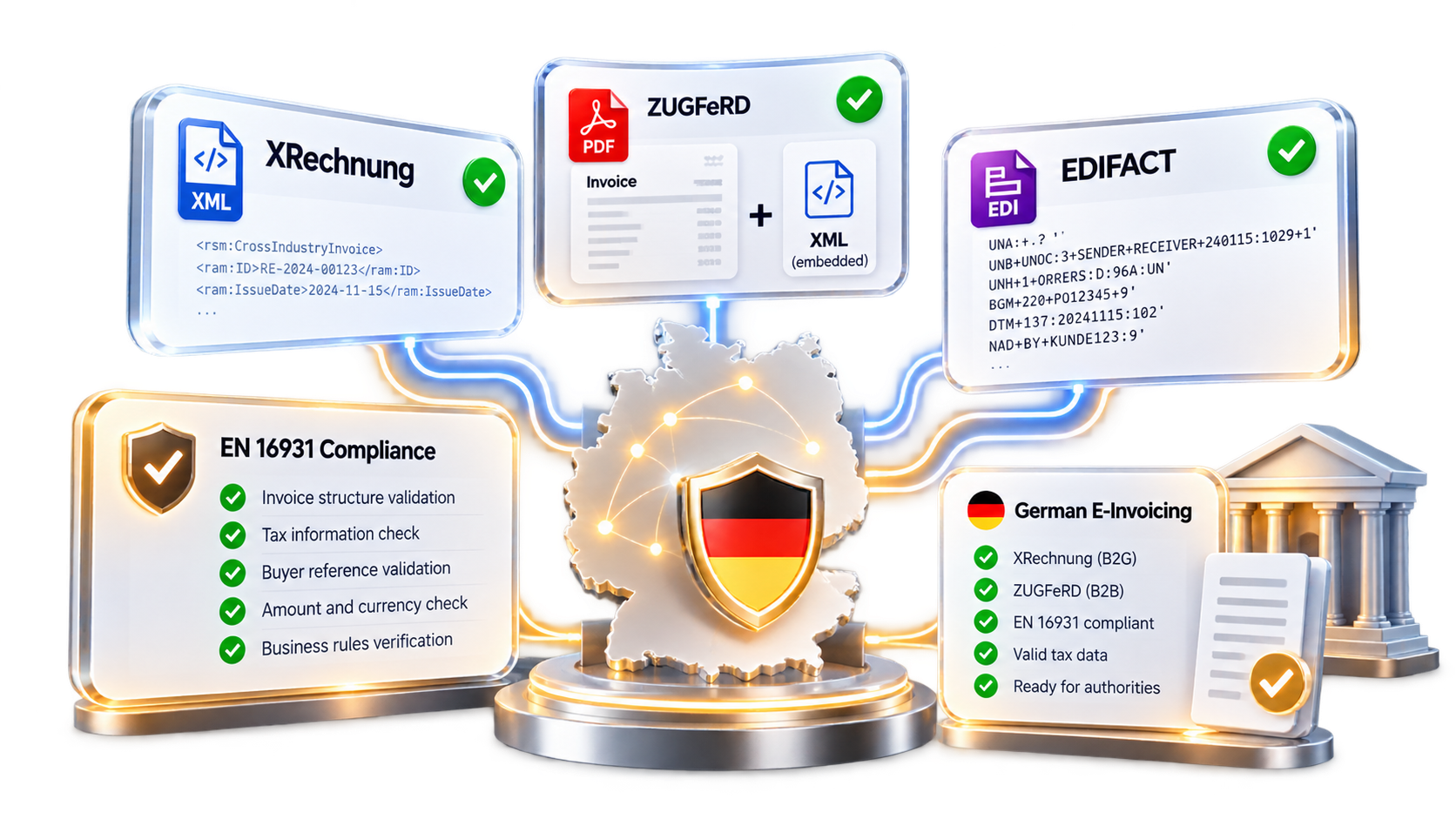
Germany's Federal Ministry of Finance allows agreed EDI processes, including EDIFACT, where the required invoice information can be extracted correctly and completely. This does not automatically make every older EDIFACT invoice compliant. Review actual message content and the applicable rules before keeping an existing invoice flow unchanged. A useful iPaaS should protect established partner connections while adding compliant invoices where required. There is no need to force every trading document into one format.
Which iPaaS options deserve a closer look?
HubBroker is worth reviewing for German operations. Its published services cover XRechnung and ZUGFeRD, alongside wider EDI integration. Ask to see your own EDIFACT messages processed from start to finish. Lobster also lists XRechnung and ZUGFeRD capabilities. Before choosing it, check whether its EDIFACT mappings and transmission options match each partner's setup.
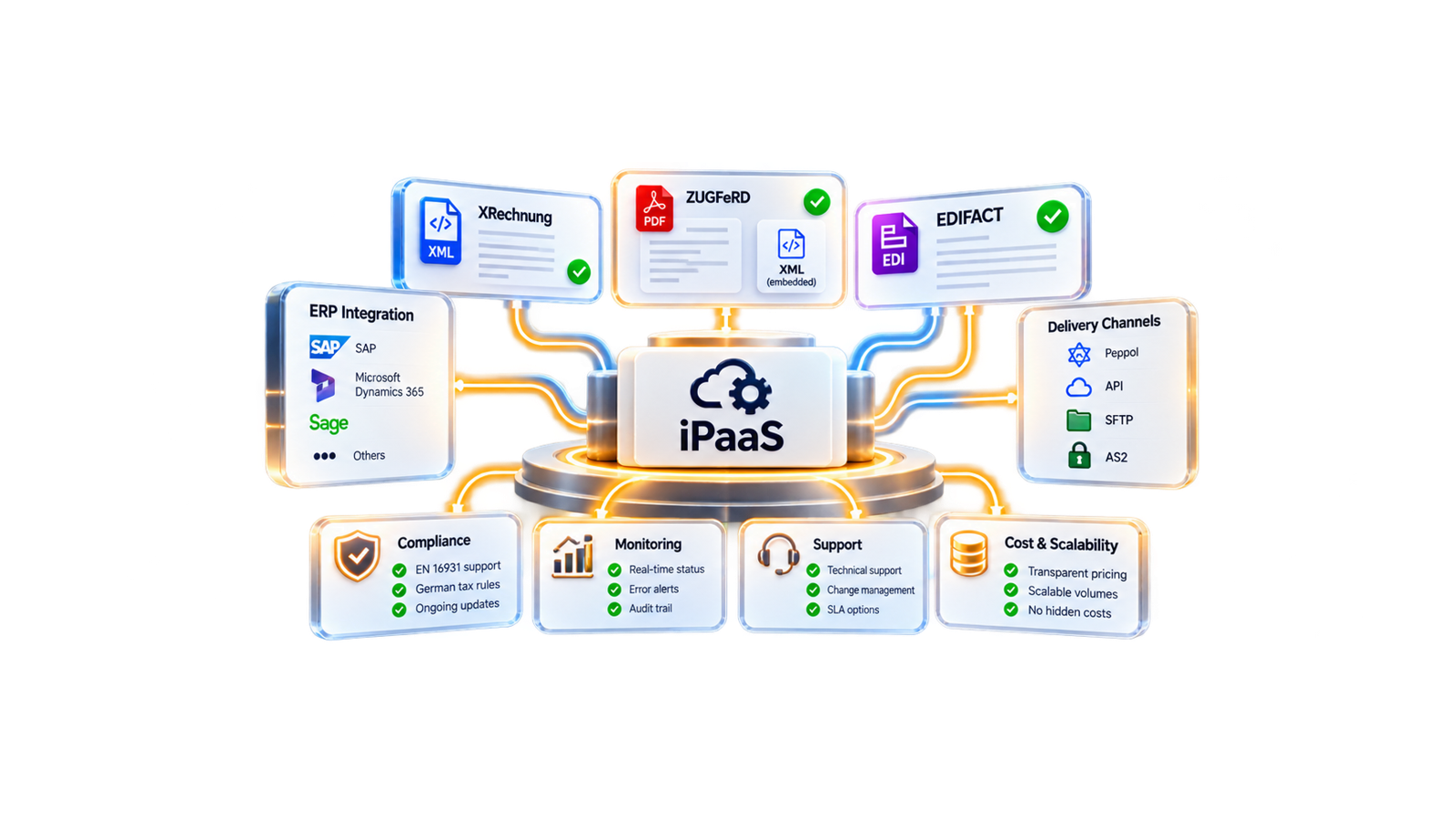
HubBroker provides iPaaS, EDI conversion, ERP connections, and Peppol services. Ask HubBroker to confirm specific XRechnung versions, ZUGFeRD profiles, EDIFACT message types, and validation rules in writing. If something needs custom development, include it in the project scope and price.
Use this comparison when speaking with any provider:
What to check | Why it matters | What to request |
|---|---|---|
XRechnung versions | Buyer requirements differ | Supported version list |
ZUGFeRD profiles | Compliance depends on profile | Supported profile list |
EDIFACT messages | Partners use agreed formats | Sample message mapping |
ERP connection | Data must reach correct fields | Live import demonstration |
Delivery channels | Partners use different routes | AS2, SFTP, API or Peppol test |
Error monitoring | Failed files need attention | Rejection and retry walkthrough |
Ongoing support | Rules and mappings change | Update and support terms |
How to test one platform against your real invoice and EDI flows
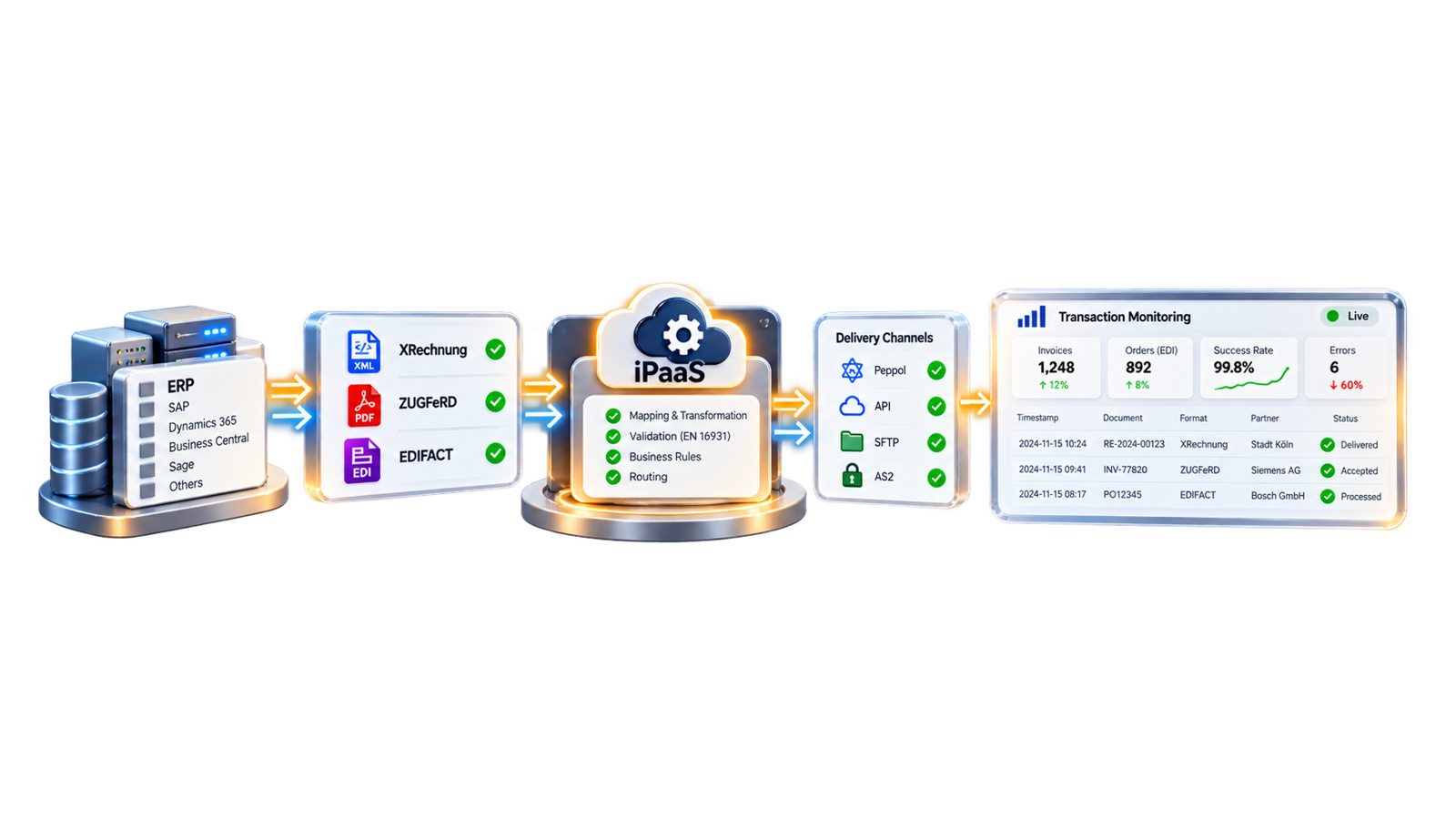
Gather genuine samples. Include XRechnung invoices, ZUGFeRD PDFs, and EDIFACT orders or invoices from several partners. Add rejected files and partner guidelines. Clean demonstration files alone will not show the difficult cases.
Check conversion and validation. Have the provider map those files into your ERP fields. Review EN 16931 checks, tax figures, references, attachments, identifiers, and how failures are explained.
Try actual delivery routes. Test the connections your partners use, including AS2, SFTP, APIs, email, or Peppol where relevant. Check acknowledgements, automatic retries, and alerts when delivery fails.
Compare the complete cost. Include initial setup, mapping changes, partner onboarding, transaction fees, support, and future standard updates. A cheaper monthly licence can still lead to higher project costs.
What matters after the integration goes live?
Finance teams need to trace missing invoices without asking developers for help. IT teams need enough detail to understand failed mappings and retry documents safely. Searchable transaction histories, dashboards, alerts, and clear access controls all help.
Ask who maintains the German validation rules and who responds when a partner changes its message format. Also establish responsibilities for data protection, permissions, archiving, and incidents. These everyday duties deserve as much attention as the first successful test.
Choose for continuity, not just format support
A suitable iPaaS keeps existing EDIFACT relationships running while bringing XRechnung and ZUGFeRD into a manageable process. Start with real documents, verify compliance and ERP mapping, and compare the full operating cost. A small pilot with HubBroker or another shortlisted provider gives you better evidence than a feature checklist alone.
