
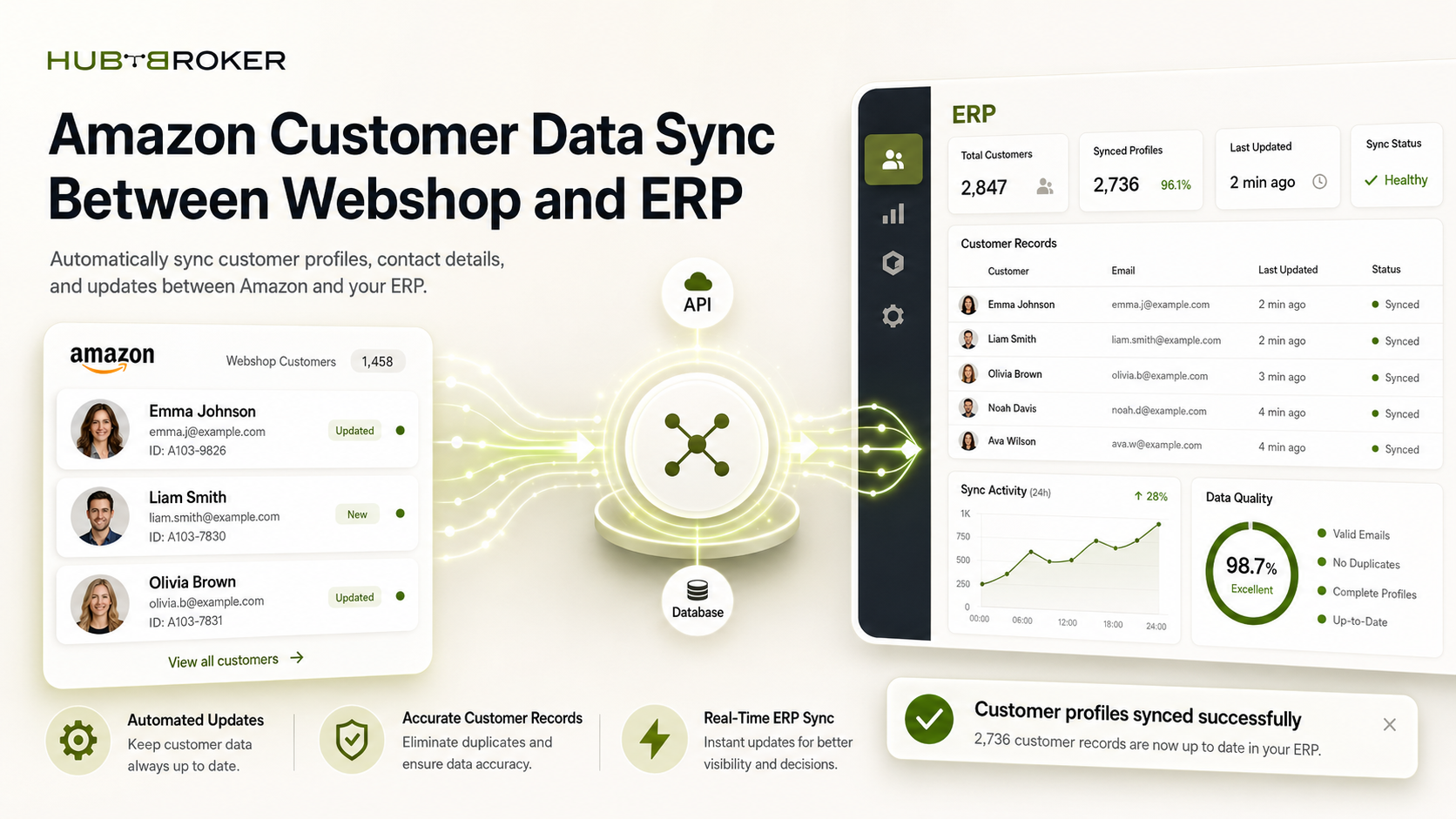
Amazon Customer Data Sync Between Webshop and ERP
Introduction
For Amazon sellers and webshop owners, customer data connects orders, invoices, shipments, returns, support, and ERP reporting. When Amazon, the webshop, and ERP work separately, teams waste time fixing duplicate records, correcting addresses, and checking order details manually.
That is why Amazon customer data sync ERP integration is important for ecommerce businesses that want faster order processing, cleaner records, and fewer operational errors. With the right setup, customer and order data can move automatically from Amazon and the webshop into ERP.
Why Do Amazon Webshop Users Need Customer Data Sync With ERP?
Amazon webshop users need customer data sync because manual entry becomes risky as order volume grows. One missed field can affect delivery, invoicing, and support.
A proper sync helps businesses:
Create or update ERP customer records automatically.
Reduce duplicate customer entries.
Move Amazon and webshop order details into ERP faster.
Keep shipping and invoice data aligned.
Give finance, warehouse, and support teams the same customer view.
Reduce CSV uploads and manual copy-paste work.
For growing Amazon sellers, ERP should become the central place where customer, order, invoice, and fulfillment information is managed.
Sync Amazon Customer Data Without Manual Work
Connect your webshop and ERP for cleaner, faster customer data.
Contact Us to Know More
What Customer Data Should Be Synced From Amazon and Webshop to ERP?
The exact customer data depends on the marketplace, webshop platform, ERP system, and approved permissions. The goal is to sync only the data required for order processing, shipping, invoicing, and support.
Important fields may include:
Amazon Order ID and webshop order ID.
Buyer or recipient name, where permitted.
Customer email or marketplace reference, where available.
Shipping address, city, postal code, country, and region.
Ordered items, SKU, quantity, and price.
Tax and invoice-related details.
Shipment status, tracking details, returns, and refunds.
Amazon customer information can include sensitive PII, so access may be limited by role, fulfillment model, order status, and marketplace rules.
How Does Amazon Customer Data Sync ERP Integration Work?
Amazon customer data sync ERP integration usually works through API, EDI, or an integration platform that connects Amazon, webshop, and ERP.
A typical workflow includes:
Customer places an order on Amazon or the webshop.
Integration captures order and customer-related data.
Data is validated, cleaned, and mapped.
ERP customer master record is created or updated.
ERP sales order is generated automatically.
Invoice, shipment, and fulfillment updates are synced.
Failed records are logged for review.
If the same customer buys from Amazon and your webshop, matching rules can prevent unnecessary duplicate ERP records.
What Problems Happen Without Automated Amazon Customer Data Sync?
Without automation, customer data becomes fragmented across Amazon Seller Central, webshop admin panels, spreadsheets, and ERP.
Common problems include:
Duplicate customers with different spellings or address formats.
Delayed order creation in ERP.
Incorrect delivery information.
Invoice errors due to missing tax or customer details.
Support teams checking multiple systems for one order.
Poor sales and customer reporting.
More manual workload during peak seasons.
These issues increase operational cost over time. For multi-channel sellers, a few minutes of manual work per order can become hours of lost productivity every week.
How Can Amazon Customer Data Be Synced Securely With ERP?
Amazon customer data should be synced with proper security because it may include personal and delivery-related details.
Best practices include:
Use approved Amazon access and authorized data flows.
Sync only required customer fields.
Apply role-based access inside ERP.
Encrypt data during transfer.
Maintain logs for successful and failed transactions.
Avoid storing customer data in unsecured spreadsheets.
Set clear data retention and cleanup rules.
Monitor errors, missing fields, and unusual sync activity.
A secure integration is about controlling what data moves, where it is stored, who can access it, and how long it remains in the system.
What Do E-commerce Statistics Say About Customer Data Sync?
Customer data sync matters because ecommerce buyers expect speed, accuracy, and personalization. When Amazon, webshop, and ERP data is disconnected, businesses struggle to deliver those expectations consistently.
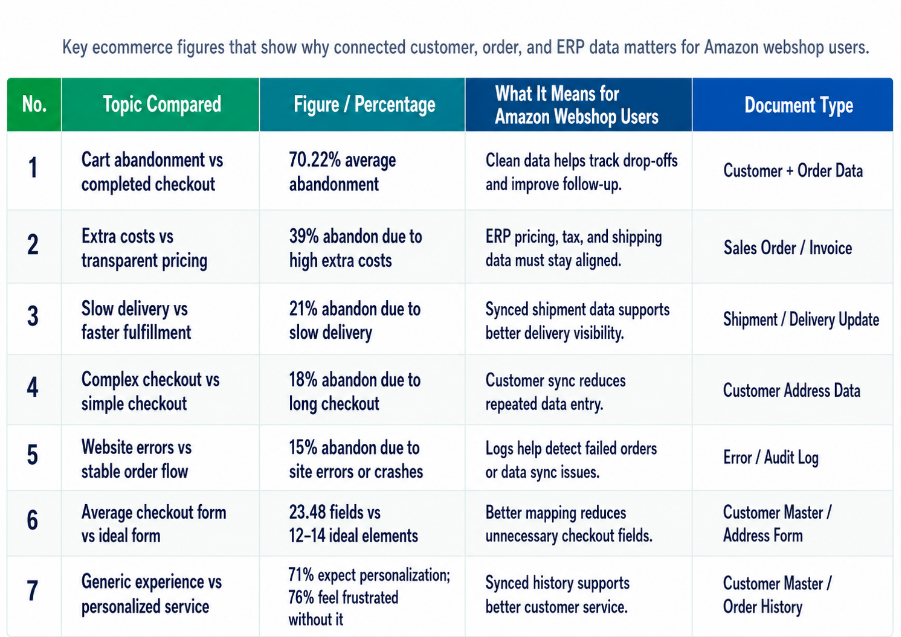
These numbers show that customer data is not just a backend requirement. It directly affects checkout performance, customer experience, personalization, and operational accuracy.
Why Should Amazon Webshop Users Choose HubBroker for Customer Data Sync With ERP?
Amazon webshop users should consider HubBroker when they want a structured and scalable way to sync customer data between Amazon, webshop, and ERP. HubBroker helps automate data flow across ecommerce platforms, marketplaces, and ERP systems so teams can work with accurate information without manual effort.
HubBroker can support Amazon customer data sync ERP integration through:
Amazon marketplace connectivity.
Webshop integration with Shopify, WooCommerce, Magento, or custom stores.
ERP integration with Microsoft Dynamics 365 Business Central, SAP, Oracle, NetSuite, and other platforms.
Customer field mapping between Amazon, webshop, and ERP.
Duplicate customer validation.
Automated sales order, invoice, shipment, and fulfillment sync.
Error monitoring and transaction logs.
Secure handling of customer and order data.
Scalable workflows for growing order volumes.
HubBroker helps create a controlled process where customer records, orders, invoices, and fulfillment updates move in the right format at the right time.
For Amazon sellers and webshop owners, this means fewer manual tasks, cleaner ERP data, faster order processing, and better visibility across ecommerce operations. With HubBroker, businesses can build a connected backend that supports long-term ecommerce growth through reliable Amazon customer data sync ERP automation.
