
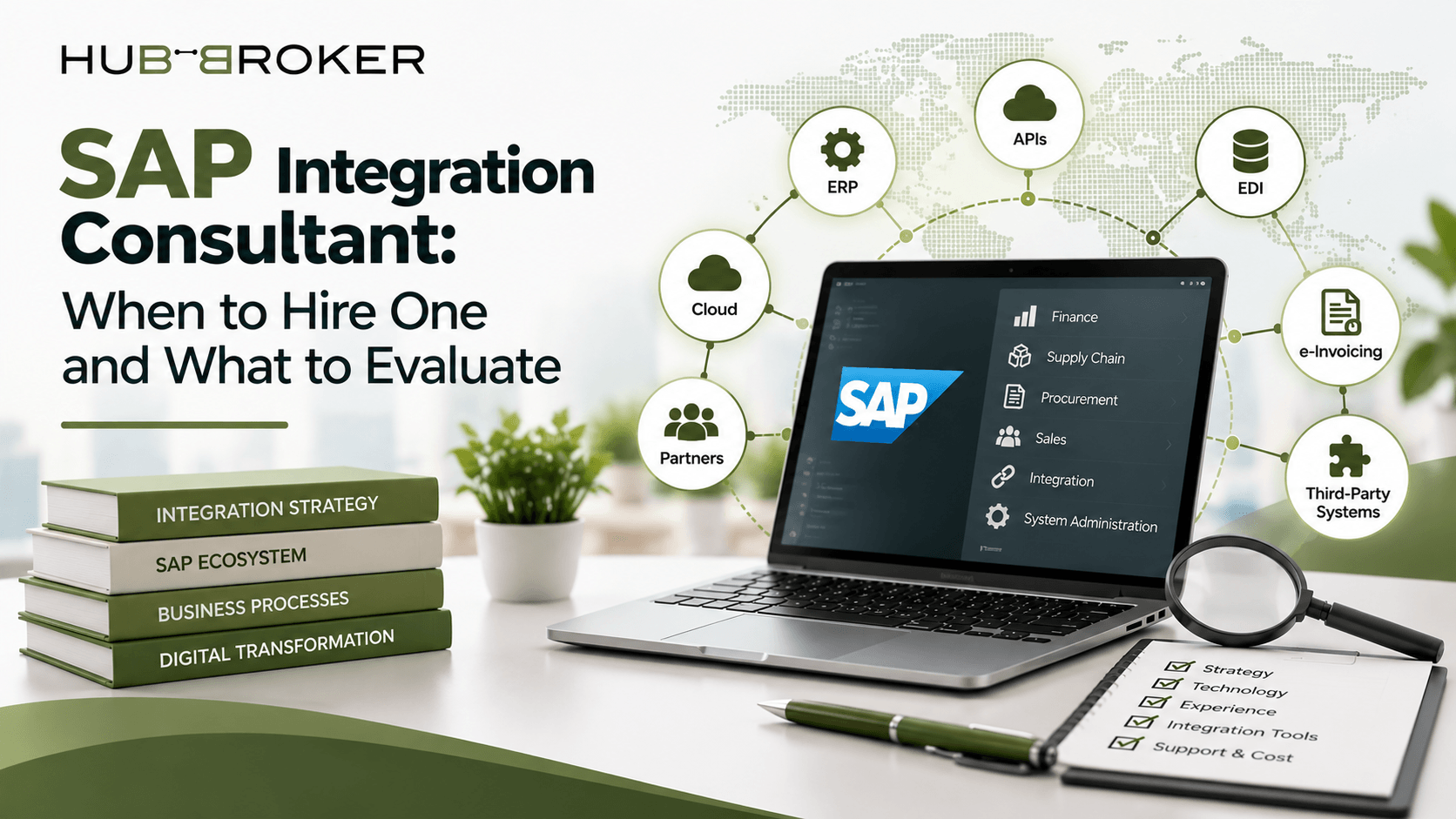
SAP Integration Consultant: When to Hire One and What to Evaluate
Your SAP system may be working fine. Finance postings are correct, purchasing works, and users already know their screens. Then business starts adding Shopify, Amazon, CRM, EDI customers, supplier portals, and few other applications. At first, IT may build one connection at a time. After some months, there are APIs, IDocs, CSV files, scheduled jobs, and partner-specific mappings everywhere. When one connection fails, three different teams may need to check three different systems.
This is where a sap integration consultant can become useful.
When Does SAP Integration Become a Consultant Problem?
You probably do not need a consultant for every SAP connection. The problem starts when integrations become difficult to understand, change, or monitor. Common warning signs are repeated interface failures, too many point-to-point connections, an SAP S/4HANA migration, new EDI partners, API projects, e-invoicing requirements, or old custom middleware nobody really wants to touch. SAP says mainstream maintenance for core SAP Business Suite 7 applications continues until the end of 2027, with optional extended maintenance available until the end of 2030. This makes integration review more important for companies still planning their move from ECC.
Migration is also not a good time to copy every old interface exactly as it is. Some existing connections may depend on old custom code, manual files, or scheduled jobs. Before rebuilding everything in S/4HANA, review what can move to standard APIs, SAP Integration Suite, or a centralized integration layer.
Scenario 1 — SAP Plus E-Commerce Starts Simple, Then Grows
A retailer may start by connecting one online store with SAP.
Store → Integration Layer → SAP
Orders move into SAP, but then inventory, shipment, and invoice updates also need to go back:
SAP → Inventory / Shipment / Invoice → Store
One store may be easy enough to manage. Add Amazon, another webshop, several warehouses, and different order rules, and the number of custom connections starts growing quite fast. A SAP integration specialist should define which system owns customer, product, stock, and order information.
They should also decide how API authentication, retries, duplicate prevention, and monitoring will work. Without this planning, what started as simple store connection can turn into daily support work.
Scenario 2 — SAP EDI Works, but Every Customer Is Different
A manufacturer may exchange orders, order confirmations, dispatch advice, and invoices with 40 different trading partners. If every customer gets its own custom SAP EDI integration, the company can quickly end up with many mappings and different support paths. One customer may send EDIFACT. Another may require XML. Another could use Peppol BIS. SAP itself may only need one stable internal structure.
In this situation, the consultant should understand SAP IDoc or API behaviour, while the integration platform can handle external formats, routing, partner-specific rules, and transaction monitoring. This keeps SAP side more controlled while partner complexity is handled outside.
What Do Current Integration Numbers Tell Us?
2026 Connectivity Benchmark shows that enterprise integration is still quite fragmented. The average organization manages 957 applications, but only 27% are connected. IT teams also spend 36% of their time designing, building, and testing custom integrations.
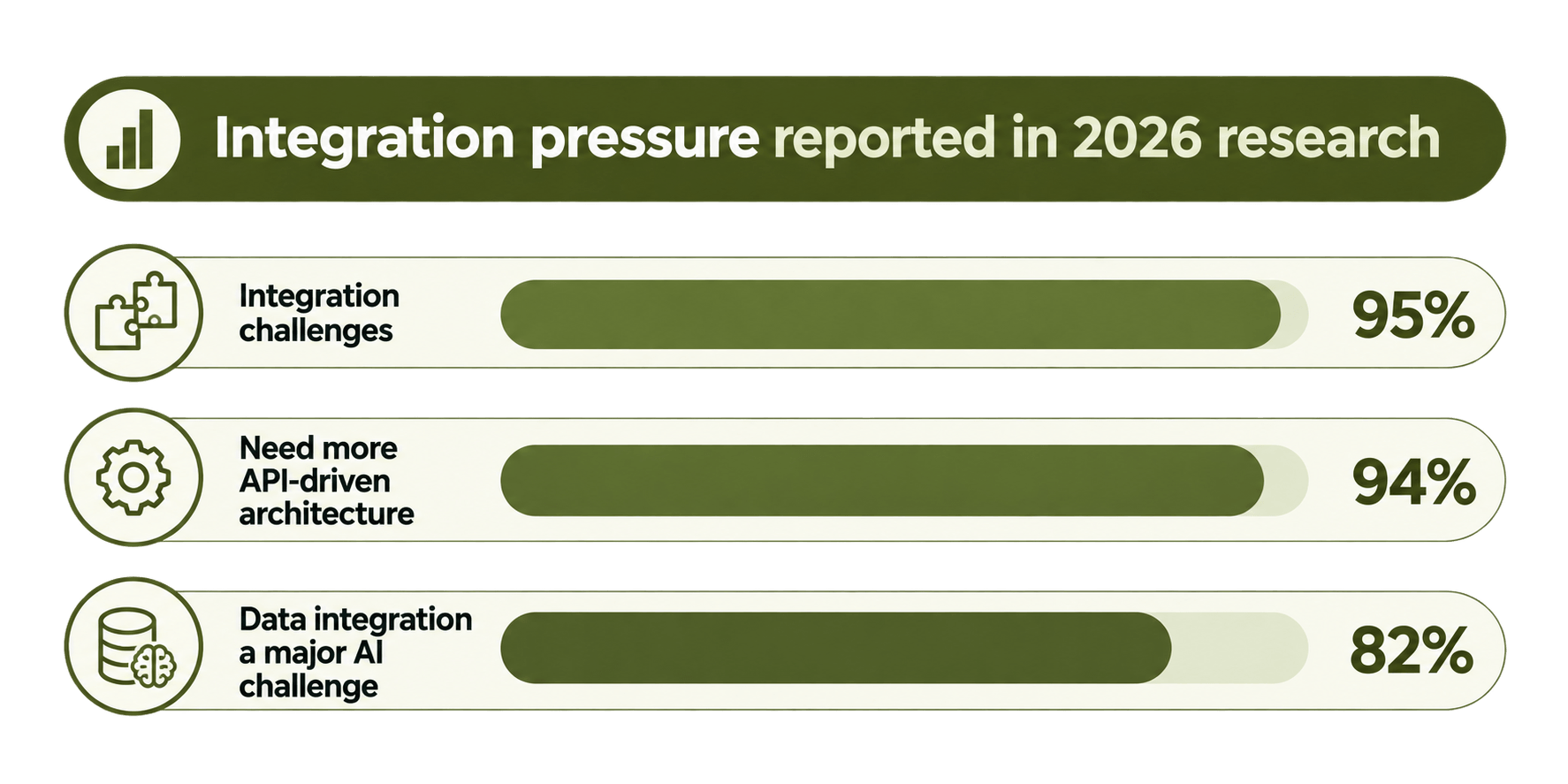
Integration pressure reported in MuleSoft 2026 research
Reports says that 95% of organizations face integration challenges. It also says 94% of IT leaders believe AI agents will need more API-driven architecture, while 82% see data integration as a major challenge when using AI. These numbers are global integration statistics, not SAP-only data. But they show why integration architecture matters when SAP is only one system inside a much bigger application setup.
What Should You Check Before Hiring a SAP Integration Consultant?
Do not choose somebody only because they have many years of SAP experience. Check what they can actually connect and how they design the full flow. Depending on your environment, they should understand SAP S/4HANA and ECC, SAP BTP, SAP Integration Suite, IDoc, OData, REST, SOAP, and RFC. More important is how they connect SAP with systems outside SAP. For EDI or API projects, the consultant should be able to explain mapping, transformation, authentication, retry logic, monitoring, and error handling in simple words.
Ask practical questions before hiring:
✔ Have you connected SAP with non-SAP systems?
✔ What happens when transaction fails?
✔ How are failed messages replayed?
✔ Who owns and maintains the mappings?
✔ Will custom code make future upgrades harder?
✔ Can we add more partners without rebuilding everything?
✔ What knowledge will stay with our internal team?
These answers usually tell more than a long list of SAP certifications.
SAP Consultant or Integration Platform — Which One Fits?
Need | SAP Consultant | Integration Platform / Provider |
|---|---|---|
SAP-side configuration | Strong fit | Depends on provider |
Many external connections | Designs architecture | Centralizes connections |
EDI and Peppol networks | May need another partner | Often included in service |
Ongoing monitoring | Depends on engagement | Usually platform feature |
Sometimes, the right answer is both.
A consultant can manage SAP-side architecture, process knowledge, and S/4HANA decisions. An integration platform can handle external APIs, EDI, ecommerce, Peppol, e-invoicing, mappings, routing, and transaction monitoring.
This is where HubBroker can support the external integration layer without trying to replace every SAP consultant.
Before hiring anyone, ask two simple questions:
✅ Who will design the integration? And
✅ what architecture will run it after the consultant leaves?
If SAP connections are becoming difficult to control, HubBroker can help review or build integrations between SAP and external business systems, trading partners, EDI networks, and e-invoicing services.