

Qatar E-Invoicing and VAT What Businesses Should Prepare for Now
Businesses in Qatar should not wait for a final compliance deadline before checking invoice data, ERP tax settings and integration capability. Qatar e-invoicing is moving from discussion towards legislation, but many important details are still not confirmed. VAT has also not been introduced nationally yet.
The practical priority is readiness. Companies can prepare clean data, flexible ERP settings and reliable invoice workflows without building the whole process around assumptions about what Qatar’s final model may look like.
Is E-Invoicing Mandatory in Qatar?
No mandatory Qatar e-invoicing system is currently in force. On 6 May 2026, Qatar’s Council of Ministers approved a draft electronic invoicing law and draft executive regulations prepared by the Ministry of Finance together with the General Tax Authority. This is an important step towards a future mandate, but approval of a draft is not same as having a final law already in operation.
As of October 2026, there is still no officially confirmed implementation date, taxpayer threshold, technical invoice schema, clearance model or penalty structure. Businesses should therefore separate what Qatar has announced as policy direction from what companies are legally required to follow today. Preparing early makes sense, but hard-coding unconfirmed requirements into ERP does not.
Has Qatar Introduced VAT Yet?
Qatar has not yet introduced a general national VAT regime. Qatar is part of the GCC VAT framework, which created a common basis for member countries to introduce VAT. However, each GCC country still needs its own domestic legislation, implementation date and detailed tax rules.
This is important because VAT and e-invoicing are connected, but they are not exactly same thing. VAT determines how transactions are taxed, reported and treated for tax purposes. E-invoicing deals more with how invoice data is created, structured, exchanged, validated or reported electronically. Businesses should therefore not assume that Qatar VAT and Qatar e-invoicing will start on same date or follow exactly the same implementation schedule.
How Should Businesses Prepare for Qatar E-Invoicing?
The safer preparation approach is improving ERP data and integration readiness without designing around a format or government architecture that is not confirmed yet.
Readiness Area | What to Check | Preparation Action |
|---|---|---|
Customer data | Names, IDs, addresses | Clean master records |
Supplier data | Registration details | Validate records |
ERP tax setup | Tax codes and logic | Review flexibility |
Invoice data | Structured invoice fields | Map ERP data |
Integration | API and export options | Assess connectivity |
Exceptions | Failed invoice handling | Define workflows |
Monitoring | Status visibility | Prepare tracking |
Finance teams should identify which information is needed to create invoices, credit notes and related financial documents. IT teams should document where this information comes from, which applications use it and how data moves between the systems. They should also check whether current ERP interfaces can send and receive structured invoice data without too much custom development. Doing this work now is useful even if final Qatar e-invoicing specifications later change.
What ERP Data Should Be Ready for VAT and E-Invoicing?
Start with master data. Legal entity names, customer and supplier identifiers, addresses, invoice references, product or service descriptions, currencies, quantities, amounts and tax-related fields should be stored properly inside ERP. Important invoice information should not depend on somebody manually changing a PDF before it is sent. ERP tax configuration should also remain flexible.
Future tax codes, exemptions, VAT rates, invoice types and reporting fields may need to be added once Qatar publishes final requirements. Businesses operating in several GCC countries should be careful not to copy Saudi Arabia, UAE or another country’s setup directly into Qatar before local rules are confirmed. A future-ready flow could look like this:
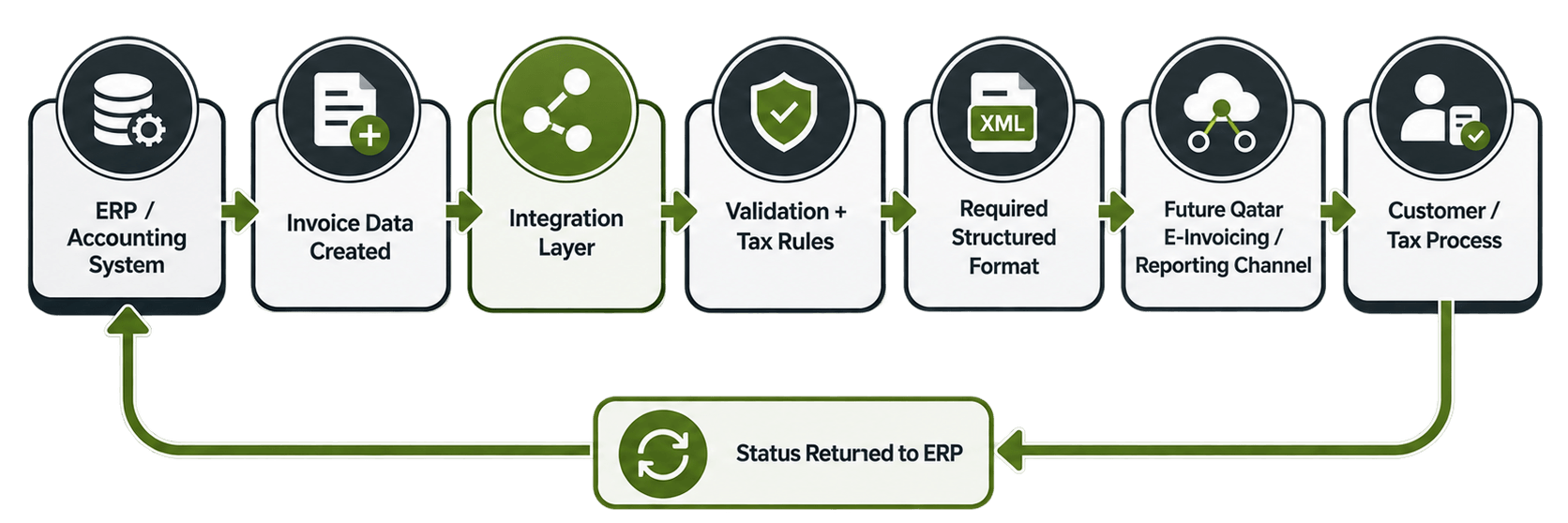
This is only a readiness model. It is not an officially defined Qatar architecture. The final workflow should follow whatever technical model Qatar authorities eventually publish.
Will Qatar E-Invoicing Require Structured Invoice Data?
Structured electronic data is a sensible capability for businesses to prepare now. However, Qatar has not officially confirmed a mandatory XML, UBL, Peppol or other national e-invoice format yet.
Because of this, companies should make sure their systems can create and transform structured information without locking everything into one unconfirmed schema. This is where an integration layer can be useful. ERP can continue creating the main financial and invoice data, while the integration layer handles mapping, validation and transformation into whatever external structure becomes required. If technical requirements change later, companies can update the external mapping instead of rebuilding the complete ERP billing process.
That gives more flexibility while the final Qatar model is still developing.
What Should Businesses Look for in Qatar E-Invoicing Software?
At this stage, flexibility is more important than promises of guaranteed future compliance. A suitable platform should support ERP and API connectivity, configurable mappings, structured-data transformation, validation, error handling, status synchronization, monitoring and audit records. Businesses should ask practical questions before selecting a provider.
✔ How quickly can mappings be changed when Qatar publishes final technical rules?
✔ Can the platform support new invoice fields or tax logic?
✔ How are failed invoices tracked?
✔ Can statuses return into ERP?
✔ Who maintains the country-specific configuration?
Regional coverage can also be useful, but companies should be careful with marketing claims. Support for Saudi Arabia, UAE or another GCC country does not automatically mean the same solution is already compliant with a future Qatar system.
How Can HubBroker Support Qatar E-Invoicing Readiness?
HubBroker can work as an integration and automation layer between ERP systems and future Qatar electronic invoicing workflows.
A possible setup could be:
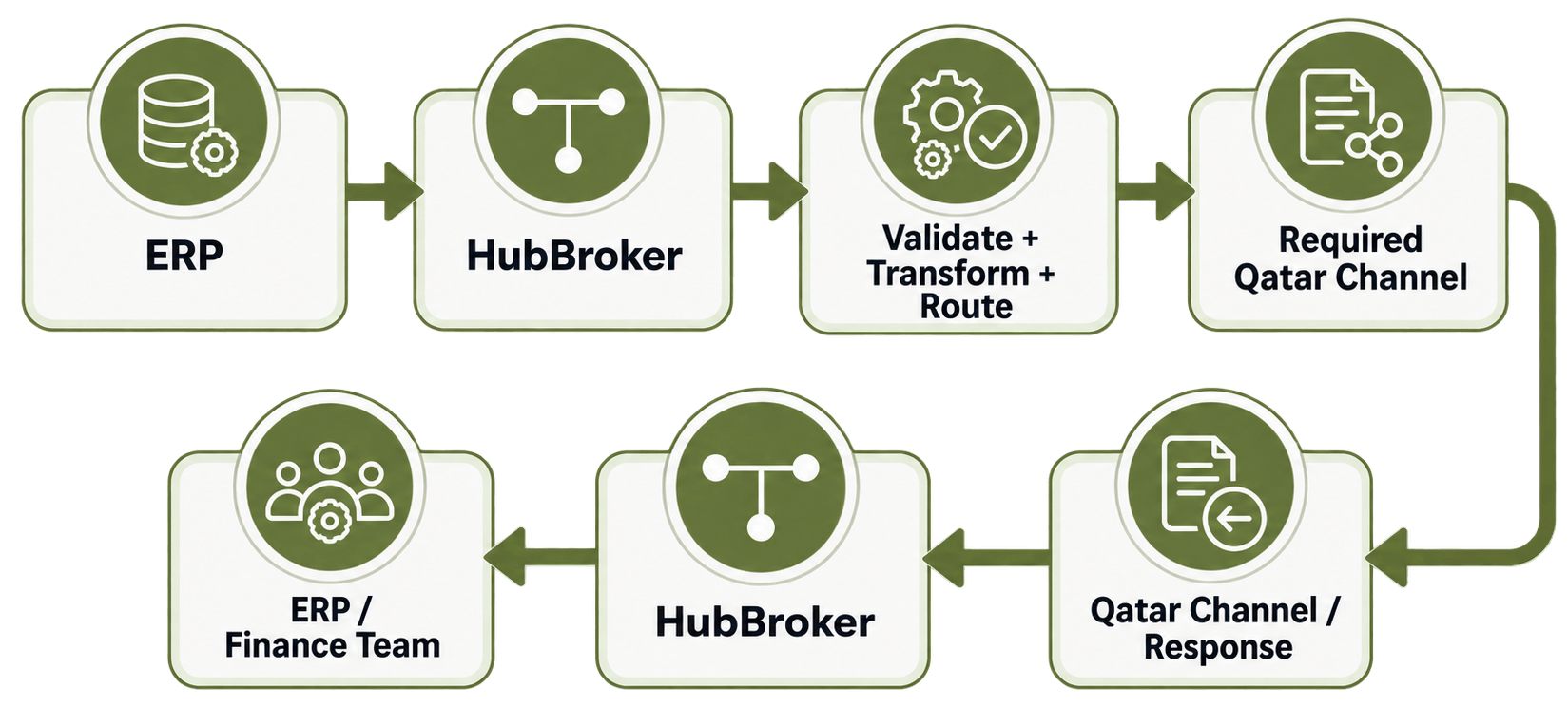
This type of architecture can improve invoice-data quality, automate system connections and keep the external compliance layer more adaptable when new rules are published. Businesses can prepare their ERP and invoice process now without pretending that Qatar’s final technical model is already known. If your company is preparing for future Qatar VAT and e-invoicing requirements, HubBroker can help review ERP data, invoice workflows and integration readiness so your systems are easier to adapt when final requirements are released.
Talk to our team about your Qatar e-invoicing setup and current ERP environment.
