
Poland Peppol e Invoicing Registration Guide Requirements Process and Setup Explained
What is Peppol and its role in Poland e-invoicing
Peppol (Pan-European Public Procurement Online) is a standardized digital network that allows businesses and government organizations to exchange electronic documents, such as invoices, in a secure and structured way. Instead of sending invoices manually through emails or paper, Peppol ensures that all documents are sent in a uniform format that can be automatically read and processed by different systems. This removes compatibility issues between various ERP and accounting platforms, making invoicing faster, more accurate, and error-free. It also improves transparency and traceability, as every document is sent through a trusted and validated network.
In Poland, Peppol plays an important role in supporting cross-border e-invoicing and aligning with the European Union’s digital transformation goals. While KSeF (the National e-Invoicing System) is mandatory for domestic invoicing, Peppol complements it by enabling seamless communication with international trading partners. Businesses that operate across EU countries can use Peppol to standardize their invoicing processes, reduce manual work, and ensure compliance with different regulations. By combining Peppol with systems like KSeF, companies in Poland can achieve a more automated, efficient, and scalable invoicing process across both local and international markets.
Looking to Register your Business on Peppol in Poland?
Use our Peppol Registration Portal for free: Free Register on peppol Now
Overview of Poland e-invoicing regulations and KSeF system requirements
Poland’s e-invoicing landscape is evolving with the introduction of KSeF (Krajowy System e-Faktur), a centralized government platform for issuing and receiving structured invoices. KSeF is becoming mandatory, requiring businesses to comply with specific formats and submission processes. It ensures real-time invoice reporting, improved tax transparency, and better compliance with regulatory standards.
Key Requirements
 Which businesses need Peppol e-invoicing compliance in Poland today
Peppol e-invoicing is essential for businesses operating across EU borders or working with government entities. In Poland, companies dealing with international partners benefit from Peppol for standardized and automated invoice exchange. It ensures compliance, reduces manual work, and improves efficiency in financial operations.
Businesses Requiring Compliance
Export-Oriented Companies – Businesses dealing with cross-border sales across EU markets. Require standardized Peppol invoicing to ensure compliance and smooth international transactions.
Import Businesses – Companies receiving invoices from global suppliers. Need compatible e-invoicing formats to process and manage incoming invoices efficiently.
Government Contractors – Organizations supplying goods or services to public sector entities. Must comply with mandatory Peppol standards for public procurement invoicing.
Large Enterprises – Corporations handling high volumes of invoices across multiple regions. Require automation, scalability, and compliance for efficient financial operations.
SMEs Expanding Internationally – Small and medium businesses entering EU markets. Need compliant invoicing systems to ensure smooth cross-border business operations.
E-commerce Businesses – Online sellers managing large volumes of daily transactions. Require automated invoicing systems for speed, accuracy, and compliance.
Manufacturing Companies – Businesses managing complex supply chains and vendor networks. Need integrated invoicing systems to streamline operations and data exchange.
Logistics & Transportation Firms – Companies handling frequent shipments and billing cycles. Require efficient, automated invoice exchange for timely processing and tracking.
Key requirements for starting Peppol registration process in Poland successfully
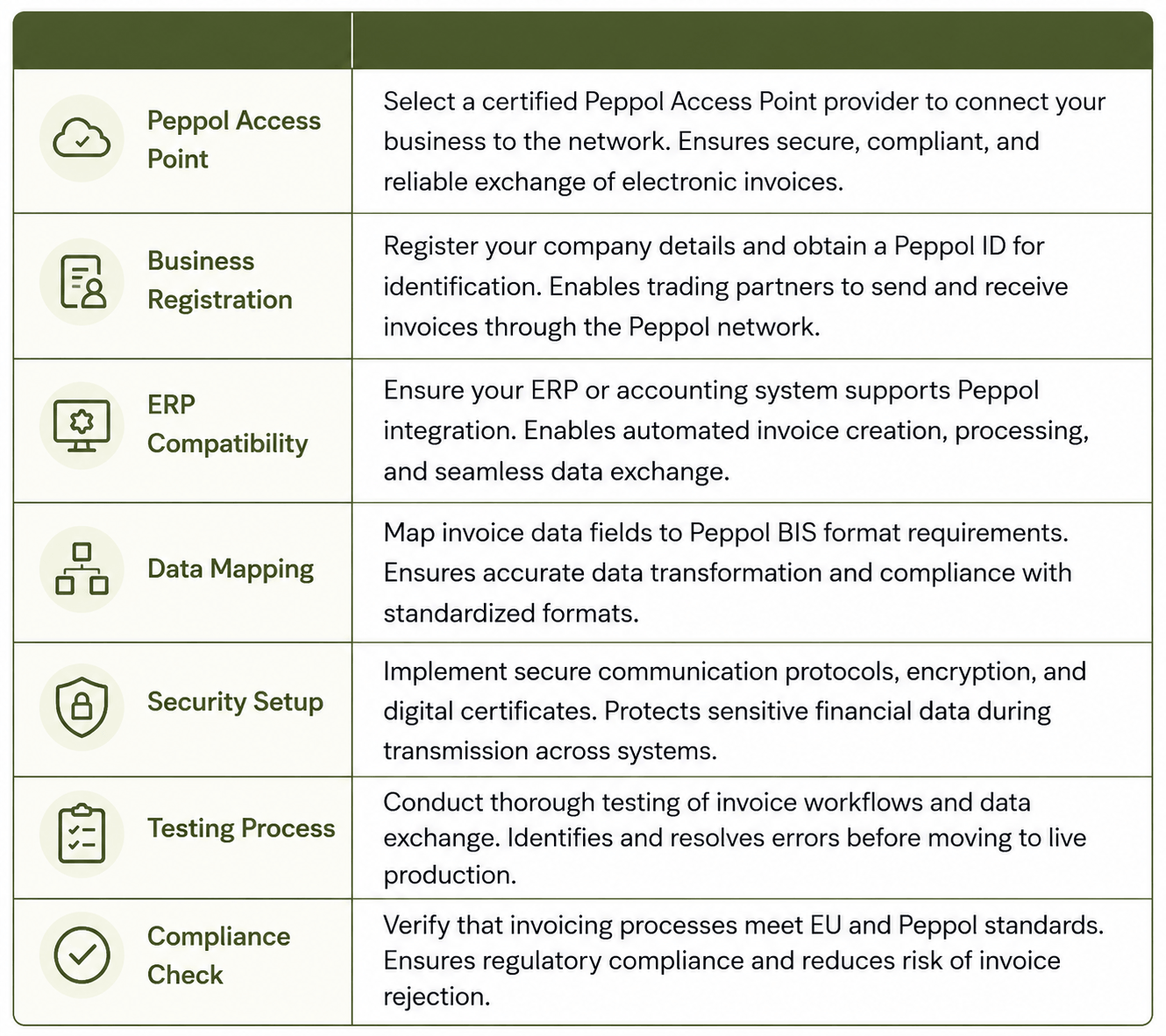
Starting Peppol registration in Poland requires businesses to prepare their systems and processes for compliance and integration. This includes selecting the right access point, ensuring system compatibility, and aligning invoice formats with Peppol standards. Proper planning helps avoid delays and ensures a smooth onboarding experience.
Key Requirements
Step-by-step process for Peppol e-invoicing registration in Poland explained
Registering for Peppol in Poland involves a structured process to ensure compliance and seamless integration. Businesses must connect their ERP systems, configure data formats, and establish a connection with a certified access point provider. Proper setup ensures efficient and secure invoice exchange.
Steps
Requirement Analysis – Identify business invoicing needs, transaction volumes, and compliance requirements. Define clear integration goals to ensure a smooth and efficient implementation process.
Select Access Point – Choose a certified Peppol Access Point provider. This enables secure connectivity to the Peppol network for compliant invoice exchange.
Business Registration – Register your organization with the selected provider and obtain a unique Peppol ID. This ensures proper identification within the network.
System Configuration – Configure ERP or accounting systems to support integration. Ensure system readiness for automated data exchange and invoicing workflows.
Integration Setup – Connect ERP systems with the Peppol network using EDI or iPaaS solutions. Enables seamless and automated invoice transmission.
Data Mapping – Map invoice data fields to Peppol BIS format standards. Ensures accurate data transformation and compliance with required formats.
Testing & Validation – Test invoice workflows and validate data accuracy before go-live. Identify and resolve issues to prevent processing errors.
Go-Live & Monitoring – Launch the integration into a live environment. Continuously monitor performance, track invoices, and ensure smooth operations.
Common challenges faced during Peppol e-invoicing setup in Poland
Implementing Peppol e-invoicing in Poland can be challenging due to regulatory complexity and technical integration requirements. Businesses often struggle with aligning their systems with both Peppol standards and KSeF requirements. These challenges can delay implementation and impact efficiency.
 How HubBroker simplifies Peppol registration and integration in Poland
HubBroker simplifies Peppol registration and integration by offering a comprehensive iPaaS platform combined with certified Peppol Access Point services. This allows businesses to connect their ERP or accounting systems to the Peppol network without the need for complex development or heavy IT involvement. With streamlined onboarding and ready-to-use integration capabilities, companies can significantly reduce implementation time and operational effort while ensuring a smooth transition to digital invoicing.
With strong expertise in EDI, ERP integration, and European compliance requirements, HubBroker provides end-to-end support throughout the entire process. This includes system setup, data mapping, testing, and ongoing maintenance. The platform also ensures alignment with Poland’s KSeF requirements, helping businesses stay compliant with local regulations. By automating invoice exchange and improving data accuracy, HubBroker enables organizations to enhance efficiency, reduce errors, and scale their operations seamlessly across Poland and the wider European market.
