
Germany, January 2027: Your XRechnung and ZUGFeRD Roadmap Starts Now
Here's the part most finance teams miss: the deadline is January 2027, but the test that decides whether it applies to you is being measured right now, on your 2026 turnover.
If your business turns over more than €800,000 this year, then from 1 January 2027 you can no longer send a paper invoice or a plain PDF to a German business customer. Not "shouldn't". Can't not as a valid VAT invoice, anyway.
That's a short runway for something that touches your ERP, your master data, your AP inbox and every trading partner you invoice. So let's walk through what Germany e-invoicing 2027 actually requires, what XRechnung and ZUGFeRD have to do with it, and what a sensible twelve-month plan looks like.
What changes on 1 January 2027
Germany's B2B mandate comes from the Wachstumschancengesetz (Growth Opportunities Act), passed by the Bundesrat in March 2024, with detailed guidance published by the Bundesministerium der Finanzen (BMF) in October 2024. It rolls out in phases rather than all at once.
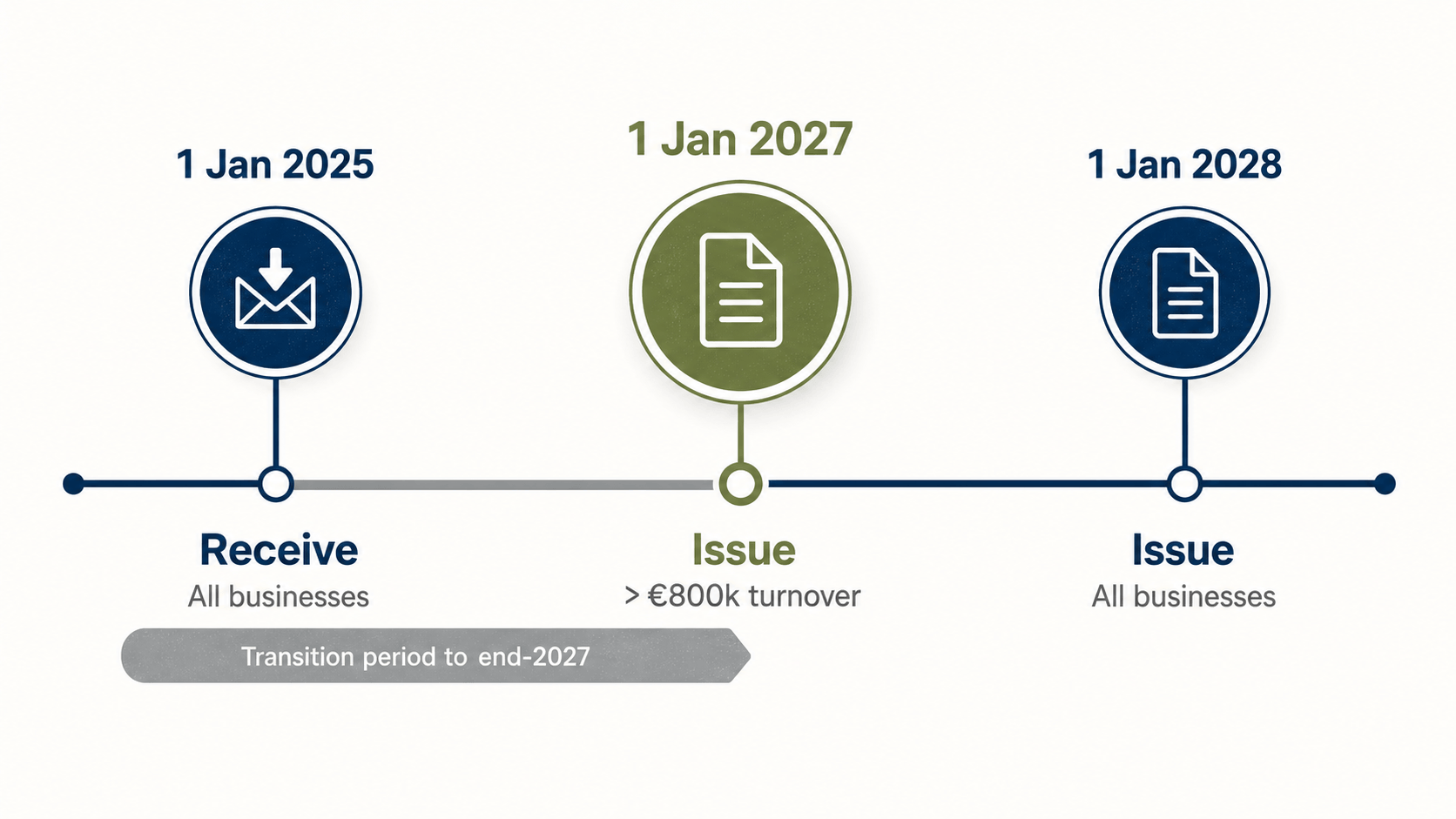
The three-phase timeline
1 January 2025 - receive. Already live. Every German business must be able to receive and process a structured e-invoice compliant with the European standard EN 16931. No turnover threshold, no exceptions for size. If a supplier sends you an XRechnung today, you are expected to take it.
1 January 2027 - issue (large). Businesses with prior-year turnover above €800,000 must issue structured e-invoices for in-scope domestic B2B transactions.
1 January 2028 - issue (everyone else). The issuing obligation extends to all remaining businesses regardless of size.
Notice the asymmetry in 2027. Your obligation to send depends on your turnover. Your obligation to receive doesn't, and hasn't since last year. Plenty of companies solved the receiving half in 2024 and quietly parked the rest.
How the €800,000 threshold works
The threshold looks at the previous calendar year. For the 1 January 2027 start, that means your 2026 turnover. There's no grace period once you cross it, and no annual re-election which is why "we'll look at this next summer" is a risky position for a company sitting anywhere near the line.
Businesses under the Kleinunternehmerregelung (§ 19 UStG) are exempt from issuing, but still have to be able to receive. Worth confirming your current status against the § 19 thresholds with your Steuerberater rather than assuming.
What's in scope and what isn't
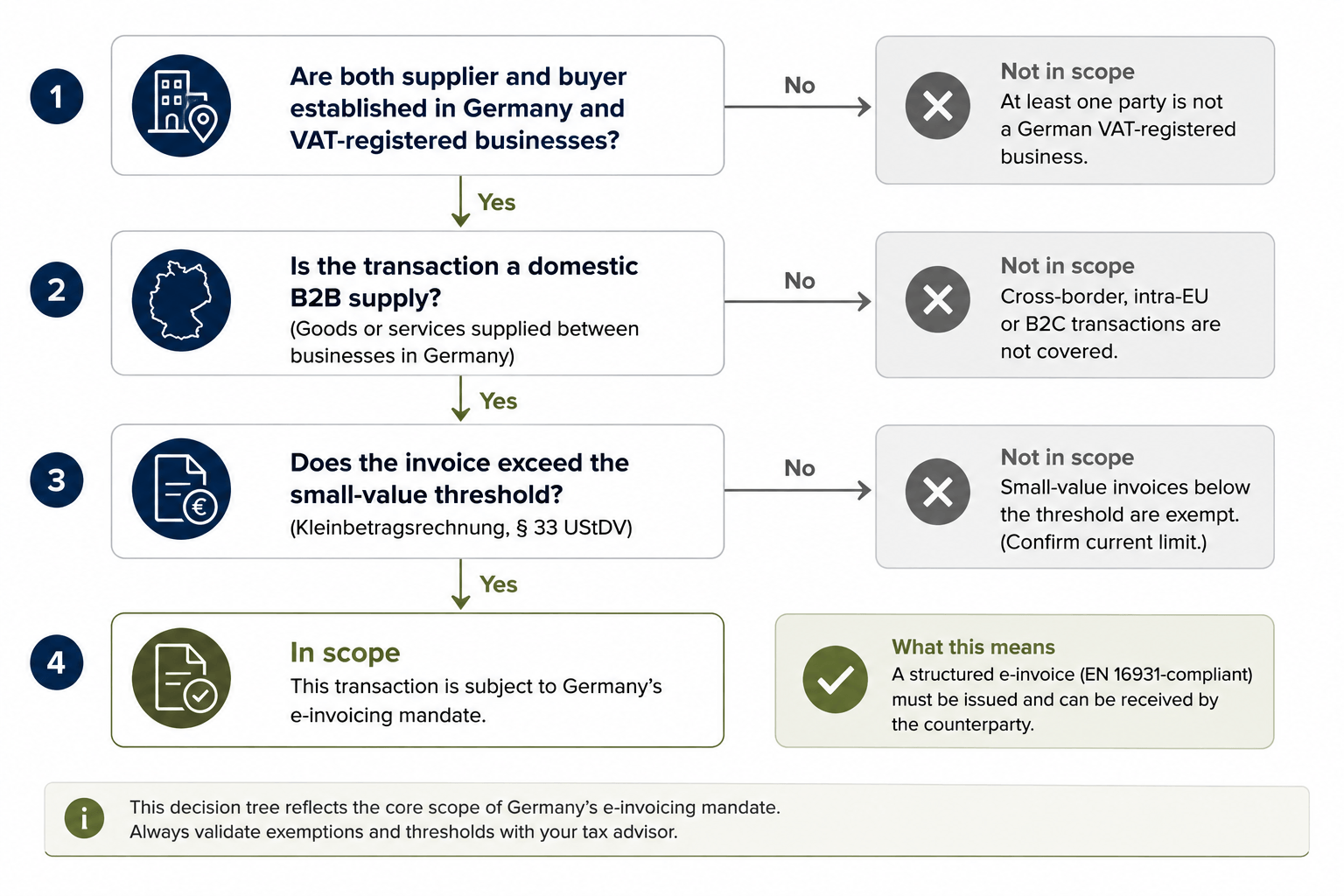
The mandate covers domestic B2B supplies where both supplier and buyer are VAT-registered businesses established in Germany. Outside that core:
B2C invoices to private consumers are not covered.
Cross-border transactions, intra-EU and international, sit outside the German mandate (though they're squarely in scope for ViDA later).
Kleinbetragsrechnungen small-value invoices, per § 33 UStDV and certain VAT-exempt supplies are reported as exempt. Confirm the current threshold before you build the rule into your ERP.
If you trade across several European markets, this is where a single e-invoicing platform beats a per-country patch, because the exemption logic differs in every jurisdiction.
XRechnung vs ZUGFeRD: which format do you actually need?
Both are valid. Both are German. They are not interchangeable, and picking the wrong default creates rework.
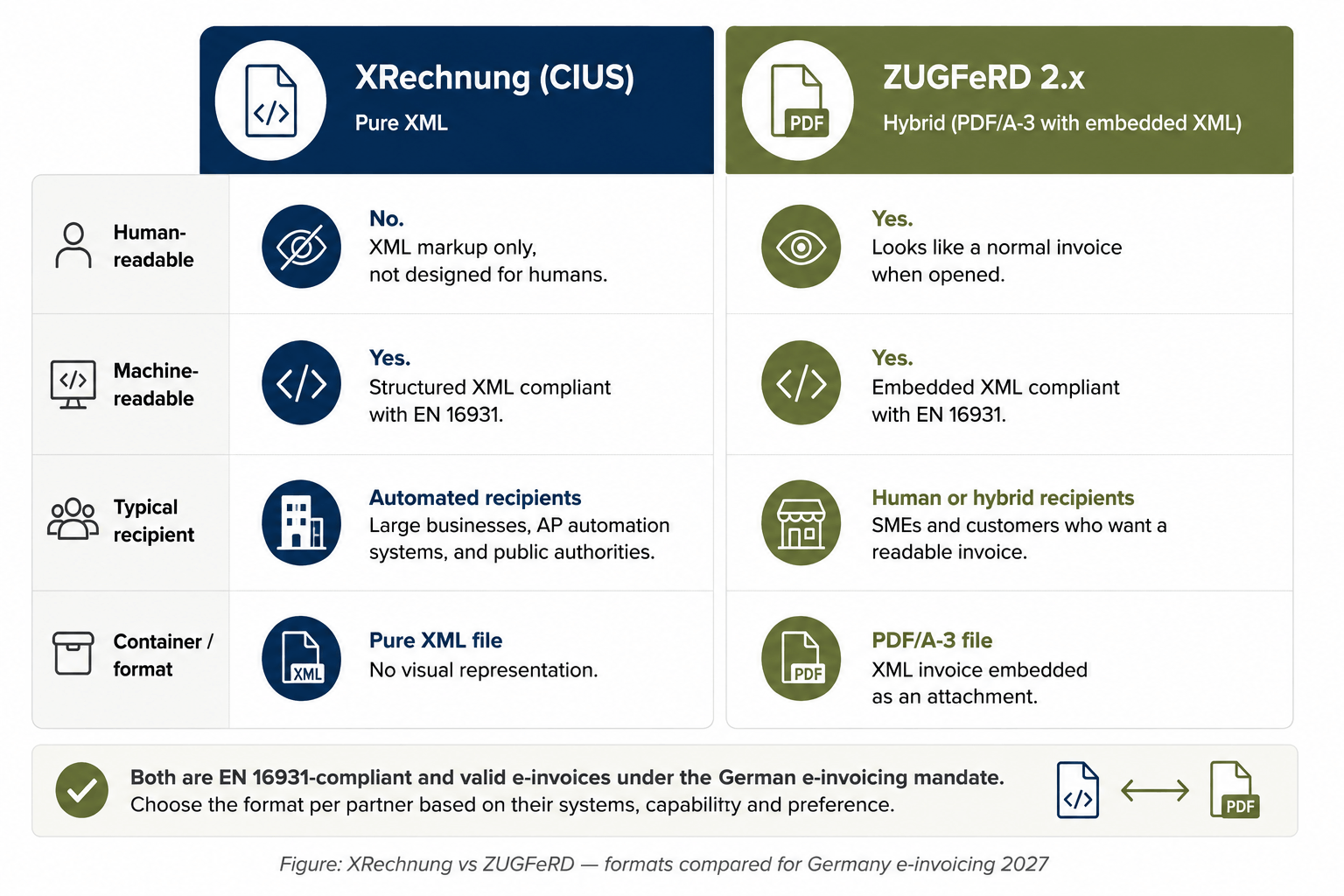
XRechnung pure XML
XRechnung is a CIUS (Core Invoice Usage Specification) of EN 16931. It is machine-only: structured XML, no human-readable layer. It's the established standard for invoicing German public authorities, and it's the safest choice when your counterparty is running a proper AP automation stack.
The trade-off: a human opening the file sees markup, not an invoice.
ZUGFeRD 2.x the hybrid
ZUGFeRD wraps the same EN 16931 data inside a PDF/A-3 container, with the XML embedded as an attachment. Your customer's accountant sees a normal-looking PDF; their software reads the XML.
That makes ZUGFeRD the pragmatic option for a long tail of smaller German customers who aren't fully automated. Version matters here only ZUGFeRD 2.x profiles from EN 16931 (Comfort) upward carry the full mandatory data set, so check the profile, not just the version number.
Peppol BIS Billing 3.0 and the EN 16931 common denominator
Germany runs a decentralised model. There is no central government clearance platform for B2B invoices, unlike Italy's SdI or Poland's KSeF. Invoices move directly between the parties.
That means transport is your decision: Peppol, AS2 or AS4, SFTP, email, or a customer portal. Peppol BIS Billing 3.0 is also EN 16931-compliant, which is why it works as the connective tissue for anyone invoicing beyond Germany alone.
Choose per partner, not per company
The winning pattern for Germany e-invoicing 2027 is a single internal invoice model one canonical structure out of your ERP with format and transport resolved at the partner level. Large automated buyers get XRechnung over Peppol. Smaller customers get ZUGFeRD by email. Existing EDI partners keep EDIFACT INVOIC where it's still permitted.
One outbound flow, many renderings. That's an ERP integration problem, not a formatting problem.
What if we already run EDI?
Good news, mostly. If you exchange invoices over EDI today, the BMF guidance provides an extended transition through 31 December 2027 for EDI flows that aren't yet EN 16931-compliant. That's genuine breathing room.
Two cautions. First, it expires 2028 arrives whether or not your mapping project finished. Second, it's about your legacy flows, not a licence to onboard new German partners onto a non-compliant format in 2027.
The realistic outcome for most EDI shops is coexistence: EDIFACT for established partners, EN 16931 for everything new. Which is fine, if your EDI integration layer can hold both without duplicating business logic.
Your readiness gap: five things to check in your ERP this quarter
Master data completeness. EN 16931 has mandatory fields that many ERPs treat as optional buyer reference, VAT identifiers, unit codes, payment means. Run a real invoice batch through a validator and count the failures. It's usually more than expected.
VAT determination. Structured invoices are validated. A tax code that a human would forgive will now bounce.
Validation before sending. Schema plus Schematron, at the point of issue. Fixing a rejected invoice three days later is a cash-flow problem, not an IT problem.
Archiving. German retention obligations apply to the structured original not a printed copy. The XML is the invoice.
Inbound processing. You've been obliged to receive since 2025, but "obliged to receive" and "able to post automatically" are different maturity levels. If inbound XRechnungen are being printed and rekeyed, Intelligent Document Processing and structured inbound handling belong in the same project.
A practical 12-month roadmap
Q4 2026: confirm scope
Establish your 2026 turnover position against the €800,000 threshold. Segment your German customer base by size and automation maturity. Inventory every system that produces an invoice the ERP, plus the webshop, plus the billing tool nobody documented.
Q1–Q2 2027: decide formats and start onboarding
Set your default outbound format per partner segment. Choose transport. Then begin partner onboarding, because this is the step that always overruns: every partner has their own contact, their own test cycle and their own timeline.
Q3 2027 onwards: pilot, validate, cut over
Run a parallel period. Send structured and legacy in tandem for a defined set of partners, reconcile, then switch. Watch rejection reasons closely in the first weeks they cluster, and fixing the cluster fixes hundreds of invoices.
Don't stop at 2027
January 2028 pulls in your remaining German counterparties. Beyond that, ViDA (VAT in the Digital Age, adopted March 2025) moves cross-border intra-EU transactions toward structured e-invoicing and digital reporting later in the decade. Building for 2027 alone means rebuilding.
Common mistakes we see
Treating a PDF as an e-invoice. An emailed PDF is an unstructured electronic document. It won't satisfy the 2027 issuing obligation.
Solving outbound only. Inbound has been mandatory since 2025 and is where most of the manual cost sits.
One format for everyone. Forcing XRechnung on a small customer with no AP automation converts your compliance win into their support ticket.
Late partner onboarding. Technically the easy part, practically the long pole. Start it before the platform work is finished.
Assuming your ERP vendor has it handled. Many do, at the format level. Fewer handle transport, partner-specific profiles, validation and archiving together.
Frequently asked questions
Is a PDF invoice an e-invoice under the German rules? No. The mandate requires a structured format that can be processed automatically and complies with EN 16931. A standard PDF is unstructured. A ZUGFeRD file happens to look like a PDF, but it qualifies because of the embedded XML not the PDF wrapper.
Should we use XRechnung or ZUGFeRD? Both are compliant. XRechnung suits automated buyers and public-sector recipients; ZUGFeRD suits customers who still want something readable. Most companies end up supporting both and deciding per partner.
Do we need Peppol for Germany? Not strictly for B2B Germany's model is decentralised, so you can agree any transport with your counterparty. Peppol is compulsory in practice for German public-sector invoicing and is the pragmatic route if you invoice across several EU countries.
What happens to our existing EDI flows? Non-EN 16931 EDI exchange benefits from a transition period running to the end of 2027. After that, structured EN 16931 compliance applies.
Does this apply to our non-German suppliers and customers? The German mandate covers domestic B2B between German-established, VAT-registered parties. Cross-border transactions are outside it for now. ViDA changes that later.
What are the penalties for non-compliance? Beyond fines, the sharper commercial risk is on the buyer's side: an invoice that doesn't meet the requirements can jeopardise input VAT deduction. Expect your German customers to start enforcing this on you before the tax authority does.
Where to start
Pick one thing this month: export a hundred real invoices from your ERP and validate them against EN 16931. The failure report tells you, in an afternoon, how big your Germany e-invoicing 2027 project actually is.
If you'd rather have someone look at it with you, HubBroker runs a certified Peppol Access Point and connects ERP systems to compliant e-invoicing flows across Europe. Book a readiness conversation or take a look at how the iPaaS handles it no obligation, and you'll leave with a clearer scope either way.
